Does a gluten-free diet help you lose weight?
Short answer
NIDDK reports that researchers have found no evidence that a gluten-free diet promotes weight loss in the general population1, and a 2023 meta-analysis of people with and without celiac disease found no significant pooled effect on weight4, 2. What happens to weight depends on what replaces the foods removed: the Gluten Intolerance Group says a diet that relies too much on processed gluten-free foods can lead to weight gain3, and the Celiac Disease Foundation's chief operating officer said in 2013 that simply substituting gluten-free products for regular things can mean gaining weight15.
Part of Nutrition and combining diets, 24 guides
Key points
- A meta-analysis of 27 articles on people with and without celiac disease found no significant pooled effect of a gluten-free diet on weight, BMI, waist circumference or body fat4, 5, 2.
- A systematic review of randomized trials in adults without celiac disease (four studies) reported that weight loss was not associated with a gluten-free diet6, 7, 8.
- The results that point toward lower weight come from survey data and one 12-week trial in obese adults with diabetes on set calorie plans9, 10, 11; a review of the US survey and the trial's authors name limits20, 21, 12.
- In a Canadian survey, calories were comparable between gluten-free and regular packaged foods overall, but gluten-free breads had more fat and less protein13.
- GIG says whether a diet promotes weight loss is not related to the presence or absence of gluten14; the CDF's chief operating officer said in 2013 that simply substituting gluten-free products for regular things can mean gaining weight15.
What reviews, surveys and trials report outside celiac disease
NIDDK describes the idea this way: more people without celiac disease have begun avoiding gluten, believing a gluten-free diet is healthier or could help them lose weight; its answer is that researchers have found no evidence it promotes better health or weight loss for the general population1. These are the studies and reviews behind that, plus the ones that point the other way.
| Source | What it looked at | What it reported | Limit |
|---|---|---|---|
| Gaesser and Angadi, 2012 (review) | Published reports of weight change on a gluten-free diet | No published reports showing weight loss on a gluten-free diet in persons without celiac disease or gluten sensitivity16 | Written in 2012; the authors said randomized trials were needed17 |
| Xin et al., 2023 (meta-analysis) | Articles on a gluten-free diet and anthropometric measures, in people with and without celiac disease4, 27 in all5 | No significant effect on weight (pooled mean difference 1.20 kg, 95% CI -1.16 to 3.55 kg), BMI, waist circumference or body fat2 | The pooled result covers people with and without celiac disease4; weight and body fat rose more in the subgroup with celiac disease18 |
| Orange et al., 2022 (systematic review) | Randomized trials in adults without celiac disease6 | Weight loss was not associated with a gluten-free diet; waist circumference, fat percentage and triglycerides were lower8 | Four studies were left after screening 3,198 articles7 |
| Kim et al., 2017 (US survey, NHANES 2009-2014) | 155 gluten-free followers without celiac disease or known cardiovascular disease19 | Self-reported weight loss of 1.33 kg over one year; BMI lower with a borderline p value of 0.0539 | A review of this study notes it can show associations only and that most followers were health-conscious, well-educated women20, 21 |
| NHANES 2009-2010 abstract, posted by the Celiac Disease Foundation | 49 individuals who reported following a gluten-free diet22 | Lower body mass index23 | A small group: 49 individuals22 |
| Henriques et al., 2022 (crossover trial) | Twenty-three women kept on a gluten-free diet for six weeks, given muffins with or without 20 g of gluten isolate; not randomized24 | Body weight and composition were similar in the gluten and gluten-free periods25 | Everyone ate gluten-free and only the muffins differed, in 23 women24 |
| Naeem et al., 2026 (randomized trial, Lahore, Pakistan) | 108 obese adults with diabetes, aged 30–55, on a conventional or gluten-free diet for 12 weeks10, 26 | Greater BMI reduction in the gluten-free group27 | Both arms had an 1800–2000 kcal/day plan11; the authors list brief duration, self-assessed adherence and limited generalizability12 |
Two reviews found no weight effect2, 8. The results that point toward lower weight are survey associations9, 23 and one trial in a particular group with calories set by the plan27, 11. A 2018 review of the diet concluded there are currently insufficient grounds to verify that gluten elimination results in weight loss for the general public28, and Harvard’s Nutrition Source says there is currently no evidence showing that a gluten-free diet is effective for weight loss29.
Why weight can fall at first, and why it can rise
Harvard’s Nutrition Source describes the first change as giving up bread, pasta, cereals and processed snack foods; because some of those products are highly processed and may be low in nutrients and high in calories, it says one may lose some weight soon after removing them30. A review of the diet speculated that weight losses may instead reflect health-conscious behaviors31.
The Celiac Disease Foundation’s chief operating officer at the time, Marilyn Geller32, put the fork this way in 2013: giving up bread, pasta, tortillas and pizza crust for a diet of protein, fruits and vegetables means losing weight, while truly just substituting gluten-free products for regular things can mean gaining it15. GIG’s educational bulletin says the same thing: a gluten-free diet could be higher in vegetables and fruits, or rely heavily on processed gluten-free foods high in fat and sugar33.
GIG’s weight bulletin, which says it was assessed and approved by a Registered Dietitian Nutritionist34, names the widespread availability of processed gluten-free foods that contain high amounts of fat, sugar and calories as one factor that likely contributes to weight being regained and gained after a gluten-free diet is begun and, in celiac disease, the intestine heals35. It says a gluten-free diet relying too much on them can lead to weight gain and related health problems, whatever the reason for being gluten-free3.
Harvard adds a “health halo” point: it says that when people believe a food is healthy, here because it is labeled “gluten-free”, there is a tendency to eat more of it36.
If you have celiac disease the picture differs: the Celiac Disease Foundation says most people with celiac disease on a strict gluten-free diet gain weight as the intestine heals and absorbs nutrients again37. Our guide on weight changes after a celiac diagnosis covers that research.
What packaged gluten-free foods contain compared with the regular versions
Three product surveys compared gluten-free foods with regular equivalents: one in Canadian grocery stores38, one in UK supermarkets39, and one on the Norwegian market41. None is a US survey, so read these as what each survey found.
| Survey | What was compared | What it found |
|---|---|---|
| Kulai and Rashid, 2014 (Canada) | 131 products, 71 gluten-free and 60 regular42, per 100 g38 | Calories comparable overall; gluten-free bread higher in fat (7.7 vs 3.6 g) and lower in protein (5.0 vs 8.0 g)13. Gluten-free pasta higher in carbohydrate (78 vs 74 g) and lower in protein, fibre, iron and folate43 |
| Allen and Orfila, 2018 (UK) | Gluten-free bread and pasta against standard equivalents, from four supermarket websites39 | Gluten-free bread higher in fat and fiber; all gluten-free products lower in protein44. Gluten-free flours are exempt from the UK legislation that requires micronutrient fortification of white wheat flour40 |
| Myhrstad et al., 2021 (Norway) | 423 gluten-free products against 337 equivalents with gluten45 | Less protein and fiber, more saturated fat, carbohydrate and salt; total fat not different46 |
The surveys agree that the gluten-free products they compared carry less protein13, 43, 44, 46. They differ on fat and fiber13, 44, 46, and only the Canadian abstract reports calories, finding them comparable overall13. Gaesser and Angadi wrote that gluten-free does not necessarily mean low-energy and that some gluten-free products have a greater energy value than the gluten-containing versions47; NIDDK says some packaged gluten-free foods may be higher in fat and sugar48.
Our verdicts for bread, pasta, cereal and cookies show which versions carry a gluten-free claim. They do not record calories or fat, so check the nutrition panel on the package you would buy.
Naturally gluten-free foods and weight
NIDDK lists meat, fish, fruits, vegetables, rice and potatoes, without additives or some seasonings, as naturally gluten-free49; our verdict for rice covers the plain and seasoned forms. The Celiac Disease Foundation wrote in 2016 that a naturally gluten-free diet of lean meats, poultry, fish, nuts, vegetables and fruits is optimal for weight management and will not contribute to weight gain if high-calorie gluten-free substitutes are avoided50.
GIG’s bulletin gives the same direction in practical terms: fill about half the plate with vegetables51 and limit extra sweets and added fats52. These are charity recommendations, not trial results. GIG also says whether or not a diet promotes weight loss is not related to the presence or absence of gluten14.
What else changes when gluten comes out
- Whole grains and fiber: Gaesser and Angadi wrote that a gluten-free diet may be deficient in whole grains and fiber53. In a 2017 BMJ cohort study of coronary heart disease, the authors noted that avoiding gluten may mean eating fewer beneficial whole grains54.
- Nutrients: NIDDK says that starting to avoid gluten without advice from a doctor or registered dietitian may leave a diet short of nutrients such as fiber, iron and calcium55.
- Cost: NIDDK says packaged gluten-free foods tend to cost more than the same foods with gluten56. In the Norwegian survey the gluten-free products were more expensive, ranging from 46%-443% more than the gluten-containing products57.
Why testing comes before cutting gluten
This matters if the reason for going gluten-free is a symptom rather than weight. NIDDK says anyone who thinks they might have celiac disease should talk with a doctor about testing before beginning a gluten-free diet, because avoiding gluten before testing can make the results inaccurate58. GIG’s bulletin says the same about celiac disease and non-celiac gluten sensitivity: testing is needed before gluten is removed, otherwise it may not yield valid results59. Our guide to celiac blood tests explains what the tests check.
Questions to bring to a doctor or dietitian
NIDDK says that without celiac disease or another health problem related to gluten, a doctor may not recommend a gluten-free diet60. If weight is the goal, these are questions to bring to that conversation:
- Is the weight change I want about gluten, or about how much I eat overall?
- If I cut bread, pasta and baked goods, what goes on my plate in their place?
- Should I be tested for celiac disease before I change what I eat?
- Which nutrients, such as fiber, iron and calcium, does my current diet provide, and would a dietitian look over a plan?
- How will we tell whether the change is working, and over what period?
This page reports what the sources say. It does not tell any one person what to eat; that is for a doctor or registered dietitian. Our guide to the balanced plate on a gluten-free diet and the one on blood sugar cover related questions.
Verdicts in this guide
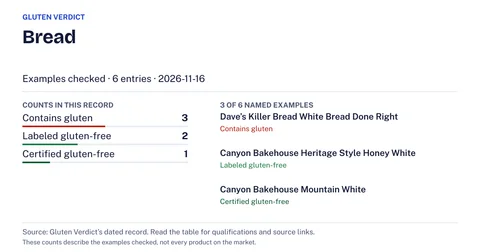 BreadContains glutenchecked Nov 16, 2026
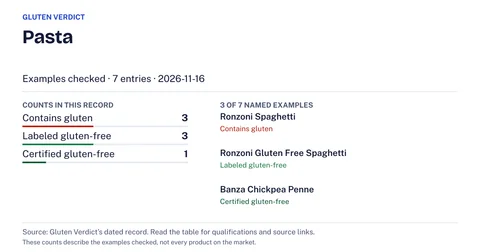 PastaContains glutenchecked Nov 16, 2026
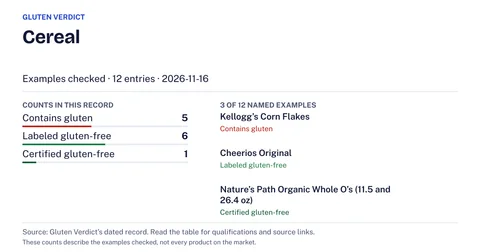 CerealDepends on the product5 of 12 products we checked contain glutenchecked Nov 16, 2026
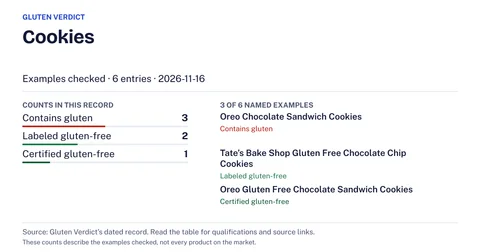 CookiesContains glutenchecked Nov 16, 2026
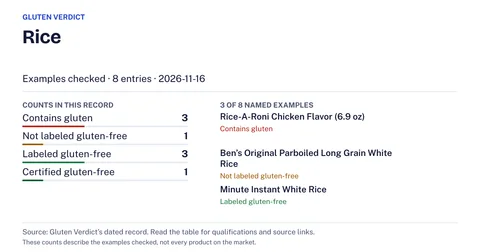 RiceNaturally gluten-free3 of 8 products we checked contain gluten: Rice-A-Roni Chicken Flavor (6.9 oz), Near East Original Rice Pilaf, and Ben’s Original Ready Rice Rice PilafBuy it labeled gluten-freechecked Nov 16, 2026
Questions people ask
Does gluten make you gain weight?
The Celiac Disease Foundation wrote in 2016: “Gluten does not make us fat; lifestyle choices do”61. In the one crossover trial here that tested gluten itself, 23 women eating gluten-free for six weeks had similar weight and body composition in the gluten and gluten-free periods24, 25.
Are gluten-free foods lower in calories?
Not by default. A Canadian survey found calories comparable between gluten-free and regular packaged foods overall13, and Gaesser and Angadi wrote that some gluten-free products have a greater energy value than the gluten-containing versions47.
Why did I lose weight when I went gluten-free?
Harvard’s Nutrition Source says that giving up highly processed bread, pasta, cereals and snack foods may mean losing some weight soon after30. An Academy of Nutrition and Dietetics spokeswoman, quoted by the Celiac Disease Foundation, agreed the diet is not a “magic bullet” for weight loss62 and said weight loss is related to activity level and food intake, not gluten63.
Can a gluten-free diet cause weight gain?
GIG says a gluten-free diet that relies too much on processed gluten-free foods can lead to weight gain3. Gaesser and Angadi wrote in 2012 that whether weight gain would be observed in people without celiac disease or gluten sensitivity remained to be established64.
More in Nutrition and combining diets
 Weight gain or loss after a celiac diagnosis: what the research foundWhat two studies found about weight before and after a celiac diagnosis, what sources say about gluten-free foods, and what to bring to a dietitian.
 Is a gluten-free diet healthy if you do not have celiac disease?What a gluten-free label promises, what studies of gluten-free products and eaters report, and why testing comes before cutting gluten.
 Gluten-free with type 2 diabetes or high cholesterol: where the plans overlapWhere a gluten-free plan and a diabetes or cholesterol plan agree, where packaged gluten-free foods cut across them, and what to ask a dietitian.
 Does a gluten-free diet change blood sugar? What each study measuredRead the BMJ heart-disease cohort, the type 2 diabetes cohort, a pasta glucose trial and celiac and type 1 diabetes sources by what each measured.
 Iron, B12 and B6 on a gluten-free diet: where they come from and how to check a labelWhich foods supply iron, B12 and B6, what US enrichment standards name, and how to check whether a gluten-free flour, bread or cereal is fortified.
 Gluten-free and low FODMAP: what to check when symptoms continueHow gluten and FODMAPs differ, what guidelines list for persistent symptoms on a gluten-free diet, and FODMAP ingredients to look for on labels.
Related guides
 Celiac Blood Tests: What tTG-IgA, Total IgA, DGP and EMA Each CheckWhat tTG-IgA, total IgA, EMA and DGP check, why total IgA is drawn with tTG-IgA, when back-up tests are used, and why gluten stays in the diet first.
 Foods that contain gluten, aisle by aisle, and the label words that give them awayA store-order map of foods that contain gluten, which depend on the brand, and which need a cross-contact check, with the label words to look for.
 Why gluten-free packaged food costs more, and what the price surveys showWhat price surveys found, what researchers say drives the gap, what FDA’s rule and one certifier require, and what a shopper can avoid.
 Grieving foods after a celiac diagnosis: what people describe and where to get helpSadness or anger about food after a celiac diagnosis: what charities and research report, small steps the sources name, and when to call a provider or 988.
Sources
- [1, 48, 49, 55, 56, 58, 60] National Institute of Diabetes and Digestive and Kidney Diseases (NIDDK), Eating, Diet, & Nutrition for Celiac Disease, checked Nov 17, 2026.
- [2, 4, 5, 18] Clinical Therapeutics (abstract on PubMed), Impact of Gluten-free Diet on Anthropometric Indicators in Individuals With and Without Celiac Disease: A Systematic Review and Meta-analysis (Xin et al., 2023), checked Nov 17, 2026.
- [3, 34, 35, 51, 52] Gluten Intolerance Group, Weight Management and the Gluten-Free Diet, checked Nov 17, 2026.
- [6, 7, 8] International Journal of Cardiovascular Sciences, Does a Gluten-free Diet Improve Metabolic Syndrome Parameters? A Systematic Review (Orange et al., 2022), checked Nov 17, 2026.
- [9, 19] Digestive Diseases and Sciences (abstract on PubMed), Obesity, Metabolic Syndrome, and Cardiovascular Risk in Gluten-Free Followers Without Celiac Disease in the United States: NHANES 2009-2014 (Kim et al., 2017), checked Nov 17, 2026.
- [10, 11, 12, 26, 27] BMC Nutrition (PubMed Central), Modulation of metabolic parameters among obese diabetic individuals through a gluten-free diet (Naeem et al., 2026), checked Nov 17, 2026.
- [13, 38, 42, 43] Canadian Journal of Dietetic Practice and Research (abstract on PubMed), Assessment of Nutritional Adequacy of Packaged Gluten-free Food Products (Kulai and Rashid, 2014), checked Nov 17, 2026.
- [14, 33, 59] Gluten Intolerance Group, The Gluten-Free Diet: Facts & Myths (educational bulletin, August 2021), checked Nov 17, 2026.
- [15, 32, 62, 63] Celiac Disease Foundation, Gluten-free is Not Always the Way to Be (2013), checked Nov 17, 2026.
- [16, 17, 47, 53, 64] Journal of the Academy of Nutrition and Dietetics, Gluten-Free Diet: Imprudent Dietary Advice for the General Population? (Gaesser and Angadi, 2012), checked Nov 17, 2026.
- [20, 21] Gastroenterology & Hepatology (PubMed Central), Health Benefits and Adverse Effects of a Gluten-Free Diet in Non-Celiac Disease Patients (Niland and Cash, 2018), checked Nov 17, 2026.
- [22, 23] Celiac Disease Foundation, Prevalence of gluten-free diet adherence among individuals without celiac disease in the USA (2013), checked Nov 17, 2026.
- [24, 25] Journal of the American Nutrition Association (abstract on PubMed), Gluten-Free Diet Reduces Diet Quality and Increases Inflammatory Potential in Non-Celiac Healthy Women (Henriques et al., 2022), checked Nov 17, 2026.
- [28, 31] Nutrients (PubMed Central), A Review on the Gluten-Free Diet: Technological and Nutritional Challenges (El Khoury et al., 2018), checked Nov 17, 2026.
- [29, 30, 36] Harvard T.H. Chan School of Public Health, The Nutrition Source, Diet Review: Gluten-Free for Weight Loss, checked Nov 17, 2026.
- [37, 50, 61] Celiac Disease Foundation, 9 Questions About Celiac Disease, Answered (2016), checked Nov 17, 2026.
- [39, 40, 44] Nutrients (abstract on PubMed), The Availability and Nutritional Adequacy of Gluten-Free Bread and Pasta (Allen and Orfila, 2018), checked Nov 17, 2026.
- [41, 45, 46, 57] Food & Nutrition Research (abstract on PubMed), Nutritional quality and costs of gluten-free products: a case-control study of food products on the Norwegian marked (Myhrstad et al., 2021), checked Nov 17, 2026.
- [54] BMJ (abstract on PubMed), Long term gluten consumption in adults without celiac disease and risk of coronary heart disease: prospective cohort study (Lebwohl et al., 2017), checked Nov 17, 2026.