Gluten-free and low FODMAP: what to check when symptoms continue
Short answer
Gluten and FODMAPs are different things2, 23. When symptoms continue on a gluten-free diet, the American College of Gastroenterology calls for a systematic workup1, and Monash University says its low-FODMAP diet is intended for people with medically diagnosed IBS27. The workup includes:
- Reviewing and confirming the original diagnosis4.
- Evaluating for inadvertent gluten exposure, through an expert dietitian and serology4.
- Assessing for a coexisting functional disorder, such as irritable bowel syndrome4, 5.
- Selective testing, based on clinical suspicion, for food intolerances (lactose, fructose), pancreatic insufficiency, microscopic colitis and small intestinal bacterial overgrowth, among others4.
Part of Nutrition and combining diets, 24 guides

Key points
- FODMAPs are short-chain carbohydrates that are not absorbed properly in the gut23; celiac disease is an immune-mediated response to gluten present in wheat, barley and rye2.
- Coeliac UK says ongoing symptoms after starting a gluten-free diet affect around 1 in 3 people, and most of the time gluten is still getting into the diet8.
- Monash says its low-FODMAP diet is best followed under a qualified dietitian or healthcare professional experienced in it28, the Celiac Disease Foundation says it should be initiated only with a specialized dietitian22, and Monash describes a 2-6 week period of high restriction before foods are gradually re-introduced28.
- A gluten-free label does not settle FODMAPs: Monash found gluten-free products, for example gluten-free pasta, that contain high-FODMAP ingredients such as soy flour or lupin flour37.
- Monash names inulin, chicory root, apple juice and fruit juice concentrates among the label ingredients to look for33, 36.
Gluten and FODMAPs are different things
Celiac disease is an immune-mediated response to gluten present in wheat, barley and rye2. FODMAPs are a collection of short-chain carbohydrates that are not absorbed properly in the gut and can trigger symptoms in people with IBS; they occur naturally in many foods and food additives23.
| Gluten | FODMAPs | |
|---|---|---|
| What it is | Present in wheat, barley and rye2 | Short-chain carbohydrates not absorbed properly in the gut23 |
| Where it turns up | Wheat, barley and rye2 | A wide range of foods, such as fruits, vegetables, breads, cereals, nuts, legumes and confectionery24 |
Wheat is where the two overlap. Monash lists wheat and rye, along with onions, garlic and legumes, among the foods that contain fructans and GOS, two kinds of FODMAP25. The Celiac Disease Foundation says that is why many clinicians and researchers think a gluten-free diet may ease IBS symptoms: it reduces the carbohydrates in wheat grains that gut bacteria ferment20.
This page reports what guidelines, NIDDK, Monash University and the charities say. It is written around celiac disease, which is what the ACG and Coeliac UK passages cover; it does not diagnose anything or replace the clinician who knows your history.
What a clinician checks when symptoms continue on a gluten-free diet
The American College of Gastroenterology (ACG) defines nonresponsive celiac disease as persistent or recurrent symptoms despite a gluten-free diet, and says these patients require a systematic workup to rule out the conditions that may cause them, especially unintentional gluten contamination1. A figure in the guideline puts the timeframe at 6–12 months of dietary gluten avoidance3.
It is not rare. Coeliac UK says ongoing symptoms after starting a gluten-free diet affect around 1 in 3 people, and that most of the time gluten is still getting into the diet8.
The ACG guideline text lists what the evaluation of persistent or recurrent symptoms takes into account:
- Reviewing and confirming the initial diagnosis4.
- Evaluation for inadvertent gluten exposure, through assessment by an expert dietitian and serology4.
- Assessment for a coexisting functional disorder4; the guideline notes that many patients with celiac disease have ongoing symptoms attributed to functional disorders such as irritable bowel syndrome5.
- Selective testing, based on clinical suspicion, of food intolerances (for example lactose and fructose), pancreatic insufficiency, microscopic colitis and small intestinal bacterial overgrowth, among others4.
Coeliac UK, writing for the UK, says the first step when non-responsive or refractory coeliac disease is suspected is usually an endoscopy with biopsy10, and that if the gut looks normal, other causes such as irritable bowel syndrome or lactose intolerance are considered11. It also says that with ongoing symptoms it is important not to guess the cause and to visit your healthcare team9.
Gluten exposure and follow-up blood tests
In a study presented at Digestive Disease Week and reported by Beyond Celiac, gluten exposure was the most frequent cause physicians cited among patients whose follow-up biopsy showed ongoing intestinal damage14.
The ACG guideline's figure on the workup says positive celiac serologies despite 12 months of treatment with a gluten-free diet suggest there may be ongoing gluten ingestion6. Beyond Celiac lists “Am I being exposed to gluten?” among the questions regular blood monitoring can help answer17, and adds that blood-test results do not always detect damage to the intestine16.
ACG is cautious about gluten-detection spot checks: it says there may be a role for them in select scenarios, but it is not given that the approach will improve adherence, quality of life or other clinical outcomes7.
For the kitchen side of hidden gluten, see our guide to gluten cross-contact at home and our reading of a tTG-IgA result.
Other causes clinicians consider
The Celiac Disease Foundation says continued gluten ingestion is the most common cause of persistent symptoms in both people with celiac disease and people with non-celiac gluten sensitivity, and that a dual diagnosis of irritable bowel syndrome is also common19.
In the same Digestive Disease Week study, among patients whose follow-up biopsy showed healing, physicians most frequently cited microscopic colitis or IBS for the ongoing symptoms13. Beyond Celiac notes that there is no test for IBS and that it is usually diagnosed when other conditions have been ruled out15.
Lactose is one of the intolerances both ACG and Coeliac UK name4, 11. Our guide to lactose intolerance after a celiac diagnosis covers it, and Monash points out that only people with lactose intolerance need to limit lactose38.
What a low-FODMAP trial is
Monash University, which developed the diet, says it is intended for people with medically diagnosed IBS, that someone whose symptoms a doctor has not diagnosed should not be following it, and that many conditions, coeliac disease among them, have symptoms similar to IBS27.
| Source | What it says |
|---|---|
| Monash University | A 2-6 week period of high restriction, then a more relaxed diet where certain foods are gradually re-introduced28 |
| Celiac Disease Foundation | Temporarily eliminating trigger foods for a period of weeks, then reintroducing them slowly to determine individual causes of symptoms21 |
| NIDDK | A doctor may suggest trying it for a few weeks; if symptoms improve, the doctor may recommend slowly adding FODMAP foods back41 |
On who should guide it, Monash says the diet is best followed under the supervision of a qualified dietitian or healthcare professional experienced in it28. The Celiac Disease Foundation says it should be initiated only with a specialized dietitian, so that the least-restrictive diet can be found22. Gluten Intolerance Group adds that it is not meant to be followed indefinitely44.
Monash reports that IBS symptoms improved in 3 out of 4 people who follow it29, and also says that 1 out of 4 people with IBS find their symptoms do not improve on the diet30.
If you do not have celiac disease
Gluten Intolerance Group describes one study (Skodje and colleagues) in which 59 people without celiac disease on a gluten-free diet were given a granola bar containing gluten, fructans or a placebo; fructans caused more severe symptoms than gluten or the placebo45. It also says there is no laboratory test for FODMAP intolerance, so a FODMAP elimination diet, under the guidance of a Registered Dietitian or another healthcare professional, should be done to determine which foods are causing symptoms43.
FODMAP ingredients on gluten-free replacement foods
A gluten-free claim answers the gluten question only. Monash says many gluten-free products are lower in FODMAPs, but it has found a number of them, gluten-free pasta for example, that contain high-FODMAP ingredients such as soy flour or lupin flour37. It also says FODMAP content cannot be guessed: laboratory analysis is needed26.
| Ingredient or food | What the source says |
|---|---|
| Inulin, chicory root or chicory root fibre, fructooligosaccharides (FOS), galactooligosaccharides (GOS) | Monash says companies making gut-health claims often add them to boost prebiotic fibre, and that in some people with IBS this can cause gas, bloating and abdominal distension36. Purified forms such as inulin, FOS and GOS count even in very small amounts32. |
| Apple juice, pear juice and fruit juice concentrates | Monash lists them as sources of excess fructose, with honey, high fructose corn syrup and glucose-fructose syrup33; the foods it names for this group include granola, muesli bars, bread and breakfast cereals34. NIDDK lists apples and pears or juice containing them, and honey and foods with high-fructose corn syrup42. |
| Soy flour, chickpea flour, Jerusalem artichoke | Monash lists them with the oligosaccharide sources (GOS and fructans)35. |
| Sorbitol, mannitol, xylitol, maltitol | NIDDK lists products, including candy and gum, with sweeteners ending in “–ol”42. |
| Milk, yogurt, ice cream | NIDDK lists dairy products such as milk, milk products, soft cheeses, yogurt, custard and ice cream42. |
Our verdict pages answer the gluten question only; they do not rate FODMAP content. For the foods above, the gluten side is at honey, high fructose corn syrup, apple juice, bread, pasta, cereal, granola bars, hummus, chickpeas and milk.
Reading one label for both questions
- Start with gluten: the gluten-free claim, the Contains line and the full ingredient list, as in our guide to reading a US food label for gluten.
- Then read the same list for the FODMAP ingredients in the table above. Monash notes that ingredients are listed in weight order and says to be particularly careful if a typically high-FODMAP food is listed in the first few ingredients31.
- Check separately for purified FODMAPs such as inulin, FOS and GOS, and for onion and garlic: Monash gives these as the exceptions to the weight-order rule, saying even very small amounts contribute significantly to the overall FODMAP load32.
Monash says products carrying its Low FODMAP Certified stamp have been laboratory tested against its criteria in the serving size on the pack39, and that the information in barcode-scanning apps is not regulated and often inaccurate40.
Why bacterial overgrowth questions go to a clinician
ACG lists small intestinal bacterial overgrowth among the conditions to test for selectively when symptoms persist4. Beyond Celiac lists it among the conditions whose symptoms overlap with celiac disease18, and NICE's public information for the UK says a doctor may check for an abnormally high level of bacteria in the intestine12.
None of the sources read for this page says whether a low-FODMAP diet suits that situation, so this guide does not either. It is a question for the clinician doing the testing.
Verdicts in this guide
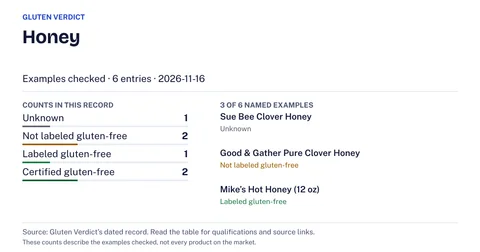 HoneyDepends on the productchecked Nov 16, 2026
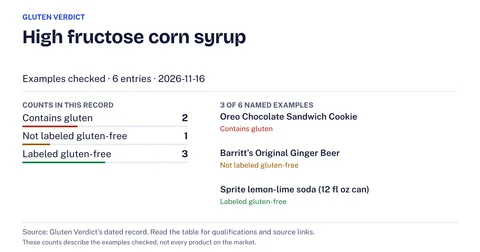 High fructose corn syrupNaturally gluten-free2 of 6 products we checked contain gluten: Oreo Chocolate Sandwich Cookie and Ritz Original Crackerschecked Nov 16, 2026
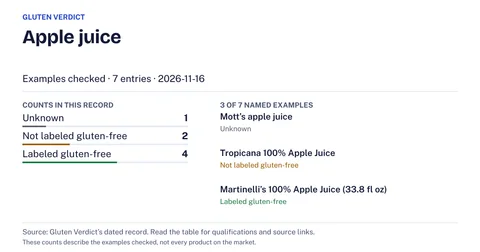 Apple juiceNaturally gluten-freechecked Nov 16, 2026
 BreadContains glutenchecked Nov 16, 2026
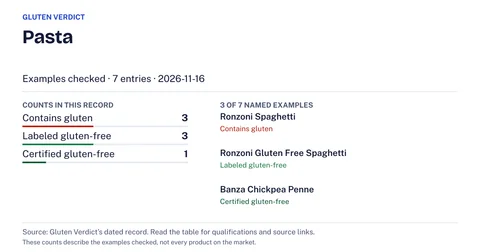 PastaContains glutenchecked Nov 16, 2026
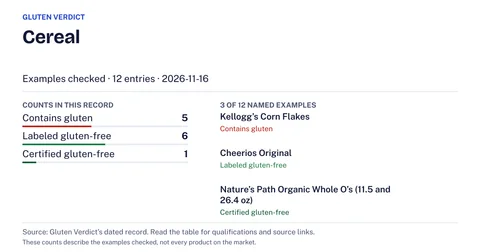 CerealDepends on the product5 of 12 products we checked contain glutenchecked Nov 16, 2026
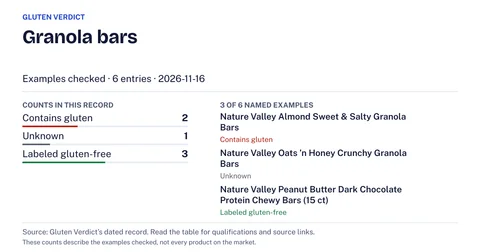 Granola barsDepends on the product2 of 6 products we checked contain gluten: Nature Valley Almond Sweet & Salty Granola Bars and Nature Valley Cinnamon Brown Sugar Soft-baked Oatmeal Squareschecked Nov 16, 2026
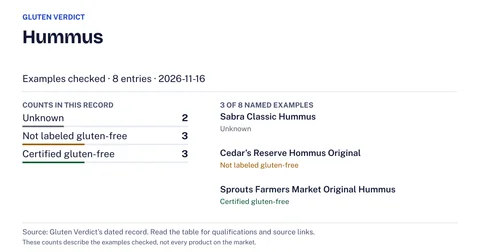 HummusDepends on the productchecked Nov 16, 2026
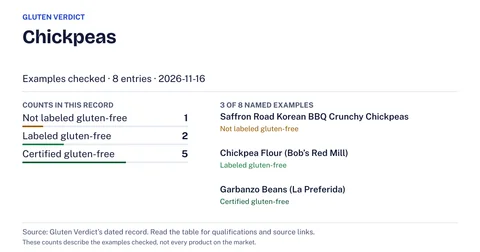 ChickpeasNaturally gluten-freechecked Nov 16, 2026
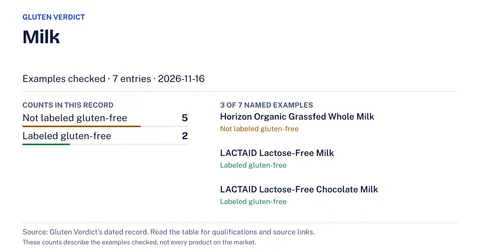 MilkNaturally gluten-freechecked Nov 16, 2026
Questions people ask
Is gluten-free the same as low FODMAP?
No. Celiac disease is a response to gluten present in wheat, barley and rye2. FODMAPs are short-chain carbohydrates that are not absorbed properly in the gut23. Wheat and rye contain fructans, one kind of FODMAP, but so do onions, garlic and legumes25.
Does a gluten-free label mean a food is low FODMAP?
No. Monash found a number of gluten-free products, for example gluten-free pasta, that contain high-FODMAP ingredients such as soy flour or lupin flour37.
Can I start a low-FODMAP diet on my own?
Monash says the diet is best followed under the supervision of a qualified dietitian or healthcare professional28, and that someone whose symptoms a doctor has not diagnosed should not be following it27. The Celiac Disease Foundation says it should be initiated only with a specialized dietitian22.
More in Nutrition and combining diets
 Does a gluten-free diet change blood sugar? What each study measuredRead the BMJ heart-disease cohort, the type 2 diabetes cohort, a pasta glucose trial and celiac and type 1 diabetes sources by what each measured.
 Gluten-free with type 2 diabetes or high cholesterol: where the plans overlapWhere a gluten-free plan and a diabetes or cholesterol plan agree, where packaged gluten-free foods cut across them, and what to ask a dietitian.
 Iron, B12 and B6 on a gluten-free diet: where they come from and how to check a labelWhich foods supply iron, B12 and B6, what US enrichment standards name, and how to check whether a gluten-free flour, bread or cereal is fortified.
 Is a gluten-free diet healthy if you do not have celiac disease?What a gluten-free label promises, what studies of gluten-free products and eaters report, and why testing comes before cutting gluten.
 Does a gluten-free diet help you lose weight?What reviews, NIDDK and celiac charities report about a gluten-free diet and weight outside celiac disease, and what the substitute foods contain.
 Fiber on a gluten-free diet: where it drops and what fills the gapCheck the fiber on gluten-free breads and pastas against the US Daily Value, and see which gluten-free whole foods charities list to add more.
Related guides
 Lactose intolerance after a celiac diagnosis: why it happens and how long it lastsWhy lactose intolerance can follow a celiac diagnosis, what published studies report about recovery on a gluten-free diet, and how lactose-free milk fits.
 Starting a gluten-free diet: testing first, then labels, oats and the kitchenWhat NIH and the celiac charities say about starting a gluten-free diet: testing first, which foods to start with, a US label check, oats and the kitchen.
 Gluten-free and dairy-free: how to check a US label for bothUS labels treat milk and gluten under different rules. How to read for both, which makers state both claims, and what to ask when eating out.
 What in wheat bothers people if it is not gluten?The non-gluten candidates for wheat symptoms (fructans, ATIs, wheat allergy), the trial or review behind each, and what limits it.
Sources
- [1, 2, 3, 4, 5, 6, 7] American College of Gastroenterology, ACG Guidelines Update: Diagnosis and Management of Celiac Disease, checked Nov 17, 2026.
- [8, 9, 10, 11] Coeliac UK, Non responsive and refractory coeliac disease, checked Nov 17, 2026.
- [12] National Institute for Health and Care Excellence (NICE), If you still have symptoms (Coeliac disease: recognition, assessment and management, NG20), checked Nov 17, 2026.
- [13, 14, 15] Beyond Celiac, Five years after diagnosis, more than half of those with celiac disease still have symptoms, checked Nov 17, 2026.
- [16, 17] Beyond Celiac, Celiac Disease Management & Monitoring, checked Nov 17, 2026.
Read on 2026-11-17: the list under “Regular monitoring with blood tests can also help answer the following questions:” names “Am I being exposed to gluten?”, “Am I at risk of developing nutritional deficiencies and associated diseases?” and “Is my immune system normalizing?”.
- [18] Beyond Celiac, Celiac Disease Symptoms, checked Nov 17, 2026.
- [19, 20, 21, 22] Celiac Disease Foundation, Irritable Bowel Syndrome, Gluten-Related Disorders, and the Low FODMAP Diet, checked Nov 17, 2026.
- [23, 24, 25, 26, 27, 28, 29, 30] Monash University, FODMAPs and Irritable Bowel Syndrome, checked Nov 17, 2026.
- [31, 32, 33, 34, 35, 36, 37, 38, 39, 40] Monash University, Label reading and FODMAPs, checked Nov 17, 2026.
- [41, 42] US National Institute of Diabetes and Digestive and Kidney Diseases (NIDDK), Eating, Diet, & Nutrition for Irritable Bowel Syndrome, checked Nov 17, 2026.
Read on 2026-11-17: the list headed “Examples of foods that contain FODMAPs include” names fruits such as apples and pears “or juice containing any of these fruits”; vegetables; dairy products such as milk, milk products, soft cheeses, yogurt, custard, and ice cream; wheat and rye products; honey and foods with high-fructose corn syrup; and products, including candy and gum, with sweeteners ending in “–ol,” such as sorbitol, mannitol, xylitol, and maltitol.
- [43, 44, 45] Gluten Intolerance Group, Low FODMAP Diet for Non-Celiac Gluten/Wheat Sensitivity, checked Nov 17, 2026.