Iron, B12 and B6 on a gluten-free diet: where they come from and how to check a label
Short answer
US standards for enriched flour, bread and macaroni name iron, thiamin, riboflavin, niacin and folic acid1, 2, 3, and the flour standard names no vitamin B12 or B64. The Gluten Intolerance Group says very few gluten-free grain products are modified to add these nutrients5, so the label and the maker’s page are the check. Look at four things:
- The iron line in Nutrition Facts, which FDA requires on food labels6, and the ingredient list, where an added form reads like “reduced iron”7.
- Lines for vitamin B12 and B6 on the panel: FDA does not require them unless the vitamin has been added8, 9.
- Foods: B12 is found in animal foods, and is not naturally present in plant foods, though some are fortified10; B6 from fish, organ meats, potatoes, chickpeas and fortified cereals11, 12; iron from meat, seafood, beans and fortified grains13, 14.
- Blood results: for vitamin B12, ODS says the cutoff between normal and deficient varies by method and laboratory15, so what a result means is for a clinician.
Part of Nutrition and combining diets, 24 guides
Key points
- The US standards for enriched flour, bread and macaroni name iron, thiamin, riboflavin, niacin and folic acid; the flour standard names no vitamin B12 or B61, 2, 3, 4.
- The gluten-free claim sets a gluten limit and no nutrient requirement, so the claim does not tell you whether iron or vitamins were added; the Nutrition Facts and ingredient list do16.
- Makers’ pages read on 2026-11-17 differ: Cheerios and Rice Chex list iron, B6 and B1217, 18, King Arthur’s gluten-free flour adds iron, thiamin, riboflavin and niacin19, and Bob’s Red Mill’s 1-to-1 flour lists no added nutrients20.
- A 2020 study of Canadian adults on a gluten-free diet reported that most commercial cereals and breads (65%) were unenriched, yet gluten-free grains were still their top food source of iron21, 22.
- B12 is found in animal foods and is not naturally present in plant foods, though some are fortified10; one slice of whole wheat bread is listed at 0.0 mcg23.
What enriched wheat products added, and what they never did
The NIH Office of Dietary Supplements (ODS) says wheat and other flours are fortified with iron in the United States, Canada and many other countries24, and that about half of dietary iron in the US comes from bread, cereal and other grain products25.
What “enriched” means is written into federal standards. The flour standard says enriched flour contains, in each pound, 2.9 milligrams of thiamin, 1.8 of riboflavin, 24 of niacin, 0.7 of folic acid and 20 of iron1. The standards for enriched bread and for enriched macaroni products name the same five nutrients at their own levels2, 3. In the flour standard, vitamin B6 and vitamin B12 are not named4.
| Standard | Nutrients it names | Iron per pound, as written |
|---|---|---|
| Enriched flour, 21 CFR 137.165 | Thiamin, riboflavin, niacin, folic acid, iron1 | 20 milligrams1 |
| Enriched bread, rolls and buns, 21 CFR 136.115 | Thiamin, riboflavin, niacin, folic acid, iron2 | 12.5 milligrams2 |
| Enriched macaroni products, 21 CFR 139.115 | Thiamin, riboflavin, niacin, folic acid, iron3 | Not less than 13 and not more than 16.5 milligrams3 |
The gluten-free claim works differently. The rule defines it by gluten-containing grains, ingredients made from them and a limit of 20 parts per million of gluten, and sets no vitamin or mineral requirement16. A gluten-free label therefore says nothing about added nutrients; the next section shows what some makers’ pages say.
Folic acid, one of the five, has its own guide: folic acid in gluten-free foods.
Are gluten-free flours, breads and cereals fortified?
The Gluten Intolerance Group (GIG) says gluten-containing grain products are commonly enriched or fortified, but very few gluten-free grain products are modified to add in these nutrients5. Two studies, one of diet records and one of supermarket product listings, point the same way, each in its own country.
A 2020 study analysed food records from 35 Canadian adults following a gluten-free diet26. Its authors report that most commercial cereals and breads (65%) were unenriched21, yet gluten-free grains were the top food source of iron in those records, despite few brands being enriched or fortified22. They also note a lack of nutrient composition data for B vitamins and minerals other than iron27.
A 2018 survey of four UK supermarket websites notes that gluten-free flours are exempt from the UK law that requires fortification of white wheat flour28, and found that only 5% of gluten-free breads were fortified with all four of the UK’s mandatory nutrients (calcium, iron, niacin and thiamin), while 28% were fortified with calcium and iron only29. Those are UK rules and UK products, not US ones.
Makers’ own pages show how far one product can differ from the next. Each row is what the page said on 2026-11-17, for the serving that page states; serving sizes differ, so read each row on its own.
| Product | Serving on the page | What the page shows |
|---|---|---|
| Bob’s Red Mill Gluten Free 1-to-1 Baking Flour | 1/4 cup (37 g) | Iron 0 mg (0% DV); the ingredients are rice, sorghum, potato and tapioca flours or starches and xanthan gum, with no added vitamin or iron20 |
| King Arthur Gluten-Free Measure for Measure Flour | 4 tbsp (31 g) | Iron 2 mg (10% DV), thiamin 15%, riboflavin 10%, niacin 15%; a vitamin and mineral blend of calcium carbonate, niacinamide, reduced iron, thiamin and riboflavin; no B6, B12 or folate line19 |
| Bob’s Red Mill Unbleached White All-Purpose Flour (wheat, for contrast) | 1/4 cup (34 g) | Iron 1 mg (6% DV), thiamin 25%, riboflavin 8%, niacin 15%, folate 20%; the ingredients name niacin, reduced iron, thiamine mononitrate, riboflavin and folic acid30, 7 |
| Schär XL Sandwich Bread (gluten-free) | 1 slice (47 g) | Iron 0.5 mg (2% DV); the ingredient list names no added vitamin or iron source31 |
| Cheerios (gluten-free cereal) | 1 1/2 cup | Iron 12.6 mg (70% DV), vitamin B6 20%, vitamin B12 20%17; the vitamins and minerals line names iron, vitamin B6, folic acid and vitamin B12 among others32 |
| Rice Chex (gluten-free cereal) | 1 1/3 cup (40 g) | Iron 12.6 mg (70% DV), vitamin B6 20%, vitamin B12 20%18; the vitamins and minerals line names iron, vitamin B6, folic acid and vitamin B12 among others33 |
So the gluten-free claim does not settle fortification: two cereals list iron, B6 and B1217, 18, one gluten-free flour adds iron, thiamin, riboflavin and niacin19, and another lists none20.
King Arthur’s page says its gluten-free flour is “Fortified with iron, calcium, and vitamin B”34. The packaging’s blend names niacinamide (vitamin B3), thiamin (vitamin B1) and riboflavin (vitamin B2), and shows no B6 or B12 line19, so “vitamin B” on that page is not vitamin B6 or B12.
Four steps at the shelf
- Find the iron line in Nutrition Facts. ODS notes that FDA requires food labels to list iron content6.
- Read the ingredient list for added forms. The enriched wheat flour above lists niacin, reduced iron, thiamine mononitrate, riboflavin and folic acid7; King Arthur’s gluten-free blend lists reduced iron, niacinamide, thiamin and riboflavin19.
- Look for vitamin B12 and B6 lines. FDA does not require labels to list either unless it has been added8, 9, so a panel with no line for them carries no addition the label had to list.
- Read the front-of-pack words against the panel: King Arthur’s page says its gluten-free flour is fortified with “vitamin B”34, while its panel lists B1, B2 and B3 and no B6 or B12 line19.
The same steps work on bread, pasta and cereal labels, and on gluten-free flours made from rice flour and other starches.
Iron: food sources and what affects absorption
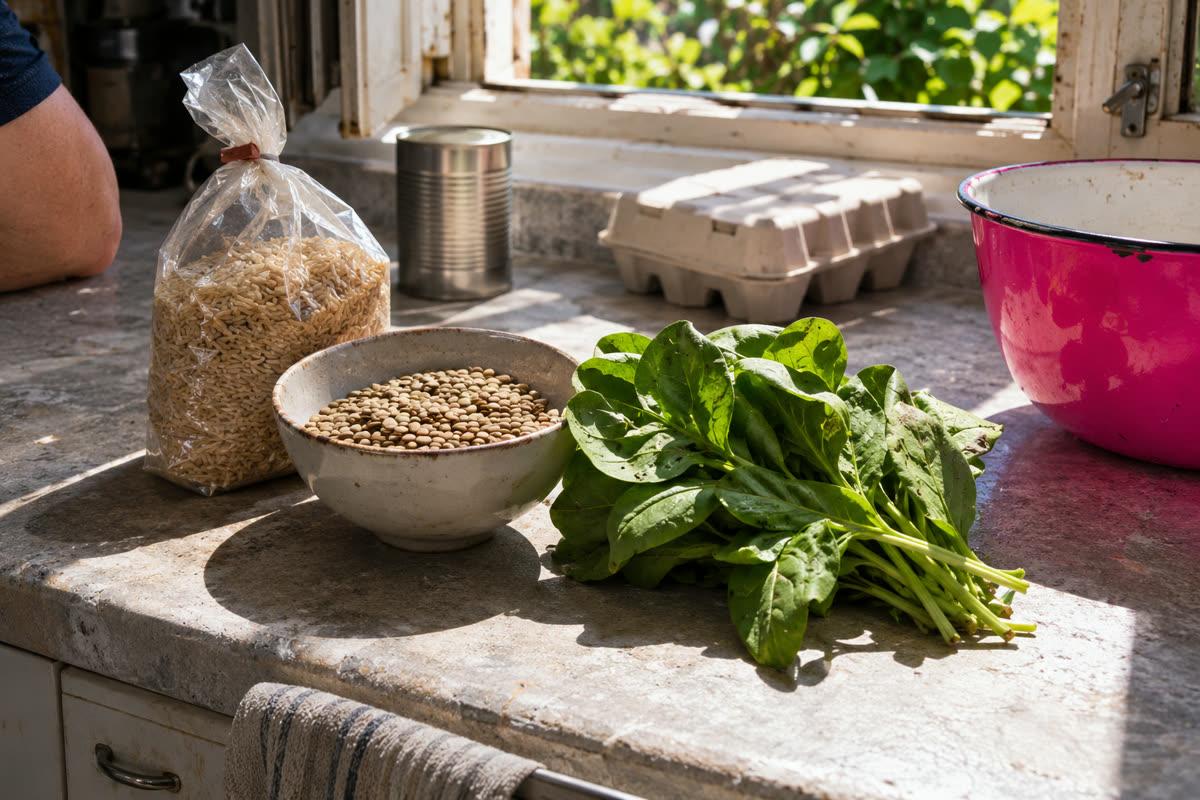
ODS lists lean meat and seafood as the richest dietary sources of heme iron, and nuts, beans and vegetables as sources of nonheme iron13; fortified grain products are also a source of nonheme iron14. GIG’s list of iron sources for people avoiding gluten names all types of meat, lentils, soybeans and tofu35.
| Food and serving | Iron (mg) | % DV |
|---|---|---|
| Breakfast cereal fortified to supply the full DV, 1 serving (check that the cereal is gluten-free) | 1836 | 100 |
| White beans, canned, 1 cup | 836 | 44 |
| Oysters, eastern, cooked, 3 ounces | 836 | 44 |
| Beef liver, pan fried, 3 ounces | 536 | 28 |
| Lentils, boiled and drained, ½ cup | 336 | 17 |
| Tofu, firm, ½ cup | 336 | 17 |
| Chickpeas, boiled and drained, ½ cup | 236 | 11 |
| Cashew nuts, oil roasted, 1 ounce | 236 | 11 |
| Egg, hard boiled, 1 large | 136 | 6 |
| Bread, white, 1 slice | 136 | 6 |
| Rice, white, long grain, enriched, parboiled, ½ cup | 136 | 6 |
These are plain foods as ODS lists them; a packaged or prepared version needs the label steps above. Our verdicts for lentils, chickpeas, quinoa and eggs cover each food’s gluten status and cross-contact caveats.
Absorption
ODS puts the bioavailability of iron at approximately 14% to 18% from mixed diets with substantial meat, seafood and vitamin C, and 5% to 12% from vegetarian diets37. It lists meat, poultry, seafood and ascorbic acid as helping nonheme iron absorption, and phytate (present in grains and beans) and certain polyphenols as working against it38, and notes that some iron-rich plant foods, such as spinach, have low iron bioavailability39. It adds that a typical western diet attenuates these effects, so they have little effect on most people’s iron status40.
Coeliac UK, a UK charity, says tea, coffee, chocolate and spinach can inhibit nonheme iron absorption, and suggests keeping tea, coffee and cocoa for between meals and choosing vitamin C-rich foods and drinks to improve absorption41.
Celiac disease and iron
ODS lists celiac disease among gastrointestinal disorders that carry an increased risk of iron deficiency, because the disorder requires dietary restrictions or results in iron malabsorption or blood loss42. GIG says that once the diet has been adapted, the intestine generally heals and absorption should improve43.
Vitamin B12: animal foods and fortified foods
ODS says vitamin B12 is found in foods of animal origin and is not naturally present in plant foods, though some plant foods are fortified with it, including many breakfast cereals and nutritional yeasts10.
That changes the question for most readers. The flour standard names no vitamin B124, and ODS lists one slice of whole wheat bread at 0.0 mcg23. Wheat bread is not listed as a B12 source in either place, so the food lists below, not the loaf, are where to look.
| Food and serving | Vitamin B12 (mcg) | % DV |
|---|---|---|
| Beef liver, pan fried, 3 ounces | 70.723 | 2,944 |
| Clams, cooked, 3 ounces | 1723 | 708 |
| Oysters, eastern, wild, cooked, 3 ounces | 14.923 | 621 |
| Salmon, Atlantic, cooked, 3 ounces | 2.623 | 108 |
| Tuna, light, canned in water, 3 ounces | 2.523 | 104 |
| Beef, ground, 85% lean, pan browned, 3 ounces | 2.423 | 100 |
| Milk, 2% milkfat, 1 cup | 1.323 | 54 |
| Yogurt, plain, fat free, 6-ounce container | 1.023 | 43 |
| Breakfast cereal fortified with 25% of the DV, 1 serving (check that the cereal is gluten-free) | 0.623 | 25 |
| Cheese, cheddar, 1½ ounces | 0.523 | 19 |
| Egg, whole, cooked, 1 large | 0.523 | 19 |
| Bread, whole wheat, 1 slice | 0.023 | 0 |
For people following a vegan diet, Coeliac UK’s page lists fortified margarines, yeast extracts, breakfast cereals and soya milk, yoghurts and desserts as B12 sources, and says many specialist vegan foods are supplemented with B12 but may not be gluten-free44. For plant-based protein on a gluten-free diet, see gluten-free vegetarian protein.
Celiac disease and B12
ODS says people with celiac disease or Crohn’s disease may be unable to absorb enough vitamin B12 from food to maintain healthy body stores45. It lists other causes of low B12 too: difficulty absorbing B12 from food, lack of intrinsic factor, gastrointestinal surgery, prolonged use of certain medications such as metformin or proton pump inhibitors, and dietary deficiency46.
One small study examined 30 adults with celiac disease who were in biopsy-proven remission after 8 to 12 years of dietary treatment47. Their mean daily intakes of folate and vitamin B-12, but not vitamin B-6, were significantly lower than the controls’48.
Vitamin B6: fish, potatoes, chickpeas and fortified cereals
ODS names fish, beef liver and other organ meats, potatoes and other starchy vegetables, and fruit other than citrus as the richest sources of vitamin B611, and says US adults get most of their dietary B6 from fortified cereals, beef, poultry, starchy vegetables and some noncitrus fruits49.
| Food and serving | Vitamin B6 (mg) | % DV |
|---|---|---|
| Chickpeas, canned, 1 cup | 1.112 | 65 |
| Beef liver, pan fried, 3 ounces | 0.912 | 53 |
| Tuna, yellowfin, fresh, cooked, 3 ounces | 0.912 | 53 |
| Salmon, sockeye, cooked, 3 ounces | 0.612 | 35 |
| Chicken breast, roasted, 3 ounces | 0.512 | 29 |
| Breakfast cereal fortified with 25% of the DV, 1 serving (check that the cereal is gluten-free) | 0.412 | 25 |
| Potatoes, boiled, 1 cup | 0.412 | 25 |
| Banana, 1 medium | 0.412 | 25 |
| Rice, white, long grain, enriched, cooked, 1 cup | 0.112 | 6 |
Fortified breakfast cereals appear on both ODS lists, and the Cheerios and Rice Chex pages above name vitamin B6 among their added vitamins32, 33.
Celiac disease and B6
ODS says people with celiac disease, Crohn’s disease, ulcerative colitis and other malabsorptive autoimmune disorders tend to have low plasma PLP50, the most common blood measure of vitamin B6 status51. It also says isolated B6 deficiency is uncommon, and that low B6 status usually goes with low levels of other B-complex vitamins, such as B12 and folic acid52.
In the 30-adult study above, plasma folate was low in 37% of the adults and plasma pyridoxal 5'-phosphate, the active form of B6, in 20%53. That is one small study.
ODS reports that high intakes of vitamin B6 from food sources have not been reported to cause adverse effects54, while chronic oral pyridoxine at 1–6 g a day for 12–40 months can cause severe, progressive sensory neuropathy55. Whether to take any B6 supplement, and how much, is for a clinician or dietitian to decide.
Look up a food or product that is not in these tables
ODS points to USDA FoodData Central, which it says lists the nutrient content of many foods and gives a comprehensive list of foods containing iron, arranged by nutrient content and by food name56.
FoodData Central describes a web-based data system made up of five distinct types of food and nutrient composition data57. Its Search menu includes a Component Search, and its Branded Foods type is described as label data collected through a public-private partnership58.
Branded entries are label data. The package in your hand is still the check.
What a clinician may check, and questions to bring
This section reports what NIH and celiac charities say. It does not tell any reader what a result means or what to take.
NIDDK says that when celiac disease is diagnosed, the doctor may test for low levels of certain vitamins and minerals and may recommend or prescribe supplements if needed59. It also says that avoiding gluten without advice from a doctor or registered dietitian may leave a diet short of nutrients such as fiber, iron and calcium60.
Coeliac UK’s page for healthcare professionals (UK) says patients should be assessed and monitored for deficiencies in iron, folate, vitamin B12, vitamin D and calcium at diagnosis and during follow up61, and that vitamin B6, magnesium and zinc should be monitored in cases of severe malabsorption62.
What the tests can and cannot show
- Iron: ODS says hemoglobin and hematocrit are the most commonly used screens for iron deficiency but are neither sensitive nor specific, and that serum ferritin, a measure of the body’s iron stores, can be affected by inflammation63.
- Vitamin B12: ODS says the cutoff between normal and deficient levels varies by method and laboratory15, and that serum methylmalonic acid (MMA) is the most sensitive marker of B12 status64.
- Vitamin B6: ODS says plasma PLP is the most common measure of vitamin B6 status51.
Questions that fit what these sources say
- Which test measured each nutrient, and what is this laboratory’s reference range? ODS says the B12 cutoff varies by laboratory15.
- Was iron judged on hemoglobin alone, or on ferritin or other measures as well, and could inflammation have affected the ferritin?63
- Were vitamin B12 and B6 part of the panel? Coeliac UK’s page lists B12 for monitoring and B6 in cases of severe malabsorption61, 62.
- Could a medication or another condition be affecting a result? ODS lists metformin, proton pump inhibitors and gastrointestinal surgery among the causes of low B1246.
- If a supplement is suggested, what is it for, and when will the result be rechecked?
Verdicts in this guide
 BreadContains glutenchecked Nov 16, 2026
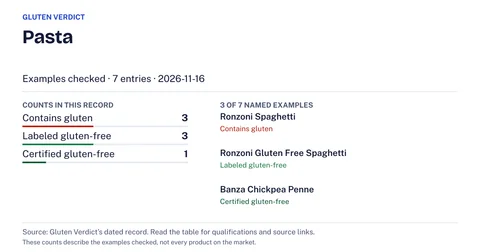 PastaContains glutenchecked Nov 16, 2026
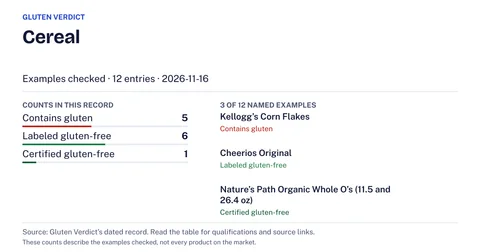 CerealDepends on the product5 of 12 products we checked contain glutenchecked Nov 16, 2026
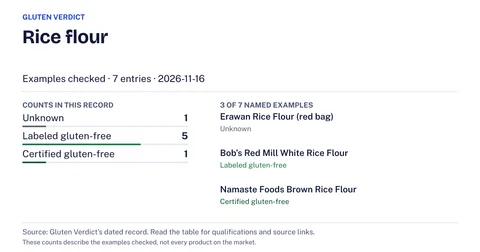 Rice flourNaturally gluten-freeBuy it labeled gluten-freechecked Nov 16, 2026
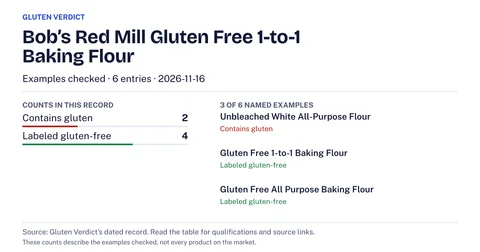 Bob’s Red Mill Gluten Free 1-to-1 Baking FlourLabeled gluten-free2 of 6 varieties we checked contain gluten: Unbleached White All-Purpose Flour and Whole Wheat FlourBob’s Red Mill Natural Foods · checked Nov 16, 2026
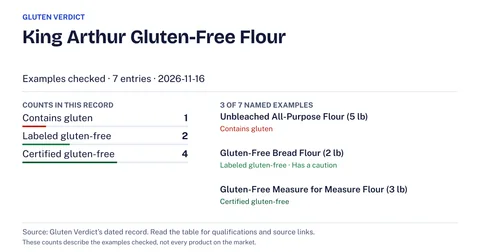 King Arthur Gluten-Free FlourCertified gluten-free1 of 7 varieties we checked contains gluten: Unbleached All-Purpose Flour (5 lb)Wheat warning on 2 of 7 varieties we checkedKing Arthur Baking Company · checked Nov 16, 2026
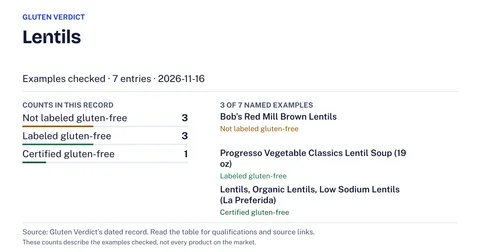 LentilsDepends on the productchecked Nov 16, 2026
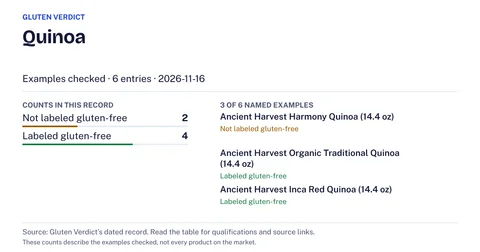 QuinoaNaturally gluten-freeBuy it labeled gluten-freechecked Nov 16, 2026
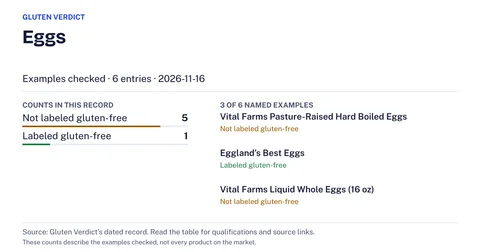 EggsNaturally gluten-freechecked Nov 16, 2026
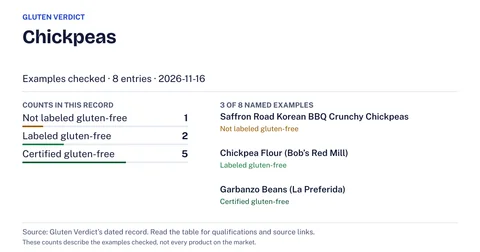 ChickpeasNaturally gluten-freechecked Nov 16, 2026
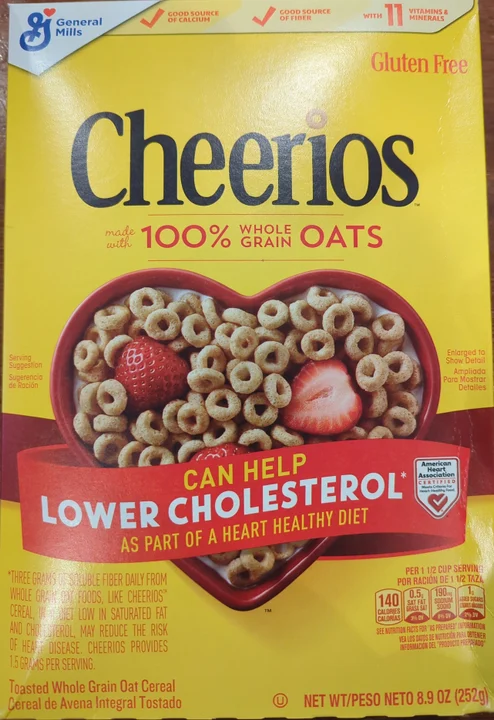 CheeriosLabeled gluten-freeWheat warning on 1 of 8 varieties we checkedGeneral Mills · checked Nov 16, 2026
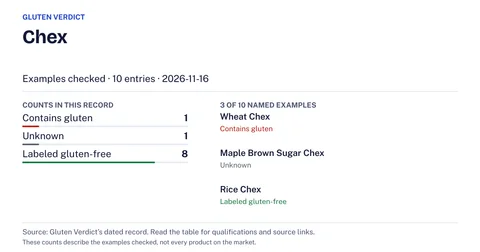 ChexLabeled gluten-free1 of 10 varieties we checked contains gluten: Wheat ChexGeneral Mills · checked Nov 16, 2026
Questions people ask
Does gluten-free bread have less iron than regular bread?
It depends on the loaf. Schär’s XL Sandwich Bread page lists iron 0.5 mg (2% DV) for one 47 g slice31, and ODS lists one slice of white bread at 1 mg36. Slice sizes differ, so read the Nutrition Facts of the loaf you buy.
Is enriched flour a source of vitamin B12?
The US standard for enriched flour names thiamin, riboflavin, niacin, folic acid and iron, and no vitamin B124. ODS lists one slice of whole wheat bread at 0.0 mcg23.
Is “fortified with vitamin B” the same as vitamin B12?
Not necessarily. King Arthur’s page for its gluten-free flour says “Fortified with iron, calcium, and vitamin B”34, while its packaging lists niacinamide (B3), thiamin (B1) and riboflavin (B2) and no B6 or B12 line19.
More in Nutrition and combining diets
 Is a gluten-free diet healthy if you do not have celiac disease?What a gluten-free label promises, what studies of gluten-free products and eaters report, and why testing comes before cutting gluten.
 Folic acid in gluten-free foods: how to check the labelUS rules require folic acid in enriched flour, not in every product. Where to look on a label, and what CDC and FDA say.
 What to eat after a celiac diagnosis: what the sources document and what they do notBone broth, collagen, glutamine or plain staples? What NIDDK, ACG and celiac charities document after a diagnosis, and what no page we read names.
 Nutrient deficiencies in celiac disease: what the guidance names for checkingWhich nutrients a celiac guideline and a charity's clinician page name for checking, where reported deficiency figures differ, and questions to bring.
 Gluten-free with type 2 diabetes or high cholesterol: where the plans overlapWhere a gluten-free plan and a diabetes or cholesterol plan agree, where packaged gluten-free foods cut across them, and what to ask a dietitian.
 Fiber on a gluten-free diet: where it drops and what fills the gapCheck the fiber on gluten-free breads and pastas against the US Daily Value, and see which gluten-free whole foods charities list to add more.
Related guides
 Iron deficiency anemia and celiac disease: why it appears and what clinicians checkWhy celiac disease causes iron deficiency anemia, what NICE and ACG say about testing, what decides oral or IV iron, and checking a supplement for gluten.
 Gluten-free and vegan: where wheat hides in plant-based foodSpot wheat gluten in vegan meat substitutes and sauces, ask the right questions at a restaurant, and see where the charities send you for nutrition.
 Gluten-free vegetarian protein: what to check on beans, lentils, tofu and tempehWhat to read on beans, lentils, tofu, tempeh and meat substitutes when you are vegetarian and gluten-free: stray grain, added grains, sauces and batters.
 Gluten-free cereal: how to check a cereal boxCheck a cereal box in order: the gluten-free claim, malt and wheat in the ingredient list, the oats, then the maker’s own page for that flavour.
Sources
- [1, 4] eCFR (US Code of Federal Regulations), 21 CFR 137.165, Enriched flour, checked Nov 17, 2026.
Read 21 CFR 137.165 on 2026-11-17: paragraph (a) names thiamin, riboflavin, niacin, folic acid and iron, paragraph (b) names optional calcium, and no paragraph names vitamin B6 or vitamin B12.
- [2] eCFR (US Code of Federal Regulations), 21 CFR 136.115, Enriched bread, rolls, and buns, checked Nov 17, 2026.
- [3] eCFR (US Code of Federal Regulations), 21 CFR 139.115, Enriched macaroni products, checked Nov 17, 2026.
- [5, 35, 43] Gluten Intolerance Group, I’m Gluten-Free. Am I Getting my Nutrients?, checked Nov 17, 2026.
Read on 2026-11-17: under “Food Sources for Vitamins & Minerals” the bulletin lists, for vitamin B12, all types of meat, poultry and fish, eggs and dairy products and, for iron, all types of meat, lentils, soybeans and tofu.
- [6, 13, 14, 24, 25, 36, 37, 38, 39, 40, 42, 56, 63] NIH Office of Dietary Supplements, Iron: Fact Sheet for Health Professionals, checked Nov 17, 2026.
Read Table 2, “Iron Content of Selected Foods”, on 2026-11-17 (its source note is USDA FoodData Central): per serving it lists breakfast cereal fortified to supply the full DV 18 mg, canned white beans 1 cup 8 mg, eastern oysters 3 ounces 8 mg, pan-fried beef liver 3 ounces 5 mg, boiled lentils ½ cup 3 mg, firm tofu ½ cup 3 mg, boiled chickpeas ½ cup 2 mg, oil-roasted cashews 1 ounce 2 mg, a hard-boiled large egg 1 mg, one slice of white bread 1 mg and enriched parboiled long-grain white rice ½ cup 1 mg; the DV for iron is 18 mg.
- [7, 30] Bob’s Red Mill, Unbleached White All-Purpose Flour, checked Nov 17, 2026.
Read the Nutrition Facts on 2026-11-17: for a 1/4 cup (34g) serving they list iron 1mg (6% DV), thiamin 25%, riboflavin 8%, niacin 2mg (15%) and folate 85mcg (20%), with no vitamin B6 or vitamin B12 line.
- [8, 10, 15, 23, 45, 46, 64] NIH Office of Dietary Supplements, Vitamin B12: Fact Sheet for Health Professionals, checked Nov 17, 2026.
Read Table 2, “Vitamin B12 Content of Selected Foods”, on 2026-11-17 (its source note is USDA FoodData Central): per serving it lists pan-fried beef liver 3 ounces 70.7 mcg, clams 3 ounces 17 mcg, eastern oysters 3 ounces 14.9 mcg, Atlantic salmon 3 ounces 2.6 mcg, light tuna canned in water 3 ounces 2.5 mcg, 85% lean ground beef 3 ounces 2.4 mcg, 2% milk 1 cup 1.3 mcg, plain fat-free yogurt 6 ounces 1.0 mcg, breakfast cereal fortified with 25% of the DV 0.6 mcg, cheddar 1½ ounces 0.5 mcg, one large egg 0.5 mcg, and one slice of whole wheat bread, ½ cup of kidney beans and ½ cup of boiled spinach 0.0 mcg; the DV for vitamin B12 is 2.4 mcg.
- [9, 11, 12, 49, 50, 51, 52, 54, 55] NIH Office of Dietary Supplements, Vitamin B6: Fact Sheet for Health Professionals, checked Nov 17, 2026.
Read Table 2, “Vitamin B6 Content of Selected Foods”, on 2026-11-17 (its source note is USDA FoodData Central): per serving it lists canned chickpeas 1 cup 1.1 mg, pan-fried beef liver 3 ounces 0.9 mg, cooked yellowfin tuna 3 ounces 0.9 mg, cooked sockeye salmon 3 ounces 0.6 mg, roasted chicken breast 3 ounces 0.5 mg, breakfast cereal fortified with 25% of the DV 0.4 mg, boiled potatoes 1 cup 0.4 mg, one medium banana 0.4 mg and enriched cooked long-grain white rice 1 cup 0.1 mg; the DV for vitamin B6 is 1.7 mg.
- [16] eCFR (US Code of Federal Regulations), 21 CFR 101.91, Gluten-free labeling of food, checked Nov 17, 2026.
Read 21 CFR 101.91 on 2026-11-17: its definition of the “gluten-free” claim and its requirements name gluten-containing grains, ingredients made from them and a limit of 20 parts per million of gluten; no vitamin, mineral or other nutrient content requirement appears in the section.
- [17, 32] Cheerios (General Mills), Original Cheerios, checked Nov 17, 2026.
Read the Nutrition Facts on 2026-11-17: for a 1 1/2 cup serving they list iron 12.6mg (70% DV), vitamin B6 20% DV and vitamin B12 20% DV; the page carries the claim “GLUTEN FREE CEREAL”.
- [18, 33] Chex (General Mills), Rice Chex, checked Nov 17, 2026.
Read the Nutrition facts on 2026-11-17: for a 1 1/3 cup (40g) serving they list iron 12.6mg (70% DV), vitamin B6 20% and vitamin B12 20%, and “Gluten-free” appears among the product highlights.
- [19] King Arthur Baking Company, Gluten-Free Measure for Measure Flour, packaging PDF, checked Nov 17, 2026.
Read the packaging PDF (page 2, an image) on 2026-11-17: the Nutrition Facts for 4 tbsp (31g) list iron 2mg (10% DV), thiamin 0.2mg (15%), riboflavin 0.14mg (10%), niacin 2.6mg (15%) and calcium 70mg (6%), with no vitamin B6, vitamin B12 or folate line; the ingredients name a vitamin and mineral blend of calcium carbonate, niacinamide (vitamin B3), reduced iron, thiamin hydrochloride (vitamin B1) and riboflavin (vitamin B2).
- [20] Bob’s Red Mill, Gluten Free 1-to-1 Baking Flour, checked Nov 17, 2026.
Read the product page on 2026-11-17: the Ingredients tab names sweet white rice flour, whole grain brown rice flour, pearled white sorghum flour, potato starch, tapioca flour and xanthan gum, and the Nutrition Facts for a 1/4 cup (37g) serving list iron 0mg (0% DV) and calcium 10mg, with no thiamin, riboflavin, niacin or folate line.
- [21, 22, 26, 27] PeerJ (PubMed), Food sources of energy and nutrients among Canadian adults following a gluten-free diet (Jamieson and Neufeld, 2020), checked Nov 17, 2026.
- [28, 29] Nutrients (PubMed), The Availability and Nutritional Adequacy of Gluten-Free Bread and Pasta (Allen and Orfila, 2018), checked Nov 17, 2026.
- [31] Schär, XL Sandwich Bread, checked Nov 17, 2026.
Read the product page on 2026-11-17: the ingredient list names corn starch, water, potato starch, sourdough, soy protein, rice syrup, rice starch, sunflower oil, modified cellulose, yeast, guar gum, psyllium seed husk, millet flour, iodized salt, quinoa flour, citrus fiber, olive oil, honey and tartaric acid, with no added vitamin or iron source, and the Nutrition Facts for one 47g slice list iron 0.5mg (2% DV) and calcium 10mg (0% DV).
- [34] King Arthur Baking Company, Gluten-Free Measure for Measure Flour, checked Nov 17, 2026.
- [41] Coeliac UK, Iron and the gluten free diet, checked Nov 17, 2026.
- [44] Coeliac UK, Following a vegetarian or vegan gluten free diet, checked Nov 17, 2026.
Read on 2026-11-17: under Vitamin B12 the page lists, for people following a vegan diet, fortified margarines, fortified yeast extracts, fortified breakfast cereals and fortified soya milk, yoghurts and desserts, and says many specialist vegan foods are supplemented with vitamin B12 but may not be gluten free.
- [47, 48, 53] Alimentary Pharmacology & Therapeutics (PubMed), Evidence of poor vitamin status in coeliac patients on a gluten-free diet for 10 years (Hallert and colleagues, 2002), checked Nov 17, 2026.
- [57] USDA FoodData Central, About Us, checked Nov 17, 2026.
- [58] USDA FoodData Central, FoodData Central home page, checked Nov 17, 2026.
Read the home page on 2026-11-17: the Search menu lists Food Search and Component Search, the Browse menu lists Foundation Foods, SR Legacy Foods, Survey Foods (FNDDS), Experimental Foods and Branded Foods, and the Branded Foods entry reads “Label data collected through a public-private partnership.”
- [59] National Institute of Diabetes and Digestive and Kidney Diseases (NIDDK), Treatment for Celiac Disease, checked Nov 17, 2026.
- [60] National Institute of Diabetes and Digestive and Kidney Diseases (NIDDK), Eating, Diet, & Nutrition for Celiac Disease, checked Nov 17, 2026.
- [61, 62] Coeliac UK, Follow up after diagnosis (for healthcare professionals), checked Nov 17, 2026.