Does a gluten-free diet change blood sugar? What each study measured
Short answer
Read each study for who it followed and what it measured, because the answers differ:
- The two large US cohorts counted heart attacks1 and physician-diagnosed type 2 diabetes2, not blood-glucose readings.
- A small product trial measured blood glucose after one meal in 13 healthy adults3, 4.
- In people with celiac disease and type 1 diabetes, Coeliac UK says blood glucose may change after the gluten-free diet starts5.
Part of Nutrition and combining diets, 24 guides

Key points
- The BMJ cohort of adults without celiac disease reported a hazard ratio of 0.95 (95% confidence interval 0.88 to 1.02) for heart disease in the highest fifth of estimated gluten intake6, 7.
- The Diabetologia cohort reported a pooled hazard ratio of 0.80 (0.76, 0.84) for type 2 diabetes in the highest fifth of gluten intake, and called the relationship an inverse association8, 9.
- The one product trial here enrolled 13 healthy adults and tested three gluten-free pastas3, 23.
- The Gluten Intolerance Group describes a genetic link between celiac disease and type 1 diabetes, and Coeliac UK says between 4 and 9% of people with type 1 diabetes also have coeliac disease; GIG says there is no connection with type 2 diabetes, and Coeliac UK says no increased risk of coeliac disease in people with type 2 diabetes10, 11.
- NIDDK says researchers have found no evidence that a gluten-free diet promotes better health or weight loss for the general population12.
What the four studies measured, side by side
A headline that joins gluten-free eating to diabetes or heart disease can be drawing on very different kinds of research. The table lays out four studies side by side: who was studied, what was actually measured, and the result as the authors reported it.
| Study | Who was studied | What was measured | Reported result |
|---|---|---|---|
| Lebwohl and colleagues, BMJ 2017 | Women in the Nurses’ Health Study and men in the Health Professionals Follow-up Study, without a history of coronary heart disease13 | Estimated gluten intake, and fatal or non-fatal myocardial infarction1 | Highest fifth of estimated intake: hazard ratio 0.95 (95% confidence interval 0.88 to 1.02)7 |
| Zong and colleagues, Diabetologia 2018 | Women in the Nurses’ Health Study and NHS II, and men in the Health Professionals Follow-Up Study14 | Estimated gluten intake, and self-reported, physician-diagnosed type 2 diabetes confirmed by a supplementary questionnaire14, 2 | Highest fifth of gluten intake: pooled hazard ratio 0.80 (0.76, 0.84)8 |
| Johnston and colleagues, Food & Function 2017 | Thirteen healthy men and women3 | Blood glucose while fasting and at half-hour intervals for 2 hours after a macaroni and cheese meal4 | 30-minute plasma glucose 57% higher for a gluten-free rice and corn pasta than for wheat pasta15 |
| Tortora and colleagues, Alimentary Pharmacology & Therapeutics 2015 | 98 patients with coeliac disease16 | Metabolic syndrome at diagnosis and after 12 months on a gluten-free diet17 | 2 patients (2%) at diagnosis and 29 patients (29.5%) after 12 months16 |
Of these four abstracts, only the product trial describes blood sampled after a meal4. The cohorts report diagnoses1, 2, and the celiac study reports counts of patients who met a set of criteria16.
The heart-disease cohort in adults without celiac disease
The BMJ paper’s title names its population: adults without celiac disease6. It drew on 64 714 women in the Nurses’ Health Study and 45 303 men in the Health Professionals Follow-up Study, none with a history of coronary heart disease, who completed a food frequency questionnaire in 1986 that was updated every four years through 201013.
Gluten intake was estimated from those questionnaires, and the outcome was the development of coronary heart disease, defined as fatal or non-fatal myocardial infarction1. Blood sugar was not the outcome1.
What the numbers showed
- After adjustment for known risk factors, the highest fifth of estimated gluten intake had a multivariable hazard ratio of 0.95 (95% confidence interval 0.88 to 1.02; P for trend=0.29)7.
- After a further adjustment for refined grains, which leaves the part of gluten intake that tracks whole-grain intake, estimated gluten consumption was associated with a lower risk, with a multivariate hazard ratio of 0.85 (0.77 to 0.93)18.
- After instead adjusting for whole grains, which leaves the part of gluten intake that corresponds to refined grains, the multivariate hazard ratio was 1.00 (0.92 to 1.09; P for trend=0.77)40.
The authors concluded that long-term dietary intake of gluten was not associated with risk of coronary heart disease. They added that avoiding gluten may reduce consumption of beneficial whole grains, and wrote that promoting gluten-free diets among people without celiac disease should not be encouraged19.
The type 2 diabetes cohort, read by its outcome
The Diabetologia paper pooled three cohorts: women from the Nurses’ Health Study (n = 71,602) and NHS II (n = 88,604), and men from the Health Professionals Follow-Up Study (n = 41,908). Gluten intake was estimated with a validated food frequency questionnaire every 2 to 4 years14.
Its outcome was incident type 2 diabetes, defined as self-reported physician-diagnosed diabetes confirmed using a supplementary questionnaire2. That is a diagnosis, not a fasting glucose or an after-meal reading. Over 4.24 million years of follow-up, 15,947 people were confirmed to have type 2 diabetes20.
- After multivariate adjustment, the pooled hazard ratios from the lowest to the highest fifth of gluten intake were 1 (reference), 0.89, 0.84, 0.78 and 0.80 (0.76, 0.84)8.
- After further adjusting for cereal fibre, the same five figures became 1 (reference), 0.91, 0.88, 0.83 and 0.87 (0.81, 0.93), which the authors describe as slightly weakened21.
The authors note that gluten intake was strongly correlated with intake of refined grains, starch and cereal fibre, with Spearman correlation coefficients above 0.622. Their own wording is that gluten intake is “inversely associated” with type 2 diabetes risk among largely healthy US men and women, and that limiting gluten is associated with lower intake of cereal fibre and possibly other beneficial nutrients9.
Blood glucose after a meal: what a product comparison looks like
Blood-glucose readings come from a different design. One randomized crossover trial compared the postprandial glycemic responses to three gluten-free pastas commonly available in the US with wheat pasta, in healthy adults23. Thirteen healthy non-smoking men and women from a university campus population took part and completed all four treatments3.
The test meal was a macaroni and cheese dish made with wheat pasta or with a gluten-free pasta of brown rice, rice and corn, or corn and quinoa flours. Blood was sampled fasting and at half-hour intervals for the first 2 hours4.
The abstract reports that 30-minute plasma glucose was 57% higher for the gluten-free rice and corn pasta than for wheat pasta (p = 0.011)15. The authors wrote that more research is needed to understand how the substitute ingredients impact health parameters and disease risk24.
That is one small trial of three pastas, each tested in one macaroni and cheese meal, in healthy adults3, 4. It speaks to those pastas, not to a whole diet. Separately, NIDDK notes that some packaged gluten-free foods may be higher in fat and sugar than the same foods that contain gluten25.
To check whether a particular product contains gluten, see our verdicts for bread, pasta, rice, cereal and potatoes. They answer the gluten question, not the glucose one.
People with celiac disease: metabolic measures after starting the diet
People with celiac disease need to follow a gluten-free diet for life37, so their studies ask a different question. One study set out to assess the prevalence of metabolic syndrome in patients with coeliac disease at diagnosis and one year after starting a gluten-free diet17. The measures it collected included waist circumference, BMI, blood pressure, lipid profile and blood glucose26.
Of 98 patients assessed, 2 (2%) met the diagnostic criteria for metabolic syndrome at diagnosis and 29 (29.5%) after 12 months of the diet16. For the glycemic component alone, the abstract counts 25 patients above the threshold after one year against 7 at baseline27.
The authors concluded that patients with coeliac disease show a high risk of metabolic syndrome one year after starting a gluten-free diet, and suggested an in-depth nutritional assessment for all such patients28. This is one study, so treat its counts as one group’s findings.
Celiac disease and type 1 diabetes: what the charities and one review say
The Gluten Intolerance Group (GIG) says there is a genetic link between type 1 diabetes and celiac disease, and no connection between type 2 diabetes and celiac disease10. Coeliac UK says there is no increased risk of coeliac disease in people with type 2 diabetes11.
The two charities state how often celiac disease occurs alongside type 1 diabetes in different forms. GIG says about 6% worldwide29; Coeliac UK says between 4 and 9%11.
What changes for blood glucose
- GIG says celiac disease can cause unstable blood sugar control, and that its symptoms are often absent in people with type 1 diabetes30, 31.
- Coeliac UK says that after someone with type 1 diabetes is diagnosed with coeliac disease, blood glucose may change once the gluten-free diet starts, because the gut lining heals and absorption of nutrients, including carbohydrates, improves5.
- Coeliac UK says people in that situation may need to keep a closer eye on blood glucose levels and talk to their diabetes team about insulin requirements32, and that they should get guidance from a dietitian about how to manage their diet33.
A 2022 review of reports on the two conditions together describes the link as an association with the same genetic background34. Its authors write that the most challenging aspect for a child with both conditions is that most gluten-free foods have a high glycemic index while low glycemic index foods are recommended for type 1 diabetes, and that dietary therapy for celiac disease could improve elevated HbA1c levels35.
The same review says it seems that adherence to the gluten-free diet in young patients with both conditions leads to regular growth and a stable body mass index without any negative effect on HbA1c or insulin requirements36. These are the reviewers’ reading of the literature, not a plan for any one person. Insulin and diet decisions belong with the person’s own diabetes and celiac care team.
People with celiac disease versus people avoiding gluten by choice
The two groups face different questions, and so do the studies about them. NIDDK says people with celiac disease need to follow a gluten-free diet for life to prevent symptoms and intestinal damage from coming back37.
For people without celiac disease or another health problem related to gluten, NIDDK says a doctor may not recommend a gluten-free diet38. It adds that researchers have found no evidence that a gluten-free diet promotes better health or weight loss for the general population12.
Both cohort papers and NIDDK raise nutrient intake. The BMJ authors wrote about whole grains19, the Diabetologia authors about cereal fibre9, and NIDDK says that avoiding gluten without advice from a doctor or dietitian may leave a diet short of nutrients such as fiber, iron and calcium39.
Verdicts in this guide
 BreadContains glutenchecked Nov 16, 2026
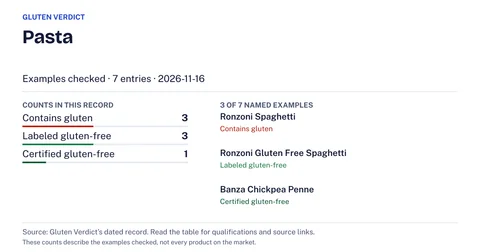 PastaContains glutenchecked Nov 16, 2026
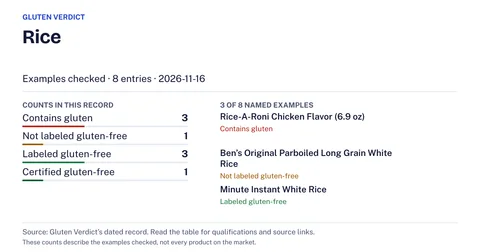 RiceNaturally gluten-free3 of 8 products we checked contain gluten: Rice-A-Roni Chicken Flavor (6.9 oz), Near East Original Rice Pilaf, and Ben’s Original Ready Rice Rice PilafBuy it labeled gluten-freechecked Nov 16, 2026
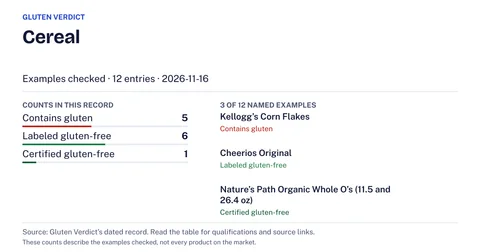 CerealDepends on the product5 of 12 products we checked contain glutenchecked Nov 16, 2026
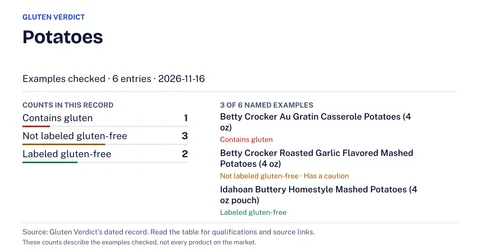 PotatoesNaturally gluten-free1 of 6 products we checked contains gluten: Betty Crocker Au Gratin Casserole Potatoes (4 oz)checked Nov 16, 2026
Questions people ask
Does a gluten-free diet raise blood sugar?
The sources here do not give one answer. One small trial of 13 healthy adults found 30-minute plasma glucose 57% higher for one gluten-free rice and corn pasta than for wheat pasta3, 15. The two large cohorts reported heart attacks and type 2 diabetes diagnoses, not blood-glucose readings1, 2. Coeliac UK says blood glucose may change after the diet starts in someone with type 1 diabetes and coeliac disease5.
Do the cohort studies show that eating gluten-free causes heart disease or diabetes?
Neither abstract says so. The BMJ authors concluded that long-term gluten intake was not associated with coronary heart disease risk19, and the Diabetologia authors reported gluten intake as inversely associated with type 2 diabetes risk9. Both are associations from food questionnaires1, 14.
Is type 2 diabetes linked to celiac disease?
GIG says there is no connection between type 2 diabetes and celiac disease10, and Coeliac UK says there is no increased risk of coeliac disease in people with type 2 diabetes11. Both charities instead describe celiac disease occurring with type 1 diabetes10, 11.
Do gluten-free foods have a higher glycemic index?
A 2022 review says most gluten-free foods have a high glycemic index, in the context of children with type 1 diabetes35. One trial found a higher 30-minute glucose response for one gluten-free rice and corn pasta than for wheat pasta15. NIDDK says some packaged gluten-free foods may be higher in fat and sugar than their gluten-containing versions25.
More in Nutrition and combining diets
 Gluten-free with type 2 diabetes or high cholesterol: where the plans overlapWhere a gluten-free plan and a diabetes or cholesterol plan agree, where packaged gluten-free foods cut across them, and what to ask a dietitian.
 Is a gluten-free diet healthy if you do not have celiac disease?What a gluten-free label promises, what studies of gluten-free products and eaters report, and why testing comes before cutting gluten.
 Weight gain or loss after a celiac diagnosis: what the research foundWhat two studies found about weight before and after a celiac diagnosis, what sources say about gluten-free foods, and what to bring to a dietitian.
 Gluten-free and low FODMAP: what to check when symptoms continueHow gluten and FODMAPs differ, what guidelines list for persistent symptoms on a gluten-free diet, and FODMAP ingredients to look for on labels.
 Does a gluten-free diet help you lose weight?What reviews, NIDDK and celiac charities report about a gluten-free diet and weight outside celiac disease, and what the substitute foods contain.
 Iron, B12 and B6 on a gluten-free diet: where they come from and how to check a labelWhich foods supply iron, B12 and B6, what US enrichment standards name, and how to check whether a gluten-free flour, bread or cereal is fortified.
Related guides
 Type 1 diabetes and celiac disease: the overlap and the screening guidelinesWhy celiac disease is more common with type 1 diabetes, what the ADA, ISPAD and ACG say about screening and timing, and what to ask the care team.
 Fiber on a gluten-free diet: where it drops and what fills the gapCheck the fiber on gluten-free breads and pastas against the US Daily Value, and see which gluten-free whole foods charities list to add more.
 Starting a gluten-free diet: testing first, then labels, oats and the kitchenWhat NIH and the celiac charities say about starting a gluten-free diet: testing first, which foods to start with, a US label check, oats and the kitchen.
 What in wheat bothers people if it is not gluten?The non-gluten candidates for wheat symptoms (fructans, ATIs, wheat allergy), the trial or review behind each, and what limits it.
Sources
- [1, 6, 7, 13, 18, 19, 40] BMJ (via PubMed), Long term gluten consumption in adults without celiac disease and risk of coronary heart disease: prospective cohort study, checked Nov 17, 2026.
- [2, 8, 9, 14, 20, 21, 22] Diabetologia (via PubMed), Gluten intake and risk of type 2 diabetes in three large prospective cohort studies of US men and women, checked Nov 17, 2026.
- [3, 4, 15, 23, 24] Food & Function (via PubMed), Gluten-free pastas and postprandial glycemia compared with wheat pasta in healthy adults: a double-blind randomized crossover trial, checked Nov 17, 2026.
- [5, 11, 32, 33] Coeliac UK, Coeliac Disease and Type 1 Diabetes, checked Nov 17, 2026.
- [10, 29, 30, 31] Gluten Intolerance Group, Diabetes and Celiac Disease, checked Nov 17, 2026.
- [12, 25, 37, 38, 39] National Institute of Diabetes and Digestive and Kidney Diseases (NIDDK), Eating, Diet, & Nutrition for Celiac Disease, checked Nov 17, 2026.
- [16, 17, 26, 27, 28] Alimentary Pharmacology & Therapeutics (via PubMed), Metabolic syndrome in patients with coeliac disease on a gluten-free diet, checked Nov 17, 2026.
- [34, 35, 36] Nutrients (via PubMed), Gluten-Free Diet in Co-Existent Celiac Disease and Type 1 Diabetes Mellitus: Is It Detrimental or Beneficial to Glycemic Control, Vascular Complications, and Quality of Life?, checked Nov 17, 2026.