Is a gluten-free diet healthy if you do not have celiac disease?
Short answer
A “gluten-free” label is a statement about gluten, not about nutrition1, 2. NIDDK says researchers have found no evidence that a gluten-free diet promotes better health or weight loss for the general population3, and for anyone who thinks they might have celiac disease it advises talking with a doctor about testing before starting the diet4.
Part of Nutrition and combining diets, 24 guides

Key points
- FDA’s rule defines “gluten-free” by which ingredients a food may not contain and by a gluten level below 20 ppm; it sets no calorie, fat, sugar, sodium or fiber requirement1, 2.
- NIDDK and the doctors it describes advise testing for celiac disease before a gluten-free diet starts, because the diet can affect test results5, 4.
- Studies that compare gluten-free packaged foods with wheat ones disagree: Australian, Austrian and Canadian data show some lower-protein or higher-calorie products, while a Hong Kong study found higher energy, saturated fat, free sugar and sodium in the non-gluten-free products6, 7, 8, 9.
- One large US cohort study found long-term gluten intake was not associated with coronary heart disease; its authors cautioned that avoiding gluten may mean fewer whole grains10.
- GFCO describes its certification in terms of gluten testing and audits, and the page describing it names no nutrition requirement11, 12.
Why testing comes before cutting gluten
NIDDK’s page on diagnosis says doctors most often use blood tests and biopsies of the small intestine to diagnose or rule out celiac disease13. The American College of Gastroenterology’s 2023 guideline describes the same two steps: antibody detection in the blood for initial screening, and an intestinal biopsy to confirm the diagnosis in most patients14.
For someone who has no diagnosis, NIDDK’s eating-and-diet page puts it directly: if you think you might have celiac disease, talk with your doctor about testing before you begin a gluten-free diet, because avoiding gluten first may make test results inaccurate4. The diagnosis page adds that doctors do not recommend starting a gluten-free diet before diagnostic testing because the diet can affect test results5. If you do not have celiac disease or another health problem related to gluten, NIDDK says your doctor may not recommend a gluten-free diet15.
For celiac disease the diet is the treatment: the guideline says current treatment for celiac disease requires strict adherence to a gluten-free diet and lifelong medical follow-up16. A 2025 systematic review also looked at people who report a sensitivity to gluten or wheat without celiac disease or wheat allergy17; in the studies it pooled, 40% of those reporting it (95% confidence interval 25.2% to 55.0%) adhered to a gluten-free diet18.
This guide reports what NIDDK, the American College of Gastroenterology and published studies say. It is not medical advice, and it cannot tell you whether you need testing or a diet change; that is a question for a doctor.
What the FDA “gluten-free” claim promises
The claim is voluntary, and FDA’s rule sets what it means on a label19. Foods carrying “gluten-free”, “no gluten”, “free of gluten” or “without gluten” must contain less than 20 parts per million (ppm) of gluten20, and in the regulation the unavoidable presence of gluten has to be below 20 ppm, which is below 20 mg of gluten per kg of food1. For how to read the claim on a package, see how to read a food label for gluten.
That is all the definition measures. The regulation defines the claim by the ingredients a food may not contain and by that gluten level, and it sets no limit or requirement for calories, fat, sugar, sodium, fiber or any other nutrient2. A food can meet it and still be high or low in any of them2.
| Question | What the sources say |
|---|---|
| Is there a legal gluten limit? | Yes: less than 20 ppm on FDA-regulated foods that carry the claim20. |
| Does the rule set any nutrient requirement? | Not in the text of 21 CFR 101.912. |
| Does “gluten-free” mean better health? | NIDDK: researchers have found no evidence that a gluten-free diet promotes better health or weight loss for the general population3. |
| Must a naturally gluten-free food carry the claim? | No. FDA lists spring water, fruits, vegetables and eggs as naturally gluten-free, and the claim may be absent even then21. |
What a certification mark adds
FDA says it does not endorse, accredit or recommend any particular third-party gluten-free certification program22. One such program, GFCO, describes its standard as requiring that starting ingredients and finished products test below the gluten-free threshold of the country of sale or 10 ppm, whichever is lower23. The Gluten Intolerance Group’s guidance notes that products labeled gluten-free should comply with FDA’s definition but that this is not third-party verified, and gives GFCO’s standard as 10 ppm of gluten or less24.
GFCO’s own description of its process includes quarterly review of test results25 and annual, in-person audits at every manufacturing facility that makes certified products11. The page describing that process names no calorie, fat, sugar, sodium or fiber requirement12. On the pages we read, then, the mark is described in terms of gluten testing and audits, not nutrition. Our guide to certified and naturally gluten-free foods covers when a seal matters.
What comparisons of gluten-free and wheat products report
Researchers have compared the label data of gluten-free packaged foods with their gluten-containing counterparts in several countries. The results differ by country, year, food category and how the products were grouped, so no single headline settles the question. Each study below is described as its authors and abstract describe it.
| Study | What it compared | What it reported |
|---|---|---|
| Wu and others, 2015 (Australia) | Nutrition panels of 3,213 products in ten food categories6. A product counted as gluten-free if a gluten-free declaration appeared anywhere on its packaging26. The main score was the Health Star Rating, a nutrient profiling scheme endorsed by the Australian Government27. | Plain dry gluten-free pasta scored nearly 0.5 Health Star Rating stars lower; breads and ready-to-eat cereals did not differ significantly6. Gluten-free pasta and bread had 52% and 32% less protein28. |
| Missbach and others, 2015 (Austria) | 63 gluten-free and 126 gluten-containing counterpart products from 12 Austrian supermarkets29. | Protein more than two-fold lower across 57% of food categories; 65% of gluten-free foods had low sodium (under 120 mg per 100 g); 19% counted as a high-fiber source (over 6 g per 100 g)7. Cost was higher, from +205% (cereals) to +267% (bread and bakery)30. |
| Vergeer and others, 2021 (Canada) | Packaged foods in the University of Toronto’s 2013 and 2017 label databases31. | Median calories and sodium were significantly higher in gluten-free products; no significant difference in saturated fat or sugars8. |
| Ho and others, 2023 (Hong Kong) | 18,292 pre-packaged items in a 2019 database32, sorted into declared gluten-free, gluten-free by ingredient or naturally gluten-free, and non-gluten-free33. | Non-gluten-free products had higher energy, protein, saturated fat, trans-fat, free sugar and sodium, and less fibre than the other two gluten categories9. |
Several of these authors drew conclusions. The Australian authors wrote that consuming gluten-free products is unlikely to confer health benefits unless there is clear evidence of gluten intolerance34. The Hong Kong authors reached a different conclusion: non-gluten-free products there were generally less healthy than gluten-free ones35. The Austrian authors wrote that for healthy consumers, replacing gluten-containing products with gluten-free ones comes with substantial cost differences but gives no additional health benefits from a nutritional perspective36.
Coeliac UK, reacting in May 2017 to media reports of a Spanish study, said its own UK data showed gluten-free fresh breads were on average higher in fat and gluten-free products could be lower in protein37, and that gluten-free foods contained no more sugar than conventional equivalents38. It also pointed out that this kind of research compares individual products, not the gluten-free diet as a whole39.
NIDDK’s summary is that some packaged gluten-free foods may be higher in fat and sugar than the same foods that contain gluten40. Where we have checked the same kinds of foods, our verdicts are here: bread, pasta, cereal, cookies, crackers and granola bars. They answer whether a product contains gluten, not whether it is nutritious. If the question is about an ingredient name, see maltodextrin, modified food starch and natural flavors.
Fiber, iron and folate: where reviews report gaps
A 2016 review searched studies published from 1990 to September 201541. It found the gluten-free diet poor in fiber, because foods naturally rich in fiber such as grains are avoided and gluten-free products are usually made with starches or refined flours42, and it reported micronutrients as poor, in particular vitamin D, vitamin B12 and folate, and minerals including iron, zinc, magnesium and calcium43. The review’s abstract is framed around celiac disease, where the gluten-free diet is the treatment44; it does not say that its findings apply to people without celiac disease.
The Gluten Intolerance Group says gluten-free diets can be high in fat and low in complex carbohydrates and fiber, iron, folate, niacin, thiamin and riboflavin45. NIDDK says that someone who starts avoiding gluten without advice from a doctor or a registered dietitian may not get enough nutrients such as fiber, iron and calcium40.
These are reports about diets and products on average. They do not say what any one person is missing, and this guide gives no advice on supplements or amounts.
What a long-term study of people without celiac disease reported
A BMJ study titled “Long term gluten consumption in adults without celiac disease and risk of coronary heart disease” was a prospective cohort study, not a trial of the diet46. It followed 64,714 women in the Nurses’ Health Study and 45,303 men in the Health Professionals Follow-up Study who had no history of coronary heart disease, using food frequency questionnaires from 1986, updated every four years through 201046.
The authors reported that, after adjustment for known risk factors, those in the highest fifth of estimated gluten intake had a multivariable hazard ratio for coronary heart disease of 0.95 (95% confidence interval 0.88 to 1.02)47. Their conclusion was that long-term dietary intake of gluten was not associated with coronary heart disease, that avoiding gluten may mean eating fewer beneficial whole grains, and that promoting gluten-free diets among people without celiac disease should not be encouraged10.
Two details of its design: gluten intake was estimated from food frequency questionnaires, and the main outcome measured was coronary heart disease48. The abstract reports no results on weight or digestion.
Naturally gluten-free whole foods and federal guidance
NIDDK lists meat, fish, fruits, vegetables, rice and potatoes without additives or some seasonings as naturally gluten-free49, and FDA says a naturally gluten-free food does not have to carry the claim21. NIDDK also says packaged gluten-free foods tend to cost more than the same foods with gluten50.
The Gluten Intolerance Group’s guidance for eating gluten-free suggests filling about half the plate with non-starchy vegetables51 and names gluten-free grains such as amaranth, quinoa, buckwheat, brown rice, teff, millet and corn52. It adds that eating at least half of your grains whole means more vitamins, minerals, fiber and protein than refined counterparts53.
The federal Dietary Guidelines for Americans, 2025–2030 say to prioritize fiber-rich whole grains54 and to significantly reduce highly processed, refined carbohydrates such as white bread, ready-to-eat or packaged breakfast options, flour tortillas and crackers55. They do not discuss gluten-free eating: the word “gluten” does not appear in them56.
Questions to bring to a doctor or dietitian
NIDDK says a doctor or a registered dietitian can guide what to eat to maintain a balanced diet57. These are questions to take to one; they are not answers.
- Could eating less gluten before testing change the result of a celiac blood test or biopsy for me?5
- Is there a reason, other than a celiac diagnosis, that a gluten-free diet is worth considering for me?15
- If I do go gluten-free, which of the foods I would remove supply fiber, iron or calcium, and what would replace them?40
- Which gluten-free packaged foods, if any, belong in my diet, given that some may be higher in fat and sugar?40
Verdicts in this guide
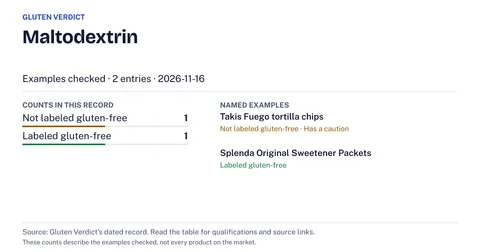 MaltodextrinNaturally gluten-freechecked Nov 16, 2026
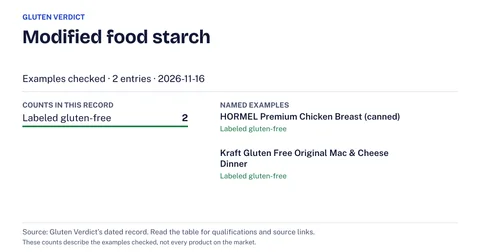 Modified food starchDepends on the productchecked Nov 16, 2026
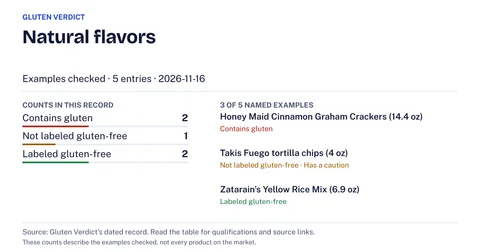 Natural flavorsDepends on the product2 of 5 products we checked contain gluten: Honey Maid Cinnamon Graham Crackers (14.4 oz) and Chex Mix Sour Cream & Onionchecked Nov 16, 2026
 BreadContains glutenchecked Nov 16, 2026
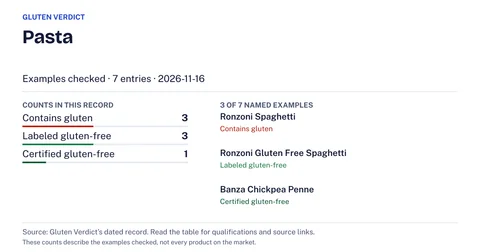 PastaContains glutenchecked Nov 16, 2026
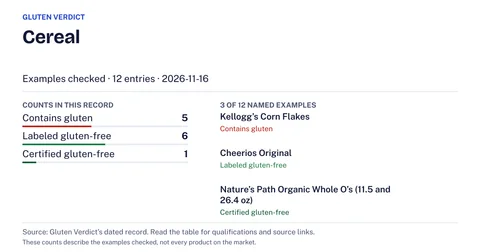 CerealDepends on the product5 of 12 products we checked contain glutenchecked Nov 16, 2026
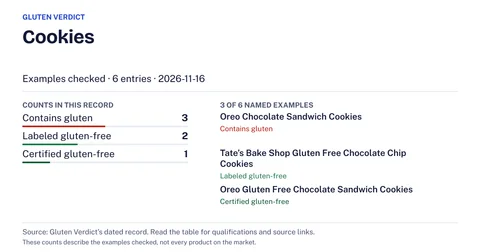 CookiesContains glutenchecked Nov 16, 2026
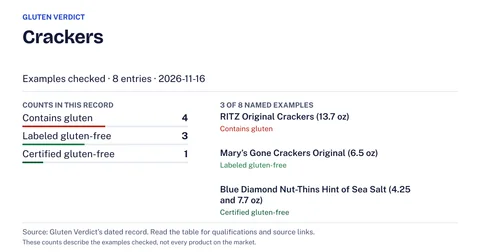 CrackersDepends on the product4 of 8 products we checked contain glutenchecked Nov 16, 2026
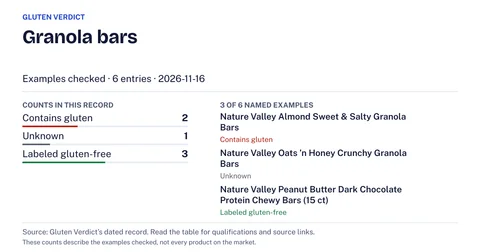 Granola barsDepends on the product2 of 6 products we checked contain gluten: Nature Valley Almond Sweet & Salty Granola Bars and Nature Valley Cinnamon Brown Sugar Soft-baked Oatmeal Squareschecked Nov 16, 2026
Questions people ask
Is a gluten-free diet healthier?
NIDDK says researchers have found no evidence that a gluten-free diet promotes better health or weight loss for the general population3. Studies of packaged gluten-free foods report differences in both directions6, 9.
Does gluten-free mean low-calorie or low-sugar?
No. The FDA rule defines the claim by gluten content and sets no requirement for calories or sugar2. In Canadian data, median calories were significantly higher in gluten-free products and sugars did not differ significantly8.
Does a GFCO or other certification mark mean the food is more nutritious?
The GFCO process page describes ingredient review, testing, audits and sampling for gluten and names no nutrient requirement12.
Can going gluten-free first affect celiac test results?
NIDDK says doctors do not recommend starting a gluten-free diet before diagnostic testing because the diet can affect test results5.
More in Nutrition and combining diets
 Does a gluten-free diet help you lose weight?What reviews, NIDDK and celiac charities report about a gluten-free diet and weight outside celiac disease, and what the substitute foods contain.
 Iron, B12 and B6 on a gluten-free diet: where they come from and how to check a labelWhich foods supply iron, B12 and B6, what US enrichment standards name, and how to check whether a gluten-free flour, bread or cereal is fortified.
 Nutrient deficiencies in celiac disease: what the guidance names for checkingWhich nutrients a celiac guideline and a charity's clinician page name for checking, where reported deficiency figures differ, and questions to bring.
 Does a gluten-free diet change blood sugar? What each study measuredRead the BMJ heart-disease cohort, the type 2 diabetes cohort, a pasta glucose trial and celiac and type 1 diabetes sources by what each measured.
 Gluten-free with type 2 diabetes or high cholesterol: where the plans overlapWhere a gluten-free plan and a diabetes or cholesterol plan agree, where packaged gluten-free foods cut across them, and what to ask a dietitian.
 Weight gain or loss after a celiac diagnosis: what the research foundWhat two studies found about weight before and after a celiac diagnosis, what sources say about gluten-free foods, and what to bring to a dietitian.
Related guides
 Celiac disease vs gluten intolerance: three conditions, three diagnosesHow celiac disease, non-celiac gluten sensitivity and wheat allergy differ in mechanism, diagnosis and diet, with a source behind every point.
 Wheat allergy tests vs celiac tests: which test answers which conditionWhich test answers which condition: celiac antibodies and biopsy versus wheat IgE, skin prick and food challenge, as ACG, NIAID, FARE and NIH say.
 How non-celiac gluten sensitivity is diagnosed: the Salerno criteriaWhat counts as a diagnosis of non-celiac gluten sensitivity: the exclusions, the Salerno criteria steps and what a blinded gluten challenge involves.
 Certified or naturally gluten-free: when a seal mattersWhich naturally gluten-free foods are worth buying with a claim or seal: produce, grains, flours, oats and processed foods, with FDA rules and test data.
Sources
- [1, 2] eCFR (US Government Publishing Office), 21 CFR 101.91 Gluten-free labeling of food, checked Nov 17, 2026.
Read 21 CFR 101.91 on 2026-11-17: paragraph (a)(3) defines the claim “gluten-free” by which ingredients the food may not contain and by a gluten level below 20 ppm; the section sets no limit or requirement for calories, fat, sugar, sodium, fiber or any other nutrient.
- [3, 4, 15, 40, 49, 50, 57] National Institute of Diabetes and Digestive and Kidney Diseases (NIDDK), Eating, Diet, & Nutrition for Celiac Disease, checked Nov 17, 2026.
- [5, 13] National Institute of Diabetes and Digestive and Kidney Diseases (NIDDK), Diagnosis of Celiac Disease, checked Nov 17, 2026.
- [6, 26, 27, 28, 34] British Journal of Nutrition (PubMed abstract), Are gluten-free foods healthier than non-gluten-free foods? An evaluation of supermarket products in Australia (Wu and others, 2015), checked Nov 17, 2026.
- [7, 29, 30, 36] PeerJ (PubMed abstract), Gluten-free food database: the nutritional quality and cost of packaged gluten-free foods (Missbach and others, 2015), checked Nov 17, 2026.
- [8, 31] Nutrients (PubMed abstract), The Level of Processing, Nutritional Composition and Prices of Canadian Packaged Foods and Beverages with and without Gluten-Free Claims (Vergeer and others, 2021), checked Nov 17, 2026.
- [9, 32, 33, 35] Annals of Nutrition and Metabolism (PubMed abstract), The Nutritional Quality of Gluten-Free versus Non-Gluten-Free Pre-Packaged Foods and Beverages Sold in Hong Kong (Ho and others, 2023), checked Nov 17, 2026.
- [10, 46, 47, 48] BMJ (PubMed abstract), Long term gluten consumption in adults without celiac disease and risk of coronary heart disease: prospective cohort study (Lebwohl and others, BMJ, 2017), checked Nov 17, 2026.
- [11, 12, 25] Gluten Intolerance Group, How Does GFCO Certify Gluten-Free Food?, checked Nov 17, 2026.
Read on 2026-11-17: the page describes GFCO’s application review of products and ingredients, ingredient risk levels and testing, quarterly test results, annual audits, and surveillance sampling; it names no calorie, fat, sugar, sodium or fiber requirement for certified products.
- [14, 16] American Journal of Gastroenterology (PubMed abstract), American College of Gastroenterology Guidelines Update: Diagnosis and Management of Celiac Disease (Rubio-Tapia and others, 2023), checked Nov 17, 2026.
- [17, 18] Gut (PubMed abstract), Global prevalence of self-reported non-coeliac gluten and wheat sensitivity: a systematic review and meta-analysis (2025), checked Nov 17, 2026.
- [19, 20, 21, 22] US Food and Drug Administration, Gluten and Food Labeling, checked Nov 17, 2026.
- [23] Gluten-Free Certification Organization (GFCO), GFCO home page, checked Nov 17, 2026.
- [24, 45, 51, 52, 53] Gluten Intolerance Group, Healthy Gluten-Free Eating Guidelines, checked Nov 17, 2026.
- [37, 38, 39] Coeliac UK, Media reports on nutritional content of gluten free food, checked Nov 17, 2026.
- [41, 42, 43, 44] Clinical Nutrition (PubMed abstract), Gluten free diet and nutrient deficiencies: A review (Vici and others, 2016), checked Nov 17, 2026.
- [54, 55, 56] US Department of Agriculture and US Department of Health and Human Services, Dietary Guidelines for Americans, 2025–2030 (PDF), checked Nov 17, 2026.
Read the PDF text on 2026-11-17: the word “gluten” does not appear anywhere in it.