Stomach pain after gluten-free bread: what the label can and cannot tell you
Short answer
Two different things can sit behind stomach pain after gluten-free bread: gluten that reached the loaf, and an ingredient that causes gas in some people whether or not gluten is involved1, 2, 50. Read the claim, the ingredient list and the kitchen for both. NIDDK says to talk with a doctor if gas symptoms bother you, change suddenly or come with other symptoms such as abdominal pain, constipation, diarrhea or weight loss3.
Part of Symptoms, reactions and persistent complaints, 22 guides
Key points
- FDA’s “gluten-free” definition is about gluten, with any unavoidable gluten under 20 ppm4, and the rule does not require makers to test5.
- A gluten-free loaf can still be high in fermentable carbohydrates: in one Spanish study of 25 gluten-free cereal-based foods, not all were low-FODMAP6, 2.
- Monash University says purified inulin and fructooligosaccharides count toward a food’s FODMAP load even in very small amounts, wherever they sit in the list7.
- The four gluten-free loaf and bun pages we read on 2026-11-17 name agave, honey, applesauce, xanthan gum or psyllium husk, and none names inulin or chicory8, 9, 10, 11.
- NIDDK says to talk with a doctor if gas symptoms bother you, change suddenly or come with other symptoms such as abdominal pain, constipation, diarrhea or weight loss3.
Two different causes, one symptom
Gluten-free bread can hurt for two unrelated reasons, and one label read can speak to both. One is gluten: a loaf that was not as gluten-free as it looked, or crumbs from a shared kitchen50. The other is an ingredient that causes gas in some people whether or not gluten is involved.
NIDDK describes the second route: some people have more gas symptoms when they eat certain carbohydrates that the stomach and small intestine do not fully digest, and bacteria in the large intestine break them down and make gas1. It adds that FODMAPs are carbohydrates that are hard to digest12.
Going gluten-free does remove one source of them, because the Gluten Intolerance Group notes that wheat, rye and barley are also high-FODMAP foods13. It does not remove all of them. A 2024 Spanish study analysed 25 gluten-free cereal-based foods, bread among them, and 25 gluten-containing equivalents6. The gluten-free foods generally contained fewer FODMAPs14, but not all of them were low-FODMAP2.
Neither cause rules out a medical one. MedlinePlus lists irritable bowel syndrome and problems digesting other foods among the common causes of bloating, and celiac disease among the more serious disorders that may cause it15.
Ingredients in gluten-free bread that can cause gas
The table sets out what each source says about each ingredient. None of these sources says that a particular loaf will cause pain. The review behind the inulin, guar gum and psyllium figures covered studies in adults without gastrointestinal disease16, so its numbers are not a threshold for anyone in particular.
| On the label | What the sources say |
|---|---|
| Inulin, chicory root or chicory root fibre, fructooligosaccharides (FOS) | Monash University says companies making gut-health claims often add these to boost prebiotic fibre, and that in some people with IBS this can cause gas, bloating and abdominal distension17. It also says even very small amounts of purified inulin or FOS add to a food’s FODMAP load, so a place near the end of the list does not clear them7. In a review of inulin studies, doses of 0.75 to 5 g a day led to only mild flatulence and doses of 7.5 to 20 g a day to mild and moderate symptoms18. |
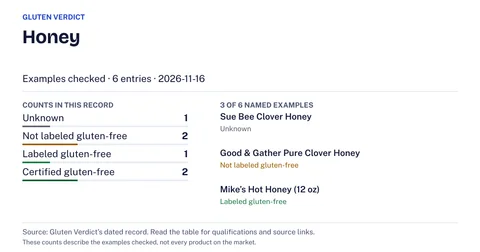
| Honey, agave syrup, apple or pear juice and concentrates, high-fructose corn syrup | Monash lists honey, high-fructose corn syrup and fruit juices as excess-fructose ingredients and names bread among the foods that contain them19. Its table of high-FODMAP label ingredients also includes agave syrup20. Our honey verdict covers honey and gluten. |
| Soy flour, lupin flour, chickpea flour | Monash says many gluten-free products are lower in FODMAPs but some contain high-FODMAP ingredients such as soy flour or lupin flour, which raise the FODMAP content21. It lists chickpea flour and soy flour among oligosaccharide ingredients and bread among the foods that carry them22. |
| Sorbitol, mannitol, maltitol, xylitol, erythritol (sugar alcohols) | NIDDK lists sweeteners ending in “-ol” among the carbohydrates that may lead to excess gas23, and MedlinePlus says foods containing sorbitol may cause bloating24. For mannitol, the federal rule requires the statement “Excess consumption may have a laxative effect” on foods whose reasonably foreseeable consumption could reach 20 grams a day25. |
| Xanthan gum, guar gum | EFSA’s re-evaluation says xanthan gum is expected to be partially fermented by gut bacteria26. EFSA cites a study of 15 g a day in which flatulence rose significantly27, and says that when adults ate up to 15 g a day for at least ten days some individuals experienced abdominal discomfort, which its panel considered undesirable but not adverse28. Those are the studies’ doses, not a slice of bread. For guar gum, the review found no undesirable tolerance effects at 5 to 11.4 g a day and generally mild to moderate flatulence at 13 to 40 g a day29. |
| Psyllium husk, bran and other added fibre | NIDDK says some people have more gas symptoms when they eat too much fiber30. MedlinePlus says insoluble fiber such as bran can cause more bloating and gas, while soluble fiber supplements such as psyllium are usually better tolerated31. One psyllium study in the review found tolerance symptoms did not differ from the control at 18 g a day, and the authors call for more studies32. |
FODMAP content cannot be read off a label: Monash says laboratory analysis is the only way to accurately determine it33. Our guide on gluten-free and low FODMAP covers the diet itself.
How to read the label for both causes
- Find the claim. A US food labeled “gluten-free” must have any unavoidable gluten under 20 ppm4, and using the claim is voluntary34.
- Read the whole ingredient list. Monash notes that ingredients are listed in weight order35, with purified inulin and FOS, onion and garlic as the exceptions whose small amounts still count7.
- Look at the front of the pack too. Monash points to gut-health and prebiotic claims as where inulin and chicory root turn up17.
- Note any advisory line. FDA says its rule does not prohibit a voluntary advisory statement such as “made in a facility that also processes wheat” on a food that also carries a gluten-free claim, provided the statement is truthful and not misleading36.
- Note the kind of claim: a maker’s own words, or a certification mark you can look up (see how to check a seal in the certifier directory).
The rest of the label (the Contains line, malt) is in how to read a US food label for gluten.
What a gluten-free claim and an ingredient list each tell you
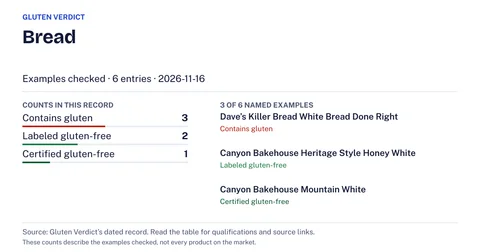
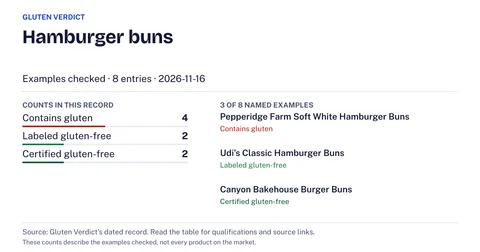
We read four gluten-free loaf and bun pages on 2026-11-17. The gluten verdicts are in our bread and hamburger buns records; this table reads the same kind of pages for the ingredients above.
| Product (maker’s page) | What the page says about gluten | Ingredients from the table the list names |
|---|---|---|
| Canyon Bakehouse Mountain White | Says “Certified Gluten-Free”37; the GFCO product finder lists “Canyon Mountain White Gluten Free Bread”38. | Organic agave syrup and xanthan gum; no inulin, chicory, sugar alcohol or psyllium8. |
| Canyon Bakehouse Heritage Style Honey White | Says “Certified Gluten-Free”39; GFCO lists “Heritage Honey White Bread”, a name that is not identical, so we hold to the maker’s own claim38. | Honey and xanthan gum; no inulin, chicory, sugar alcohol or psyllium9. |
| Canyon Bakehouse Burger Buns | Says “Certified Gluten-Free”40; the GFCO product finder lists “Burger Buns”38. | Xanthan gum; none of honey, agave, inulin, chicory, sugar alcohol or psyllium10. |
| Food For Life Sprouted for Life Gluten Free Original 3 Seed Bread | The page names it “Gluten Free Original 3 Seed Bread”41, and says good manufacturing practices are used to segregate ingredients and products in a facility that also processes wheat, soy, sesame and tree nuts42. | Applesauce, agave, chia seeds, xanthan gum and psyllium husk; no inulin or chicory11. |
A gluten-free claim addresses gluten only. FDA’s definition is built from gluten-containing grains and the 20 ppm limit43, 4, and it is a separate matter whether the loaf also lists honey, agave or a gum. A loaf that names none of these ingredients is not ruled out as a cause either, because Monash says laboratory analysis is the only way to accurately determine FODMAP content33.
When the cause might be gluten: claims, certification and your kitchen
The FDA rule does not require manufacturers to test starting ingredients or finished foods labeled “gluten-free”, though manufacturers are responsible for complying with it5.
A certification mark adds a program’s own terms. The Gluten-Free Certification Organization (GFCO) says it requires established brands to run ongoing regular testing of ingredients, shared equipment and finished products44, says certified brands must give GFCO the results immediately, before the product leaves the production facility, if any gluten above 10 ppm is detected in a product or its ingredients45, and says it checks for cross-contact steps in yearly in-person audits46. Our guides on certified versus naturally gluten-free and comparing certification programs go further.
Bakery loaves are a different case from packaged ones. The Celiac Disease Foundation lists “gluten-free” goods from otherwise gluten-containing bakeries, when not certified, among easily contaminated foods47.
At home, the Celiac Disease Foundation defines cross-contact as foods or ingredients coming into contact with gluten, generally through shared utensils or a shared cooking or storage environment48, and lists toasters used for both gluten-free and regular bread49. The Gluten Intolerance Group says that in a shared kitchen even a crumb of gluten-containing bread can be enough to cause problems for people with celiac disease or gluten sensitivity50. More in gluten cross-contact at home.
A one-change-at-a-time log
NIDDK says a doctor may ask for a diary of what a person eats and drinks and when gas symptoms occur, and that the diary can help a doctor or dietitian work out whether certain foods or drinks could be causing them51.
A log separates the two causes only when two entries differ in one thing. For each bread meal, write down:
- the loaf or bun, its brand and the number of slices;
- the toaster, spread and everything else eaten or drunk with it;
- when the pain started and how long it lasted;
- which names from the table above the label lists.
Then compare like with like: the same loaf on a clean toaster against the shared one, or a loaf with an ingredient from the table against one without it, everything else held the same. One entry shows little. For a fuller template see a food and symptom diary for tracking possible gluten exposure.
A log points; it does not diagnose. The Gluten Intolerance Group says anyone considering a low-FODMAP diet should consult a healthcare provider and a dietitian with knowledge of the diet52.
When the sources say to see a doctor
- NIDDK says to talk with a doctor if gas symptoms bother you, if they change suddenly, or if they come with other symptoms such as abdominal pain, constipation, diarrhea or weight loss3.
- MedlinePlus lists reasons to contact a provider about bloating, including abdominal pain, blood in the stools or dark, tarry stools, diarrhea, worsening heartburn, vomiting and weight loss53.
- Coeliac UK, a UK charity, says on its page about non-responsive coeliac disease that ongoing symptoms after starting a gluten-free diet are quite common, affecting around 1 in 3 people, that most of the time gluten is still getting into the diet, and that it is important not to guess the cause but to visit the local healthcare team54.
NIDDK also says that a person who thinks they might have celiac disease should talk with a doctor about testing before starting a gluten-free diet, because avoiding gluten first can make test results inaccurate55. Our still symptomatic on a gluten-free diet checklist goes through the usual causes.
Verdicts in this guide
Questions people ask
Can gluten-free bread cause bloating if it has no gluten in it?
NIDDK says some people have more gas symptoms from carbohydrates that are not fully digested1, and in one Spanish study not all the gluten-free samples were low-FODMAP2.
Is inulin gluten?
No. Monash describes gluten as a protein found in wheat, barley, rye and triticale56, and lists inulin among oligosaccharide ingredients, GOS and fructans22. It says gluten and fructans play different roles in foods57.
Does a gluten-free label mean the bread is low in FODMAPs?
No. FDA’s definition is built around gluten-containing grains and 20 ppm43, 4. Monash’s Low FODMAP Certified stamp is a separate mark, for products laboratory tested to its criteria in the serving size on the pack58.
Does xanthan gum cause stomach pain?
EFSA reports that in adults eating large amounts, up to 15 g a day for at least ten days, some individuals experienced abdominal discomfort, which its panel considered undesirable but not adverse28. The sources we read give no figure for how much a slice of bread contains.
More in Symptoms, reactions and persistent complaints
 A food and symptom diary for tracking possible gluten exposureWhat to write in a food and symptom diary on a gluten-free diet, how to read it, a template to copy, and what to bring to a dietitian or doctor.
 Joint pain and celiac disease: what the research documents and what it does notWhat studies report on joint pain in celiac disease, how strong each link is, why the rheumatoid arthritis evidence is mixed, and other causes.
 Constipation and celiac disease: when it is the main symptomWhat studies and guidelines report about constipation in celiac disease, why it is easy to miss, and how diet-related constipation differs.
 Celiac disease symptoms in adults: what the sources list and who gets testedDigestive and non-digestive celiac symptoms as NIDDK, ACG and Coeliac UK list them, who guidelines say to test, and why gluten stays in the diet first.
 If you think you were glutened: what the celiac organizations say to doWhat the celiac charities, FDA and NIDDK say to do after accidental gluten exposure, when to contact a clinician, and how to trace the cause.
 Still having symptoms on a gluten-free diet? Where gluten can still get inA checklist of label, kitchen, restaurant, product and medicine sources of gluten, and what the sources say about when to see a doctor.
All 22 guides in Symptoms, reactions and persistent complaints
Related guides
 How to read a US food label for glutenWhere gluten shows up on a US food label: the gluten-free claim, the Contains line, the ingredient list and may-contain lines, and what each means.
 Gluten-free and low FODMAP: what to check when symptoms continueHow gluten and FODMAPs differ, what guidelines list for persistent symptoms on a gluten-free diet, and FODMAP ingredients to look for on labels.
 Gluten cross-contact at home: where it happens and what to do about itHow gluten reaches gluten-free food at home, whether to separate, wash or ask for each route, and which rules have lab data behind them.
 Gluten-free bread, buns and wraps: what the package tells youHow to tell a gluten-free bread, bun or wrap from a wheat look-alike: certification mark, maker’s claim or ingredient list, in a fixed order.
Sources
- [1, 12, 23, 30, 51] National Institute of Diabetes and Digestive and Kidney Diseases (NIDDK), Eating, Diet, & Nutrition for Gas in the Digestive Tract, checked Nov 17, 2026.
- [2, 6, 14] PubMed (Plant Foods for Human Nutrition, 2024), FODMAP Content Like-by-like Comparison in Spanish Gluten-free and Gluten-containing Cereal-based Products, checked Nov 17, 2026.
- [3] National Institute of Diabetes and Digestive and Kidney Diseases (NIDDK), Symptoms & Causes of Gas in the Digestive Tract, checked Nov 17, 2026.
Read on 2026-11-17: under “When should I talk with a doctor about my gas symptoms?” NIDDK lists: gas symptoms bother you; your symptoms change suddenly; and you have other symptoms, such as abdominal pain, constipation, diarrhea, or weight loss, along with gas symptoms.
- [4, 5, 34, 36, 43] US Food and Drug Administration, Questions and Answers on the Gluten-Free Food Labeling Final Rule, checked Nov 17, 2026.
- [7, 17, 19, 21, 22, 35, 58] Monash University FODMAP, Label Reading and FODMAPs, checked Nov 17, 2026.
- [8, 37] Canyon Bakehouse, Mountain White, checked Nov 17, 2026.
- [9, 39] Canyon Bakehouse, Heritage Style Honey White, checked Nov 17, 2026.
- [10, 40] Canyon Bakehouse, Burger Buns, checked Nov 17, 2026.
- [11, 41, 42] Food For Life, Sprouted For Life Gluten Free Original, checked Nov 17, 2026.
- [13, 52] Gluten Intolerance Group, Gluten Sensitivity and FODMAPs, checked Nov 17, 2026.
- [15, 24, 31, 53] MedlinePlus (US National Library of Medicine), Abdominal bloating, checked Nov 17, 2026.
Read on 2026-11-17: the list headed “Common causes include” names swallowing air, constipation, GERD, irritable bowel syndrome, lactose intolerance and problems digesting other foods, and overeating; the list headed “More serious disorders that may cause bloating are” names celiac disease among others.
Read on 2026-11-17: under “When to Contact a Medical Professional” MedlinePlus lists: abdominal pain; blood in the stools or dark, tarry looking stools; diarrhea; heartburn that is getting worse; vomiting; weight loss.
- [16, 18, 29, 32] Advances in Nutrition (via PubMed Central), Gastrointestinal Effects and Tolerance of Nondigestible Carbohydrate Consumption, checked Nov 17, 2026.
- [20, 33] Monash University FODMAP, Food processing and FODMAPs - what you need to know, checked Nov 17, 2026.
Read on 2026-11-17: “Table 1: High FODMAP ingredients to look for on food labels” has a Fructose column that names dried fruit, high fructose corn syrup, honey, fruit juice, fruit juice concentrate, fruit pieces (if a main ingredient), crystalline fructose, agave syrup and fruit sugar, and a Fructans column that names inulin and chicory root extract.
- [25] Electronic Code of Federal Regulations, 21 CFR 180.25 Mannitol, checked Nov 17, 2026.
- [26, 27, 28] EFSA Journal (via PubMed Central), Re-evaluation of xanthan gum (E 415) as a food additive, checked Nov 17, 2026.
- [38] Gluten-Free Certification Organization, GFCO Product Finder search for Canyon Bakehouse, checked Nov 17, 2026.
Read on 2026-11-17: the GFCO Product Finder results for the brand Canyon Bakehouse include “Canyon Mountain White Gluten Free Bread”, “Burger Buns”, “Brioche-Style Hamburger Buns” and “Heritage Honey White Bread”.
- [44, 45, 46] Gluten Intolerance Group (GFCO), How GFCO certifies gluten-free food, checked Nov 17, 2026.
- [47, 48, 49] Celiac Disease Foundation, Sources of Gluten, checked Nov 17, 2026.
Read on 2026-11-17: the list headed “Easily contaminated foods” includes “Non-certified baked goods (e.g., “gluten-free” goods from otherwise gluten-containing bakeries)”.
Read on 2026-11-17: the list headed “Places where cross contact can occur” begins with “Toasters used for both gluten-free and regular bread”.
- [50] Gluten Intolerance Group, I am very strict about eating gluten-free at home and work, but I still feel like I am getting gluten in my system, checked Nov 17, 2026.
- [54] Coeliac UK, Non-responsive and refractory coeliac disease, checked Nov 17, 2026.
- [55] National Institute of Diabetes and Digestive and Kidney Diseases (NIDDK), Eating, Diet, & Nutrition for Celiac Disease, checked Nov 17, 2026.
- [56, 57] Monash University FODMAP, Gluten and IBS, checked Nov 17, 2026.