Gluten-free cereal: how to check a cereal box
Short answer
A cereal’s main grain does not settle whether it is gluten-free: the cereal can still list malt made from barley1. Check the box in this order:
- The “gluten-free” claim: on a food FDA regulates the food must meet FDA’s definition, including any unavoidable gluten below 20 parts per million, and malt extract cannot be used in a food that carries it2, 3.
- The ingredient list, for malt flavor, malt extract, wheat, barley and rye, because the claim is voluntary4.
- The oats: oats labeled gluten-free must also be under 20 parts per million5.
- The maker’s own page for that exact flavour, because one brand can say one cereal is gluten-free and its neighbour is not6, 7.
Part of Grains, flours and substitutes, 13 guides
Key points
- Corn and rice cereals are not automatically gluten-free: Kellogg’s says Corn Flakes, Rice Krispies and Frosted Flakes are not labeled gluten free because they contain malt, which comes from barley1.
- The 2004 allergen labeling law (FALCPA) names wheat, not barley, in its list of major food allergens8, and Kellogg’s says its Corn Flakes do not list wheat as an allergen but contain malt, which comes from barley1.
- A food that carries a “gluten-free” claim without meeting FDA’s rule is deemed misbranded9.
- Siblings differ: Chex says Wheat Chex is not gluten-free while Rice and Corn Chex are6, 7.
Why the main grain does not decide
FDA says any grain other than wheat, rye, barley or their hybrids can be labeled “gluten-free” if the unavoidable gluten from cross-contact stays under 20 parts per million (ppm)10. But a cereal is more than its grain, as the next example shows.
Kellogg’s describes its own boxes this way: Corn Flakes, Rice Krispies and Frosted Flakes do not list wheat as an allergen but are not labeled gluten free because they contain malt, and the malt comes from barley and may contain gluten1.
A Contains line may not mention barley malt: the 2004 allergen labeling law (FALCPA) names wheat and not barley in its list of major food allergens8. Read the full ingredient list, as in our guide to reading a food label for gluten.
What the gluten-free claim on a cereal box means
On a food FDA regulates, “gluten-free” means the food either is inherently gluten free or contains none of these: a gluten-containing grain, an ingredient derived from one that has not been processed to remove gluten, or an ingredient derived from one that has been processed to remove gluten if its use puts 20 ppm or more gluten in the food. Any unavoidable gluten in the food must also be below 20 ppm2. “Free of gluten”, “without gluten” and “no gluten” carry the same requirements11.
The claim is voluntary4, and a food that bears it without meeting the rule is deemed misbranded9. So a cereal that makes the claim has to meet the rule, and a cereal without the claim has not made it, which leaves the ingredient list and the maker’s page to read.
A “made in a facility that also processes wheat” line can sit on the same box as a gluten-free claim, as long as it is truthful and not misleading12.
Malt on a cereal box
FDA says malt extract and similar malt-derived ingredients are derived from gluten-containing grains that have not been processed to remove gluten, so they cannot be used in foods that bear a “gluten-free” claim3.
On Kellogg’s own SmartLabel pages, malt flavor is in the list for Corn Flakes13 and for Rice Krispies14. More on the wording in malt on a food label and our malt extract entry.
Oat cereals and the gluten-free claim
FDA says oats do not have to be certified to be labeled “gluten-free”, but oats that carry the label must contain less than 20 ppm gluten5.
General Mills describes what it does for its gluten-free Cheerios: a mechanical and optical sorting process to remove gluten-containing grains from the oats15, then tests of composited samples of finished product to ensure every production lot meets FDA’s standard for gluten-free foods16. That is the maker’s own account; for how makers compare, see mechanically sorted or purity-protocol oats.
Corn, rice and oat cereals side by side
What each maker’s page says, and the main ingredients on the same page (added vitamins and minerals left out). Our verdicts link the cereals we have checked.
| Cereal | What the maker says | Main ingredients on the page |
|---|---|---|
| Corn Chex | Chex says most flavors are gluten-free, including Rice Chex and Corn Chex6. | Whole Grain Corn, Corn Meal, Sugar, Corn Starch, Salt, Baking Soda17. |
| Rice Chex | Same Chex statement6. | Whole Grain Rice, Rice, Sugar, Salt, Molasses18. |
| Wheat Chex | “Wheat Chex is not gluten-free”7. | Whole Grain Wheat, Sugar, Salt, Molasses, Baking Soda19. |
| Kellogg’s Corn Flakes | Not labeled gluten free because they contain malt1. | Milled corn, sugar, malt flavor, salt (2% or less)13. |
| Kellogg’s Rice Krispies | Not labeled gluten free because they contain malt1. | Rice, sugar, salt (2% or less), malt flavor14. |
| Nature’s Path Honey’d Corn Flakes | Describes the cereal as certified gluten-free20. | Corn meal and/or yellow corn flour, cane sugar, honey, sea salt21. |
| Original Cheerios | General Mills says both original and Honey Nut Cheerios are gluten free22. | Whole Grain Oats, Corn Starch, Sugar, Salt, Tripotassium Phosphate23. |
Same brand, different flavour
A brand name is not a verdict. Chex says most flavors are gluten-free and names Wheat Chex as the one that is not6, 7. The Lucky Charms site says Original Lucky Charms are gluten free24, while its S’mores page says “Contains wheat ingredients”25. General Mills says original and Honey Nut Cheerios are gluten free22; the Cheerios Oat Crunch Cinnamon page carries the line “May contain wheat ingredients”26.
A box check, in order
- Look for “gluten-free” on the box. If it is there, the maker is claiming the food meets FDA’s rule4, 9.
- Read the whole ingredient list for malt, wheat, barley and rye.
- For an oat cereal, look for the claim on the box: FDA says oats labeled “gluten-free” must contain less than 20 ppm gluten5.
- Open the maker’s page for the exact flavour and size, and look for its gluten statement and its ingredient list.
- If the page and the box in your hand disagree, go by the box, which is the label on the product you are holding.
Our gluten scanner looks for these ingredient names in a photo of a label or in pasted text.
Where our cereal verdicts sit
Each verdict lists the sources it rests on and the date we read them. Start with cereal, then the specific boxes: Cheerios, Honey Nut Cheerios, Corn Chex, Rice Chex, corn flakes, Rice Krispies, Frosted Flakes and Lucky Charms. On the same aisle: granola and Nutri-Grain bars.
Verdicts in this guide
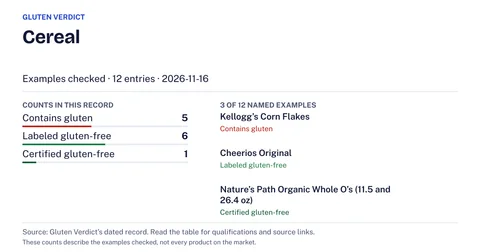 CerealDepends on the product5 of 12 products we checked contain glutenchecked Nov 16, 2026
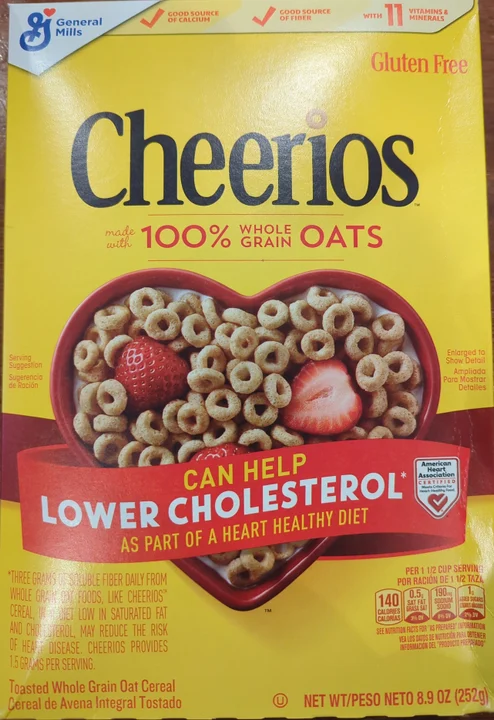 CheeriosLabeled gluten-freeWheat warning on 1 of 8 varieties we checkedGeneral Mills · checked Nov 16, 2026
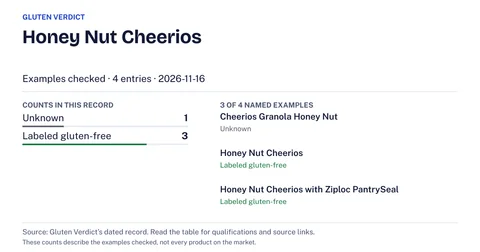 Honey Nut CheeriosLabeled gluten-freeGeneral Mills · checked Nov 16, 2026
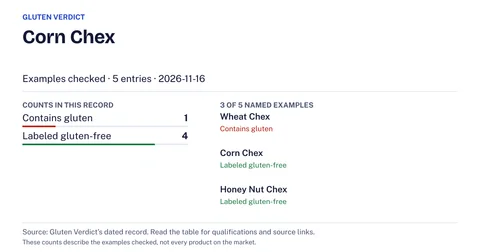 Corn ChexLabeled gluten-free1 of 5 varieties we checked contains gluten: Wheat ChexGeneral Mills · checked Nov 16, 2026
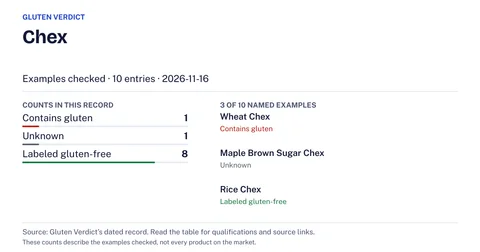 ChexLabeled gluten-free1 of 10 varieties we checked contains gluten: Wheat ChexGeneral Mills · checked Nov 16, 2026
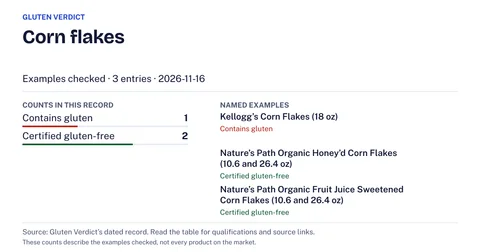 Corn flakesDepends on the product1 of 3 products we checked contains gluten: Kellogg’s Corn Flakes (18 oz)checked Nov 16, 2026
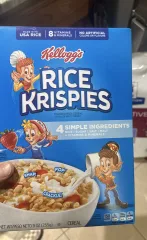 Rice KrispiesContains glutenWK Kellogg Co · checked Nov 16, 2026
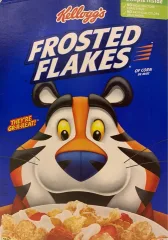 Frosted FlakesContains glutenWK Kellogg Co · checked Nov 16, 2026
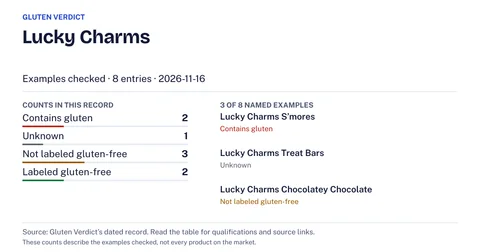 Lucky CharmsLabeled gluten-free2 of 8 varieties we checked contain gluten: Lucky Charms S’mores and Pillsbury Lucky Charms Sugar Cookie DoughGeneral Mills · checked Nov 16, 2026
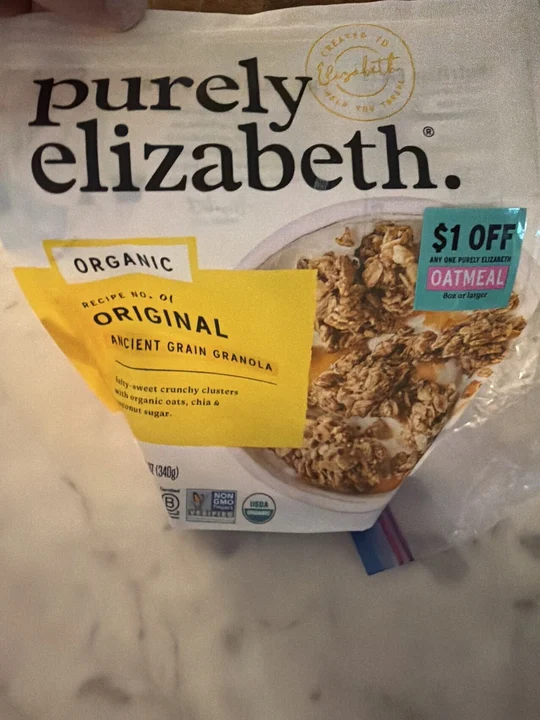 GranolaDepends on the product1 of 6 products we checked contains gluten: Honey Bunches of Oats Honey Roasted Granolachecked Nov 16, 2026
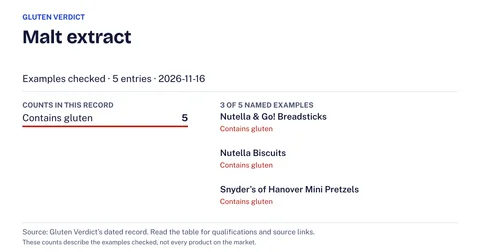 Malt extractContains glutenchecked Nov 16, 2026
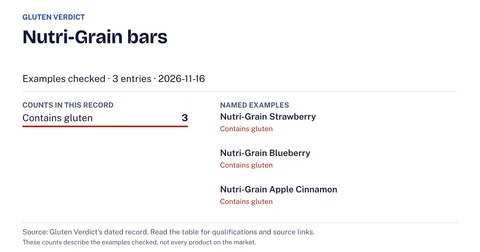 Nutri-Grain barsContains glutenKellogg’s · checked Nov 16, 2026
Questions people ask
Is corn flakes cereal gluten-free?
It depends on the brand and the box. Kellogg’s says its Corn Flakes are not labeled gluten free because they contain malt1; Nature’s Path describes its Honey’d Corn Flakes as certified gluten-free20.
Is malt flavor in cereal gluten?
Kellogg’s says the malt in its Corn Flakes, Rice Krispies and Frosted Flakes comes from barley and may contain gluten1. FDA says malt extract and similar malt-derived ingredients are derived from gluten-containing grains that have not been processed to remove gluten3.
Can a gluten-free cereal box also carry a “made in a facility that also processes wheat” line?
FDA says its regulation does not prohibit a voluntary advisory statement such as “made in a facility that also processes wheat” on a label that also carries a voluntary gluten-free claim, provided the statement is truthful and not misleading12. The food still has to meet the gluten-free rule2.
Do oats have to be certified to be labeled gluten-free?
No. FDA says oats labeled gluten-free must contain less than 20 ppm gluten, but certification is not required for the label5.
More in Grains, flours and substitutes
 Oats and celiac disease: what a gluten-free oat label does and does not tell youWhat FDA’s rule covers for oats, how makers get oats to the gluten-free limit, what avenin studies found, and what to ask your doctor.
 Mechanically sorted or purity-protocol oats: what the makers' own pages sayTwo routes lead to a gluten-free oat label. See how to sort a pack by the maker's own words, which pages say what, and what they leave out.
 Gluten-free breakfast: what to check on the label and in your kitchenGo through a usual breakfast item by item: what is gluten-free by nature, what needs a label check, and which kitchen habits cause trouble.
 Gluten-free substitutes: the swap for each wheat ingredient and the label check it needsA lookup table of gluten-free swaps for wheat flour, pasta, bread, soy sauce, beer and more, with the one label check each swap needs.
 Gluten-free breadcrumbs, panko and coatings: what to read on the packHow to read a crumb, panko or batter mix for wheat, which gluten-free crumbs makers state, and what their pages say about baking and frying.
 Gluten-free pasta and noodles: what to read on the boxHow to read a pasta or noodle box: the gluten-free claim, the ingredient list, same-brand wheat twins, and why soba and udon need a close read.
Related guides
 Malt on a food label: which forms are barley and what to checkWhat malt extract, syrup, flavoring and vinegar on a US label mean for gluten, why the Contains line misses barley, and what to check first.
 Gluten-free snack bars: reading oats and barley malt on the wrapperRead a snack-bar wrapper in four steps (gluten-free claim, malt, oats, Contains line), with a Clif and a KIND bar worked through.
 The FDA gluten-free rule: what 21 CFR 101.91 requires and what 20 ppm measuresWhat FDA’s gluten-free rule requires, which claim words it covers, what 20 ppm means for a portion of food, and how FDA checks that a claim holds.
 Gluten-free baby food: what the makers’ labels say about wheat, barley and oatsWhat baby cereal, puff, snack and pouch makers print about wheat, barley, oats and gluten, read from their own pages, with the date we read them.
Sources
- [1] WK Kellogg Co, Frequently asked questions, checked Nov 17, 2026.
- [2, 3, 4, 5, 10, 11, 12] US Food and Drug Administration, Questions and Answers on the Gluten-Free Food Labeling Final Rule, checked Nov 17, 2026.
- [6] General Mills (Chex), Chex FAQs, checked Nov 17, 2026.
- [7, 19] General Mills (Chex), Wheat Chex, checked Nov 17, 2026.
- [8] US Food and Drug Administration, Food Allergen Labeling and Consumer Protection Act of 2004 (FALCPA), checked Nov 17, 2026.
- [9] Electronic Code of Federal Regulations, 21 CFR 101.91 Gluten-free labeling of food, checked Nov 17, 2026.
- [13] WK Kellogg Co (SmartLabel), Kellogg’s Corn Flakes cereal, 18 oz, checked Nov 17, 2026.
Read on 2026-11-17: the ingredient list on the page names milled corn, sugar, malt flavor and salt (listed as 2% or less), followed by vitamins and minerals.
- [14] WK Kellogg Co (SmartLabel), Kellogg’s Rice Krispies cereal, 9 oz, checked Nov 17, 2026.
Read on 2026-11-17: the ingredient list on the page names rice, sugar, salt (listed as 2% or less) and malt flavor, followed by vitamins and minerals.
- [15, 16] General Mills (Cheerios), Gluten Free Cheerios: our gluten-free process, checked Nov 17, 2026.
- [17] General Mills (Chex), Corn Chex, checked Nov 17, 2026.
- [18] General Mills (Chex), Rice Chex, checked Nov 17, 2026.
- [20, 21] Nature’s Path, Organic Honey’d Corn Flakes, checked Nov 17, 2026.
- [22] General Mills (Cheerios), Cheerios FAQs, checked Nov 17, 2026.
- [23] General Mills (Cheerios), Original Cheerios, checked Nov 17, 2026.
- [24] General Mills (Lucky Charms), About Lucky Charms, checked Nov 17, 2026.
- [25] General Mills (Lucky Charms), Lucky Charms S’mores, checked Nov 17, 2026.
- [26] General Mills (Cheerios), Cheerios Oat Crunch Cinnamon, checked Nov 17, 2026.