Gluten-free labeling in Canada: the claim, the gluten-source declaration and oats
Short answer
Under the Regulations, Canada bars a gluten-free claim on any food containing gluten protein, and specially produced oats are handled by a separate Marketing Authorization1, 22. Health Canada's position is that gluten at or under 20 ppm from cross-contamination, with good manufacturing practices followed, meets the rule's intent2. Gluten sources, oats included, are declared by grain name in the ingredient list or a Contains statement3, 4; the US major-allergen list names wheat, not barley, rye or oats42.
Part of Gluten-free labeling law by country, 12 guides

Key points
- Under the Regulations, the ban on the claim covers any food containing gluten protein from barley, oats, rye, triticale or wheat; specially produced oats are handled by a separate Marketing Authorization1, 5, 22.
- The 20 ppm figure is Health Canada's position, not a number written in the Regulations7, 2.
- Gluten sources are declared by grain name in the ingredient list or a Contains statement; kamut and spelt are declared with the word “wheat”3, 13.
- Oats are declared whenever present, and a gluten-free food that contains oats may use only specially produced “gluten-free oats”, named as such21, 24, 26.
- May-contain statements are voluntary and cover unintended presence, not deliberately added ingredients28, 30.
What a gluten-free claim requires on a Canadian pack
The core rule is one section of the Food and Drug Regulations, B.24.018. It prohibits labelling, packaging, selling or advertising a food in a way likely to create the impression that it is gluten-free if the food contains any gluten protein or modified gluten protein, including any gluten protein fraction1.
The regulations define gluten by grain: gluten protein from barley, oats, rye, triticale, or wheat, kamut or spelt, or a hybrid of them, plus modified gluten protein derived from those grains5. Oats are on that list5; FDA's Q&A on its rule names wheat, rye, barley and their crossbred hybrids like triticale as the gluten-containing grains6. The comparison below sets the two side by side.
The number most readers look for is not in that text. Health Canada's June 2012 position page says no specific threshold is mentioned in the Regulations themselves, and that the best available scientific evidence indicates gluten below 20 ppm in gluten-free foods would be protective of the health of the vast majority of people with celiac disease7. In practice, Health Canada's position is that gluten at or under 20 ppm from cross-contamination, with good manufacturing practices followed, would meet the intent of B.24.0182.
When the claim does not hold
An ingredient that is intentionally added counts even in small amounts. Health Canada's example is wheat flour in a seasoning mixture that makes up a small part of the final food: it must be declared, and a gluten-free claim on that food would be considered false and misleading8.
There is an exception for processing. If a manufacturer using a cereal-derived ingredient adds steps that are demonstrated to be effective in removing gluten, the food may be represented as gluten-free9.
The test is gluten protein, not the grain's name. Health Canada's Q&A says products made with barley, oats, rye, triticale or wheat that do not contain gluten protein may be labelled gluten-free, and gives pure maltodextrin derived from wheat as an example10.
Which gluten sources must be named, and where
Canada's label rule is wider than a wheat-only allergen line. A gluten source has to be declared when a food contains gluten protein, modified gluten protein or gluten protein fractions from barley, oats, rye, triticale or wheat, or a hybrid of them11. Health Canada's Q&A says the sources are declared by grain name, not just as “gluten”3.
The maker can declare a source in the ingredient list or in a statement right after it called “Contains”. Health Canada's advice to readers is to read the ingredient list first and, if the source is not there, to look in the Contains statement4. Canada requires the statement to be headed “Contains” and to be exhaustive: every allergen present as an ingredient is declared12.
| Ingredient | How it has to be declared |
|---|---|
| Wheat species: wheat, spelt, durum, kamut | With the word “wheat”, as the ingredient or in brackets beside it, for example “kamut (wheat)”13 |
| Triticale | As triticale14 |
| Barley, rye and oats | By grain name3 |
| Hydrolysed plant protein, starch and modified starch | The specific source named by its common name, in the list or a Contains statement15 |
| Vinegar | Standardized vinegar has to declare allergens and gluten sources on any part of the label, in a list of ingredients or a Contains statement16 |
Celiac Canada turns this into a reading routine: look for barley, rye, oats, wheat and triticale17.
Where the declaration rule stops
It covers prepackaged food sold in Canada18. For beer, Health Canada's Q&A says the amendments did not require standardized beer to carry a list of ingredients, but that a list voluntarily provided has to be complete under the allergen rules19. Treat a beer label with no list as silent, not as a clearance. Our beer verdict is a US page; check Health Canada's current wording for beer before you rely on this.
Oats: when they can appear in a gluten-free food
Health Canada treats regular commercial oats as a source of gluten, mainly because of the high potential for cross-contamination with other grains that contain gluten20. For that reason oats must always be declared when present, in the list of ingredients or a Contains statement21.
Specially produced oats are handled separately. On May 19, 2015, Health Canada registered a Marketing Authorization that permits gluten-free claims for gluten-free oats and for foods containing them22. Health Canada's page sets out the conditions23:
- The food contains no oats other than specially produced “gluten-free oats”24.
- The finished product does not contain more than 20 ppm of gluten from wheat, rye, barley or their hybridized strains25.
- The food contains no intentionally added gluten from wheat, rye, barley or their hybridized strains45.
- The “gluten-free oats” are clearly identified as such wherever “oats” appears, including in the list of ingredients26.
On a pack that makes a gluten-free claim on the strength of the Authorization, the oats therefore would not be listed as plain “oats”26. Health Canada says regular oats that have not been specially produced or processed to be gluten free should not be eaten by people with celiac disease or other gluten-related disorders27. The page we read is dated 2015 and says further regulations were being developed to update the Food and Drug Regulations46, so check Health Canada's current pages for any later change.
Our US verdicts on oatmeal and Cheerios cover US products and US rules only; a Canadian pack of the same name is not covered by them.
May-contain statements: voluntary, and what they do not tell you
Precautionary statements are voluntary in Canada: Health Canada says there is no regulatory requirement for, or prohibition of, precautionary labelling28. Celiac Canada says the same of “May Contain” labels, which it describes as voluntary in many countries including Canada29.
They are separate from the declaration rules above. Health Canada's Q&A says the enhanced labelling rules cover allergens and gluten sources deliberately added during manufacturing, while precautionary labelling notifies consumers that an allergen may be unintentionally present30. Health Canada's policy says precautionary labelling is for cases where unintended presence is unavoidable despite all reasonable measures, and must not be used when an allergen or allergen-containing ingredient is deliberately added31.
The wording is not fixed: Health Canada's policy is non-prescriptive and requires only that such statements be truthful, clear and non-ambiguous, and not a substitute for good manufacturing practices32. The page also records a recommendation of “may contain [X]”, and notes that the policy was under review when it was written33.
What the charity advises
Celiac Canada says a “May Contain” statement does not mean gluten is an ingredient; it warns of a possible risk of cross-contact during manufacturing34. For barley, rye, regular oats, wheat or triticale, Celiac Canada recommends avoiding a product that carries one35. That is the charity's advice, not a rule of the regulations.
The charity also points to a source of confusion: a product can meet the 20 ppm requirement for a gluten-free claim while a “May Contain Wheat” statement may have been intended to alert people with a wheat allergy36. In a July 2026 update to its post, it reported that the Codex Alimentarius Commission had formally adopted new international guidance on precautionary allergen labelling37, and noted that Codex standards do not automatically become Canadian law38.
How this differs from the US rule
If you know the FDA claim, these are the differences that matter on a pack. The rows are each regulator's own description, not our summary of enforcement.
| Question | Canada | United States |
|---|---|---|
| Where does 20 ppm come from? | Health Canada's position; the Regulations name no threshold7, 2 | FDA's rule: foods labelled gluten-free must contain less than 20 parts per million of gluten39 |
| Unavoidable gluten | At or under 20 ppm from cross-contamination under good manufacturing practices meets the intent2 | Any unavoidable presence must be less than 20 ppm40 |
| Grains named for the claim | Barley, oats, rye, triticale, wheat, kamut, spelt5 | Wheat, rye, barley or their crossbred hybrids like triticale6 |
| Oats in a gluten-free food | If oats are in the food, only specially produced “gluten-free oats”, named as such24, 26 | Oats labelled gluten-free must contain less than 20 ppm; no certification needed41 |
| Gluten named on the label | By grain name: barley, oats, rye, triticale, wheat3 | The major-allergen list names wheat, not barley or rye42 |
| Precautionary statements | No requirement and no prohibition28 | Allowed beside a gluten-free claim if truthful and not misleading43 |
Health Canada's Q&A says both the US and Canada require allergens to be declared in the ingredient list or in a “Contains” statement12.
If you carry food across the border, a food imported into the US that makes a gluten-free claim has to meet FDA's requirements44. For the US side in full, see how to read a US label; for phrases and food in Canada, see our Canada travel guide; for other countries, labeling laws by country and US labels for visitors.
Verdicts in this guide
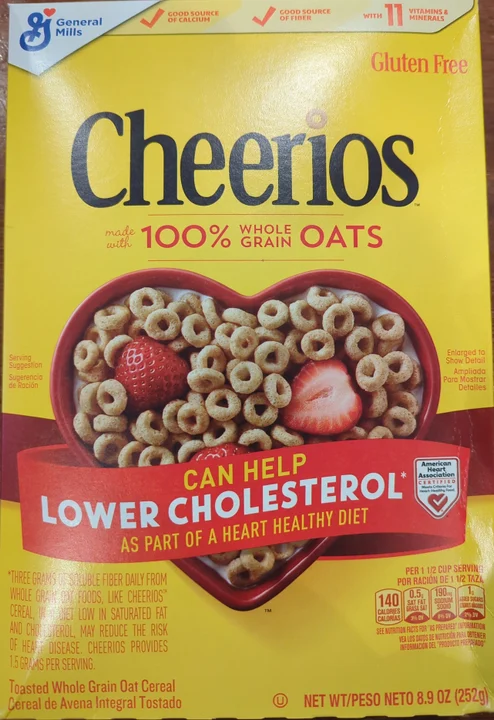 CheeriosLabeled gluten-freeWheat warning on 1 of 8 varieties we checkedGeneral Mills · checked Nov 16, 2026
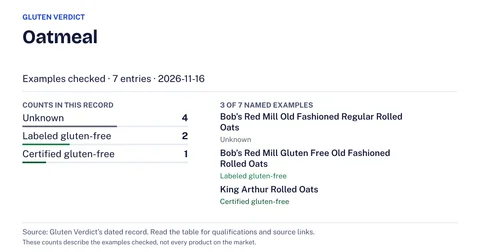 OatmealDepends on the productchecked Nov 16, 2026
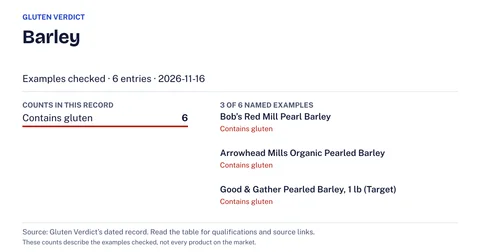 BarleyContains glutenchecked Nov 16, 2026
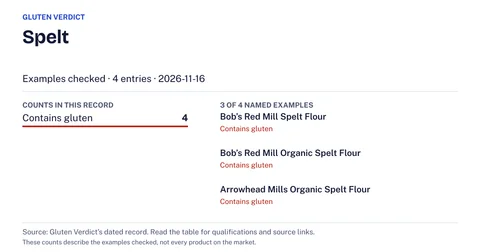 SpeltContains glutenchecked Nov 16, 2026
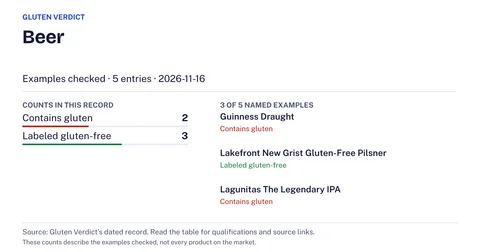 BeerDepends on the product2 of 5 products we checked contain gluten: Guinness Draught and Lagunitas The Legendary IPAchecked Nov 16, 2026
Questions people ask
Is the 20 ppm limit written into Canadian law?
Health Canada's June 2012 page says no specific threshold is mentioned in the Regulations themselves; the 20 ppm figure is Health Canada's position on what meets the intent of B.24.0187, 2.
Can a Canadian food with oats be labelled gluten-free?
Yes, under Health Canada's Marketing Authorization, if the only oats are specially produced “gluten-free oats”, identified as such, the finished product has no more than 20 ppm of gluten from wheat, rye, barley or their hybrids, and the food has no intentionally added gluten from those grains24, 25, 26, 45.
Will a Contains line name barley and rye in Canada?
When they are present as gluten sources, yes: Health Canada's Q&A says gluten sources are declared by grain name, in the ingredient list or a Contains statement3, 4. In the US, the major-allergen list names wheat42.
Does a Canadian label have to say “may contain”?
No. Health Canada says there is no regulatory requirement for, or prohibition of, precautionary labelling28.
Does a gluten-free claim on food imported into the US follow FDA's rule?
FDA says an imported food that makes a gluten-free claim must comply with the US labeling requirements44.
More in Gluten-free labeling law by country
 Which gluten grains a pack’s allergen line must name, by countryWhether the allergen line must name barley, rye and oats, country by country: US, Canada, EU, UK, Australia and New Zealand, Brazil, Japan.
 Gluten-free oats by country: where the claim is allowed and where it is barredWhether oats can carry a gluten-free claim in the US, Canada, EU, UK, Australia and New Zealand, in each regulator’s own words.
 Gluten-free labeling rules by country: ceilings, claim wording and where no rule was foundLook up the gluten-free limit and claim wording for the US, Canada, EU, UK, Australia, New Zealand and more, each figure tied to the page we read.
 Gluten-free and very low gluten on EU labels, and how allergens are highlightedWhat EU “gluten-free” and “very low gluten” claims permit, how cereals containing gluten are highlighted in ingredient lists, and the rules for loose food.
 Gluten-free labelling in Australia and New Zealand: what the claim meansWhat “gluten free” and “low gluten” mean on Australian and New Zealand packs: no detectable gluten, no oats, no malt, and how US packs compare.
 Reading US gluten-free labels as a visitor from the UK, EU, Canada or AustraliaWhat a US gluten-free claim, the Contains line, malt and alcohol labels mean if you are used to UK, EU, Canadian or Australian labels.
Related guides
 Gluten-free logos outside the US: who issues each one and what it requiresTell a certifier’s gluten-free logo from a maker’s own: who issues Crossed Grain, Coeliac Australia’s and Celiac Canada’s marks, and the limit each sets.
 May-contain labels abroad: what each country’s regulator says about themWhether a “may contain” or shared-facility line is required, voluntary or guided by a scheme in the US, UK, EU, Canada, Australia, New Zealand and Codex.
 Eating gluten-free in Canada: gluten-source labels, poutine and Tim HortonsHow a Canadian label names gluten sources, what Health Canada says about gluten-free claims, and how to judge poutine and Tim Hortons.
 Oats and celiac disease: what a gluten-free oat label does and does not tell youWhat FDA’s rule covers for oats, how makers get oats to the gluten-free limit, what avenin studies found, and what to ask your doctor.
Sources
- [1, 2, 5, 7, 8, 9] Health Canada, Health Canada's Position on Gluten-Free Claims, checked Nov 17, 2026.
Read on 2026-11-17: the definition of “gluten” in subsection B.01.010.1(1), quoted on the page, lists gluten protein from the grain of barley, oats, rye, triticale, or wheat, kamut or spelt (or a hybridized strain of these cereals), and any modified gluten protein, including any gluten protein fraction, derived from them.
- [3, 4, 10, 11, 12, 13, 14, 15, 16, 18, 19, 20, 21, 30] Health Canada, Questions and answers on the regulations to enhance labelling of food allergens, gluten sources and added sulphites, checked Nov 17, 2026.
- [6, 40, 41, 43, 44] US Food and Drug Administration, Questions and Answers on the Gluten-Free Food Labeling Final Rule, checked Nov 17, 2026.
- [17, 34, 35] Celiac Canada, Food Labelling, checked Nov 17, 2026.
- [22, 23, 24, 25, 26, 27, 45, 46] Health Canada, Gluten-free labelling claims for products containing specially produced "gluten-free oats", checked Nov 17, 2026.
- [28, 31, 32, 33] Health Canada, The Use Of Food Allergen Precautionary Statements On Prepackaged Foods, checked Nov 17, 2026.
Read on 2026-11-17: the page is dated March 2012. Under “only one precautionary statement” it says Health Canada and the CFIA recommend that food manufacturers and importers begin to use “may contain [X]”, where X is the name by which the allergen is commonly known; under “Other information” it says Health Canada is reviewing its policy on the use of food allergen precautionary statements on prepackaged foods.
- [29, 36, 37, 38] Celiac Canada, Less Confusion, More Confidence: A New Era for “May Contain” Labels Coming, checked Nov 17, 2026.
- [39] US Food and Drug Administration, Gluten and Food Labeling, checked Nov 17, 2026.
- [42] US Food and Drug Administration, Food Allergen Labeling and Consumer Protection Act of 2004 (FALCPA), checked Nov 17, 2026.