Which gluten grains a pack’s allergen line must name, by country
Short answer
It depends on the country. Canada, the EU, the UK, Australia and New Zealand require barley, rye and oats to be named alongside wheat (in Canada, Australia and New Zealand when they contain gluten), but the US major-allergen list and Japan’s mandatory list name wheat and none of the other gluten grains12, 20, 28, 39, 1, 47. Read the pack by its country’s rule:
- Canada, EU, UK, Australia and New Zealand: look for the cereal’s name in the Contains statement or emphasised in the ingredient list, as that country’s rule sets out14, 23, 31, 41.
- United States and Japan: the allergen line is no check for barley, rye or oats, so read the whole ingredient list1, 5, 47.
- Brazil: two separate statements. Look for “contém Glúten” or “não contém Glúten”, which state whether the food contains gluten45, and for an allergen warning such as “ALÉRGICOS: CONTÉM CEVADA”, which Anvisa’s Q&A describes for wheat, rye, barley, oats and their hybridised strains49.
Part of Gluten-free labeling law by country, 12 guides

Key points
- The US list of major food allergens names wheat but not barley, rye or oats, and FDA says the Contains statement is reserved for major food allergens, so a US Contains line is not a check for those grains1, 5.
- In the EU and the UK the allergen rule names barley, rye and oats alongside wheat20, 28; in Canada, Australia and New Zealand it does so when the food contains gluten12, 13, 39.
- Where the cereals are named, some derivatives are still carved out: the EU’s Annex II lists four exceptions, among them wheat-based glucose syrups and cereals used for alcoholic distillates21.
- Brazil has two statements: Lei 10.674 requires every industrialised food to carry “contém Glúten” or “não contém Glúten” and names no grain45, 54, while Anvisa’s Q&A describes a separate allergen warning for wheat, rye, barley, oats and their hybridised strains49, 50.
- A declaration is not a report on cross-contact: US advisory statements are not required by law, and Canada’s duty to declare excludes gluten present through cross-contamination6, 18.
What an allergen line is, and what it can miss
In this guide an allergen line means the part of a label that a country’s law requires, in a set form, for a set list of foods. What it can tell you depends on what is on that list. Where the law names the gluten cereals, the line is the first place to look for them. Where it names only wheat, the line is silent about barley and rye.
So there are two questions for any pack: which country’s rule does the label follow, and what does that rule’s list contain. The tables below answer both.
This page is about the allergen declaration on packaged food. For gluten-free claims, see gluten-free labeling rules by country.
Which gluten grains each country’s rule names
| Country | Gluten grains the allergen rule names | What the rule is called |
|---|---|---|
| United States | Wheat. Barley, rye and oats are not on the list of major food allergens1. | Major food allergens; the Contains statement is reserved for them5. |
| Canada | Barley, oats, rye, triticale and wheat, by grain name, when the food contains gluten protein from them12, 13. | Gluten sources, declared by their prescribed source names14. |
| European Union | Wheat, rye, barley, oats, spelt, kamut or their hybridised strains, and products thereof, as Annex II was published in 201120; the Commission’s allergen page lists “wheat, rye, barley, oats, etc.”52. A 2014 delegated regulation later reworded point 122. | Annex II, point 1: cereals containing gluten20. |
| United Kingdom | Wheat (such as spelt and khorasan wheat), rye, barley, oats or their hybridised strains, and products thereof28. The FSA lists “cereals containing gluten” among the 14 main allergens30. | Annex II, point 1, as it applies in the UK28. |
| Australia and New Zealand | Wheat always, with its hybrids such as triticale declared as “wheat”37. Barley, oats and rye when the food contains gluten39. | Required names in the statement of ingredients; “gluten” is added to the summary statement when gluten is present38, 39. |
| Brazil | Two separate rules. The gluten law names no grain: every industrialised food states whether it contains gluten45, 54. Anvisa’s allergen Q&A describes an allergen warning for wheat, rye, barley, oats and their hybridised strains, for example “ALÉRGICOS: CONTÉM CEVADA”49. | Gluten law: “contém Glúten” or “não contém Glúten” (our translation: “contains gluten”, “does not contain gluten”)45. Anvisa distinguishes the allergen labelling rules from the gluten declaration50. |
| Japan | Wheat is on the mandatory row. Barley, rye and oats are on neither the mandatory nor the recommended row47. | Specified ingredients (labelling mandatory) and items equivalent to them (recommended)47. |
Australia and New Zealand word the rule as barley, oats or rye “and contains gluten”39, and Health Canada’s Q&A ties Canada’s gluten sources to gluten protein from the grains12. The EU and UK Annex II list the cereals themselves20, 28.
Where the declaration sits on the pack
| Country | What the label must do |
|---|---|
| United States | Print a line starting “Contains”, in type no smaller than the ingredient list’s, immediately after or next to the list2; or follow the ingredient’s name with its food source in parentheses3. |
| Canada | Declare the source in the ingredient list, in parentheses after the ingredient51, or in a Contains statement14. A Contains statement goes immediately after the ingredient list16, and if one is used it must carry all the allergen and gluten information15. Ingredient-list entries may not be bold; entries in the Contains statement may be regular or bold17. |
| European Union | Emphasise the name of the Annex II substance or product in the ingredient list in a typeset that sets it apart, for example by font, style or background colour23, 53. Where there is no ingredient list, the indication is the word “contains” followed by the name24. |
| United Kingdom | Emphasise allergenic ingredients every time they appear in the ingredients list, for example in bold, contrasting colours or underlining31. An alcoholic drink with no ingredients list uses “contains” followed by the allergen32. |
| Australia and New Zealand | Declare in the statement of ingredients in bold41, and add a separate summary statement in bold beginning “contains”, in the same field of view and directly next to the statement of ingredients42. |
| Brazil | Print the “contém Glúten” or “não contém Glúten” inscription on labels and packaging in clear, easy-to-read characters with prominence (our translation of “em caracteres com destaque, nítidos e de fácil leitura”)46. |
| Japan | List allergens individually as a general rule; collectively only on an exceptional basis48. |
The same bold word means different things on different packs. In Canada bold is not allowed in the ingredient list, so the signal is the Contains statement or a source in parentheses14, 17, 51. In the EU and the UK the signal is the emphasis in the ingredient list itself23, 31; the EU’s “contains” wording is the rule for a pack with no ingredient list24.
Spelt, kamut, triticale and derivatives
- Spelt and khorasan wheat (kamut). The EU’s Annex II as published in 2011 names spelt and kamut next to wheat20. The UK’s copy of Annex II, which records that point 1 was substituted by Commission Delegated Regulation (EU) No 78/2014, reads “wheat (such as spelt and khorasan wheat)”22, 28. In Canada, Health Canada’s Q&A says any triticum species of wheat, such as spelt, durum and kamut, is declared with the word “wheat”55. Coeliac UK lists the words to expect on a UK label: wheat, rye, barley, oats, spelt and khorasan wheat34. See our verdict on spelt.
- Triticale. In Canada triticale is declared as “triticale”56. In Australia and New Zealand it counts as a wheat hybrid and is declared as “wheat”37. The EU and UK text covers “hybridised strains”20, 28.
- Derivatives. The EU’s “and products thereof” has four exceptions: wheat-based glucose syrups including dextrose, wheat-based maltodextrins, glucose syrups based on barley, and cereals used for making alcoholic distillates; a footnote on the first two ties them to products whose processing is not likely to increase allergenicity21. The UK text lists the same four29. In Australia and New Zealand, barley, oats or rye need not be declared if present in a form that does not contain gluten40. See our verdicts on glucose syrup and maltodextrin.
- Oats. Named in the EU and the UK20, 28; in Canada, Australia and New Zealand when they contain gluten12, 39; not on the US list1. Whether an oat product has met other grains is a separate question: see gluten-free oats vs regular oats.
When the line names only wheat
On a US pack the Contains statement is reserved for major food allergens5, and of the gluten grains only wheat is among them1. A line reading “Contains milk and soy” therefore says nothing either way about barley or rye, and neither does a line that names wheat.
The US rule reaches flavorings through the same list: a flavoring that bears or contains a major food allergen has to follow the allergen labeling rules4. Our natural flavors verdict records what we found about barley in flavors.
FDA describes gluten as occurring naturally in wheat, rye, barley and crossbreeds of them10, and says malt extract and malt syrup are ingredients derived from barley9. Those are the words to look for in a US ingredient list: wheat, rye, barley, oats and malt. See barley and malt extract.
FDA’s enforcement of the allergen law does not include meat, poultry and egg products (regulated by USDA) or alcoholic beverages subject to TTB labeling regulations7. TTB says its current regulations do not require major food allergens to be disclosed on alcohol labels11. See beer and the alcohol guide.
Japan’s table is an allergen list, not a gluten rule: wheat is mandatory, and barley, rye and oats are on neither row47. Read the full ingredient list on a Japanese pack too.
Loose and restaurant food
The rules for food without a package label differ again. In the EU, the allergen particulars25 are mandatory for food sold without prepackaging26, but Member States may adopt national measures on how they are made available27. In the UK, Coeliac UK says foods packed on the premises where they are sold35 have had to carry a full ingredients list with allergens emphasised since 1 October 202136. In Australia and New Zealand, food not required to bear a label, such as at a café or takeaway, needs declarations displayed with the food or provided on request43. In the US, FDA says the allergen law’s labeling requirements reach retail and food-service establishments that package and label products, but not foods wrapped after a customer’s order8.
What a declaration does not tell you
What the rules we read say about cross-contact and “may contain” wording:
- United States: FDA says advisory statements such as “may contain” are not required by law6.
- Canada: the duty to declare does not include gluten that is present through cross-contamination18. A maker may add a cross-contamination statement when, despite all reasonable measures, food allergens are unintentionally present19.
- United Kingdom: the FSA says precautionary allergen labelling should only be used after a thorough risk assessment33.
- Australia and New Zealand: voluntary statements such as “may contain” are not regulated by the Food Standards Code44.
A gluten-free claim is a separate rule with its own limit in each country: see gluten-free labeling rules by country. For the US label in full, read how to read a US food label for gluten; for readers used to another system, reading US gluten-free labels as a visitor.
How to check a pack in your hand
- Work out which country’s rule the label was written for, and read that country’s row in the tables above.
- US or Japanese label: read every word of the ingredient list for wheat, rye, barley, oats and malt. The allergen line will not flag barley, rye or oats1, 47.
- Canadian label: look for the cereal in the Contains statement or in parentheses after an ingredient, not in bold in the list14, 17, 51.
- EU or UK label: look for the cereal emphasised in the ingredient list, for example in bold23, 31, and remember the four named exceptions21, 29.
- Australian or New Zealand label: look for bold names in the list41 and a bold Contains summary42; the summary adds “gluten” when the wheat or cereal contains gluten38, 39.
- Brazilian label: find “contém Glúten” or “não contém Glúten”45, and read any “ALÉRGICOS: CONTÉM …” warning for the cereal49.
- Then read any “may contain” wording and any gluten-free claim as separate statements. Recipes change, so the pack in your hand has the final word.
Verdicts in this guide
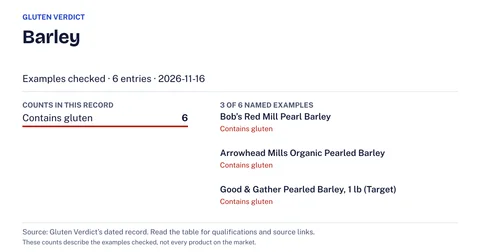 BarleyContains glutenchecked Nov 16, 2026
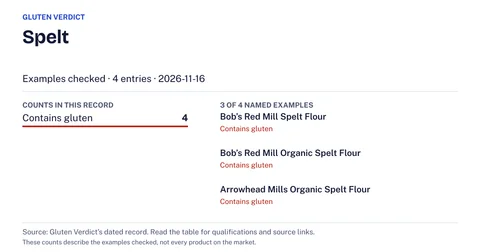 SpeltContains glutenchecked Nov 16, 2026
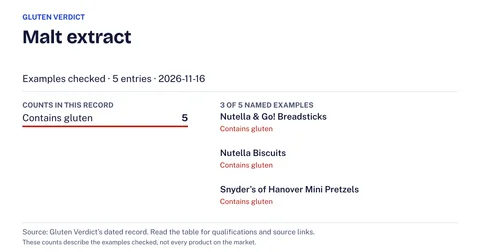 Malt extractContains glutenchecked Nov 16, 2026
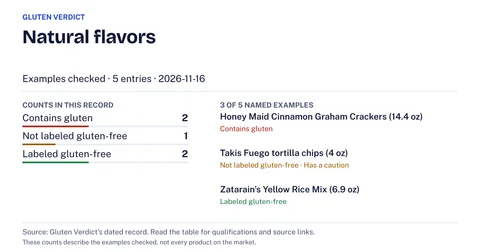 Natural flavorsDepends on the product2 of 5 products we checked contain gluten: Honey Maid Cinnamon Graham Crackers (14.4 oz) and Chex Mix Sour Cream & Onionchecked Nov 16, 2026
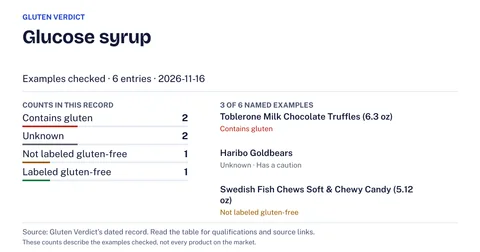 Glucose syrupNaturally gluten-free2 of 6 products we checked contain gluten: Toblerone Milk Chocolate Truffles (6.3 oz) and Darrell Lea Original Black Licorice (7 oz)checked Nov 16, 2026
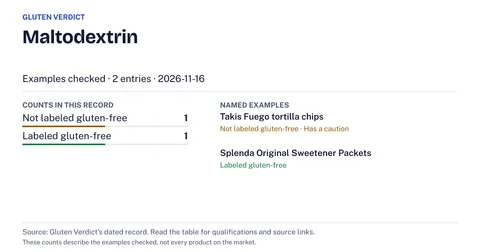 MaltodextrinNaturally gluten-freechecked Nov 16, 2026
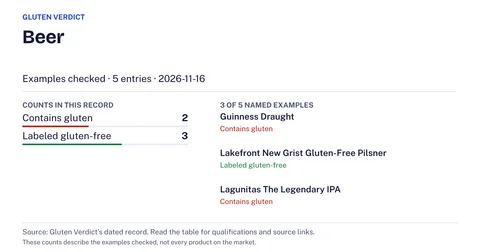 BeerDepends on the product2 of 5 products we checked contain gluten: Guinness Draught and Lagunitas The Legendary IPAchecked Nov 16, 2026
Questions people ask
Is barley an allergen on labels?
It depends on the country. In the EU and the UK it is named among the gluten cereals20, 28; in Canada, Australia and New Zealand it is declared when the food contains gluten12, 39; in the US it is not on the list of major food allergens1.
Why is the ingredient list on a Canadian pack not bolded?
Canadian rules do not permit bolding, italics or underlining in the ingredient list; only entries in the Contains statement may be regular or bold17.
Does a Brazilian pack have to say if it has no gluten?
The law requires every industrialised food to carry either “contém Glúten” or “não contém Glúten”, as the case may be (our translation)45.
More in Gluten-free labeling law by country
 Gluten-free labeling in Canada: the claim, the gluten-source declaration and oatsHow Health Canada's gluten-free claim works, how gluten sources and oats must be declared on a Canadian pack, and how it differs from the FDA rule.
 Gluten-free labeling rules by country: ceilings, claim wording and where no rule was foundLook up the gluten-free limit and claim wording for the US, Canada, EU, UK, Australia, New Zealand and more, each figure tied to the page we read.
 Gluten-free labelling in Australia and New Zealand: what the claim meansWhat “gluten free” and “low gluten” mean on Australian and New Zealand packs: no detectable gluten, no oats, no malt, and how US packs compare.
 Gluten-free and very low gluten on EU labels, and how allergens are highlightedWhat EU “gluten-free” and “very low gluten” claims permit, how cereals containing gluten are highlighted in ingredient lists, and the rules for loose food.
 Gluten-free oats by country: where the claim is allowed and where it is barredWhether oats can carry a gluten-free claim in the US, Canada, EU, UK, Australia and New Zealand, in each regulator’s own words.
 May-contain labels abroad: what each country’s regulator says about themWhether a “may contain” or shared-facility line is required, voluntary or guided by a scheme in the US, UK, EU, Canada, Australia, New Zealand and Codex.
Related guides
 Reading US gluten-free labels as a visitor from the UK, EU, Canada or AustraliaWhat a US gluten-free claim, the Contains line, malt and alcohol labels mean if you are used to UK, EU, Canadian or Australian labels.
 The Contains line names wheat, not barley or rye: what US allergen labels coverWhat the US allergen Contains line covers, why it names wheat but not barley or rye, and which ingredient-list names stand in for them.
 UK gluten-free labelling: the legal rules, Natasha’s Law and the Crossed GrainWhat UK law requires on allergen and gluten-free labels, what Natasha’s Law added for food packed on site, and how the Crossed Grain mark differs.
 What a European restaurant must tell you about gluten, country by countryWhether restaurants in France, Germany, Austria, Italy, Spain and the UK must show allergens in writing or may answer aloud, and what to ask.
Sources
- [1, 6, 7, 8] US Food and Drug Administration, Food Allergies, checked Nov 17, 2026.
- [2, 3, 4] US Food and Drug Administration, Food Allergen Labeling and Consumer Protection Act of 2004 (FALCPA), checked Nov 17, 2026.
- [5] US Food and Drug Administration, Frequently Asked Questions: Food Allergen Labeling Guidance for Industry, checked Nov 17, 2026.
- [9] US Food and Drug Administration, Questions and Answers on the Gluten-Free Food Labeling Final Rule, checked Nov 17, 2026.
- [10] US Food and Drug Administration, Gluten and Food Labeling, checked Nov 17, 2026.
- [11] Alcohol and Tobacco Tax and Trade Bureau (TTB), Major Food Allergen Labeling for Wines, Distilled Spirits, and Malt Beverages, checked Nov 17, 2026.
- [12, 13, 55, 56] Health Canada, Questions and answers on the regulations to enhance labelling of food allergens, gluten sources and added sulphites, checked Nov 17, 2026.
- [14, 15, 16, 17, 19, 51] Canadian Food Inspection Agency, List of ingredients and allergens on food labels, checked Nov 17, 2026.
- [18] Canadian Food Inspection Agency, Allergen-free, gluten-free and cross-contamination statements, checked Nov 17, 2026.
- [20, 21, 23, 24, 25, 26, 27] European Commission (EUR-Lex), Regulation (EU) No 1169/2011, Annex II, point 1 (as published, OJ L 304, 22.11.2011), checked Nov 17, 2026.
Read on 2026-11-17: the exceptions listed with Annex II point 1 are (a) wheat based glucose syrups including dextrose (footnote 1); (b) wheat based maltodextrins (footnote 1); (c) glucose syrups based on barley; (d) cereals used for making alcoholic distillates including ethyl alcohol of agricultural origin. Footnote 1 reads: “And the products thereof, in so far as the process that they have undergone is not likely to increase the level of allergenicity assessed by the Authority for the relevant product from which they originated.”
- [22, 28, 29] legislation.gov.uk (The National Archives), Regulation (EU) No 1169/2011, Annex II, as it applies in the UK (amendment note), checked Nov 17, 2026.
Read on 2026-11-17: under Annex II point 1 the page carries the textual amendment note “F1 Substituted by Commission Delegated Regulation (EU) No 78/2014 of 22 November 2013 amending Annexes II and III to Regulation (EU) No 1169/2011”.
Read on 2026-11-17: after “and products thereof, except:” the Annex lists wheat based glucose syrups including dextrose; wheat based maltodextrins; glucose syrups based on barley; and cereals used for making alcoholic distillates including ethyl alcohol of agricultural origin.
- [30, 31, 32, 33] Food Standards Agency, Allergen labelling for food manufacturers, checked Nov 17, 2026.
- [34, 35, 36] Coeliac UK, How to read food labels, checked Nov 17, 2026.
Read on 2026-11-17: under “Manufacturers will name the specific cereal used, so you will see these words on the ingredients list” the page lists Wheat, Rye, Barley, Oats, Spelt and Khorasan wheat (commercially known as Kamut®).
- [37, 38, 39, 40, 41, 42, 43, 44] Food Standards Australia New Zealand, Allergen labelling, checked Nov 17, 2026.
- [45, 46, 54] Câmara dos Deputados (Brasil), Lei nº 10.674, de 16 de maio de 2003, checked Nov 17, 2026.
Read on 2026-11-17: the whole text of the law (Art. 1 to Art. 4; Arts. 2 and 3 are marked “vetado”) names no cereal.
- [47, 48] Consumer Affairs Agency, Japan, Allergen labelling (English PDF), checked Nov 17, 2026.
Read on 2026-11-17: in the table headed “Specified ingredients, etc.”, the row “Specified ingredients” (labelling is mandatory) names shrimp, crab, walnut, wheat, buckwheat, egg, dairy products and peanut; the row “Items equivalent to specified ingredients” (labelling is recommended) names almond, abalone, squid, salmon roe, orange, cashew nut, kiwi fruit, beef, sesame, salmon, mackerel, soybean, chicken, banana, pork, macadamia nut, peach, yam, apple and gelatin. Barley, rye and oats appear in neither row.
- [49, 50] Anvisa (Brazil), Rotulagem de alimentos alergênicos: perguntas e respostas, 6th ed. (13 May 2024), question 53, checked Nov 17, 2026.
- [52, 53] European Commission (DG SANTE), Allergies (European Commission campaign page), checked Nov 17, 2026.
Read on 2026-11-17: under “Which allergens must be declared?” the page lists 14 allergens; the first, “Cereals containing gluten”, is followed by “wheat, rye, barley, oats, etc.”.