How to check whether a packaged food is gluten-free
Short answer
Check four things in order, and write down what each one returns. If the steps disagree, or the maker’s page is silent, the food is not confirmed and the next move is a written question to the maker.
- The claim on the pack. On a food FDA regulates, “gluten-free” is a voluntary claim that has to mean less than 20 parts per million (ppm) of gluten1, 2.
- The whole ingredient list, then the allergen line. Wheat is on the US allergen list but barley and rye are not, so gluten can hide behind other names3, 4.
- The maker’s own page for that exact product, with the date you read it, because a maker’s ingredient and allergen statements can change; General Mills says so on its Cheerios page5.
- The certifier’s directory, if the pack shows a seal: GFCO’s Product Finder says products are considered certified if they appear on its list and carry one of its marks6.
Part of Label reading and gluten-free claims, 17 guides
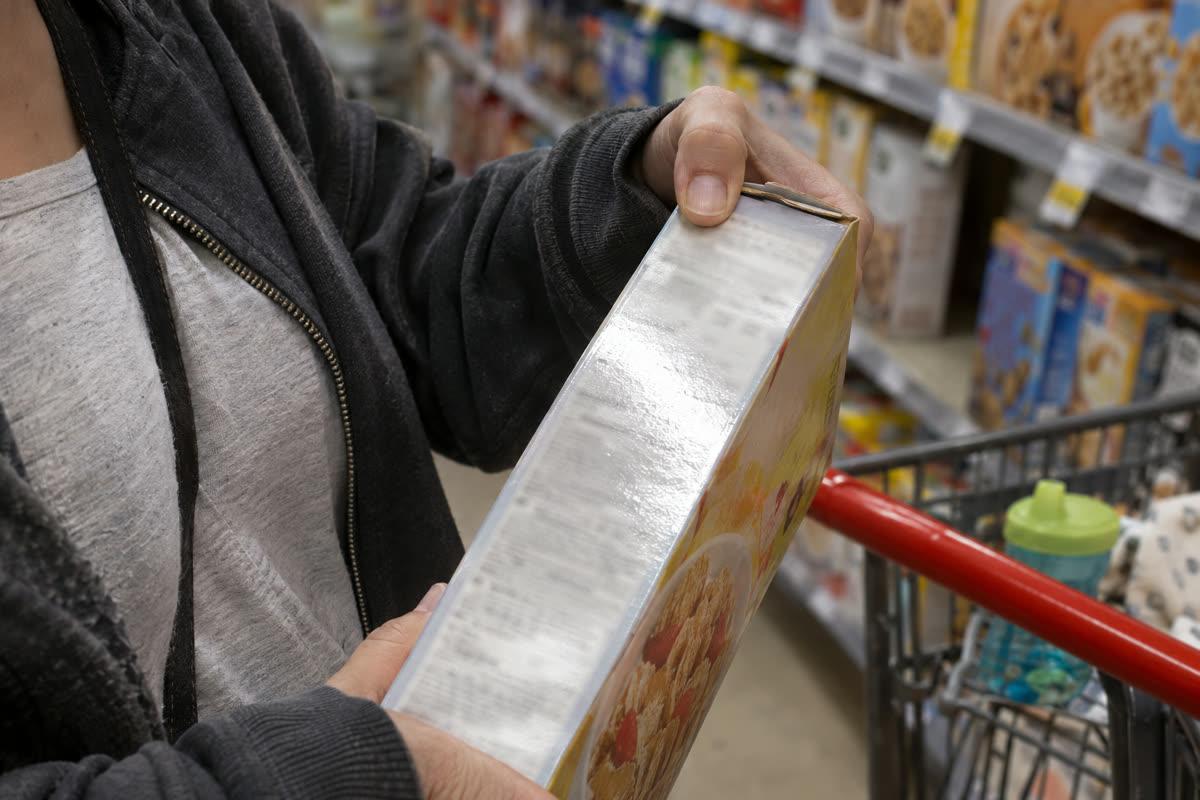
Key points
- A “gluten-free” claim is a legal definition, not a lab report: FDA’s rule does not require a maker to test, though the maker is responsible for meeting it7.
- “Made with no gluten-containing ingredients” is not the claim: unless the label also says gluten-free, FDA says consumers should not assume the food meets the rule8.
- On GFCO’s Product Finder, a product is considered certified if it appears on the list and carries one of its marks; a listed product whose pack lacks the mark is not certified6, 9.
- With no claim, the National Celiac Association (NCA) says processed foods and grain products such as cereal and flours have a high risk of cross-contact, and the Gluten Intolerance Group (GIG) says oats, lentils and milled products made from grains, beans, seeds or legumes carry a higher risk10, 11.
- In one 2015 survey by FDA authors, 36 of 186 foods with no gluten-free label and no wheat, rye or barley on the ingredient label had more than 20 ppm of gluten on at least one of two test kits, against 3 of 275 foods labeled gluten-free12.
The four checks, and why they run in this order
Each check answers a different question, and each can fail on its own. They run from the one in your hand to the one that can change without notice, so an early “no” saves the rest.
| Step | Where you look | The question it answers | Write down |
|---|---|---|---|
| 1. The claim | The pack: front and back panels | Does the maker call this exact product gluten-free, and in what words? | The wording, and a photo of the panel |
| 2. The lists | The ingredient list, the allergen line and any may-contain line | Does the list name wheat, barley, rye, malt or oats, or a word that can hide them? | Each word that gave you pause |
| 3. The maker’s page | The maker’s own page for that product | What does the maker say about this product, and as of when? | The address, the date you read it and the wording |
| 4. The directory | The certifier’s own product list | If the pack shows a seal, is this product on the list? | The search you ran and what came back |
This guide is about packaged food sold in the US. FDA’s gluten-free rule applies to foods FDA regulates; it does not apply to foods whose labeling USDA or TTB regulates (USDA generally covers meat, poultry and certain egg products)13. For a walk through the rest of a label, see how to read a US food label for gluten.
Step 1: What the claim on the pack promises
The rule covers four phrases: “gluten-free”, “no gluten”, “free of gluten” and “without gluten”2. A food that carries any of them has to contain less than 20 ppm of gluten2. The regulation’s own text says any unavoidable presence of gluten in the food bearing the claim must be below 20 ppm14, and a food that bears the claim and fails the regulation’s requirements is deemed misbranded15.
Using the claim is the maker’s choice1. FDA’s rule does not require a maker to test for gluten, though the maker is responsible for making sure the food meets it7. FDA says it enforces the rule through sampling, inspections, label reviews and follow-up on complaints16.
Two published looks at claims found few failures. In an analysis FDA released in 2017, one product among 702 samples from more than 250 products labeled “gluten-free” did not comply with the labeling requirements17. In a 2015 survey by FDA authors, 3 of 275 foods labeled gluten-free were mislabeled or misbranded at the 20 ppm threshold12. Neither says anything about the pack in your hand, which is why steps 2 to 4 exist.
Statements that look like the claim but are not
- “Made with no gluten-containing ingredients”: allowed when truthful, but unless the label also carries a “gluten-free” claim, FDA says consumers should not assume the food meets the gluten-free rule8.
- A certification logo: a maker may print one if its use is truthful and not misleading, and FDA does not endorse, accredit or recommend any particular program18. Step 4 covers it.
- “Made in a facility that also processes wheat”: FDA calls this a voluntary advisory statement and allows it beside a gluten-free claim when it is truthful and not misleading; the food must still meet the rule19, 15.
A pack with no claim at all is a separate case, covered after step 2.
Step 2: Read the whole ingredient list, then the allergen line
GIG advises reading the full ingredient list, not just the Contains statement20. Why it matters: wheat is on the US list of major food allergens3, while GIG notes that barley and rye are not, which makes it easy for gluten to hide behind other names in an ingredient list4.
| On the list | What the source says | Our verdict page |
|---|---|---|
| Wheat, rye, barley, malt, brewer’s yeast, oats | These are the six words NCA says to watch for on a food that is not labeled gluten free21. | Malt extract, brewer’s yeast |
| Malt | NCA says any product containing malt is not gluten free22. | Malt extract |
| Oats | GIG says the cross-contact risk with gluten is high for oats and advises looking for a certification on oat-containing products23. In the 2015 survey by FDA authors, the presence of oats in foods without a gluten-free label was strongly correlated with a positive test result24. | Oatmeal |
| Natural flavors | NCA says wheat has to be disclosed on FDA-regulated labels but malt or barley does not, and that the best way to find out about a food with natural flavors is to contact the manufacturer25. | Natural flavors |
| Yeast extract | GIG says some yeast extract may be made from spent brewer’s yeast and could contain residual barley gluten, and that in the US the source may not be clear26. | Yeast extract |
| Modified food starch | NCA says that on FDA-regulated products, starch derived from wheat will be listed in the ingredients or a Contains statement; if wheat is not listed in either place, NCA says it can be considered gluten free27. | Modified food starch |
Wheat on a pack that also says gluten-free needs a statement. If the food bears the claim and also names wheat in its list or a Contains wheat line, the regulation deems it misbranded unless the word wheat is marked with a symbol that leads to this sentence: “The wheat has been processed to allow this food to meet the Food and Drug Administration (FDA) requirements for gluten-free foods.”28
May-contain lines are one more thing to write down. FDA describes “made in a facility that also processes wheat” as voluntary19, and the 2015 survey by FDA authors reported that gluten was also found in a significant number of foods with gluten/wheat-related advisory warnings29. A line like this does not replace steps 3 and 4.
If the pack makes no claim at all
A missing claim does not by itself mean gluten is present. FDA says producers of foods that are gluten-free by nature, such as bottled spring water, fresh fruits and vegetables and fresh seafood, may choose not to label them30. NCA says there is no need to look for a gluten-free label on fresh produce and whole foods such as plain milk, eggs, cheese and plain meats, but recommends gluten-free labeling on processed foods and on naturally gluten-free grain products such as cereal and flours, because it says they have a high risk of cross-contact with gluten10.
FDA makes a similar point about grains, legumes and seeds: on those foods, a gluten-free claim tells the consumer to expect that any gluten present is under 20 ppm in the final product31.
GIG answers a reader who has only an ingredient list: some products that look gluten-free from the list have a higher risk of cross-contact and are best avoided unless certified or labeled gluten-free, and it names oats, lentils and milled products made from grains, beans, seeds or legumes11.
One survey in numbers. The 2015 survey by FDA authors tested 275 foods labeled gluten-free and 186 foods with no gluten-free label and no wheat, rye or barley on the ingredient label. Of the labeled foods, 3 (1.1%) were mislabeled or misbranded at 20 ppm; of the unlabeled ones, 36 (19.4%) had more than 20 ppm on at least one of two test kits, and 19 had more than 100 ppm12. It is one survey, and the figures are the authors’.
With no claim, a processed or grain-based food, or a word from the table above, the label alone cannot settle it. Go to step 3.
Step 3: The maker’s own page, and the date you read it
Find the maker’s own page for that product and read the claim wording, the ingredient list, the allergen statement, any may-contain line and any statement about testing. Make sure the page is for the same product, size and variety as the pack in your hand.
Write down the address and the date. Pages change: General Mills’ Cheerios product page states that ingredients, nutrition facts and allergen statements can change, and that the actual package has the most complete and accurate information5.
Match the exact product. A brand’s pages can cover products with different answers: General Mills’ Cheerios FAQ says ingredients vary across Cheerios products and tells readers to check the label32.
A claim on a maker’s page is the maker’s statement. Where the page is silent on what you need (a claim, the source of a natural flavor, a cross-contact statement), record it as silent: for now the food is not confirmed.
Step 4: The certifier’s directory, if the pack shows a seal
A seal is a third party’s claim, and the certifier’s own list is where to confirm it. The Gluten-Free Certification Organization (GFCO) is GIG’s product certification program33. GIG’s page on the program says GFCO does not certify gluten-free brands or manufacturing facilities and certifies physical products displaying its mark34.
GFCO’s Product Finder states the rule: products are considered certified if they appear on its list and carry one of its marks6. A product on the list whose packaging does not carry the mark is not certified9. If a product carries one of the marks but is not on the list, the page says to contact GFCO, which says it will review and confirm the status35.
The search form takes a name, keywords or a UPC, among other fields36. Use the UPC when the name is ambiguous.
On what the seal rests, as GIG’s page on its GFCO program puts it: certified brands must send it results immediately, before the product leaves the production facility, if gluten above 10 ppm is detected in a product or its ingredients37, and GIG says GFCO confirms cross-contact protocols are followed in annual in-person audits at every facility where certified products are made38.
Certification is optional. FDA lists participation in a third-party certification program as one of several quality-control tools a maker may choose39, so a food can carry the claim with no listing; a search that finds nothing means only that GFCO does not list it. If the seal is another program’s, use that program’s own lookup the same way.
Worked example: Cheerios, four steps, read on 2026-11-17
We ran the four steps on a product we cover in our verdicts. We cannot hold your box, so step 1 uses the claim wording on General Mills’ product page; with the box in your hand, read the panel itself.
| Step | What we read | What it showed |
|---|---|---|
| 1. Claim | General Mills’ Original Cheerios page | The description calls it a “gluten free, toasted whole grain oat cereal”40. |
| 2. Lists | The page’s ingredient list and allergen field | The list names whole grain oats, corn starch, sugar, salt and tripotassium phosphate, plus vitamin E and added vitamins and minerals, with no wheat, barley, rye or malt among them; the allergen field reads “Does not contain declaration obligatory allergens”41. Oats is one of NCA’s six words21, so it goes on to steps 3 and 4. |
| 3. Maker’s page | General Mills’ Gluten Free page | General Mills says it separates the oats from grains that contain gluten42 and tests multiple composited samples of finished product so every production lot meets FDA’s gluten-free standard43. The page publishes no test results or ppm figure42. |
| 4. Directory | GFCO Product Finder, search for “Cheerios” | “No products found”44. |
Reading it: the claim and the maker’s page agree, the list names no wheat, barley, rye or malt, only oats, and the maker describes how it handles the oats. The directory returned nothing, which fits a claim the maker makes itself rather than a GFCO-certified one (the search says nothing about other certifiers); it would be a conflict only if your box showed a GFCO mark. Record it that way: the maker’s own gluten-free claim, with a described process and no published test figure. Our Cheerios verdict and Honey Nut Cheerios verdict show what we read on each maker page and when.
Same brand, different product
The Cheerios Oat Crunch Cinnamon page carries no gluten-free claim, and its allergen line reads “May contain wheat ingredients.”45 Same brand name, different answers at steps 1 and 2, which is why step 3 asks for the exact product.
The same directory shows how a listing follows the exact product. A search for “Bisquick” returned one product, the Gluten Free mix46. Our Bisquick verdict separates that mix from the regular ones, and our King Arthur flour verdict does the same for that maker’s flours.
When the steps disagree
| What you see | What it means | Next move |
|---|---|---|
| A gluten-free claim, but the list names wheat | The regulation deems the food misbranded unless the wheat is marked with the processed-to-meet-the-rule statement28. | Look for that statement beside the list. If it is missing, write to the maker and keep the pack. |
| A gluten-free claim, but the list names malt | NCA says there have been a few instances of products labeled gluten free that contain malt, calls them incorrectly labeled, and says to avoid them unless the malt is derived from a gluten-free grain and clearly labeled as such47. | Write to the maker. |
| A seal on the pack, nothing in the directory | GFCO’s page says to contact it if a product carries one of the marks but is not on the list, and that it will review and confirm the status35. | Search again by UPC, then write to GFCO. |
| Listed in the directory, no mark on the pack | GFCO says that product is not certified9. | Treat the seal as absent and go by steps 1 to 3. |
| The maker’s page and the pack differ | General Mills’ Cheerios product page says to refer to the actual package5. | Go by the package, and write to the maker about the difference. |
| No claim, and natural flavors or yeast extract on the list | NCA says to contact the manufacturer about natural flavors25; GIG says to choose yeast extract labeled gluten-free or contact the manufacturer26. | Write to the maker. |
| The maker’s page is silent, or you cannot find one | Nothing confirms the food. | Write to the maker. |
A maker’s reply is the maker’s statement, not a test result you can see. Record who sent it and when.
When to write to the maker, and what to keep
Write when two steps disagree, when step 3 is silent on something you need, or when the food has no claim and a word from the table in step 2. A written question leaves a record.
What to include
- The product’s full name, size and variety, and the number printed under the barcode.
- Any best-by date or lot code printed on the pack.
- Your questions, one at a time: Is this exact product made to FDA’s gluten-free definition? If the list says natural flavors, yeast extract or modified food starch, what is it made from? Is the product made on shared equipment, and how does the plant guard against cross-contact? Is finished product tested, and does a certifier stand behind the claim?
What to keep
- A photo of the front, the ingredient list, the allergen and any may-contain lines, and the barcode.
- The maker page’s address, the date you read it and the wording you relied on.
- The directory search you ran and what it returned.
- The maker’s reply, with its date and who sent it.
If a gluten-free claim looks wrong, FDA’s Q&A on the rule says suspected labeling concerns may be reported to FDA48.
Where our scanner helps and where it stops
Our gluten scanner reads an ingredient list from a photo or pasted text and highlights the words that name wheat, barley, rye, malt or oats. That is step 2 only. It does not see a claim on a panel you did not photograph, read the maker’s page or search a directory, and a curved or blurry photo can drop a word, so compare its result with the box.
Verdicts in this guide
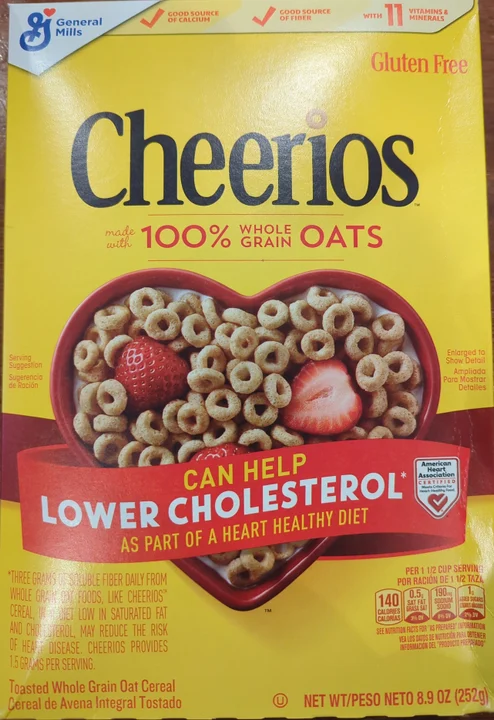 CheeriosLabeled gluten-freeWheat warning on 1 of 8 varieties we checkedGeneral Mills · checked Nov 16, 2026
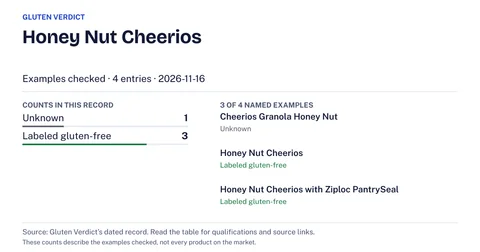 Honey Nut CheeriosLabeled gluten-freeGeneral Mills · checked Nov 16, 2026
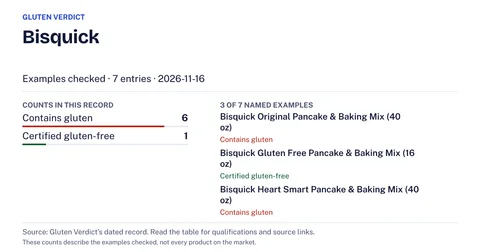 BisquickContains glutenGeneral Mills (Betty Crocker) · checked Nov 16, 2026
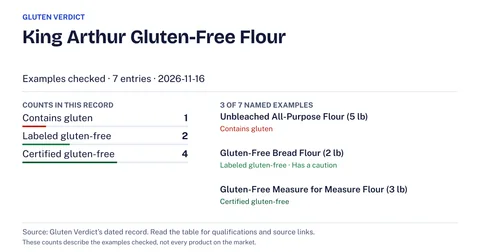 King Arthur Gluten-Free FlourCertified gluten-free1 of 7 varieties we checked contains gluten: Unbleached All-Purpose Flour (5 lb)Wheat warning on 2 of 7 varieties we checkedKing Arthur Baking Company · checked Nov 16, 2026
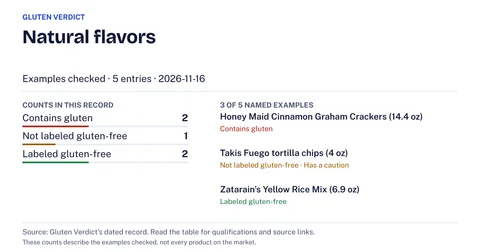 Natural flavorsDepends on the product2 of 5 products we checked contain gluten: Honey Maid Cinnamon Graham Crackers (14.4 oz) and Chex Mix Sour Cream & Onionchecked Nov 16, 2026
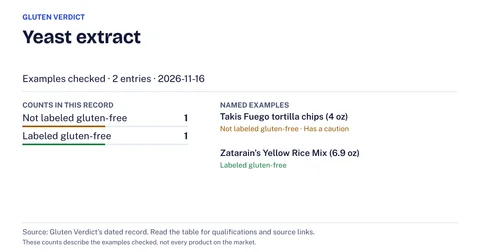 Yeast extractDepends on the productchecked Nov 16, 2026
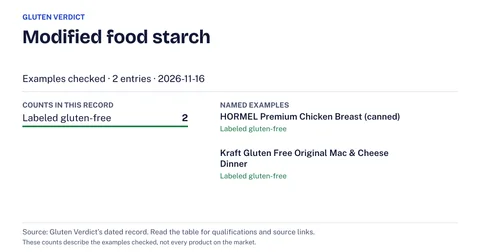 Modified food starchDepends on the productchecked Nov 16, 2026
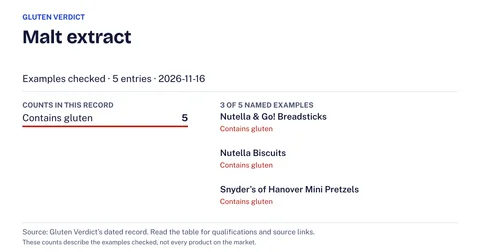 Malt extractContains glutenchecked Nov 16, 2026
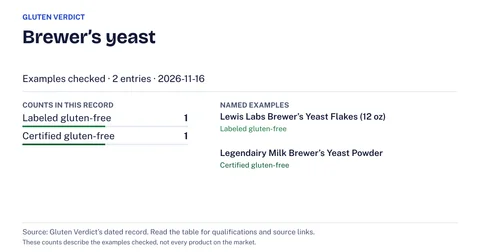 Brewer’s yeastDepends on the productchecked Nov 16, 2026
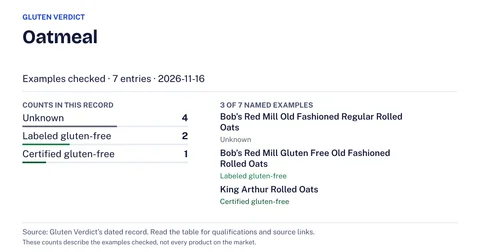 OatmealDepends on the productchecked Nov 16, 2026
Questions people ask
Is a food gluten-free if the pack does not say so?
Not necessarily either way. FDA says makers of foods that are gluten-free by nature may choose not to label them30, while NCA recommends gluten-free labeling on processed foods and on grain products such as cereal and flours10.
Does a gluten-free claim mean the food was tested?
FDA’s rule does not require makers to test; makers are responsible for meeting the rule7. FDA says it checks through sampling, inspections, label reviews and complaints16.
Is a certification seal the same as FDA’s gluten-free claim?
They are different things. FDA says it does not endorse, accredit or recommend any particular certification program18. GIG says GFCO certifies physical products displaying its mark34, and its Product Finder says products are considered certified if they appear on its list and carry one of its marks6.
Which do I go by when the maker’s website and the box differ?
The box. General Mills’ Cheerios product page tells readers to refer to the actual package5. Write to the maker about the difference.
More in Label reading and gluten-free claims
 How to read a US food label for glutenWhere gluten shows up on a US food label: the gluten-free claim, the Contains line, the ingredient list and may-contain lines, and what each means.
 The Contains line names wheat, not barley or rye: what US allergen labels coverWhat the US allergen Contains line covers, why it names wheat but not barley or rye, and which ingredient-list names stand in for them.
 When a gluten-free label looks wrong: what to keep, who to tell, where to lookFound wheat, barley or malt in a food labeled gluten-free? What to keep, whom to tell, which US agency takes the report, and where recalls are listed.
 How to check a gluten-free seal in the certifier's own directorySearch GFCO's Product Finder by brand, product or UPC, read what an entry shows, and learn what a missing listing means for the seal on your pack.
 What “may contain wheat” and “made in a facility with wheat” mean on a US labelHow to read “may contain wheat”, shared-facility and shared-equipment lines on US labels, with and without a gluten-free claim, and what to check next.
 The FDA gluten-free rule: what 21 CFR 101.91 requires and what 20 ppm measuresWhat FDA’s gluten-free rule requires, which claim words it covers, what 20 ppm means for a portion of food, and how FDA checks that a claim holds.
Related guides
 What to ask a food maker about gluten, and how to read the replyHow to write to a food maker about gluten: what to include, questions that get a usable answer, and how to sort the reply.
 How to check a grocery listing for gluten before you orderRead an online grocery listing for gluten in a fixed order, tell a store tag from a maker claim and a certifier mark, and re-check on reorders.
 Teaching a child to read gluten-free labels, one skill at a timeFour label skills to teach a gluten-free child in order, a cupboard practice game, and the questions an adult still answers.
 Starting a gluten-free diet: testing first, then labels, oats and the kitchenWhat NIH and the celiac charities say about starting a gluten-free diet: testing first, which foods to start with, a US label check, oats and the kitchen.
Sources
- [1, 2, 17] US Food and Drug Administration, Gluten and Food Labeling, checked Nov 17, 2026.
- [3] US Food and Drug Administration, Food Allergen Labeling and Consumer Protection Act of 2004 (FALCPA), checked Nov 17, 2026.
- [4, 20, 23, 26] Gluten Intolerance Group, Advanced Label-Reading Tips, checked Nov 17, 2026.
- [5, 40, 41] General Mills (cheerios.com), Original Cheerios, checked Nov 17, 2026.
- [6, 9, 35, 36] Gluten-Free Certification Organization (GFCO), GFCO Product Finder, checked Nov 17, 2026.
Read on 2026-11-17: the page says that a product carrying one of the marks but not found on the list should be brought to GFCO (an email address is given), and that GFCO will review and confirm the status of the product.
Read on 2026-11-17: the search form has fields for Name, Keywords, UPC, Brand, Category and Sales Region.
- [7, 8, 13, 16, 18, 19, 30, 31, 39, 48] US Food and Drug Administration, Questions and Answers on the Gluten-Free Food Labeling Final Rule, checked Nov 17, 2026.
- [10, 21] National Celiac Association, Can I eat a product that is not labeled gluten free but does not contain ingredients with gluten? (reviewed April 8, 2025), checked Nov 17, 2026.
Read on 2026-11-17: the page says “If something is not labeled GF watch out for these six words on the label:” and the list under it names Wheat, Rye, Barley, Malt, Brewer’s yeast and Oats.
- [11] Gluten Intolerance Group, GIG FAQ: products that are not certified or labeled gluten-free, judged by the ingredient list, checked Nov 17, 2026.
- [12, 24, 29] Food Chemistry (via PubMed), Gluten detection in foods available in the United States: a market survey (Sharma, Pereira, Williams, 2015), checked Nov 17, 2026.
- [14, 15, 28] Electronic Code of Federal Regulations (eCFR), 21 CFR 101.91: Gluten-free labeling of food, checked Nov 17, 2026.
- [22, 25, 27, 47] National Celiac Association, Ingredients People Question, checked Nov 17, 2026.
- [32] General Mills (cheerios.com), Cheerios FAQs, checked Nov 17, 2026.
- [33, 34, 37, 38] Gluten Intolerance Group, How Does GFCO Certify Gluten-Free Food?, checked Nov 17, 2026.
- [42, 43] General Mills (cheerios.com), Cheerios: Gluten Free, checked Nov 17, 2026.
- [44] Gluten-Free Certification Organization (GFCO), GFCO Product Finder search: Cheerios, checked Nov 17, 2026.
- [45] General Mills (cheerios.com), Cheerios Oat Crunch Cinnamon, checked Nov 17, 2026.
- [46] Gluten-Free Certification Organization (GFCO), GFCO Product Finder search: Bisquick, checked Nov 17, 2026.
Read on 2026-11-17: the search for “Bisquick” returned one product, Bisquick Gluten Free Pancake & Baking Mix, brand Betty Crocker, UPC 16000-27746.