How to check a grocery listing for gluten before you order
Short answer
A store’s gluten-free filter is a starting point, not a check. Instacart, for one, says its gluten-free label applies to products that identify as free of the ingredient on their packaging or description, and that its product information is not a substitute for checking product labels16, 17. On each listing, read in this order:
- The full ingredient list. Instacart says the package can carry more or different information than its listing19.
- The Contains line or allergen field, if the listing shows one: wheat is on the US law’s list of major food allergens, barley and rye are not9.
- A maker’s gluten-free claim, which on foods FDA regulates must meet FDA’s definition, including less than 20 parts per million of unavoidable gluten2.
- A certifier mark: GFCO considers a product certified if it is on its list and carries its mark12, 13.
- The package that arrives, read before you eat it20.
Part of Grocery shopping and meal planning, 15 guides

Key points
- Instacart says the packaging in store may carry more and/or different information than its listing19.
- A maker’s gluten-free claim is voluntary and, on foods FDA regulates, must meet FDA’s definition, including under 20 ppm of unavoidable gluten; foods whose labeling USDA or TTB regulates are outside that rule1, 2, 26.
- GFCO certifies physical products, not brands, so look up the exact product14.
- When an item is unavailable, Instacart’s choices are best match, specific items or a refund22, 23, 28; read any replacement’s listing the same way.
What a gluten-free filter or badge tells you
Instacart’s help center says its gluten-free label applies to products that identify as free of the ingredient on the product packaging or product description17. It says the nutritional information on its listings comes from third-party sources, including product packaging, the product manufacturer or other information sources18.
Instacart tells shoppers to read the package as well: it says actual packaging in store may contain more and/or different information than shown on Instacart19.
FDA has looked at this question. In April 2023 it issued a Request for Information on the content, format and accuracy of the food labeling information that online grocery platforms provide10, saying the input would help it improve access to consistent and accurate labeling information for packaged foods sold online11.
We read Instacart’s help pages. We make no claim about how any other store assigns its filters or badges, so the order below does not rely on a store’s tag.
The order to read a listing in
- Ingredient list. Read every item, not just the first line. The names to look for are in our guide to reading food labels.
- Contains line or allergen field, if the listing shows one. Where a package uses a Contains line, the allergen law (FALCPA) has it printed immediately after or adjacent to the ingredient list8. Wheat is on the law’s list of major food allergens; barley and rye are not9, so check the ingredient list for them as well.
- Gluten-free claim. On a food FDA regulates, “gluten-free” has to meet FDA’s definition, including less than 20 ppm of any unavoidable gluten2. Look for the same claim on the package photo, not only in the title or bullet points.
- Certifier mark. If the photo shows one, look the product up in the certifier’s directory (next section).
- The package. When it arrives, read the ingredient list again. Instacart asks shoppers to read all labels, warnings and directions on the packaging20.
Store tag, maker claim, certifier mark: three different promises
| What you see | Whose it is | What the sources say |
|---|---|---|
| A store filter, tag or badge | The store | Instacart says its gluten-free label applies to products that identify as free of the ingredient on the packaging or description17, and that its product information is not a substitute for checking the label16. |
| “Gluten-free” on the package | The maker | The claim is voluntary1. On foods FDA regulates, food labeled gluten-free has to meet FDA’s definition, including under 20 ppm of unavoidable gluten2. FDA does not require makers to test but holds them responsible for complying4. |
| A certifier’s logo | The certifier | FDA allows a certification logo if its use is truthful and not misleading, and does not endorse any one program3. GFCO considers a product certified if it is on its list and carries its mark12. |
Two limits on the maker’s claim. First, FDA’s gluten-free rule does not apply to foods whose labeling USDA or TTB regulates; USDA generally regulates the labeling of meats, poultry and certain egg products26. Second, a claim is optional: FDA says it may not appear even if the food is gluten-free7. A listing with no claim is therefore not a warning by itself, and FDA’s advice to people with celiac disease is to read and scrutinize labels to avoid gluten ingredients5.
Check a certifier mark in the certifier’s own directory
A logo in a product photo is the start of the check. GFCO, the Gluten Intolerance Group’s product certification program29, considers a product certified if it appears on its list and carries one of its certification marks12. A product that is on the list but whose packaging lacks the mark is not certified13.
GFCO says it does not certify brands or manufacturing facilities, only physical products displaying its mark14, so look up the exact product, not the brand.
- Find the product’s name, or its UPC if the listing shows one.
- Search GFCO’s Product Finder, which takes a name, keywords or a UPC, and can filter by brand, category and sales region27.
- Confirm that the package photo carries the mark as well as the directory listing13.
- If the product is not listed, ask the certifier or the maker. Our guide on what to ask a manufacturer has the questions.
GFCO also says it performs random surveillance testing on hundreds of certified products each year, taken from retail stores, online stores and manufacturer websites15. FDA does not endorse, accredit or recommend any particular certification program3. Where we checked a certified product, our verdict says so: see King Arthur’s gluten-free flour.
Marketplace sellers and repackaged items
We found no source we could cite on how marketplace sellers are shown on a listing, or on how repackaged, bundled or multipack gluten-free products are labeled online, so we give no rule for them. When the brand, the seller or the pack count looks unusual, the maker’s own product page, or an answer from the maker, is the place to check what the product is.
Reorders and replacements
Instacart says the packaging may contain more and/or different information than its listing19, so a product you have bought before is worth one more read of its ingredient list and package on each order.
On Instacart, item instructions carry over to future orders, and the page says to review your notes when ordering the same items later21. If you set no replacement preference, Instacart selects “best match” for you, where your shopper chooses the best possible replacement22. You can instead search the catalog or choose up to three replacement options23, or ask for a refund, though the shopper may still suggest a replacement for you to approve or decline28.
A replacement is a different product. Read its listing, and its package when it arrives, the same way.
When the package does not match the listing
Save a dated screenshot of the listing before you order, and keep the package. A dated record shows what you read.
Instacart says you can report an order with missing or wrong items through its app or website within three days of pickup or delivery24, and that not all issues automatically qualify for a credit or refund25. FDA’s answer to someone who believes a product is not appropriately labeled “gluten-free” is to keep any food packages because they may contain important information, and it says labeling concerns may be reported to FDA6.
Our verdicts as a second check
The same shelf holds products that rest on different kinds of evidence. Where we have checked a product, its verdict shows which.
| Our verdict | What it rests on |
|---|---|
| King Arthur gluten-free flour | A certifier’s directory listing |
| Bob’s Red Mill 1-to-1 baking flour | The maker’s own product page |
| Cheerios and Honey Nut Cheerios | The maker’s own statement |
| Quaker Instant Oatmeal | No gluten-free claim in anything we could read, so the status is unknown |
| Granola bars, protein powder and crackers | Depends on the product; read each one |
| Pasta and soy sauce | The regular versions contain gluten, so a listing for one needs its own claim or certification |
For a pack in your hand, the gluten scanner reads a photo of the label or pasted text, and the general routine is in our grocery shopping tips.
Verdicts in this guide
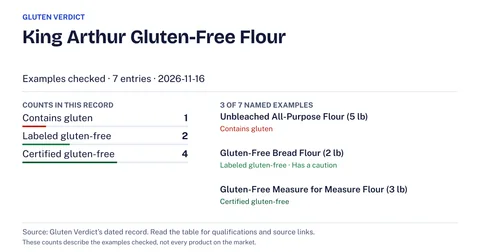 King Arthur Gluten-Free FlourCertified gluten-free1 of 7 varieties we checked contains gluten: Unbleached All-Purpose Flour (5 lb)Wheat warning on 2 of 7 varieties we checkedKing Arthur Baking Company · checked Nov 16, 2026
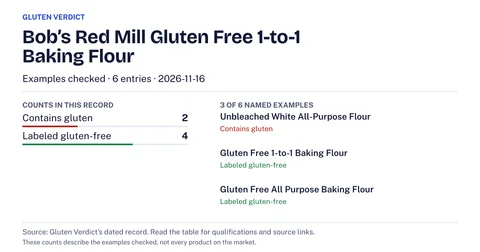 Bob’s Red Mill Gluten Free 1-to-1 Baking FlourLabeled gluten-free2 of 6 varieties we checked contain gluten: Unbleached White All-Purpose Flour and Whole Wheat FlourBob’s Red Mill Natural Foods · checked Nov 16, 2026
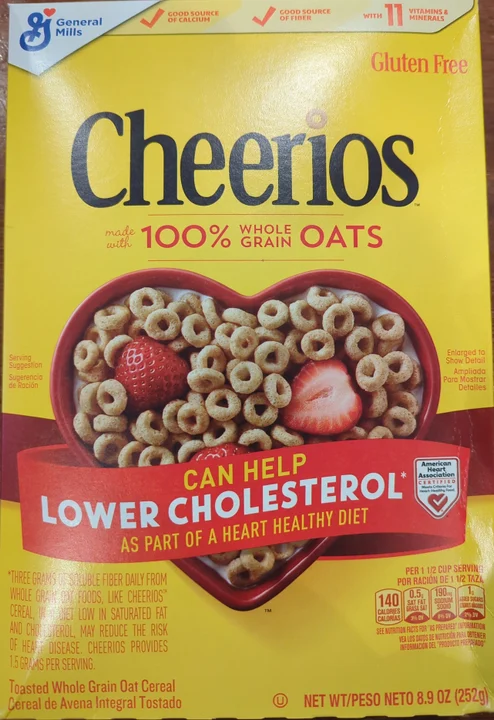 CheeriosLabeled gluten-freeWheat warning on 1 of 8 varieties we checkedGeneral Mills · checked Nov 16, 2026
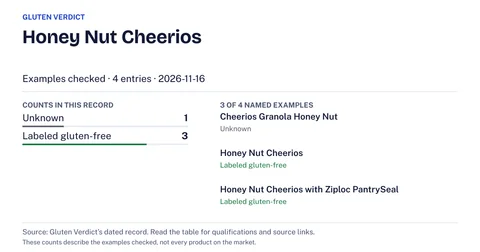 Honey Nut CheeriosLabeled gluten-freeGeneral Mills · checked Nov 16, 2026
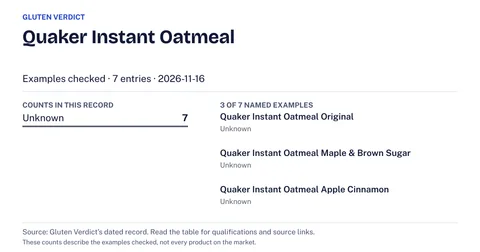 Quaker Instant OatmealUnknownThe Quaker Oats Company · checked Nov 16, 2026
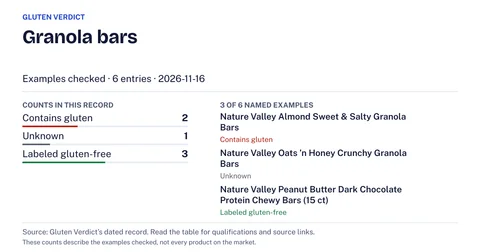 Granola barsDepends on the product2 of 6 products we checked contain gluten: Nature Valley Almond Sweet & Salty Granola Bars and Nature Valley Cinnamon Brown Sugar Soft-baked Oatmeal Squareschecked Nov 16, 2026
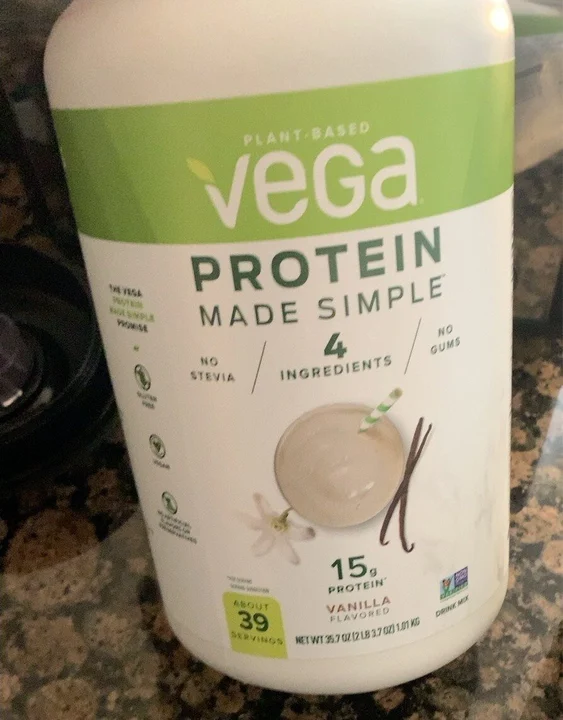 Protein powderDepends on the productchecked Nov 16, 2026
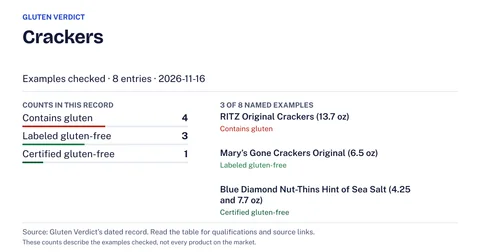 CrackersDepends on the product4 of 8 products we checked contain glutenchecked Nov 16, 2026
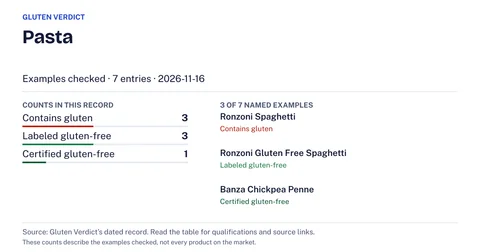 PastaContains glutenchecked Nov 16, 2026
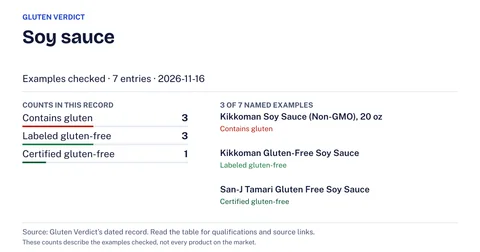 Soy sauceDepends on the product3 of 7 products we checked contain gluten: Kikkoman Soy Sauce (Non-GMO), 20 oz; San-J Organic Shoyu Soy Sauce; and Lee Kum Kee Premium Soy Sauce (No Preservatives Added)checked Nov 16, 2026
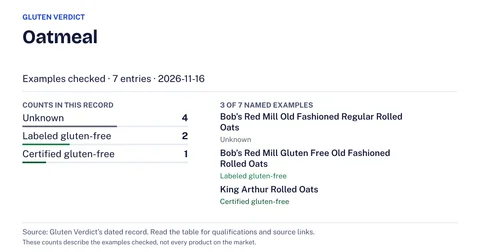 OatmealDepends on the productchecked Nov 16, 2026
Questions people ask
Is the gluten-free filter on a grocery site reliable?
Instacart says its gluten-free label applies to products that identify as free of the ingredient on the packaging or description17, and that its product information is not a substitute for checking the label16. We found no help page describing how other stores assign theirs, so read the ingredient list and the claim on each listing.
Does a certification logo in the product photo mean the product is certified?
For GFCO, a product is certified if it is on GFCO’s list and carries one of its marks; a listed product whose packaging lacks the mark is not certified12, 13. FDA says a logo’s use must be truthful and not misleading3.
More in Grocery shopping and meal planning
 Gluten-free grocery shopping: what to check at the shelf, the bulk bins and the checkoutOne reading order for any US supermarket pack, plus what to do about bulk bins, frozen cases, wheat starch and storage once the bags are home.
 A gluten-free grocery list by aisle for US supermarketsAn aisle-by-aisle gluten-free grocery list for US stores: what needs no label, what needs a check, and what stays off the list.
 Gluten-free grocery pickup and delivery: setting substitutions and checking swapsHow to set no-substitution choices on Instacart, Target and Whole Foods orders, check each swapped item at the door, and report a swap that fails.
 Store-brand gluten-free: what the tag, claim or seal rests onSort a store-brand item into certified, maker-stated or ingredient-only, see what each lets you conclude, and know what to ask the store.
 A gluten-free meal plan as a shopping template, by meal slotA weekly gluten-free shopping template: staples for each meal slot, the check each packaged item needs, and a ledger of when you last read each label.
 A starter gluten-free pantry: 30 shelf items and the label check for eachThirty shelf items for a first gluten-free pantry, tagged by the label check each needs, plus how to keep jars, toaster and colander apart at home.
Related guides
 How to check a gluten-free seal in the certifier's own directorySearch GFCO's Product Finder by brand, product or UPC, read what an entry shows, and learn what a missing listing means for the seal on your pack.
 What to ask a food maker about gluten, and how to read the replyHow to write to a food maker about gluten: what to include, questions that get a usable answer, and how to sort the reply.
 How to check whether a packaged food is gluten-freeA four-step check for one packaged food: the claim, the ingredient and allergen lines, the maker’s dated page and the certifier’s directory.
 A price-per-ounce worksheet for comparing gluten-free staples at any store, club or onlineA worksheet for comparing gluten-free staples by price per ounce across stores, clubs and online, with a column for the gluten-free statement.
Sources
- [1, 2, 3, 4, 5, 6, 26] US Food and Drug Administration, Questions and Answers on the Gluten-Free Food Labeling Final Rule, checked Nov 17, 2026.
- [7] US Food and Drug Administration, Gluten and Food Labeling, checked Nov 17, 2026.
- [8, 9] US Food and Drug Administration, Food Allergen Labeling and Consumer Protection Act of 2004 (FALCPA), checked Nov 17, 2026.
- [10, 11] US Food and Drug Administration, FDA Issues Request for Information on Food Labeling in Online Grocery Shopping, checked Nov 17, 2026.
- [12, 13, 27] Gluten Intolerance Group (GFCO), GFCO Product Finder, checked Nov 17, 2026.
Read on 2026-11-17: the page has a search box labeled “Name, Keywords, UPC”, a Brand filter, a Category list and a Sales Region list that includes US, below the note that certified products appear on the list and carry a certification mark.
- [14, 15, 29] Gluten Intolerance Group (GFCO), How Does GFCO Certify Gluten-Free Food?, checked Nov 17, 2026.
- [16, 17, 18, 19, 20] Instacart, Nutritional Information on Instacart, checked Nov 17, 2026.
- [21, 22, 23, 28] Instacart, Adding item and replacement instructions, checked Nov 17, 2026.
- [24, 25] Instacart, Report a problem with your order, checked Nov 17, 2026.