When a gluten-free label looks wrong: what to keep, who to tell, where to look
Short answer
In the US, keep the package and report the product to the agency that regulates it: FDA evaluates each report, and a report is not a finding1, 2. In four steps:
- Keep the package, and photograph the claim, the ingredient list and the lot code, expiration date and UPC code3, 4; for meat, poultry and egg products USDA also asks for any uneaten portion25.
- Tell the maker or the store if you want an answer from them; FDA’s report page does not ask you to do that first, and USDA says you can complain to the store or the maker if you choose not to make a formal complaint to USDA5, 6.
- Report to FDA for most packaged foods and supplements7, to USDA for meat, poultry and egg products8, and to state or local agencies for a restaurant or store9.
- Check the recall lists: FDA’s recalls list and Enforcement Report, and USDA’s recalls page10, 11, 12.
Part of Label reading and gluten-free claims, 17 guides
Key points
- A gluten-free claim and an ingredient list that does not fit together is a mismatch FDA names: it says malt extract and malt vinegar cannot be used in a food that bears the claim13, 14.
- FDA’s rule applies to packaged foods, including dietary supplements; reports about restaurant food go to state and local agencies15, 9.
- FDA’s coordinator phone numbers were retired on October 1, 2024; older pages that still send you to one are out of date16, 17.
- A product missing from a recall list is not cleared: FDA says not all recalls are posted on its recalls list10.
- A report does not decide the question: FDA says it evaluates each report to decide what follow-up is needed2.
What counts as a label problem
Under FDA’s definition, a gluten-free food either is inherently gluten free or contains none of these: a gluten grain as an ingredient; an ingredient made from one that was not processed to remove gluten; or an ingredient made from one that was processed to remove gluten, if its use leaves 20 parts per million (ppm) or more gluten in the food. Any unavoidable gluten must be under 20 ppm18. A food labeled gluten-free cannot be made on purpose with any amount of a gluten grain, or of an ingredient from one that was not processed to remove gluten19. The rule covers packaged foods, including dietary supplements15.
That makes some combinations a clear mismatch and others not. This table separates them.
| What you see | What FDA says |
|---|---|
| Malt extract, malt syrup or another similar malt-derived ingredient in a food that says gluten-free | These cannot be used in a food that bears a gluten-free claim13. |
| Malt vinegar in a food that says gluten-free | It cannot be used in a food that bears the claim14. |
| Soy sauce made with wheat that says gluten-free on its label | In general, soy sauce made from soybeans and wheat may not bear the claim20. |
| Wheat or wheat starch named in the ingredients of a food that says gluten-free | Not a violation by itself: an ingredient from a gluten grain can be used if it was processed to remove gluten and its use leaves the food under 20 ppm18. FDA adds that a food made with wheat processed to remove gluten, with a claim and wheat declared, must carry a disclaimer saying so21. |
| “Made in a facility that also processes wheat” next to a gluten-free claim | FDA allows the statement if it is truthful and not misleading22; the food must still meet the gluten-free rule18. |
| Wheat in a food with no gluten-free claim and no wheat declared | Wheat is one of the major food allergens named in the allergen labeling law; barley and rye are not named there23. Failure to list a major allergen is one reason FDA gives for recalls24. |
If your product falls in the first three rows, say so in your report and name the ingredient. If you are not sure, write down exactly what the label says and report it anyway; FDA states that labeling concerns may be reported3.
What to keep before you contact anyone
FDA’s advice, in its answer for a person who becomes ill after a product labeled gluten-free, is to keep any food packages because they may contain important information3. FDA also lists what it asks a report to include4. Put together, the list for a label problem is:
- The package. For meat, poultry and egg products USDA says it needs the original container and any uneaten portion, refrigerated or frozen25.
- Photos of the front claim, the full ingredient list, any Contains line, and the lot code, expiration date and UPC code. FDA’s list names the photos of the product, label, ingredient statement and lot code4.
- The store, its address and the date you bought it, which is also on FDA’s list4. Keep the receipt if you have one.
- A screenshot of the maker’s web page for the product, with the date. One entry on Gluten Free Watchdog’s list notes that a product’s ingredients list on the package differs from the one posted online26.
- If you had a reaction: the date, your symptoms, how long after eating they began, medications you used, and whether you needed medical care. That is the detail FDA’s list asks for4.
Tell the maker and the store
Telling the maker is a separate step from reporting. The FDA page for reporting a food problem lists the online portal and the phone line and does not ask you to contact the maker first5, and USDA says you can complain to the store or the maker if you choose not to make a formal complaint to USDA6. A message to the maker is the direct way to ask what is in the product; a report to an agency is how the problem reaches the regulator.
Name the product, the lot code and the ingredient or claim that does not fit, and attach your photos. Our guide on what to ask a food maker covers the questions and how to read the reply.
A maker may answer that an ingredient was processed to remove gluten. In one entry on Gluten Free Watchdog’s list, a maker replied that the barley in its tea “has been processed to allow to meet” FDA’s gluten-free requirements27. If you get that reply, ask where the label says so, since FDA says a food made with wheat processed to remove gluten, bearing a claim and declaring wheat, must carry a disclaimer to that effect21.
Which agency takes the report
| Product | Where it goes |
|---|---|
| Most packaged foods and dietary supplements | FDA. Its Food and Cosmetic Information Center takes complaints on FDA-regulated food and supplements28, through an online reporting portal or by phone on 1-888-723-33667. |
| Meat, poultry and egg products | USDA. Call the Meat and Poultry Hotline on 1-888-674-6854 or report online8. USDA’s online form accepts reports of mislabeling29. FDA’s own page sends meat and poultry problems to USDA30, and FDA regulates the labeling of shell eggs31. |
| Alcohol | TTB. FDA’s contact list gives TTB’s number as 202-453-2000 and says TTB handles consumer complaints about misleading advertising of alcoholic beverages32. For which agency rules on a drink’s label, see who regulates a gluten-free claim. |
| A restaurant, grocery store or other retail business | State and local regulatory agencies9. USDA’s page also sends restaurant problems to the health department in your city, county or state33. |
For unpackaged food, such as restaurant dishes, FDA says it will monitor reports and share the complaints it receives with state and local partners34.
If an older page tells you to call the FDA Consumer Complaint Coordinator for your state, it is out of date. A 2015 Celiac Disease Foundation post, for one, sends readers there35. FDA announced that the phone numbers tied to the coordinators would stop on October 1, 202416, and its coordinators page says the numbers are no longer in use17. FDA says its Human Foods Program now receives and evaluates complaints, and its Office of Inspections and Investigations follows up with firms as needed36.
If you were made ill
For a person who becomes ill after eating a product labeled gluten-free, FDA’s answer is to contact a healthcare provider immediately and keep the packages3. USDA’s page says, “If you think you are ill, see a physician”37. Our own guide, what the celiac organizations say to do after exposure, covers the next steps; this guide covers the report.
An illness report is separate from a labeling report, and you can make both. FDA says a report may be about an adverse event, which it describes as an illness or serious allergic reaction3, and FDA’s list asks for the symptoms and timing4.
Check the recall lists
Recalls for a wrong label are not limited to gluten claims. FDA names failure to list a major allergen on the label as a reason for a recall24. Wheat is one of the major food allergens named in the allergen labeling law, so a product with undeclared wheat can be recalled on that ground; barley and rye are not named there23. In the 2015 Cheerios case, General Mills recalled lots of Cheerios and Honey Nut Cheerios labeled gluten-free “due to the presence of wheat flour (an undeclared allergen)”38. Gluten Free Watchdog reports that recall notices for several sauces, posted to FDA’s enforcement report in December 202039, gave as the reason a gluten-free claim on a product with a fermented soy sauce made from wheat that was not processed to remove gluten40.
- FDA’s recalls list. It is built from press releases and public notices about certain recalls, and not all recalls have a press release or are posted there10. It has a recall-reason column and a product-type filter41.
- FDA’s Enforcement Report. It includes all recalls FDA monitors once they are classified, and sometimes earlier11.
- USDA’s recalls page for meat, poultry and egg products12. It lists current recalls and public health alerts42.
A recall notice helps you match your package: FDA says a recalling firm’s notice to its customers names the product, the package size and type, the UPC, product codes such as lot codes, sell-by or use-by dates, and where the product was sold43. Compare it with your photos.
Not being on FDA’s recalls list does not clear a product, since not all recalls are posted there10. Gluten Free Watchdog reports one recall that was initiated on January 4, 2021 but did not appear in any public FDA notification until April 11, 202244.
What a report does and does not do
FDA says it enforces the gluten-free rule through routine monitoring: sampling, inspections of food manufacturing facilities, label reviews, follow-up on consumer and industry complaints, and, when needed, gluten analyses of food samples1. It says it will consider regulatory action for products found to be misbranded case by case45. Each report is evaluated to decide how serious the problem is and what follow-up is needed2, and reports are logged in a complaint database46.
The 2015 Cheerios case shows one path from reported reactions to a recall. As the Celiac Disease Foundation reported it, FDA tested 36 samples of Cheerios products labeled gluten-free after adverse reactions were reported, and one sample of Honey Nut Cheerios contained 43 ppm of gluten47; the recall followed38. Our verdicts on Cheerios and Honey Nut Cheerios are the place to check where each product stands today.
For scale, FDA’s own sampling from July 2015 to August 201648 collected 702 samples from more than 250 products labeled gluten-free, and only one product was found not to comply with one of the major requirements49. FDA reported that more than 99.5 percent of the sampled products complied50. That sampling dates from 2015 to 2016 and covers one requirement; it does not tell you about your product.
Do not count on a ruling on your product, or on enforcement action, from a report alone. The author of Gluten Free Watchdog’s list writes that, to the best of the author’s knowledge, none of the products it reported to FDA with malt syrup or malt extract and a gluten-free label had been subject to any enforcement action by FDA51. That is one advocate’s account of the group’s own reports, not an FDA statement. It is a reason to keep your own record and to tell the maker as well.
Verdicts in this guide
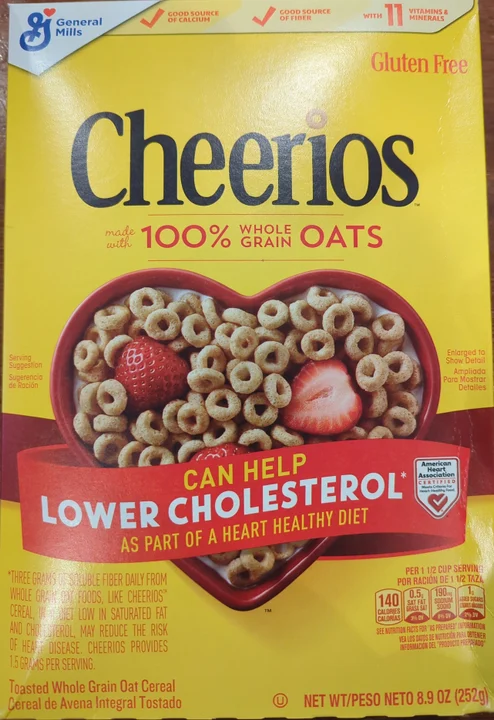 CheeriosLabeled gluten-freeWheat warning on 1 of 8 varieties we checkedGeneral Mills · checked Nov 16, 2026
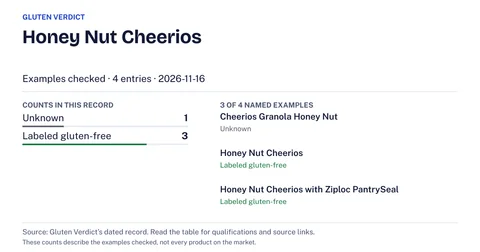 Honey Nut CheeriosLabeled gluten-freeGeneral Mills · checked Nov 16, 2026
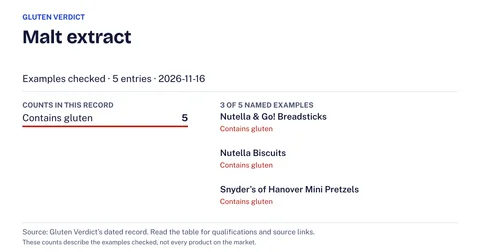 Malt extractContains glutenchecked Nov 16, 2026
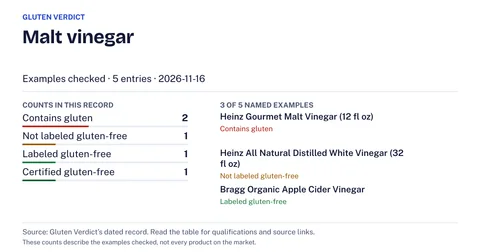 Malt vinegarContains glutenchecked Nov 16, 2026
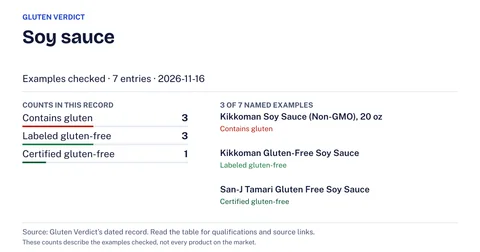 Soy sauceDepends on the product3 of 7 products we checked contain gluten: Kikkoman Soy Sauce (Non-GMO), 20 oz; San-J Organic Shoyu Soy Sauce; and Lee Kum Kee Premium Soy Sauce (No Preservatives Added)checked Nov 16, 2026
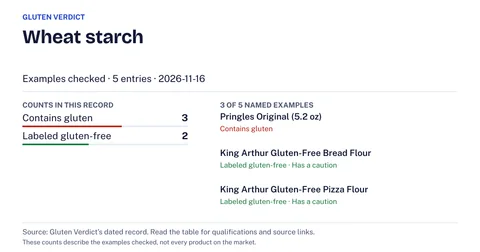 Wheat starchDepends on the product3 of 5 products we checked contain gluten: Pringles Original (5.2 oz), Jiffy Corn Muffin Mix, and Chex Mix Bold Garlic and Herbchecked Nov 16, 2026
Questions people ask
Do I have to contact the maker before reporting to FDA?
No. FDA’s report page lists the portal and the phone line without a maker step5. USDA notes that you can complain to the store or the maker if you do not make a formal complaint to USDA6.
Can I report a gluten-free item I was served in a restaurant?
FDA’s rule applies to packaged foods15. FDA says it will monitor reports about unpackaged food and share them with state and local partners34, and it points restaurant complaints to state and local agencies9.
Is wheat starch on a gluten-free label automatically a violation?
No. An ingredient from a gluten grain can be used if it was processed to remove gluten and its use leaves the food under 20 ppm18. Check the label for the disclaimer FDA describes for wheat processed to remove gluten21.
Does FDA test the product when I report it?
FDA lists gluten analyses of food samples “when needed” among its monitoring activities, together with sampling, inspections, label reviews and follow-up on complaints1.
More in Label reading and gluten-free claims
 How to read a US food label for glutenWhere gluten shows up on a US food label: the gluten-free claim, the Contains line, the ingredient list and may-contain lines, and what each means.
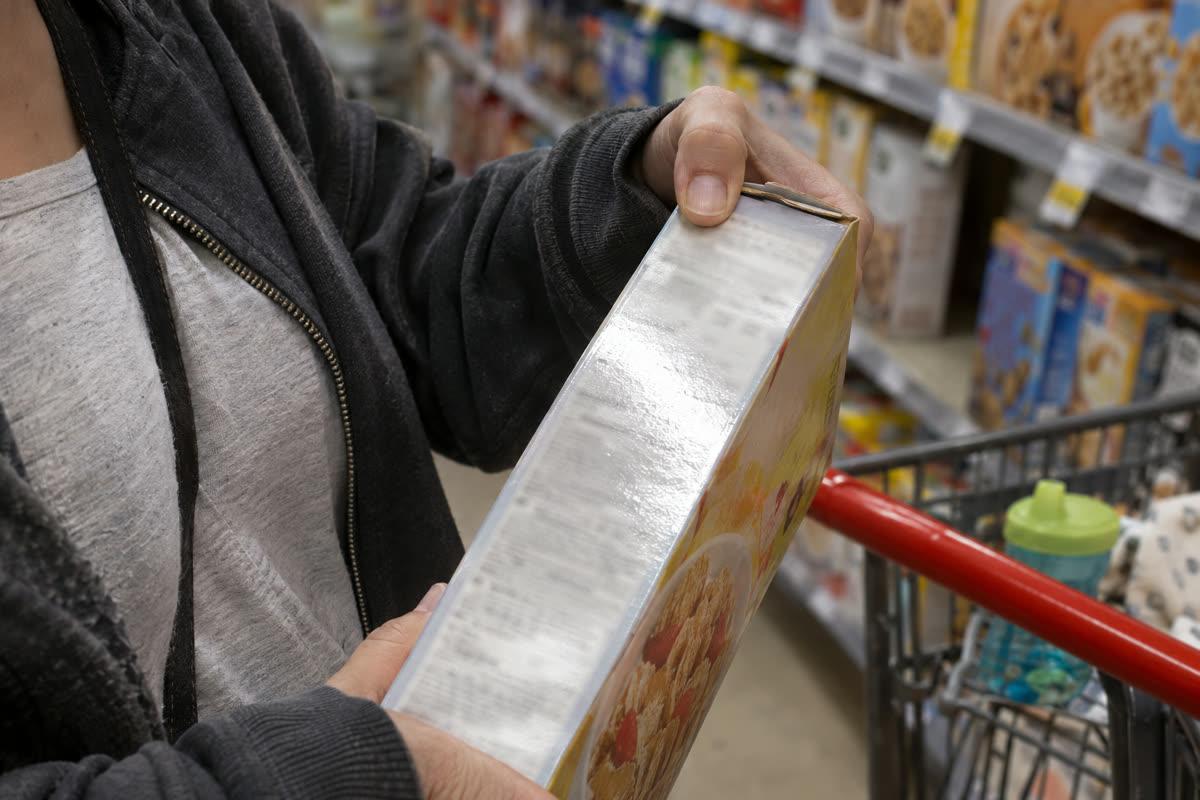 How to check whether a packaged food is gluten-freeA four-step check for one packaged food: the claim, the ingredient and allergen lines, the maker’s dated page and the certifier’s directory.
 The FDA gluten-free rule: what 21 CFR 101.91 requires and what 20 ppm measuresWhat FDA’s gluten-free rule requires, which claim words it covers, what 20 ppm means for a portion of food, and how FDA checks that a claim holds.
 Fermented, hydrolyzed and distilled foods: how a gluten-free claim is checkedHow FDA’s 2020 rule checks a gluten-free claim on fermented, hydrolyzed and distilled foods, why a test cannot settle it, and where TTB takes over.
 The Contains line names wheat, not barley or rye: what US allergen labels coverWhat the US allergen Contains line covers, why it names wheat but not barley or rye, and which ingredient-list names stand in for them.
 What “may contain wheat” and “made in a facility with wheat” mean on a US labelHow to read “may contain wheat”, shared-facility and shared-equipment lines on US labels, with and without a gluten-free claim, and what to check next.
Related guides
 What to ask a food maker about gluten, and how to read the replyHow to write to a food maker about gluten: what to include, questions that get a usable answer, and how to sort the reply.
 Who regulates a gluten-free claim: FDA, USDA or TTBWhich agency sets the rules for a gluten-free claim on packaged food, meat, eggs, beer, wine and spirits, and what to check when a label is unclear.
 Wheat, barley and rye on an ingredient list: the names to look forLook up wheat, barley and rye names on a US ingredient list, from durum to malt, and sort each as contains gluten, depends on the maker, or lookalike.
 Where wheat, barley and rye hide in processed food: 15 places to checkFifteen processed foods where wheat, barley or rye turn up, the label step that catches each, and what US allergen law does and does not flag.
Sources
- [1, 3, 4, 13, 14, 15, 18, 19, 20, 21, 22, 31, 34, 45] US Food and Drug Administration, Questions and Answers on the Gluten-Free Food Labeling Final Rule, checked Nov 17, 2026.
Read on 2026-11-17: the list under “Reports submitted to FDA should include as much information as possible, such as:” names who is reporting and who was affected; the name and address of the place where the product was purchased; a description of any reaction (the date, all symptoms, how long after eating or drinking it began, medications used, and whether further medical care was needed); and a description of the product (the date of purchase, any codes or identifying marks on the label or container such as lot number, expiration date and UPC code, and photos of the product, label, ingredient statement and lot code).
- [2, 5, 7, 9, 28, 30, 32] US Food and Drug Administration, Get Assistance from the FDA Human Foods Program (HFP), checked Nov 17, 2026.
Read on 2026-11-17: the “Report a Problem with Food or Dietary Supplements” section lists the online portal and the phone line as ways to report, and does not ask the reporter to contact the maker or the store first.
Read on 2026-11-17: the section headed “Report a Problem with Food or Dietary Supplements” says a consumer or health professional who wants to report voluntarily can use FDA’s online reporting portal, and that a person who wants to speak to someone can call the Food and Cosmetic Information Center on 1-888-723-3366, Monday to Friday 10:00 AM to 4:00 PM ET, closed Thursdays 12:30 PM to 1:30 PM ET and on federal holidays.
- [6, 8, 25, 33, 37] USDA Food Safety and Inspection Service, Report a Problem with Food, checked Nov 17, 2026.
Read on 2026-11-17: under “In order for the USDA to investigate a problem with meat, poultry or egg products, you must have:” the page lists the original container or packaging, any foreign object found in the product, and any uneaten portion of the food (refrigerate or freeze it).
- [10, 41] US Food and Drug Administration, Recalls, Market Withdrawals, & Safety Alerts, checked Nov 17, 2026.
Read on 2026-11-17: the list has columns for date, brand name(s), product description, product type, recall reason description, company name and terminated recall, and a Product Type filter that includes Food & Beverages; one entry dated 11/13/2026, for a dietary supplement, gives the recall reason “Contain undeclared milk.”
- [11] US Food and Drug Administration, Enforcement Reports, checked Nov 17, 2026.
- [12, 24, 43] US Food and Drug Administration, Food Recalls: What You Need to Know, checked Nov 17, 2026.
- [16, 36] US Food and Drug Administration, FDA Introduces Streamlined Complaint Process in New Human Foods Program, checked Nov 17, 2026.
- [17] US Food and Drug Administration, Consumer Complaint Coordinators, checked Nov 17, 2026.
- [23] US Food and Drug Administration, Food Allergen Labeling and Consumer Protection Act of 2004 (FALCPA), checked Nov 17, 2026.
- [26, 27, 39, 40, 44, 51] Gluten Free Watchdog, Running List of Potentially Misbranded Gluten-Free Products Reported to FDA & USDA by Gluten Free Watchdog, checked Nov 17, 2026.
- [29] USDA Food Safety and Inspection Service, Electronic Consumer Complaint Form (eCCF), checked Nov 17, 2026.
- [35, 38, 47] Celiac Disease Foundation, FDA investigates complaints associated with Cheerios labeled gluten free: General Mills voluntarily recalls affected lots, checked Nov 17, 2026.
- [42] USDA Food Safety and Inspection Service, Recalls & Public Health Alerts, checked Nov 17, 2026.
Read on 2026-11-17: the page lists current recalls and public health alerts from FSIS, each with the firm, the date, the states affected where given, and a description of the products, and it defines USDA recall classes I, II and III.
- [46] US Food and Drug Administration, Human Foods Complaint System (HFCS), checked Nov 17, 2026.
- [48, 49, 50] US Food and Drug Administration, FDA Sampling Finds High Level of Compliance with Gluten-Free Standards, checked Nov 17, 2026.