Teaching a child to read gluten-free labels, one skill at a time
Short answer
Teach label reading in four steps, one at a time. In preschool and lower elementary school, CDF says a high level of parent involvement is required in managing a child’s health condition1, so an adult confirms anything the child is unsure about. The order the Celiac Disease Foundation suggests:
Part of Kids, school, college and family, 21 guides

Key points
- Two sources tie label reading to reading level rather than an age: Stanford Children’s Health ties its label guidelines to “your child’s reading level”6, and Coeliac Australia says younger children can start with familiar packaging7.
- The Contains line covers wheat but not barley or rye, so a Contains line without wheat does not finish the check8, 9.
- Malt, barley and rye are the second lesson, found in the full ingredient list4.
- A food with no gluten-free claim is not an answer either way: FDA says makers of naturally gluten-free foods may leave the claim off10.
- When the child is unsure, ask an adult; when the adult is unsure, Stanford’s guide says to contact the manufacturer11.
In what order should a child learn label skills?
The Celiac Disease Foundation (CDF) gives a four-step order for children: recognize a “gluten-free” label2, then read the allergen warning for “Contains: wheat”3, then search the full ingredient list for “malt,” “barley” or “rye”4, and for advanced readers, treat oats as acceptable only when paired with a “gluten-free” label5.
Two of the sources we read tie label reading to reading level rather than an age. Stanford’s guide for parents ties its label guidelines to “your child’s reading level”6. Coeliac Australia says younger children can start by recognising familiar packaging, and that label reading comes once a child can confidently read7. We found no source that gives an age for each skill, so the ages below are our rough planning guide, not a rule.
| Stage (rough guide) | What the child learns | What the adult still does |
|---|---|---|
| Pre-reader, about 4 to 6 | Recognize familiar packages and the words “gluten-free”7, 2 | Reads every label. |
| Early reader, about 7 to 9 | Find the Contains line and look for the word wheat3 | Reads the full ingredient list. |
| Confident reader, about 10 to 12 | Search the ingredient list for malt, barley and rye, and check oats4, 5 | Confirms anything unfamiliar, any may-contain line and any food with no claim. |
Step 1: How does a child find the gluten-free claim?
Start with the words. On a food FDA regulates, “gluten-free”, “no gluten”, “free of gluten” and “without gluten” each mean the food must contain less than 20 parts per million (ppm) of gluten12. A child only has to learn to spot the words; what they promise is the adult’s part of the lesson.
Tell the child the claim can be anywhere: FDA’s rule does not require a specific place on the label13. Make it a search: how many places on this box can you find the words?
Certification logos are a separate thing to recognize. Some makers print a logo from a gluten-free certification program, and FDA does not endorse, accredit or recommend any particular program14. The Gluten Intolerance Group says its GFCO standard is twice as strict as FDA’s threshold of less than 20 ppm15. Which logos your family relies on is your call; teach the child to match those.
Teach “wheat-free” as a red flag, not a green light. Stanford’s guide says to remember that wheat-free does not necessarily mean gluten-free, because rye, barley and non-gluten-free oats contain gluten16.
Step 2: What can the Contains line tell a child?
US allergen law gives a maker two ways to name a major allergen: a line starting with “Contains” printed immediately after or next to the ingredient list17, or the food source in parentheses after the allergen’s name inside the list18.
Wheat is on the law’s list of major food allergens; barley and rye are not8. Stanford’s parent guide puts it in plain terms: if a food contains wheat it will be listed in the contains statement, but barley and rye are not included, so read the label9.
So the child’s job at this step is narrow: find the line, look for the word wheat. A line with no wheat does not clear the food, which is why Step 3 comes next. Parents can model the habit out loud; the National Celiac Association suggests thinking aloud with the child, for example “I am going to double check the label to make sure it is gluten free. Do you want to help me look?”19.
Step 3: Which words should a child search for in the ingredient list?
CDF’s third step is to search the full ingredient list for “malt,” “barley” or “rye”4. The Gluten Intolerance Group’s article for parents gives a short list of basics to avoid for children who can read, and notes that label reading can be complicated even for adults20. Its list21 is the one to put on a word card:
- Wheat, including wheat protein and types such as spelt, and wheat starch unless the product is labeled or certified gluten-free21
- Barley and malt, which is made from barley21
- Rye21
- Brewer’s yeast21
- Oats, unless they are certified or labeled gluten-free21
Give malt its own lesson, because it hides in breakfast foods. CDF’s school guide lists breakfast cereals that contain malt or malt flavoring among the foods with gluten-containing grains that must be eliminated from the diet22, and FDA says malt extract and malt syrup are derived from barley that has not been processed to remove gluten23. Our verdicts on malt extract and cereal show where the word turns up. For a longer list of hidden names, see where wheat, barley and rye hide in processed food.
Read the whole list every time. The Canadian Celiac Association’s parent workbook says to read food labels every time you shop, since ingredients in products can change without notice24. That is a Canadian charity’s advice; the habit applies to US packages too.
Step 4: What do oats, no-claim foods and may-contain lines mean?
CDF’s last step is for advanced readers: oats count as acceptable only when paired with a “gluten-free” label5. That fits FDA’s rule, under which oats labeled gluten-free must contain less than 20 ppm of gluten, and oats do not have to be certified to carry the claim25. Our oatmeal verdict shows what we read on oat products.
The hardest idea is that no claim is not an answer. CDF’s list of what an older child should know says foods do not have to be labeled gluten-free to be gluten-free, and that no label does not by itself mean a food contains gluten26; FDA says makers of foods that are free of gluten by nature may choose not to label them10. The same CDF list says to avoid naturally gluten-free grain-based products that are not labeled gluten-free, because they might have a higher risk of cross-contact, and names corn chips, rice or corn cereals, and oat-based granola or protein bars40. For the child, “no claim” is a reason to ask an adult.
CDF’s dining tips for middle and high school students add that chips and other snack foods should be labeled gluten-free, because of possible cross-contact in preparation and hidden ingredients like malt27.
Lines such as “made in a facility that also processes wheat” are voluntary, and FDA allows one on a food that also carries a gluten-free claim if the statement is truthful and not misleading28. For a child, a may-contain line is a reason to ask an adult, not something to decode alone. The parent’s version is in what “may contain wheat” means on a US label.
How can a family practice with packages from the cupboard?
Stanford’s guide calls labels a great teaching tool as children learn to read and identify gluten-free foods on their own29. Turn it into a game with three packages, such as a cereal, a cracker and a bag of oats:
- Round one, every age: the child finds the words “gluten-free”, or says there are none. Count how many places they found the words.
- Round two: find the Contains line and point to the word wheat if it is there.
- Round three: run a finger along the ingredient list and stop at malt, barley, rye or anything else on the word card.
- Final round: the child says “I think it has gluten”, “I think it does not” or “I am not sure”. The adult checks. “I am not sure” is always an acceptable answer.
Check the child’s answers against our verdicts, which show what the pages and ingredient lists we read said, and the date we read them: cereal, Cheerios, Honey Nut Cheerios, oatmeal, Goldfish and Cheez-It. Packages change, so repeat the game when a favorite arrives in new packaging.
What does the child still ask an adult about?
CDF notes that in preschool and lower elementary school a high level of parent involvement is required, because children do not yet understand long-term consequences to their health or have the communication skills to assert their needs in new environments1. Label reading follows the same path: the child builds the skill, and the adult keeps the final check. These are the questions that always go to an adult:
- Any word the child cannot read or does not recognize.
- Any food with no gluten-free claim, because makers of naturally gluten-free foods may leave it off10 and CDF says to avoid unlabeled grain-based products40.
- Any may-contain or shared-facility line28.
- Foods from other countries: Stanford’s guide says standards for them can vary, so use caution30.
- Any food with no ingredient list: CDF’s dining tips for middle and high school students say to avoid anything without one, or search for the product online to review the ingredients31.
- Anything the adult cannot settle either: Stanford’s guide says to contact the manufacturer directly11.
How do these skills work at friends’ houses, parties and menus?
Labels are only part of eating away from home. CDF suggests keeping snacks or frozen meals at friends’ houses for play dates32, and calling ahead about the menu for parties and other social events33. It also suggests practicing at home and with family how the child talks about their needs, including not eating gluten-containing foods when offered34. Stanford’s guide adds speaking to the parents of your child’s friends and encouraging your child to do the same35.
At a restaurant, an older child can borrow a label habit: CDF’s guidance for teens is to ask to see labels of foods if staff are unsure of the ingredients36. For school meals and lunchboxes, see school lunches and classroom snacks and the 504 plan guide.
When can a child take over more of the label checking?
CDF’s guidance for middle and high school says teens can and should become proficient at reading food labels, and encourages parents to have the child be responsible for all of their food choices37. Stanford’s guide says that as a child grows older they will become more independent, especially about food choices and eating out38. Hand over one more skill at a time, starting with the one the child already does without help.
Verdicts in this guide
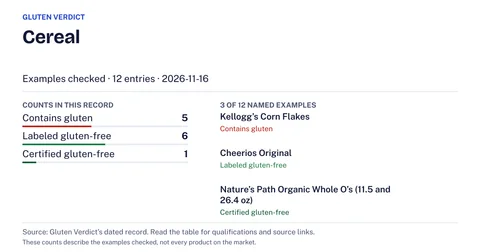 CerealDepends on the product5 of 12 products we checked contain glutenchecked Nov 16, 2026
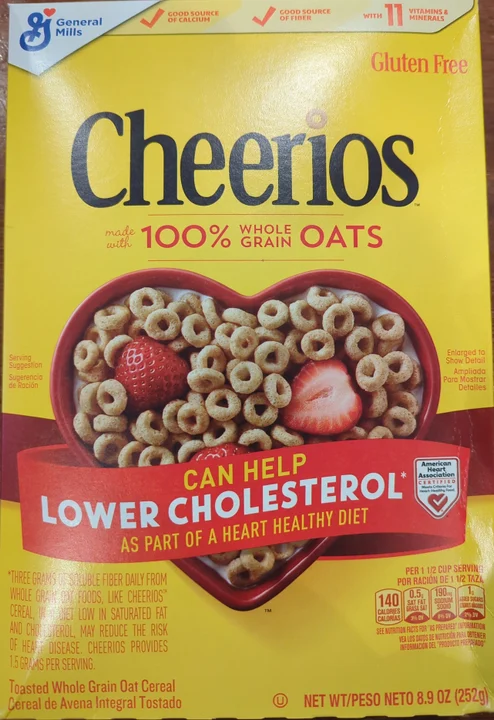 CheeriosLabeled gluten-freeWheat warning on 1 of 8 varieties we checkedGeneral Mills · checked Nov 16, 2026
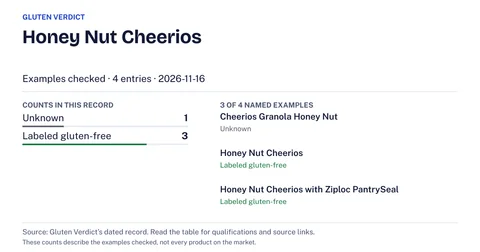 Honey Nut CheeriosLabeled gluten-freeGeneral Mills · checked Nov 16, 2026
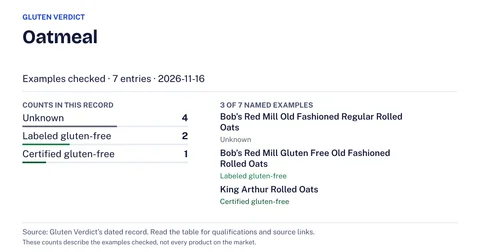 OatmealDepends on the productchecked Nov 16, 2026
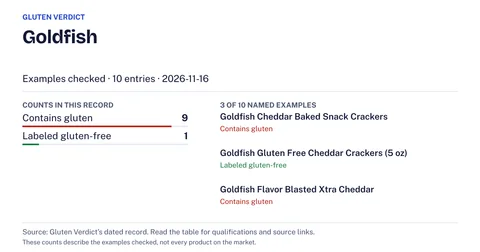 GoldfishContains glutenPepperidge Farm · checked Nov 16, 2026
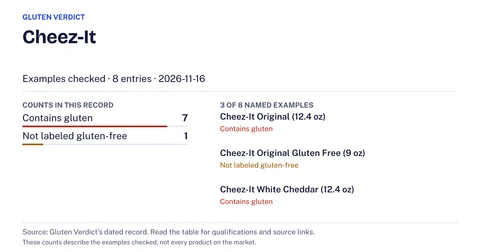 Cheez-ItContains glutenCheez-It · checked Nov 16, 2026
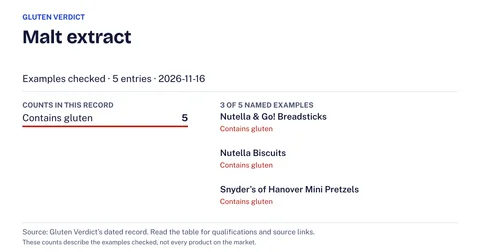 Malt extractContains glutenchecked Nov 16, 2026
Questions people ask
At what age can a child read gluten-free labels alone?
No source we read gives one age. Stanford ties label reading to a child’s reading level6, Coeliac Australia to when a child can confidently read7, and CDF says to expect a high level of parent involvement in preschool and lower elementary school1.
More in Kids, school, college and family
 Your child has celiac disease: a first-week plan for the kitchen, labels, school and talking to your childThe first week after a child’s celiac diagnosis, in order: the diet plan, first labels, kitchen, two school routes, talking to your child and follow-up.
 A care sheet for the babysitter or grandparent of a child with celiac diseaseA one-page care sheet for a babysitter or grandparent: the checked foods, the kitchen cross-contact points, what to do after an exposure, and whom to call.
 Gluten-free school lunches and classroom snacks: a checklist for parentsHow to prove each lunchbox item, read a snack label for oats, malt and wheat, brief the teacher, and when the school cafeteria is the better route.
 A gluten-free child who refuses food: what to track and when to ask the doctorHow to tell ordinary picky eating from a pattern to raise with your child’s doctor or dietitian, what ARFID is, and a one-week log to bring.
 Going gluten-free as a family: choose the household rule, then fix the kitchenAll gluten-free, shared with rules or split: what NIDDK, the charities and one small study say, plus rules for siblings and visiting relatives.
 Why Goldfish, Cheez-It and Nutri-Grain contain gluten, and what a swap has to showSee the wheat ingredient in Goldfish, Cheez-It and Nutri-Grain in each maker's words, then check any swap against a gluten-free claim or certifier mark.
Related guides
 How to read a US food label for glutenWhere gluten shows up on a US food label: the gluten-free claim, the Contains line, the ingredient list and may-contain lines, and what each means.
 What “may contain wheat” and “made in a facility with wheat” mean on a US labelHow to read “may contain wheat”, shared-facility and shared-equipment lines on US labels, with and without a gluten-free claim, and what to check next.
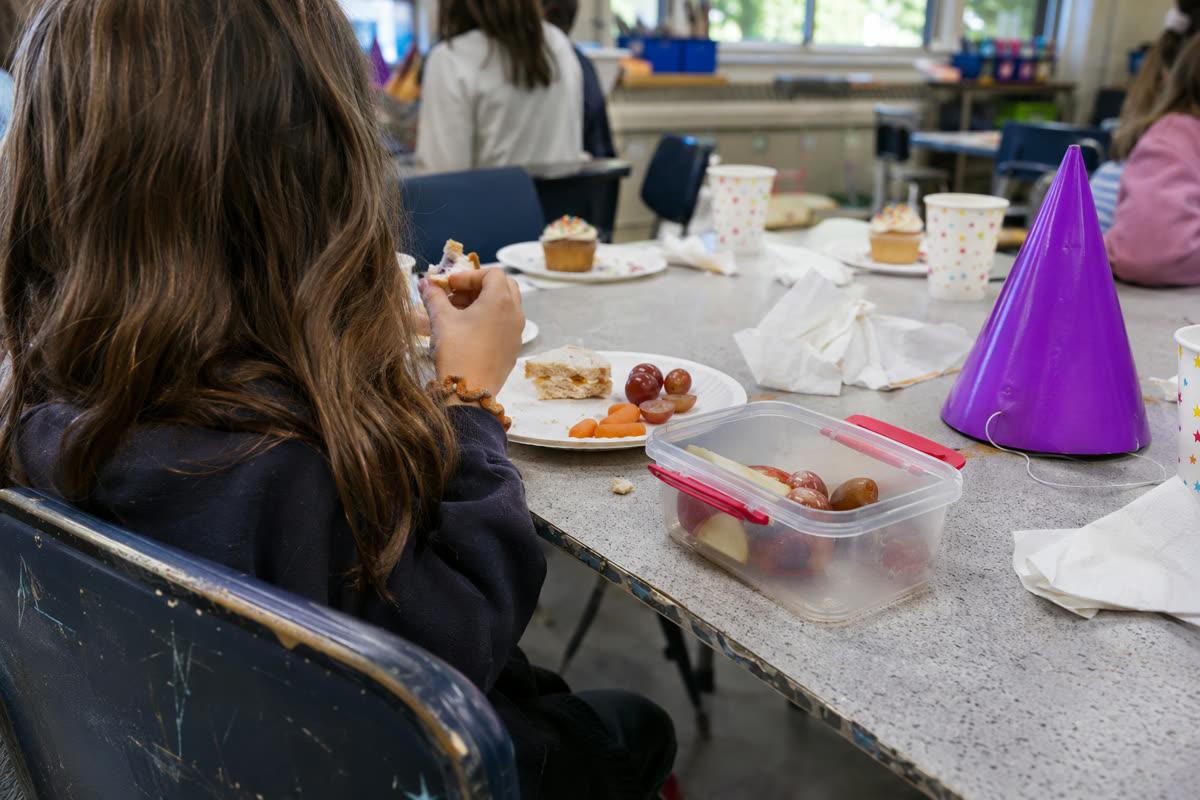 Helping a gluten-free child feel included at the table, at parties, in class and at restaurantsOne plan for each place a gluten-free child gets singled out: the table, parties, class and restaurants, with a sentence the child can say.
 Celiac disease in teenagers: friends, eating out and taking over their own careWhat research and celiac charities say about teenagers with celiac disease: telling friends, eating out, taking over care and clinic follow-up.
Sources
- [1, 2, 3, 4, 5, 22, 26, 27, 31, 32, 33, 34, 36, 37, 40] Celiac Disease Foundation, Back-to-School with Your Gluten-Free Child (parent guide, PDF), checked Nov 17, 2026.
- [6, 9, 11, 16, 29, 30, 35, 38] Stanford Medicine Children’s Health, Celiac Disease Resource Guide for a Gluten-Free Diet (PDF), checked Nov 17, 2026.
- [7] Coeliac Australia, Parents’ guide for children with coeliac disease (PDF), checked Nov 17, 2026.
- [8, 17, 18] US Food and Drug Administration, Food Allergen Labeling and Consumer Protection Act of 2004 (FALCPA), checked Nov 17, 2026.
- [10, 23, 25, 28] US Food and Drug Administration, Questions and Answers on the Gluten-Free Food Labeling Final Rule, checked Nov 17, 2026.
- [12, 13, 14] US Food and Drug Administration, Gluten and Food Labeling, checked Nov 17, 2026.
- [15] Gluten Intolerance Group, 3 Tips for Gluten-Free Label Reading, checked Nov 17, 2026.
- [19] National Celiac Association, How can I help my child handle their anxiety?, checked Nov 17, 2026.
- [20, 21, 39] Gluten Intolerance Group, Importance of Teaching Kids Kitchen Skills, checked Nov 17, 2026.
Read on 2026-11-17: the list under “kids can get started looking for the basic things to avoid” names wheat (including wheat starch and wheat protein, and types of wheat such as spelt); barley; malt (a derivative of barley); rye; brewer’s yeast; and oats, unless they are certified or labeled gluten-free. A footnote on wheat starch says it could be gluten-free if sufficiently processed and limits that to wheat starch in products labeled or certified gluten-free.
- [24] Canadian Celiac Association, Growing Up Celiac: a workbook for parents raising children with celiac disease (PDF), checked Nov 17, 2026.