Gluten-free certification programs compared: limit, testing and audits
Short answer
FDA’s gluten-free rule applies to every “gluten-free” claim, seal or no seal: any unavoidable gluten must be less than 20 parts per million1, 2. A certification seal adds a private program’s own requirements, which differ: GFCO states 10 ppm3, the National Celiac Association says GFFP certifies to 5 ppm or less4, and NSF says its certification assures a product does not contain gluten over FDA’s 20 ppm limit13. The BRCGS-based marks are audited by approved certification bodies5; Celiac Canada says that for products bearing its own trademark, certification includes final product testing for less than 20 ppm6.
Part of Label reading and gluten-free claims, 17 guides
Key points
- FDA’s rule covers every “gluten-free” claim, and a seal is voluntary: GFCO itself says its program is not a requirement for gluten-free labeling7, and FDA does not endorse any particular program8.
- The limits differ by program: GFCO 10 ppm3, GFFP 5 ppm or less per the National Celiac Association4, NSF a product not over FDA’s 20 ppm limit by its own description13, and, for products bearing the Celiac Canada trademark, final product testing for less than 20 ppm per Celiac Canada6, against FDA’s less than 20 ppm1.
- The programs check different things: GFCO reviews the manufacturer’s products and ingredients and audits every facility each year9, 10; the BRCGS standard is a management-system standard audited by an approved certification body11, 5.
- GFCO certifies products, not brands or facilities, so check the product in your hand rather than the brand12.
What a seal adds to the FDA claim
FDA’s regulation sets the requirements for any voluntary “gluten-free” claim2. Among them, any unavoidable gluten in the food must be less than 20 ppm1. The rule does not require manufacturers to test for gluten14, and FDA lists taking part in a third-party certification program as one of the quality control tools a maker may choose15.
Certification sits beside the claim, not in place of it. GFCO describes its program as independent and third-party, one that “does not enforce federal regulations” and “is not a requirement for gluten-free product labeling”7. FDA allows a certification logo on a label when its use is truthful and not misleading, and says it does not endorse, accredit or recommend any particular program8.
FDA says that currently it has no plans to authorize third parties to inspect facilities or to verify the regulatory definition16. It enforces the rule through its own post-market monitoring, which includes sampling and periodic inspections of manufacturing facilities17.
Read a seal together with the rest of the pack. How to read a US food label for gluten goes through the claim, the Contains line and the ingredient list.
The programs side by side
The table uses the pages cited in each cell: each program’s own, except GFFP’s limit (from the National Celiac Association) and the BRCGS-based testing figure (from Celiac Canada). A cell that says “not on the page” means we looked and the page did not give it; we did not fill gaps from other sites.
| Program | Run by | Gluten limit | Testing | Audit |
|---|---|---|---|---|
| FDA “gluten-free” claim (no seal needed) | US government rule, enforced by FDA17 | Any unavoidable gluten less than 20 ppm1 | Makers are not required to test14 | No third-party inspectors authorized; FDA uses routine monitoring, including periodic inspections16, 17 |
| GFCO (Gluten-Free Certification Organization) | A program of the Gluten Intolerance Group, a 501c3 non-profit18 | Starting ingredients and finished products below 10 ppm, or the country’s limit if lower3 | High-risk ingredients tested per lot; established brands send testing results to GFCO every quarter; random sampling of products on sale19, 20, 21 | Annual in-person audit at every facility making certified products10 |
| GFFP (Gluten-Free Food Program) | Established by the Celiac Sprue Association in 200422 | 5 ppm or less of gluten, per the National Celiac Association4 | Not on the pages we read23, 35 | GFFP says it conducts ongoing monitoring and audits to ensure continued compliance; no interval on the pages we read35, 23 |
| BRCGS Global Standard Gluten-Free (its certified sites may use the Beyond Celiac mark in the US)24 | BRCGS owns the standard25; Celiac Canada says it is licensed to Beyond Celiac in the US11 | Celiac Canada says certification for products bearing its trademark includes final product testing for less than 20 ppm6; the BRCGS guide gives no figure26 | A systems-based, HACCP approach from supply to packaging, plus final product testing, per Celiac Canada27, 6 | On-site audit by an approved certification body5, 28; the guide gives no interval26 |
| NSF gluten-free certification | NSF13 | NSF says its certification assures a product does not contain gluten over FDA’s 20 ppm limit13 | No test method or sampling plan on the page we read13 | NSF says certified products are made in a facility that prevents cross-contamination; no audit interval on the page we read13 |
The figures are each program’s own wording or a charity’s description of it, and they do not measure the same thing: GFCO’s applies to starting ingredients and finished products3, NSF’s is a statement of what its certification assures13, and the BRCGS-based figure is final product testing6. Read each as that source describes it.
GFCO: certification of products by a non-profit’s program
GFCO certifies physical products that display its mark; it does not certify brands or manufacturing facilities12. A product counts as certified when it is on GFCO’s product list and carries one of its marks29, and GFCO says a product on the list whose packaging lacks the mark is not certified30.
GFCO risk-rates ingredients: all grains are high-risk, oats get its highest risk level, and every high-risk ingredient must be tested per lot before it goes into a finished product19. If a certified brand finds gluten above 10 ppm in a product or ingredient, it must send GFCO the result before the product leaves the production facility31.
On accreditation, GFCO says its certification body is accredited to ISO 17065 and its auditing services to ISO 17021 or 1706532. It also contrasts itself with other programs: unlike certifications “which only audit record-keeping”, it says, GFCO reviews the manufacturer’s products and ingredients and tailors testing to risk9. That is GFCO’s description of its own program; we did not check it against other programs’ standards.
GFCO says a brand must keep meeting its standard at each audit, gets no automatic renewal and cannot buy the right to use the mark33.
A certified product can still contain a processed wheat ingredient. GFCO’s FAQ says the wheat would need to be processed to remove all protein, wheat starch being the most common example, and the ingredient would need to meet GFCO’s 10 ppm threshold34.
GFFP, the program the Celiac Sprue Association started
The National Celiac Association’s page on certified products says the Gluten-Free Food Program was established in 2004 by the Celiac Sprue Association and was the first program to certify manufacturers and brands as gluten-free in the United States22. It also says GFFP certifies manufactured products to 5 ppm or less of gluten4.
That page gives no audit frequency, testing schedule or ingredient rules23. GFFP’s own page for manufacturers says it conducts ongoing monitoring and audits to ensure continued compliance, and names no interval35.
The BRCGS Global Standard Gluten-Free and the Beyond Celiac mark
Celiac Canada says the Global Standard Gluten-Free was created by Celiac Canada and the Allergen Control Group in 2011 as a management system that helps manufacturers control gluten risk, and that it is licensed to Beyond Celiac in the United States11. It says BRCGS currently owns the standard25.
BRCGS’s own guide describes a systems-based approach to preventing gluten contamination36. Audits are delivered by approved certification bodies5: the auditor observes procedures and processes, reviews documentation and interviews staff28. The guide names the Beyond Celiac trademark in the USA among the on-pack trademarks certified sites may use24.
Celiac Canada says the standard differs from other programs because it is built on HACCP principles27, and that, for products bearing its trademark, certification includes final product testing for less than 20 ppm of gluten6. It adds that products bearing the Celiac Canada trademark cannot intentionally include gluten-containing ingredients in any concentration, including ingredients processed to remove gluten37. That is a rule for the Celiac Canada trademark; we could not read the equivalent for the Beyond Celiac mark.
So two certified products can differ on wheat starch: GFCO’s FAQ allows it when it meets 10 ppm34, and Celiac Canada says its own trademark does not37.
NSF, and programs outside the US
NSF’s gluten-free page says NSF gluten-free certification assures consumers that the product does not contain gluten over FDA’s allowable limit of 20 ppm and that it is manufactured in a facility that prevents cross-contamination13. The page names no test method, sampling plan or audit interval.
Outside the US the programs differ again. Coeliac UK says that food certified under its Crossed Grain Trademark scheme has been through extra checks, including checking gluten analysis certificates and independent audits of how they are manufactured38. Country limits and claim wording are in gluten-free labeling rules by country, and Canada has its own page: gluten-free labeling in Canada.
Self-declared logos and how to check a seal
A generic gluten-free logo names no program. The National Celiac Association’s page says it is common for manufacturers to self-declare rather than certify, and that it is a frequent practice to set a gluten threshold as high as 20 ppm, the legal maximum39. Whatever the logo, the food still has to meet FDA’s rule1, and a maker that states a lower figure on the label is saying each food contains no more than that amount40.
To check a seal on a pack in your hand:
- Find the program’s name on the mark. A logo with no program name gives you nothing to look up.
- Look the product up in that program’s own product list. GFCO counts a product as certified only if it is on its list and carries its mark29, 30.
- Compare the pack with the list entry (brand, product name, size) and read the ingredient list as usual. Certified or naturally gluten-free covers when a seal matters.
Where our verdicts mention seals
Our verdicts record what each maker says about certification and what GFCO’s directory returned when we searched it. Examples: King Arthur gluten-free flour, Barilla pasta, Krusteaz gluten-free flour, Bob’s Red Mill 1-to-1 baking flour and almond milk. GFCO certifies products, not brands12, so check the product in your hand rather than assuming the brand’s other products are certified.
Verdicts in this guide
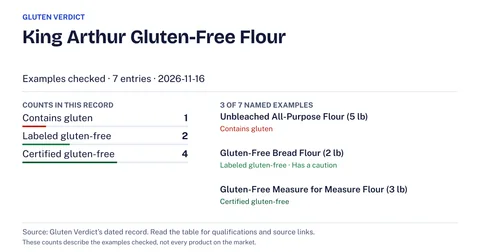 King Arthur Gluten-Free FlourCertified gluten-free1 of 7 varieties we checked contains gluten: Unbleached All-Purpose Flour (5 lb)Wheat warning on 2 of 7 varieties we checkedKing Arthur Baking Company · checked Nov 16, 2026
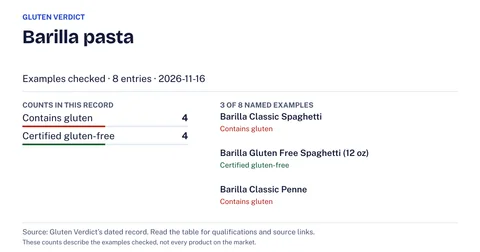 Barilla pastaContains glutenBarilla America, Inc. · checked Nov 16, 2026
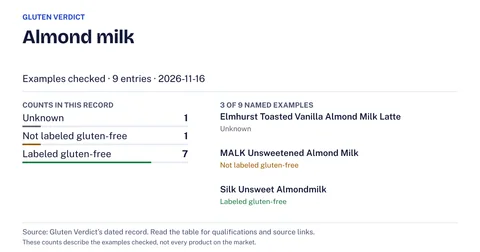 Almond milkNaturally gluten-freechecked Nov 16, 2026
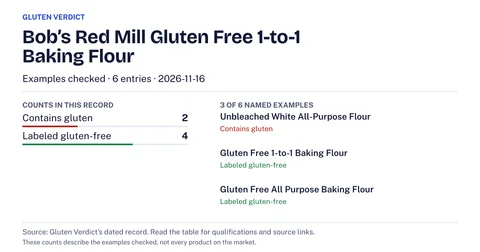 Bob’s Red Mill Gluten Free 1-to-1 Baking FlourLabeled gluten-free2 of 6 varieties we checked contain gluten: Unbleached White All-Purpose Flour and Whole Wheat FlourBob’s Red Mill Natural Foods · checked Nov 16, 2026
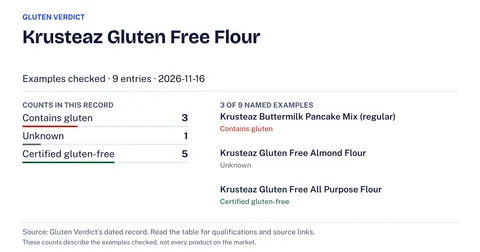 Krusteaz Gluten Free FlourCertified gluten-free3 of 9 varieties we checked contain gluten: Krusteaz Buttermilk Pancake Mix (regular), Krusteaz Honey Cornbread Muffin Mix (regular), and Krusteaz Pie Crust Mix (regular)Krusteaz · checked Nov 16, 2026
Questions people ask
Is a certification seal required to say “gluten-free”?
No. FDA’s rule governs the voluntary claim2, and GFCO says its program is not a requirement for gluten-free product labeling7.
Does FDA recommend one certification program?
No. FDA says it does not endorse, accredit or recommend any particular third-party program8.
What limits do the programs state?
Of the programs we could read: GFCO states 10 ppm3; the National Celiac Association says GFFP certifies to 5 ppm or less4; NSF says its certification assures a product does not contain gluten over FDA’s 20 ppm limit13; and Celiac Canada says that, for products bearing its trademark, certification under the Global Standard Gluten-Free includes final product testing for less than 20 ppm6. FDA’s claim requires less than 20 ppm1.
Can a certified product contain wheat?
GFCO’s FAQ says it is possible when the wheat was processed to remove all protein, such as wheat starch, and the ingredient meets GFCO’s 10 ppm threshold34.
More in Label reading and gluten-free claims
 How to check a gluten-free seal in the certifier's own directorySearch GFCO's Product Finder by brand, product or UPC, read what an entry shows, and learn what a missing listing means for the seal on your pack.
 The FDA gluten-free rule: what 21 CFR 101.91 requires and what 20 ppm measuresWhat FDA’s gluten-free rule requires, which claim words it covers, what 20 ppm means for a portion of food, and how FDA checks that a claim holds.
 How to check whether a packaged food is gluten-freeA four-step check for one packaged food: the claim, the ingredient and allergen lines, the maker’s dated page and the certifier’s directory.
 Vegan, organic, non-GMO, natural and keto labels do not mean gluten-freeVegan, organic, non-GMO, natural, plant-based and keto labels describe other things. What each claims, and which gluten claim or source to check instead.
 What to ask a food maker about gluten, and how to read the replyHow to write to a food maker about gluten: what to include, questions that get a usable answer, and how to sort the reply.
 Certified or naturally gluten-free: when a seal mattersWhich naturally gluten-free foods are worth buying with a claim or seal: produce, grains, flours, oats and processed foods, with FDA rules and test data.
Related guides
 Gluten-free logos outside the US: who issues each one and what it requiresTell a certifier’s gluten-free logo from a maker’s own: who issues Crossed Grain, Coeliac Australia’s and Celiac Canada’s marks, and the limit each sets.
 Gluten-free flours and starches: what each one is and how to read the bagWhich flours and starches are gluten-free by nature, what a claim and a certification mark on the bag each mean, and how to read a blend’s list.
 Folic acid in gluten-free foods: how to check the labelUS rules require folic acid in enriched flour, not in every product. Where to look on a label, and what CDC and FDA say.
 1-to-1, all-purpose and bread flour blends: what each maker’s page says the bag is forWhat King Arthur and Bob’s Red Mill say their 1-to-1, all-purpose, bread and pizza gluten-free flours are for, and which bakes each sends elsewhere.
Sources
- [1, 2, 8, 14, 15, 16, 17, 40] US Food and Drug Administration, Questions and Answers on the Gluten-Free Food Labeling Final Rule, checked Nov 17, 2026.
Read on 2026-11-17: the answer to “Are manufacturers required to test for gluten to make a “gluten-free” claim on their food labels?” lists four quality control tools a maker may choose: in-house testing of ingredients or finished foods, a third-party laboratory, certificates of gluten analysis from ingredient suppliers, and participating in a third-party “gluten-free” certification program.
- [3, 9] Gluten-Free Certification Organization (GFCO), GFCO home page, checked Nov 17, 2026.
- [4, 22, 23, 39] National Celiac Association, Certified Gluten-Free Products, checked Nov 17, 2026.
Read on 2026-11-17: the page gives GFFP’s 5 ppm limit and describes its logos for manufacturers, food service establishments and hospitality venues; it gives no audit frequency, no testing schedule and no ingredient rules.
- [5, 24, 26, 28, 36] BRCGS, Gluten-Free Standard: Guide to Certification, checked Nov 17, 2026.
Read on 2026-11-17: the guide gives no gluten limit in ppm and no audit interval.
- [6, 11, 25, 27, 37] Celiac Canada, Certification: what is the Global Standard Gluten-Free?, checked Nov 17, 2026.
- [7, 18, 32] Gluten-Free Certification Organization (GFCO), About Us, checked Nov 17, 2026.
- [10, 12, 19, 20, 21, 31] Gluten Intolerance Group, How Does GFCO Certify Gluten-Free Food?, checked Nov 17, 2026.
- [13] NSF, Gluten-Free | NSF, checked Nov 17, 2026.
- [29, 30] Gluten-Free Certification Organization (GFCO), GFCO Product Finder, checked Nov 17, 2026.
- [33] Gluten Intolerance Group, New GFCO Certification Mark, checked Nov 17, 2026.
- [34] Gluten Intolerance Group, Is it possible for an item that contains wheat to be certified gluten-free? (GIG FAQ), checked Nov 17, 2026.
- [35] Gluten-Free Food Program, GFFP certification for manufacturers, checked Nov 17, 2026.
- [38] Coeliac UK, Look out for our Crossed Grain symbol, checked Nov 17, 2026.