WIC and gluten-free food: what the package includes and how to ask for a substitution
Short answer
WIC has no single gluten-free list: the federal rule sets the food categories and each state names the brands, so the answer sits on your state's list and at your clinic1, 2, 6. Work through it in this order:
- Open your state's current approved-foods list and look for a gluten-free mark or a gluten-free bread or grain entry: Florida's and Oklahoma's lists use “GF = Gluten Free”, and Oregon's names gluten-free whole grain breads3, 4, 5.
- Check each product you pick against its package, because the federal cereal, bread and whole grain tables do not mention gluten and a food labeled gluten-free has to meet FDA's rule of less than 20 parts per million6, 7.
- Ask the clinic what it offers in place of a wheat-based item: states such as Virginia and Minnesota point to gluten-free cereals, rice and corn tortillas8, 9.
- Ask whether it wants a note from a health care provider. The federal list of foods that need medical documentation names formula and Food Package III foods, not cereal or bread10.
Part of Cost, taxes and food assistance, 14 guides

Key points
- WIC's standard packages for children 1 to 4 and for women include breakfast cereal and whole wheat or whole grain bread, and the federal rule requires a state to authorize whole wheat or whole grain bread11, 12, 13.
- Whole wheat bread contains gluten, while whole grain bread may or may not, depending on the grain, as USDA put it in 202415.
- Other whole grains are a state option, and the federal list of them includes gluten-containing grains such as bulgur, barley, triticale and whole wheat products next to brown rice and corn tortillas13, 16, 25.
- USDA encourages state agencies to authorize whole grain breads without gluten as participants need them, while each state identifies the brands acceptable there17, 1.
- Whether a clinic wants a provider's note for a grain swap is not answered by the federal list; ask it, and bring the state list with you10.
Who decides what is on the list: the federal rule or your state?
WIC food packages are built from categories the federal rule sets. For a child aged 1 to 4, and for a pregnant woman, the categories include breakfast cereal and whole wheat or whole grain bread, alongside milk, eggs, fruits and vegetables, legumes and/or peanut butter, juice and canned fish11, 12.
The state then chooses what goes on its own list. Each state agency identifies the brands and package sizes that are acceptable in that state1, and it may add criteria on top of the federal minimums2. Two states' lists can therefore differ, which is why this guide reports what each state says rather than one national answer.
USDA wrote in the 2024 final rule that WIC state agencies are best positioned to decide which whole grain options to authorize for their participants18. The same rule left room for variety: it names spelt among the examples of extra whole grains a state may authorize19, and FDA's rule names spelt wheat as a gluten-containing grain20. A longer list of whole grains is not a gluten-free list.
Which parts of the standard package carry wheat?
FDA lists breads, cakes, cereals, pastas and other grain-based foods among the foods that typically contain gluten21. In a WIC package the grain foods are the cereal and bread categories11, any whole grain option a state adds13 and, for infants, the infant cereal22. The rest of the package (milk, eggs, fruits and vegetables, legumes, peanut butter) is where our verdicts apply form by form: see milk, eggs and peanut butter.
| Package category | What the federal rule sets | What it leaves to the product and the state |
|---|---|---|
| Breakfast cereal | Minimums for iron, a cap on added sugar, and whole grain as the first ingredient for 75 percent of a state's authorized cereals23. | No gluten test: the section never mentions gluten6. USDA noted that gluten-free whole grain cereals exist24. Check the box; see cereal. |
| Whole wheat or whole grain bread | Whole wheat bread must list whole wheat flour as its only flour14. A state must authorize whole wheat or whole grain bread13. | Whole wheat bread contains gluten; whole grain bread may or may not, depending on the grain15. See bread. |
| Other whole grains (a state option) | A state may also authorize options from a federal list, including brown rice, quinoa, oats, corn tortillas and whole wheat pasta13, 16. | Item by item: the same list names bulgur (cracked wheat), barley, triticale and wheat berries16, and FDA names wheat, rye, barley and triticale as gluten-containing grains25. Oats labeled gluten-free must be under 20 ppm26. |
| Infant cereal (infants 6 through 11 months) | Infant cereal is one of the three categories in that package, with an iron minimum22, 27. | USDA calls infant rice cereal an important gluten-free alternative and lets states limit it28, 29. |
Check each product too: rice, quinoa and corn tortillas each have a verdict, and oats are a special case covered in gluten-free oats versus regular oats and under oatmeal.
A WIC listing is not a gluten-free claim. The federal tables set iron, sugar and whole grain rules, not a gluten limit6, and a gluten-free claim on a food is a separate, voluntary label statement under FDA's rule30. For how to read that claim, see how to read a US food label for gluten.
How state lists mark gluten-free items
We read the five state documents below on 2026-11-17. They show how different the lists look, not how your state's does: use this table to know what to look for, then open your own state's current list.
| State and document | What it says |
|---|---|
| Florida, Florida WIC Foods (July 2026) | The list carries a legend “GF = Gluten Free” on its cereal page3, and its bread section includes an entry for gluten-free whole grain bread, muffins, bagels or rolls31. |
| Oklahoma, WIC Approved Food List (effective January 2026) | Several listings carry a “GF = Gluten Free” legend4. After the bread brands it asks “Gluten free?” and tells readers to contact the WIC office for gluten free options32. |
| Oregon, WIC Food List (effective July 1, 2025) | Gluten free whole grain breads are among the authorized brands5. The page adds that certain medical foods may be provided when prescribed33. |
| Virginia, provider page (updated March 20, 2025) | Under allergies it says gluten free cereals are labeled on the allowable foods list and that rice and corn tortillas are offered in the whole grain category8. |
| Minnesota, WIC staff guidance (updated February 7, 2024) | Tells staff to use the shopping guide to point out gluten-free WIC foods in the grains category, and names brown rice and corn tortillas as gluten-free whole grain choices34, 9. |
Oklahoma's list does not say how its gluten-free mark is decided4, so treat any mark as where to start and the package as the check. Minnesota's WIC guidance tells staff to look for “gluten free” labeling on packages, since naturally gluten free foods may have gluten-containing additives or be cross contaminated during processing35.
Swaps, and when a provider's note comes in
WIC's own term for changing a package to fit a participant is nutrition tailoring: making substitutions, reductions or eliminations to accommodate special dietary needs, cultural practices or personal preference36. A food can be reduced or eliminated only after a nutrition assessment and an offer of the substitution options the state has37. A smaller allowance than the maximum is appropriate only in listed cases, one of which is when it is medically or nutritionally warranted38.
Virginia's provider page describes the same idea in plain terms: foods a participant cannot consume are removed from the benefits, and when no appropriate substitute exists, staff give counseling on other ways to get the same nutrients39. It also says some options already built into the standard benefits allow flexibilities for people with allergies40.
What the federal rule says about medical documentation
The federal rule lists the foods that need medical documentation: non-contract brand and exempt infant formulas, WIC-eligible nutritionals, and any food issued in Food Package III10. Breakfast cereal, bread and the whole grain options are not named in that list10.
Food Package III is the formula pathway: it is reserved for participants with a documented qualifying condition that requires a WIC formula41. The section does not mention celiac disease or gluten anywhere6, so the rule alone does not show whether a gluten-free grain swap runs through that package; ask the clinic.
Where documentation is required, the rule defines it as a determination and written documentation from a health care professional licensed to write prescriptions in the state42. It must name the authorized foods and amounts and how long they are needed43. Oregon's page adds that medical foods may be provided when prescribed by a physician or health professional for a specified medical condition33.
What a particular clinic asks for in order to swap a wheat-based item is not set out in the federal list, so ask it directly and ask for the answer in writing.
Iowa's copy of WIC nutrition risk criterion 354, Celiac Disease, is dated 06/2012. It lists tailoring food packages to substitute or remove gluten-containing foods among the things WIC staff may do44, and says a self-reported diagnosis should prompt staff to ask more pointed questions45. It is an older document and the current USDA text may differ, so ask the clinic what it uses now. For the medical background, NIDDK says doctors treat celiac disease by helping people follow a gluten-free diet46.
Infants and toddlers: infant cereal and first foods
Infants 6 through 11 months who do not need Food Package III get infant formula, infant cereal and infant foods22. Children 1 to 4 years move to the package with breakfast cereal and bread categories11.
On infant cereal, USDA said in 2024 that rice cereal is an important gluten-free alternative and kept it as an option28. It also encouraged states to offer a variety of infant cereal grain types, while leaving states able to limit rice cereal if they judge it necessary29. So the infant cereals on your state's list may differ from a neighboring state's: check which grains the list names and read the box for a gluten-free claim, which has to meet FDA's rule on any food that carries it7.
Questions to bring to the clinic
Bring your state's current approved-foods list, marked up. These questions come from the sections above; the answers are the clinic's.
- Which items on the list for my category carry the state's gluten-free mark, and what is the mark based on?
- What can replace the wheat-based bread, cereal or pasta on my package: a gluten-free bread, brown rice, corn tortillas, or something else on the list?
- Does the clinic need a note from a health care provider for that swap, and what must the note say (foods, amounts, how long)?
- If the list has no gluten-free option for a category, what will you do about that item: remove it, reduce it or offer something else?
- For my infant, which infant cereals are on the list, and is rice cereal limited here?
- Will you put the answer in my file so the next appointment starts from it?
If the list has no gluten-free option
Federal rules require a state to authorize whole wheat or whole grain bread, and make other whole grain options a state choice13, so a state's list can lack a gluten-free bread or grain. USDA encourages state agencies to authorize whole grain breads without gluten as necessary to meet participants' needs17; you can point the clinic to that passage in the 2024 final rule.
Oklahoma's list, for example, answers its own “Gluten free?” prompt with “Contact your WIC office for gluten free options”32. WIC is one source of help. Our guides on SNAP and gluten-free food and on food banks and pantries cover others, and gluten-free on a budget covers the cost of the staples.
Verdicts in this guide
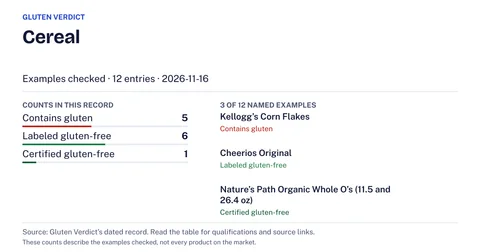 CerealDepends on the product5 of 12 products we checked contain glutenchecked Nov 16, 2026
 BreadContains glutenchecked Nov 16, 2026
 OatmealDepends on the productchecked Nov 16, 2026
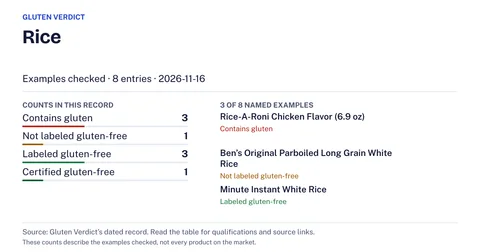 RiceNaturally gluten-free3 of 8 products we checked contain gluten: Rice-A-Roni Chicken Flavor (6.9 oz), Near East Original Rice Pilaf, and Ben’s Original Ready Rice Rice PilafBuy it labeled gluten-freechecked Nov 16, 2026
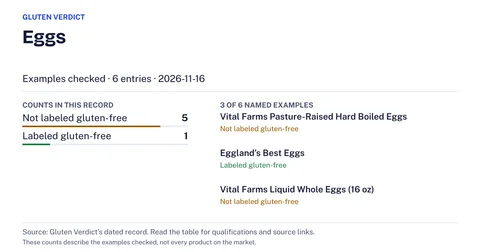 EggsNaturally gluten-freechecked Nov 16, 2026
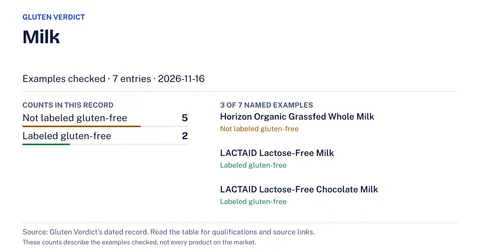 MilkNaturally gluten-freechecked Nov 16, 2026
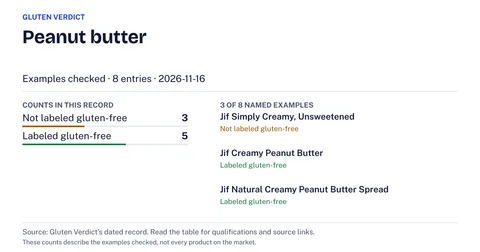 Peanut butterDepends on the productchecked Nov 16, 2026
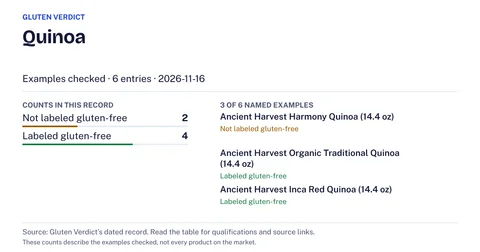 QuinoaNaturally gluten-freeBuy it labeled gluten-freechecked Nov 16, 2026
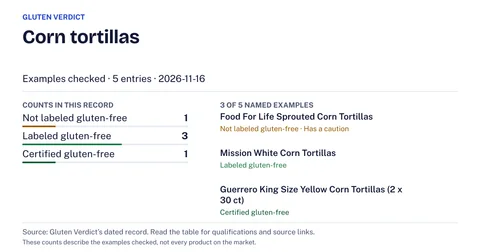 Corn tortillasDepends on the productchecked Nov 16, 2026
Questions people ask
Does WIC provide gluten-free food?
The federal rule sets food categories, and each state lists the brands it allows1. Some states mark gluten-free items or name gluten-free swaps, for example Florida, Oklahoma, Oregon, Virginia and Minnesota3, 4, 5, 8, 9.
Do I need a doctor's note for gluten-free bread or cereal on WIC?
The federal list of foods that need medical documentation names formula and Food Package III foods, not cereal or bread10. What your clinic wants for a swap is the clinic's call, so ask.
Is everything on my state's WIC list gluten-free?
No. The standard package includes whole wheat bread, which contains gluten15, and the federal whole grain list includes wheat, barley and triticale products16.
More in Cost, taxes and food assistance
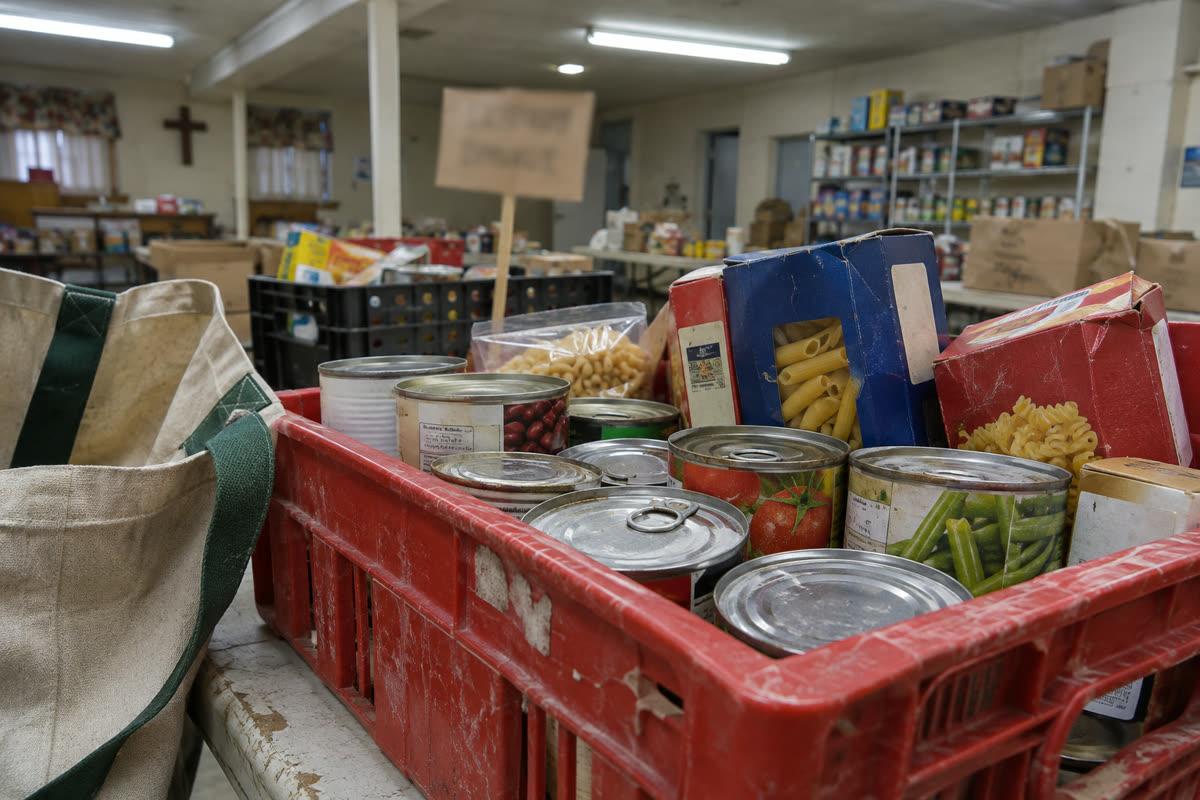 Food banks and pantries: how to ask for gluten-free items and check donated foodHow to find a pantry, ask for gluten-free items in a way a volunteer can act on, and check a donated item before you eat it or serve it.
 SNAP and gluten-free food: what the benefit covers and how to shop itWhich gluten-free foods SNAP covers, what it excludes, and how to build a list from naturally gluten-free staples plus a few labeled items.
 Gluten-free on a budget: what costs extra and what does notSort a gluten-free shopping list into plain foods, foods that need a statement and packaged substitutes, then compare costs and check each claim.
 Why gluten-free packaged food costs more, and what the price surveys showWhat price surveys found, what researchers say drives the gap, what FDA’s rule and one certifier require, and what a shopper can avoid.
 A price-per-ounce worksheet for comparing gluten-free staples at any store, club or onlineA worksheet for comparing gluten-free staples by price per ounce across stores, clubs and online, with a column for the gluten-free statement.
 Is gluten-free food tax deductible? What the IRS says and what to keepWhat IRS Publication 502 says about special food as a medical expense, how the excess-cost sum works, and what records to bring to a tax professional.
Related guides
 Gluten-free baby food: what the makers’ labels say about wheat, barley and oatsWhat baby cereal, puff, snack and pouch makers print about wheat, barley, oats and gluten, read from their own pages, with the date we read them.
 Celiac disease and pregnancy: what the research reportsWhat studies report on celiac disease and pregnancy, what charities, NIDDK and the USPSTF say about care and folic acid, and a child's own risk.
 Costco and gluten: which items make a claim and which only list ingredientsSort a Costco cart into claim, ingredient list only, or nothing to read, using Costco’s own item pages and what FDA’s gluten-free rule requires.
 Gluten-free substitutes: the swap for each wheat ingredient and the label check it needsA lookup table of gluten-free swaps for wheat flour, pasta, bread, soy sauce, beer and more, with the one label check each swap needs.
Sources
- [1, 2, 6, 10, 11, 12, 13, 14, 16, 22, 23, 27, 36, 37, 38, 41, 42, 43] USDA Food and Nutrition Service (7 CFR 246.10, eCFR), 7 CFR 246.10, Supplemental foods, checked Nov 17, 2026.
Read 7 CFR 246.10 in the eCFR on 2026-11-17 (page text opened through Exa, because the direct page returned an access check): the words “gluten” and “celiac” do not appear anywhere in the section, including the breakfast cereal, bread and whole grain tables.
Read on 2026-11-17: the row headed “Whole Grain Options” in Table 4 to paragraph (e)(12) names brown rice, wild rice, quinoa, bulgur (cracked wheat), oats, whole-grain barley, millet, triticale, amaranth, cornmeal, corn masa flour, whole wheat macaroni (pasta) products, whole wheat bread products (pita, English muffin, bagels, naan), soft corn or whole wheat tortillas, buckwheat, teff, kamut, sorghum and wheat berries, and says State agencies have the option to authorize other intact whole grain options.
- [3, 31] Florida Department of Health (Florida WIC), Florida WIC Foods (July 2026), checked Nov 17, 2026.
- [4, 32] Oklahoma WIC (Oklahoma Health Care Authority and state WIC program), WIC Approved Food List (effective January 2026), checked Nov 17, 2026.
Read on 2026-11-17: the cold cereal, hot cereal, tortilla, oatmeal and brown rice listings each carry a legend “GF = Gluten Free”; no sentence in the document says how the GF mark is decided.
- [5, 33] Oregon Health Authority (Oregon WIC), WIC Food List (approved foods effective July 1, 2025), checked Nov 17, 2026.
Read on 2026-11-17: the list under “Which brands are eligible?” names adult cereals, corn tortillas, corn meal and masa flour, whole wheat tortillas, whole wheat pasta, whole wheat pita and naan, and “Gluten free whole grain breads” among the specific brands Oregon WIC has authorized.
- [7, 21] US Food and Drug Administration, Gluten and Food Labeling, checked Nov 17, 2026.
- [8, 39, 40] Virginia Department of Health (Virginia WIC), Healthcare Providers - Women, Infants and Children (page last updated March 20, 2025), checked Nov 17, 2026.
- [9, 34, 35] Minnesota Department of Health (Minnesota WIC), Gluten-Free Diets: Topic of the Month (WIC staff guidance, updated February 7, 2024), checked Nov 17, 2026.
- [15, 17, 18, 19, 24, 28, 29] USDA Food and Nutrition Service (Federal Register), WIC: Revisions in the WIC Food Packages; Final Rule (89 FR 28488, April 18, 2024), checked Nov 17, 2026.
- [20, 25, 26, 30] US Food and Drug Administration, Questions and Answers on the Gluten-Free Food Labeling Final Rule, checked Nov 17, 2026.
- [44, 45] Iowa Department of Health and Human Services (Iowa WIC), Clinical/Health/Medical: Celiac Disease, WIC nutrition risk criterion 354 (document dated 06/2012), checked Nov 17, 2026.
- [46] National Institute of Diabetes and Digestive and Kidney Diseases (NIH), Treatment for Celiac Disease, checked Nov 17, 2026.