Food banks and pantries: how to ask for gluten-free items and check donated food
Short answer
Not every pantry can supply a gluten-free diet, so call ahead, ask whether it has gluten-free items, and ask for naturally gluten-free staples if it does not1, 5, 7. Then read each donated item the way you read a store product:
- Find your local food bank by ZIP code, or call the National Hunger Hotline or 2112, 3, 4.
- Call before you go: the National Celiac Association says some pantries require you to live in a certain area and some may require a doctor’s note stating a medical need for gluten-free food5.
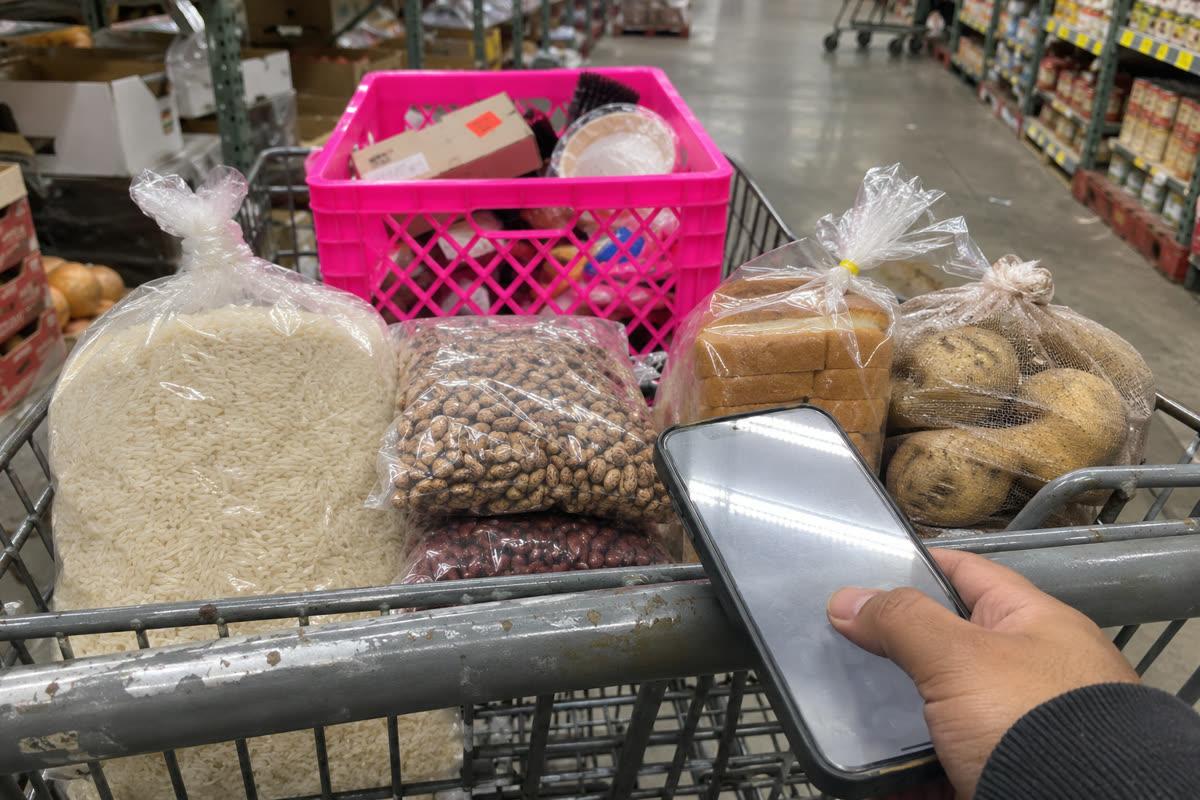
- Ask for naturally gluten-free staples such as potatoes, rice, beans and lentils, and ask whether it has specialized gluten-free items6, 7.
- Read every donated item, and set aside any with a torn, missing or changed label8, 9.
Part of Cost, taxes and food assistance, 14 guides
Key points
- A food bank stores donated food; a pantry gets its food from a food bank and gives it to people, so the food bank is the place to start looking10.
- Not all pantries can provide a gluten-free diet, and some ask for residency or a doctor’s note, so call first1, 5.
- Plain staples such as fruit, vegetables and eggs are naturally gluten-free and may carry no gluten-free claim11.
- Donated food can arrive with a torn or missing label, and a changed label might not list the right ingredients8, 9.
- Lentils carry a higher cross-contact risk than other legumes, according to the Gluten Intolerance Group12.
How food banks and pantries fit together
A food bank is a warehouse that collects and stores donated food. A food pantry is where people get free food, and it gets that food from a food bank, according to Feeding America10. In Feeding America’s network, food banks collect, sort and distribute donations to local pantries and meal programs, which then hand the food to people13. Not every pantry can provide this diet1, which is why the next sections start with a phone call.
Federal help runs alongside. USAGov says you can apply for the Emergency Food Assistance Program (TEFAP) through your state agency14. The program’s rule counts food banks, food pantries and soup kitchens among the emergency feeding organizations that can be eligible to receive USDA Foods15, and each state agency must establish statewide criteria for which households can receive USDA Foods for home consumption16.
Who may visit: Feeding America says anyone who needs extra help affording food can visit a pantry or meal program, and some have added requirements, such as living in a certain area17.
How to find a pantry and call ahead
- Look up your nearest food bank. Feeding America’s ZIP search lists it and says to contact it directly for local services and hours2. Your local food bank can help you find food today, even if you need temporary help18.
- Look at the National Celiac Association’s pantry list for sites that may be able to help with gluten-free food1.
- Call the National Hunger Hotline, 1-866-348-6479 (1-877-842-6273 in Spanish), Monday through Friday, 8:00 AM to 8:00 PM Eastern Time3, or call 2114. USAGov also points to HUD’s Find Shelter tool, which takes a zip code and finds your closest food pantry19.
Then call the pantry itself. The National Celiac Association recommends contacting a pantry in advance to make sure you can get the food you need, and notes that some pantries require you to live in a certain area, some may require a doctor’s note stating a medical need for gluten-free food, and other restrictions may apply5. If a note is needed, ask what it has to say.
Ask how food is given out, too. A mobile pantry may hand out pre-packed grocery boxes or let you choose what you want20, and Feeding America says a food bank’s online mobile pantry schedule may have last-minute cancellations or changes, so recheck it before you go21.
At your first visit, volunteers may ask questions or have you fill out a form about your family’s needs, which helps them give the right amount of food and connect you with other programs22. That form is the natural place to say that someone in your household needs gluten-free food.
What to ask for
Start with the need, then the request, then a fallback a volunteer can act on:
- Say that someone in your household has celiac disease and needs gluten-free food.
- Ask whether the pantry has specialized gluten-free items7. Some pantries on the National Celiac Association’s list are described as having a dedicated gluten-free shelf32.
- If not, ask for naturally gluten-free items. The National Celiac Association suggests asking whether the pantry offers fresh produce, meat, dairy and other naturally gluten-free items23.
- Ask whether gluten-free donations are kept together and labeled. The National Celiac Association’s list describes some food banks as able to accept gluten-free donations and label them as such24.
The National Celiac Association lists potatoes, rice, meat and poultry, fruits and vegetables, and beans and lentils as naturally gluten-free6. FDA lists fruits, vegetables and eggs the same way11. What to check on each, and where our verdicts are:
| Ask for | What to check | Our verdict |
|---|---|---|
| Rice | Grains can pick up gluten through crop rotation and shared harvest, transport and storage equipment, FDA says25. The Gluten Intolerance Group says small grains such as rice can be rinsed in a fine sieve or colander26. | Rice |
| Dried beans and chickpeas | The Gluten Intolerance Group says washing and visually sorting dry beans for anything that is not a bean, such as a stray grain, works very well27. | Chickpeas |
| Lentils | The Gluten Intolerance Group says lentils should be labeled gluten-free under FDA regulations or, for additional assurance, GFCO-certified, because of a higher cross-contact risk than other legumes or beans12. | Lentils |
| Potatoes | On the National Celiac Association’s list of naturally gluten-free foods6. A potato product in a package gets its label read, as in the next section. | Potatoes |
| Eggs | FDA lists eggs among naturally gluten-free foods11. Certain egg products are regulated by USDA, outside FDA’s gluten-free rule28. | Eggs |
| Oats and oatmeal | Oats labeled gluten-free must contain less than 20 parts per million of gluten, FDA says29. An oatmeal with no claim is a separate question. | Oatmeal |
Pantries and programs that stock gluten-free food
The National Celiac Association runs a program called Feeding Gluten Free, which it says addresses an unmet need by improving education and access to gluten-free food in food banks and pantries30. It says the program coordinates donations of gluten-free food to where the known need is, pays for shipping of some donations and buys gluten-free food when necessary31.
Its pantry list names sites described as having gluten-free shelves. On the page we read, JFCS Squirrel Hill Food Pantry in Pittsburgh and South Lansing Ministries in Lansing, Michigan are described as having a dedicated gluten-free shelf, and Life Works Community Action in Ballston Spa, New York as having a separate shelf for gluten-free items32. The entries carry no date, so treat each as a lead and call first.
The Gluten Intolerance Group runs a Cutting Costs program, which it describes as committed to making trusted gluten-free food more accessible and affordable for individuals and families in need33. When we read the page on 2026-11-17 it still described food support boxes for eligible households as upcoming, with applications anticipated to open in June 2026 and quarterly shipments estimated to begin in October 202634. Both dates have passed, so check the page for where the program stands now.
How to check a donated item
FDA notes that donated food can include products whose sell-by date has passed or whose can label is torn or missing8. Check each item as you would at a store.
The label
- A gluten-free claim: on foods FDA regulates, a food labeled gluten-free, no gluten, free of gluten or without gluten must contain less than 20 parts per million of gluten35.
- Meat, poultry and certain egg products are regulated by USDA and fall outside FDA’s gluten-free regulation28.
- No claim: not a warning on its own, because foods that are naturally gluten-free may carry none11. Read the full ingredient list, as our guide to reading a food label shows.
- An advisory line such as made in a facility that also processes wheat: FDA’s rule does not prohibit one on a food that also carries a gluten-free claim, provided the statement is truthful and not misleading36.
The package
- A can or package whose label has been changed might not list the right ingredients, FDA warns shoppers at surplus stores, and the warning matters most with a food allergy or other dietary restriction9.
- FDA tells surplus-store shoppers to skip a package that appears to have been resealed or repaired, and says food should be sold only in the original, intact package37.
- FDA’s advice for surplus food also says not to buy refrigerated food past its use-by or sell-by date, because it may be perishable and may have begun to spoil38. Ask the volunteer how the pantry handles dates.
Dry grains and beans
Plain grains, beans and seeds can pick up gluten before they reach a pantry shelf, through crop rotation and shared harvest, transport and storage equipment25. The Gluten Intolerance Group suggests washing and sorting dry beans27 and rinsing rice in a fine sieve26, and says lentils should carry a gluten-free label or GFCO certification12.
When an item has no label
A can with no label has no ingredient list to read and no maker to look up. With nothing to read, set the item aside and ask the volunteer for another.
A gluten-free claim is not required on foods that are naturally gluten-free, so fresh fruit and vegetables without one are normal11. A packaged item with no label at all is a different case: there is nothing to check.
If you volunteer or donate
- Ask the local food bank first. Feeding America advises partnering with it for guidance on what foods are needed most, donation procedures and drop-off options39.
- Give unexpired, unopened items in original packaging, as Feeding America asks40. For a gluten-free item, the original package keeps the claim and ingredient list in view for the person reading it.
- Ask whether the site can keep gluten-free donations together. The National Celiac Association’s list describes some food banks as able to accept and label them24.
- Consider money: Feeding America says cash from virtual food drives helps food banks purchase food41, and the National Celiac Association says its program buys gluten-free food when necessary31.
- The National Celiac Association also suggests encouraging a pantry to work with a food rescue organization, which frequently works with local pantries42.
Other help while you wait
Feeding America’s help page also lists school-based programs: a School Pantry Program where parents pick up food at their child’s school, and a BackPack Program that gives children food to take home for the weekends43. The National Celiac Association notes that SNAP covers many naturally gluten-free items44 and that WIC covers some, including milk, cheese, eggs, fruits and vegetables, peanut butter and legumes45.
Our SNAP guide covers what the benefit pays for, and gluten-free on a budget covers what costs extra and what does not.
Verdicts in this guide
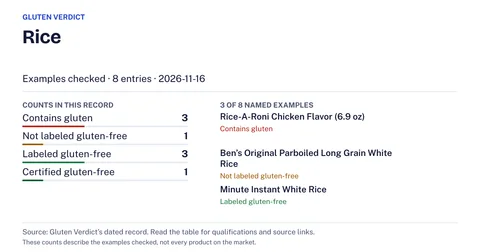 RiceNaturally gluten-free3 of 8 products we checked contain gluten: Rice-A-Roni Chicken Flavor (6.9 oz), Near East Original Rice Pilaf, and Ben’s Original Ready Rice Rice PilafBuy it labeled gluten-freechecked Nov 16, 2026
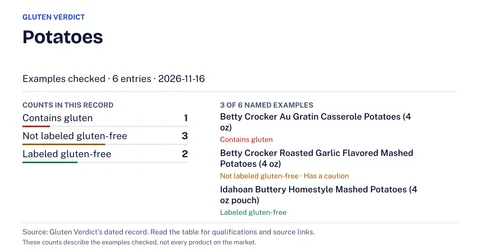 PotatoesNaturally gluten-free1 of 6 products we checked contains gluten: Betty Crocker Au Gratin Casserole Potatoes (4 oz)checked Nov 16, 2026
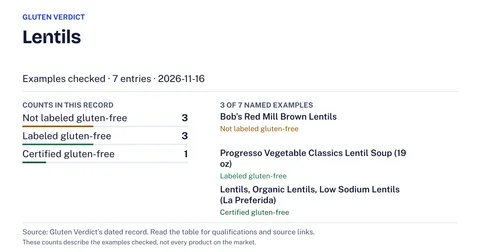 LentilsDepends on the productchecked Nov 16, 2026
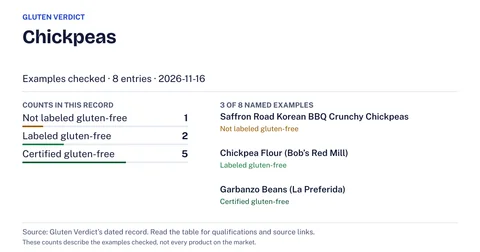 ChickpeasNaturally gluten-freechecked Nov 16, 2026
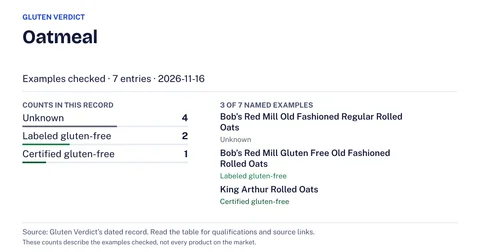 OatmealDepends on the productchecked Nov 16, 2026
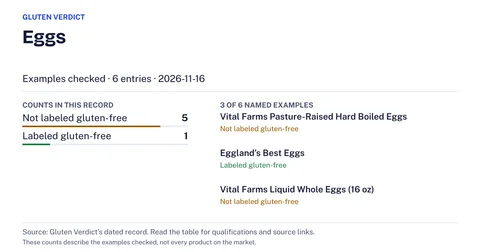 EggsNaturally gluten-freechecked Nov 16, 2026
Questions people ask
Do food pantries have gluten-free food?
Some do, and some cannot: the National Celiac Association says not all pantries can provide this diet1. Its list describes some pantries as having a dedicated gluten-free shelf32.
Do I need a doctor’s note to get gluten-free food?
Some pantries may ask for one. The National Celiac Association says some may require a doctor’s note stating a medical need for gluten-free food, and recommends contacting the pantry in advance5.
More in Cost, taxes and food assistance
 WIC and gluten-free food: what the package includes and how to ask for a substitutionHow WIC food packages treat wheat, how states mark gluten-free items, and what to ask the clinic about a substitute for bread, cereal or grains.
 SNAP and gluten-free food: what the benefit covers and how to shop itWhich gluten-free foods SNAP covers, what it excludes, and how to build a list from naturally gluten-free staples plus a few labeled items.
 Gluten-free on a budget: what costs extra and what does notSort a gluten-free shopping list into plain foods, foods that need a statement and packaged substitutes, then compare costs and check each claim.
 A price-per-ounce worksheet for comparing gluten-free staples at any store, club or onlineA worksheet for comparing gluten-free staples by price per ounce across stores, clubs and online, with a column for the gluten-free statement.
 Why gluten-free packaged food costs more, and what the price surveys showWhat price surveys found, what researchers say drives the gap, what FDA’s rule and one certifier require, and what a shopper can avoid.
 Financial help for a gluten-free diet in the US: each program and where to startThe US programs that touch the cost of a gluten-free diet, who runs each one, and which page to open to read its own rule.
Related guides
 A starter gluten-free pantry: 30 shelf items and the label check for eachThirty shelf items for a first gluten-free pantry, tagged by the label check each needs, plus how to keep jars, toaster and colander apart at home.
 How to build a gluten-free emergency food supplyBuild a gluten-free emergency food supply: a stock list by food type, reading a freeze-dried pouch, maker shelf-life claims and what to bring to a shelter.
 What to eat after a celiac diagnosis: what the sources document and what they do notBone broth, collagen, glutamine or plain staples? What NIDDK, ACG and celiac charities document after a diagnosis, and what no page we read names.
 Is gluten in everything? Where it starts and where it gets addedSort your pantry into foods that start without gluten, foods where it is added as an ingredient, and foods that pick it up by contact.
Sources
- [1, 5, 6, 7, 23, 24, 30, 31, 32, 42, 44, 45] National Celiac Association, Feeding Gluten Free: find a food bank or pantry, checked Nov 17, 2026.
Read on 2026-11-17: the pantry search list on the page describes Greater Chicago Food Depository (Chicago, IL) as able to accept and label donations as gluten-free for its agencies, and St. Louis Food Bank (Bridgeton, MO) as able to accept gluten-free food donations and label them as such.
Read on 2026-11-17: the pantry search list headed “Search for a Pantry with GF Food” describes JFCS Squirrel Hill Food Pantry (Pittsburgh, PA) and South Lansing Ministries (Lansing, MI) as having a dedicated gluten-free shelf, and Life Works Community Action (Ballston Spa, NY) as having a separate shelf for gluten-free items. The entries show no date.
- [2, 10, 17, 22] Feeding America, Find your local food bank, checked Nov 17, 2026.
- [3, 4, 14, 19] USAGov, How to get emergency food assistance, checked Nov 17, 2026.
- [8, 9, 37, 38] US Food and Drug Administration, Surplus, Salvaged, and Donated Foods, checked Nov 17, 2026.
- [11, 28, 35] US Food and Drug Administration, Gluten and Food Labeling, checked Nov 17, 2026.
- [12] Gluten Intolerance Group, FAQ: organic lentils and gluten-free labeling, checked Nov 17, 2026.
- [13] Feeding America, The Feeding America network, checked Nov 17, 2026.
- [15] US Government Publishing Office (eCFR), 7 CFR 251.3, Definitions (TEFAP), checked Nov 17, 2026.
- [16] US Government Publishing Office (eCFR), 7 CFR 251.5, Eligibility determinations (TEFAP), checked Nov 17, 2026.
- [18, 43] Feeding America, Find free food and groceries, checked Nov 17, 2026.
- [20, 21] Feeding America, Mobile food pantries, checked Nov 17, 2026.
- [25, 29, 36] US Food and Drug Administration, Questions and Answers on the Gluten-Free Food Labeling Final Rule, checked Nov 17, 2026.
- [26, 27] Gluten Intolerance Group, Washing dry beans and grains, checked Nov 17, 2026.
- [33, 34] Gluten Intolerance Group, Cutting Costs boxes, checked Nov 17, 2026.
- [39, 40, 41] Feeding America, Host a food drive, checked Nov 17, 2026.