Gluten-free in Ireland: labels, pub rules, Guinness and the Crossed Grain symbol
Short answer
Ireland applies the EU rule: a pack may say “gluten-free” only at no more than 20 mg of gluten per kg1, and wheat, rye, barley and oats are declared as allergens2. Check in this order:
- Packs: look for “gluten-free”, the wording the EU rule ties to the 20 mg/kg limit1, and read the highlighted allergen words: the cereal name must be declared, not “gluten”3.
- Menus and pubs: written allergen information must be easy to find before you buy, so you should not have to ask for it4. Draught beer and cider are included5.
- The Crossed Grain symbol: a trademark used under licence on food and drink products that meet the AOECS standard6.
- Guinness: its Irish page lists malted barley, barley and roasted barley and makes no gluten-free statement7.
- Gluten-free limit
- No more than 20 mg of gluten per kg of food as sold1; the regulation is directly applicable in all Member States10
- Set by
- Commission Implementing Regulation (EU) No 828/20141, which FSAI says has applied since 20 July 201611
- Oats
- In a food presented as gluten-free, oats must be specially produced to avoid contamination by wheat, rye or barley, and cannot exceed 20 mg/kg15
- Celiac society
- The Coeliac Society of Ireland
Part of Travel: Europe, 19 guides

Key points
- Irish packs follow the EU rule: “gluten-free” only at no more than 20 mg/kg of gluten in the food as sold1.
- FSAI’s allergen list names oats among the cereals containing gluten, and gluten-free oats may still appear highlighted as “oats” in an ingredient list2, 8.
- Pubs and restaurants must give written allergen information before the sale, including for draught beer and cider4, 5.
- AOECS says it is currently unable to update the product lists displayed on its website; check the date on each product9.
- Guinness Draught lists barley ingredients on its Irish page and makes no gluten-free statement7.
What an Irish pack says: the claim and the allergen words
Ireland is an EU member, and the regulation that governs gluten-free wording, Regulation (EU) No 828/2014, is binding in its entirety and directly applicable in all Member States10. The FSAI, the Irish food regulator, says it has applied since 20 July 201611.
Under it, “gluten-free” may be used only where the food as sold contains no more than 20 mg/kg of gluten1. A second wording, “very low gluten”, is for foods made with an ingredient specially processed to reduce gluten, at no more than 100 mg/kg12. Other wording about the absence or reduced presence of gluten is not allowed13. A maker may add “suitable for coeliacs” next to either statement14.
Oats get their own condition: oats in a food presented as gluten-free or very low gluten must be specially produced to avoid contamination by wheat, rye or barley, and cannot exceed 20 mg/kg15.
The US rule is worded differently from the EU one: FDA says unavoidable gluten must be “less than 20 ppm”16, the EU rule says “no more than 20 mg/kg”1. Read the wording on each pack. Our guide to the US label rules covers the American side.
Reading the allergen words
On a prepacked food, allergens are highlighted in the ingredient list17. FSAI’s allergen list names the cereals containing gluten as wheat (such as spelt and Khorasan wheat), rye, barley and oats2. That differs from the US list, which names wheat but not barley, rye or oats18. In Ireland the cereal itself must be named and highlighted, not the word “gluten”3, so scan for the highlighted grain.
A gluten-free product can still show a highlighted “oats”: FSAI says gluten-free oats used as an ingredient may be listed as “oats” or “gluten-free oats”, and in either case “oats” must be highlighted because oats are an allergen8. FSAI’s best-practice advice is a note explaining that the oats are gluten free because of how they are produced19.
Where a food has no ingredient list, for example alcohol, the allergen is shown with the word “contains”, as in “contains barley”20. Spirits are treated differently: in the Annex of Regulation (EU) No 1169/2011 as published, the entry for cereals containing gluten lists “cereals used for making alcoholic distillates” as an exception21. Our whiskey verdict covers what the charities and makers say.
“May contain” lines
On a pack, FSAI says a business that cannot guarantee no cross-contamination, even with good manufacturing practices, “may consider” adding a “may contain” type of warning22.
Menus and pubs: what a restaurant must show you
FSAI says the EU Food Information to Consumers Regulation has required allergen information on non-prepacked food, not only prepacked, since 13 December 201424. Ireland’s rules, as FSAI sets them out, add specifics: the information must be written, in English or in Irish and English25, and must be easy to find before the sale, so that customers “must not have to ask for the information”4.
It must also name the exact food. FSAI says “Our food contains…” is not acceptable and gives “spaghetti bolognaise - contains milk, celery, wheat” as the model26. The rules cover restaurants, pubs, takeaways and contract caterers27, and sauces, condiments and drinks are included, not only main dishes28.
The written sheet lists allergens used as ingredients; FSAI says cross-contaminants unintentionally present at low levels need no declaration23. FSAI also advises people with a food allergy to talk to a member of staff in addition to reading the written information29. So use the sheet to see which dishes name wheat, rye, barley or oats, then ask how the dish is cooked.
At the counter
- Ask for the allergen sheet or menu before you order, and find the dish on it by name.
- Say you are avoiding gluten; the Irish sheet names the cereal (wheat, rye, barley or oats) rather than “gluten”, so ask the server to point to it3.
- Ask how the dish is cooked: whether the same fryer, griddle, water or board is used for foods with gluten.
- Check the sauce, gravy, coating and side separately; FSAI says sauces and condiments must be declared too28.
The Crossed Grain symbol and the Society’s lists: what they cover
The Coeliac Society of Ireland is the Irish member of the Association of European Coeliac Societies (AOECS)30. The Crossed Grain Trademark, which AOECS describes as globally registered, can be used only under licence on food and drink products that meet the AOECS standard6. AOECS says the trademark shows the product has undergone an independent audit by a non-profit organisation31.
AOECS describes the symbol as a mark for food and drink products, so use it to pick products. For restaurants, AOECS says several member societies run training and accreditation programmes32; its page links programmes for other countries, and none for Ireland32, so read the Society’s own site for any venue information.
How current is the Irish list?
AOECS’s hub page counts 403 licensed gluten-free products from 29 brands in Ireland33, but also says that it is currently unable to update the product lists on its site, and tells readers to look at the updated date on each product9. On the Ireland list, all 50 rows on the first page carry the date 22 Aug 202334.
Use the list to find brands to look for, then confirm on the pack in your hand: the claim or the symbol must be printed there.
The Society’s own site (coeliac.ie) refused our requests on 2026-11-17, so we have not read its food list, restaurant listings or symbol pages and do not summarise them here. Open them yourself before you travel and note the date each list was last updated.
Stout, cider and gluten-free beer
Guinness Draught: the product page on Guinness’s Irish site lists Water, Malted Barley, Barley, Roasted Barley, Hops, Nitrogen and Yeast, and has no gluten-free statement7. FSAI’s allergen list names barley among the cereals containing gluten2. Our beer verdict shows what Guinness’s US page lists and what the charities say about beer.
Gluten-free beer exists in the EU: AOECS describes two routes to it, brewing with gluten-free cereals such as corn, or using barley or wheat with enzymes that break down gluten35. AOECS also cautions that gluten-free beers, typically made from cereals like barley, can still contain trace amounts of gluten36. If you choose one, look for the “gluten-free” wording on the can or bottle rather than relying on a bar’s description.
In a pub, draught beer and cider are covered by the written allergen-information rule5, and the information must use the wording “Contains…”37. Ask to see it for the tap you want.
For cider, our cider verdict shows what the charities say about true hard cider and flavored ones. For a particular Irish bottle, read its label or the pub’s sheet.
Verdicts in this guide
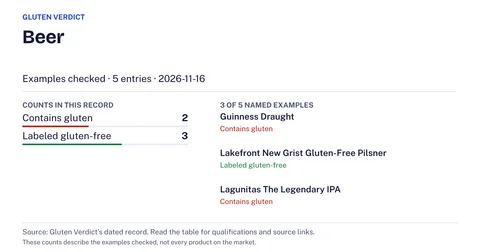 BeerDepends on the product2 of 5 products we checked contain gluten: Guinness Draught and Lagunitas The Legendary IPAchecked Nov 16, 2026
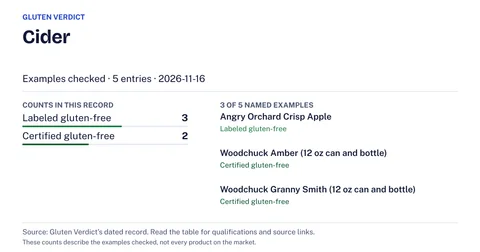 CiderNaturally gluten-freechecked Nov 16, 2026
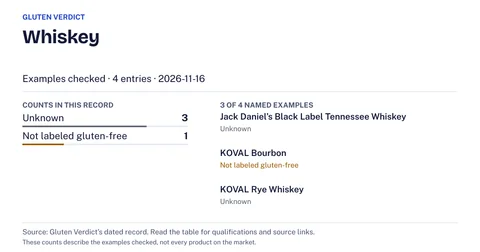 WhiskeyDepends on the productchecked Nov 16, 2026
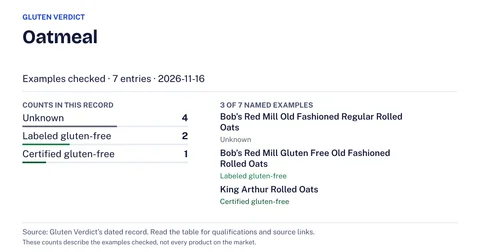 OatmealDepends on the productchecked Nov 16, 2026
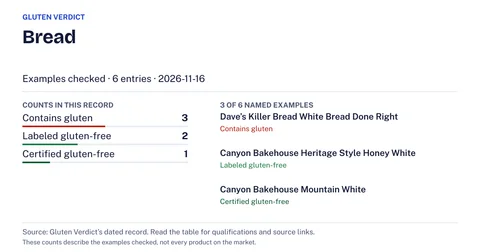 BreadContains glutenchecked Nov 16, 2026
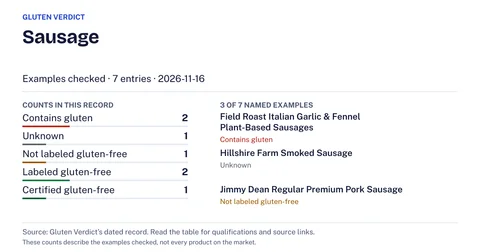 SausageDepends on the product2 of 7 products we checked contain gluten: Field Roast Italian Garlic & Fennel Plant-Based Sausages and Tofurky Plant-Based Italian Sausagechecked Nov 16, 2026
Questions people ask
Is Ireland’s gluten-free limit the same as the US limit?
The rules are worded differently: the EU rule says no more than 20 mg/kg of gluten in the food as sold1, and FDA says unavoidable gluten must be less than 20 ppm16.
Is Guinness gluten-free?
Guinness’s Irish page for Guinness Draught lists malted barley, barley and roasted barley and has no gluten-free statement7; FSAI’s allergen list names barley among the cereals containing gluten2.
Do Irish pubs and restaurants have to tell me what is in the food?
Yes, for allergens and in writing: the allergen information must be easy to find before you buy, and draught beer and cider are included4, 5.
Why does a gluten-free product show “oats” highlighted?
FSAI says gluten-free oats may be listed as “oats” or “gluten-free oats”, and “oats” must be highlighted either way because oats are an allergen8.
More in Travel: Europe
 Gluten-free in the UK: allergen rules, the Crossed Grain mark and pub and chip-shop foodHow a British pack and menu differ from a US one: the 20 mg/kg rule, 14 allergens, Crossed Grain versus venue accreditation, and chip-shop condiments.
 Gluten-free in Central Europe: the rules in five countries and where wheat hides in the dishesWhich gluten-free rule covers a pack in Austria, Czechia, Hungary, Poland and Switzerland, and where wheat enters schnitzel, dumplings and sauces.
 Gluten-free in Germany: what “glutenfrei” and German allergen rules tell youHow to read “glutenfrei” and German allergen rules, spot wheat in pretzels and Spätzle, and ask a restaurant for its allergen information.
 Gluten-free in Estonia, Latvia and Lithuania: label words, rye bread and dumplingsHow Estonia, Latvia and Lithuania word gluten-free claims, where rye, barley and wheat sit in local dishes, and which official pages to check.
 Gluten-free in Scotland: the rule, haggis, oatcakes, pies and whiskyWhat changes in Scotland: who sets the gluten-free rule, how oats count, and how to judge haggis, oatcakes, pies, broth and whisky.
 Gluten-free in the Netherlands and Belgium: labels, fryers, waffles and beerWhat glutenvrij and sans gluten mean on a pack, what Dutch and Belgian counters must tell you, and the fryer, waffle and beer questions to ask.
Related guides
 Gluten-free and very low gluten on EU labels, and how allergens are highlightedWhat EU “gluten-free” and “very low gluten” claims permit, how cereals containing gluten are highlighted in ingredient lists, and the rules for loose food.
 Fine on bread in Europe? What it does and does not showWhat a trip where bread felt fine does and does not show about celiac disease, and how EU and US gluten-free label rules compare.
 Gluten-free logos outside the US: who issues each one and what it requiresTell a certifier’s gluten-free logo from a maker’s own: who issues Crossed Grain, Coeliac Australia’s and Celiac Canada’s marks, and the limit each sets.
 Gluten-free alcohol: what US beer, spirits, wine and cider labels may sayWhich US alcohol labels may say gluten-free, who sets the wording, and how beer, spirits, wine, cider and hard seltzer differ, each rule sourced.
Sources
- [1, 10, 12, 13, 15] European Commission (EUR-Lex), Commission Implementing Regulation (EU) No 828/2014: gluten-free and very low gluten statements, checked Nov 17, 2026.
- [2, 3, 17, 20, 29] Food Safety Authority of Ireland (FSAI), Food Allergens - Advice for Consumers, checked Nov 17, 2026.
- [4, 5, 23, 24, 25, 26, 27, 28, 37] Food Safety Authority of Ireland (FSAI), Allergen Information for Non-prepacked Food, checked Nov 17, 2026.
- [6, 31] Association of European Coeliac Societies (AOECS), Gluten Free Certification, checked Nov 17, 2026.
- [7] Guinness (Diageo), Ireland site, Guinness Draught, checked Nov 17, 2026.
Read on 2026-11-17: the Guinness Draught page on guinness.com/en-ie lists the ingredients as Water, Malted Barley, Barley, Roasted Barley, Hops, Nitrogen and Yeast; the page contains no gluten-free statement.
- [8, 19, 22] Food Safety Authority of Ireland (FSAI), Labelling of allergens, checked Nov 17, 2026.
- [9, 33] Association of European Coeliac Societies (AOECS), Licensed Gluten Free Products, checked Nov 17, 2026.
- [11, 14] Food Safety Authority of Ireland (FSAI), Composition and labelling of foodstuffs suitable for people intolerant to gluten, checked Nov 17, 2026.
- [16] US Food and Drug Administration, Questions and Answers on the Gluten-Free Food Labeling Final Rule, checked Nov 17, 2026.
- [18] US Food and Drug Administration, Food Allergen Labeling and Consumer Protection Act of 2004 (FALCPA), checked Nov 17, 2026.
- [21] European Commission (EUR-Lex), Regulation (EU) No 1169/2011 on food information to consumers (as published, OJ L 304, 22.11.2011), Annex II, checked Nov 17, 2026.
- [30] Association of European Coeliac Societies (AOECS), Members, checked Nov 17, 2026.
Read on 2026-11-17: under “Republic of Ireland” the page names The Coeliac Society of Ireland and gives a “Licensed products” link (to the Ireland list) and a website link (https://coeliac.ie/).
- [32] Association of European Coeliac Societies (AOECS), Eating out gluten free, checked Nov 17, 2026.
Read on 2026-11-17: the page says several member societies run training and accreditation programmes for restaurants and hotels, and links the Eating Out programmes of the societies of Andorra, Finland, France, Hungary, Italy, the Netherlands, Poland, Portugal, Spain, Catalonia, Switzerland, the United Kingdom, Australia and New Zealand; no Irish society is among them.
- [34] Association of European Coeliac Societies (AOECS), Ireland Licensed Gluten Free Products, checked Nov 17, 2026.
Read on 2026-11-17: the Ireland list shows, for each product, a brand, description, licence number (for example IE-045-027), company and updated date; all 50 rows on its first page show the updated date 22 Aug 2023.
- [35, 36] Association of European Coeliac Societies (AOECS), Consumer information about gluten-free beer, checked Nov 17, 2026.