Gluten-free in Estonia, Latvia and Lithuania: label words, rye bread and dumplings
Short answer
All three countries are EU member states77, so “gluten-free” on a pack means no more than 20 mg of gluten per kg of food under the EU rule1, 2. Check, in this order:
- The claim word: gluteenivaba in Estonian, bez glutēna in Latvian (as the Latvian society lists it) and be glitimo in Lithuanian17, 56, 11.
- The emphasised grain name in the ingredient list: EU law has the grains that contain gluten stand out from the rest of the list, and Estonia’s food agency says the grain’s name is emphasised, not the word gluten6, 7, 19.
- The dish itself: the Latvian society lists dark rye bread, bread soup, kvass, barley porridge, bacon-filled pastries and breaded dishes as traditional foods that contain gluten, and the Estonian society’s list marks rye products, pelmeni and kali as forbidden55, 33, 35, 44.
- What the venue tells you: EU law makes allergen information mandatory for food sold without packaging9, 10, but the Estonian society says it has not checked the venues on its list, and the Latvian society says Latvia has no fully gluten-free and celiac-friendly restaurants30, 63.
Part of Travel: Europe, 19 guides

Key points
- One limit applies in all three countries: no more than 20 mg/kg for “gluten-free”, and “very low gluten” (up to 100 mg/kg) is a different statement1, 3.
- The words differ by country, and Estonia’s food agency says the claim is not replaced by phrases such as “ei sisalda gluteeni”17, 18.
- Dark rye bread is a rye product: Estonia’s society lists all rye products, bread included, as forbidden33, and a Latvian travel brochure says bread usually arrives with the main dish unasked69.
- We found no card from a Lithuanian society and no regulator page on Latvia’s claim words, so the table in this guide marks both gaps.
- Venues selling unpackaged food must give allergen information under EU law10. Latvia’s regulation says it is given in writing67 and allows oral information in some cases80, and the Latvian society’s Riga guide says awareness of cross-contamination is low60.
Which gluten-free rule applies in all three countries?
Estonia, Latvia and Lithuania are EU member states77. The EU’s Implementing Regulation 828/2014 is binding in its entirety and directly applicable in all member states2. It says “gluten-free” may be used only where the food as sold contains no more than 20 mg/kg of gluten1. Estonia’s food agency names the same regulation22 and limit23 and Lithuania’s food service repeats the 20 mg/kg limit14. We found no Latvian regulator page on the claim.
“Very low gluten” is a separate statement. It is for food made with a wheat, rye, barley or oat ingredient that was specially processed to reduce gluten, and its limit is 100 mg/kg3. It is not the same promise as “gluten-free”.
Oats in a food called gluten-free or very low gluten must have been specially produced, prepared or processed to avoid contamination by wheat, rye or barley, and the oats cannot exceed 20 mg/kg4. The EU’s definition of gluten itself names oats beside wheat, rye and barley5. For a country-by-country comparison see oat rules by country.
How it compares with the US number
FDA’s rule says any unavoidable gluten in a “gluten-free” food must be less than 20 ppm75, and it covers FDA-regulated packaged foods76. The number is the same, 20, though the EU wording is “no more than”1, FDA’s is “less than”75, and the two write the unit differently (mg/kg and ppm). The rule on the shelf is the EU’s. More on the EU text: gluten-free labeling in the EU.
What words to look for on a Baltic pack
The table gives the claim word and the four grain names in each language. The grain names are the allergen words: EU law requires the name of an Annex II substance, which includes the cereals containing gluten, to be emphasised in the ingredient list, for example by font, style or background colour6, 7.
| Estonian | Latvian | Lithuanian | |
|---|---|---|---|
| Gluten-free | gluteenivaba17 | bez glutēna, bezglutēna, nesatur glutēnu, nesatur lipekli, as the Latvian society lists them56 | be glitimo11 |
| Wheat | nisu29 | kvieši57 | kviečiai12 |
| Rye | rukis29 | rudzi57 | rugiai12 |
| Barley | oder29 | mieži57 | miežiai12 |
| Oats | kaer29 | auzas57 | avižos13 |
Estonia’s food agency says that where a grain with gluten is an ingredient, the grain’s name is emphasised, such as nisu or nisujahu, not the word gluten19. The Latvian society says allergens, gluten included, are in bold on Latvian products58.
Estonia’s food agency says “gluteenivaba” is not replaced by a phrase such as “ei sisalda gluteeni”18. The Latvian society’s word list is wider and includes “nesatur glutēnu”56, and we found no Latvian regulator page saying which wording may be used. Our own advice: look first for “bez glutēna” in Latvia and read the ingredient list either way.
In Estonia the crossed-grain mark may be used only under a licence issued by the Estonian Coeliac Society20.
May-contain lines
In Estonia, a warning about possible unintentional presence of allergens, such as a “may contain” line, is voluntary21. The Latvian society’s label list gives the Latvian wording, “Produkts var saturēt lipekli / glutēnu”, and adds that even buckwheat and rice may be contaminated59.
Is dark rye bread gluten-free? What about kvass and kali?
No. Rye is one of the cereals the EU lists as containing gluten6, and the Estonian society’s list forbids rye and everything containing rye, bread included33. Visit Estonia calls the black bread on Estonian tables a dark rye bread52.
In Latvia, a travel brochure says that in pubs and restaurants bread is usually served with the main dish without ordering69. That makes the bread basket the first thing to decline, or to ask about, at the table. Our own link to the general question: bread.
In Latvia, kvass is a drink made from rye bread: a Latvian travel brochure says it is made from stale slices of rye bread soaked in boiling water70, and the Latvian society lists “drink kvass” among traditional foods that contain gluten55. Estonia has a drink called kali: Visit Estonia describes it as a low-alcohol root beer53, and the Estonian society’s list of non-alcoholic drinks puts kali in the forbidden column44.
For beer, the Estonian society’s list says beer made from forbidden cereals is forbidden79, and a beer without a gluten-free mark is forbidden43. See beer for how we judge it.
Soups: where barley and stock cubes sit
The Latvian society names bread soup and barley porridge among traditional foods that contain gluten55. The Estonian society’s list forbids barley and everything containing it34. Its catering leaflet lists, among soups containing wheat, rye or barley, rassolnik with barley grits and pea and bean soups47, and advises replacing barley grits in soups with rice46; it notes that stock cubes may contain gluten48, and the 2025 leaflet lists stock cubes among seasonings with forbidden cereals42.
We found no authority page on beet soup or cold soups, so this guide makes no claim about them. Ask what thickens the soup and what goes in the stock. For a general view of soups see soup and barley.
Dumplings, pelmeni, breaded dishes and pastries
The Estonian society’s 2025 leaflet lists, among meat products that contain forbidden cereals, cutlets (kotletid), pelmeni, sausages, blood sausages and verikäkk35. It also forbids meat products with breading or sauces made from forbidden cereals36, and notes that meat products often contain onions roasted in wheat flour37. For fish, it names fish sticks and fish cutlets39.
Sausage and ham are not all one thing: the same leaflet says many meat products, such as smoked sausage and “dekooriga sink”, can be gluten-free or can contain gluten, so read the ingredients38. See sausage and dumplings.
The Estonian hospital leaflet lists pancakes among the baked goods that contain wheat, rye or barley49 and wheat-flour sauces for meat and fish among the forbidden foods50. For the Latvian side, the society lists bacon-filled pastries and breaded dishes of every kind55. Our page on pancakes covers the usual case.
Lithuania’s cepelinai
Lithuania Travel describes cepelinai as potato dumplings of grated and riced potatoes around a filling of ground meat, dry curd cheese or mushrooms71. The page names no flour, starch or other dough ingredient72, so it cannot tell you whether a kitchen adds any. Ask the kitchen about the dough and about what goes in the sauce. The same page says they are commonly served with sour cream sauce and bacon bits72; the Estonian society’s list puts fresh cream and sour cream among the allowed fats45, and our page on sour cream covers plain sour cream.
Sweets and bakery
The Estonian society’s leaflet lists liquorice, biscuits and wafers, candy bars, chocolate with wafer and sefiir in wafer crumbs among sweets containing forbidden cereals40. Its hospital leaflet adds kama and wafer ice cream to the forbidden desserts51.
Loose cakes and tortes may be cross-contaminated, because the same trays, bases and cake servers are often used for products containing gluten41. The Latvian society also lists semolina mousse among traditional foods that contain gluten55.
What a restaurant must tell you, and what it does not promise
Under EU law, where food is offered for sale to the final consumer or to mass caterers without prepackaging, the allergen particulars of Article 9(1)(c) are mandatory9, 10. Article 9(1)(c) covers Annex II substances such as cereals containing gluten8, 6. Member states may adopt national measures on how that information is made available78. The country rules we read:
- Estonia: a catering business must make available the dish name and the allergens in the dish24. If it cannot print them on the menu, it must post a visible written notice on where to ask, such as “Allergeenide teavet küsi teenindajalt”25, and staff must be able to give oral information on ingredients on request26. Estonia’s agency adds that the rules for gluten-free wording apply to dishes served in catering27, and that a menu uses only “gluteenivaba” or “väga väikese gluteenisisaldusega” to describe gluten17.
- Latvia: Cabinet Regulation 595 lists allergens as an item of information for unpackaged food66, says it is given in writing67, and its list of requirements that catering businesses may skip does not include that item68. Its point 9 allows the allergen information to be given orally in the cases listed in its point 880.
- Lithuania: VMVT’s allergen page points to hygiene norm HN 119:201415, and its labelling page says information on loose food sold by catering businesses is given in writing or electronically at one point at least, for example a paper or QR menu, before purchase16.
A written allergen line is not a promise about the kitchen. The Estonian Coeliac Society says it has not checked the venues on its list and is not responsible for the menu or the purity of the food30, and that venues are listed when they use gluten-free ingredients or have passed its training31. That English page is dated 5 February 202332. The Latvian society writes that Latvia has no fully gluten-free and celiac-friendly restaurants63, that awareness of cross-contamination is low (in its Riga guide)60, and that outside Riga it may be very problematic to find a place that understands a gluten-free diet64. The EU side of restaurant rules: European restaurant allergen rules.
Which regulator and society pages cover each country?
Every page below was read on 2026-11-17. Pages are in the local language unless noted.
| Country | Regulator page | Coeliac society page | Read on |
|---|---|---|---|
| Estonia | Agriculture and Food Board (PTA), food labelling: claim words, allergen emphasis, crossed-grain licence, catering information17, 19, 20, 24. PTA “Muud toidud”: the gluten-free rules apply to dishes in catering27. | Estonian Coeliac Society: English services page with a card line and word list28, 29; allowed and forbidden foods leaflet33; a member of AOECS since 200654. | 2026-11-17 |
| Latvia | No page on the claim found. Cabinet Regulation 595 on unpackaged food, on likumi.lv67. | Dzīve bez glutēna, English pages: traditional foods, label words and a card55, 57, 61; where to eat63; a member of AOECS since 201965. | 2026-11-17 |
| Lithuania | VMVT news item of 13 August 2026 on “be glitimo” and 20 mg/kg14; VMVT pages on allergens and catering information15, 16. | begliuteno.lt, listed by AOECS among coeliac societies that are not members73; its front page shows diary posts, the newest from 201874. | 2026-11-17 |
A Latvian regulator page on the gluten-free claim and a Lithuanian society card or eating-out page are the two gaps in the sources we could open. Treat the Latvian and Lithuanian rows as incomplete, and check the society pages before you travel.
A card for each country
Both cards below are the societies’ own wording, not ours.
- Estonia, from the Estonian Coeliac Society’s English page: “I wish to order gluten-free food – my food may not contain wheat, rye and barley or any cross-contamination.” Its Estonian line reads “Soovin tellida gluteenivaba toitu s.t. minu toit ei tohi sisaldada nisu, rukist, otra ja ei tohi olla ristsaastunud.”28
- Latvia, from the Latvian society, which recommends showing a gluten-free travel card each time you order61: “Lūdzu, ņemiet vērā, ka man nepieciešams ēdiens, kas ir pilnībā bez glutēna. Maize un ēdieni nedrīkst saturēt nekādas rudzu, kviešu, miežu vai auzu daļiņas.” The society’s English translation of its full card text: “Please note, I need food that is completely gluten-free. Bread and dishes must not contain any traces of rye, wheat, barley, oats.”62, 61
- Lithuania: we found no card. The front page of the Lithuanian association shows none74.
Verdicts in this guide
 BreadContains glutenchecked Nov 16, 2026
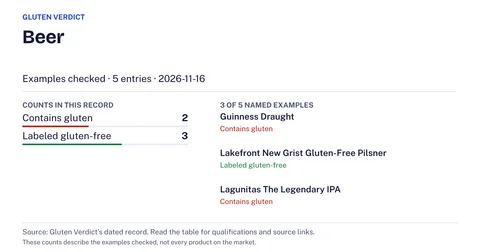 BeerDepends on the product2 of 5 products we checked contain gluten: Guinness Draught and Lagunitas The Legendary IPAchecked Nov 16, 2026
 SoupDepends on the product3 of 8 products we checked contain gluten: Campbell’s Condensed Tomato Soup (10.75 oz), Campbell’s Condensed Cream of Mushroom Soup (10.5 oz), and Progresso Traditional Chicken Noodlechecked Nov 16, 2026
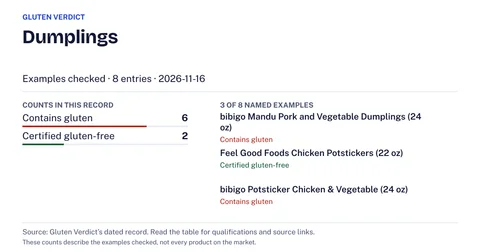 DumplingsContains glutenchecked Nov 16, 2026
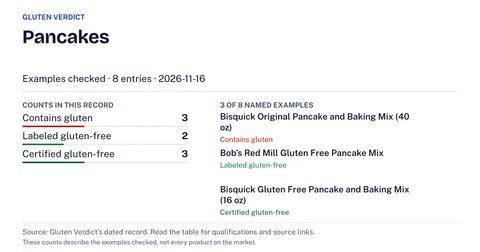 PancakesContains glutenchecked Nov 16, 2026
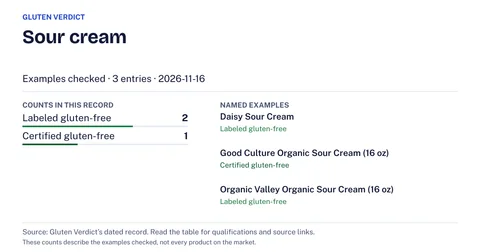 Sour creamNaturally gluten-freechecked Nov 16, 2026
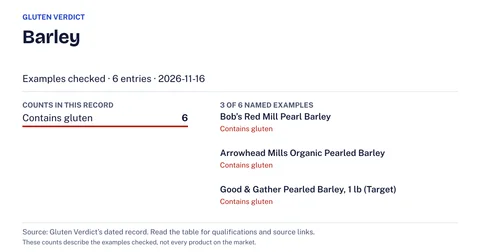 BarleyContains glutenchecked Nov 16, 2026
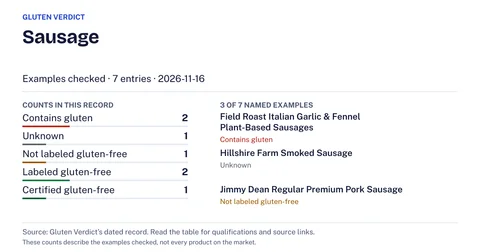 SausageDepends on the product2 of 7 products we checked contain gluten: Field Roast Italian Garlic & Fennel Plant-Based Sausages and Tofurky Plant-Based Italian Sausagechecked Nov 16, 2026
Questions people ask
Does “gluten-free” mean the same in Riga as in the US?
The number is the same, 20. The EU rule is no more than 20 mg/kg1 and FDA’s is less than 20 ppm75. The wording on the pack is the local language’s.
Can a Baltic menu say “gluten-free”?
In Estonia, the food agency says the rules for the claim apply to dishes served in catering27, and a menu uses only the words “gluteenivaba” or “väga väikese gluteenisisaldusega”17. We did not find an equivalent page for Latvia or Lithuania.
Is “very low gluten” the same as gluten-free?
No. It is a separate statement with a limit of 100 mg/kg, used on food with a wheat, rye, barley or oat ingredient that was specially processed to reduce gluten3.
More in Travel: Europe
 Gluten-free in Central Europe: the rules in five countries and where wheat hides in the dishesWhich gluten-free rule covers a pack in Austria, Czechia, Hungary, Poland and Switzerland, and where wheat enters schnitzel, dumplings and sauces.
 Gluten-free in Croatia and the Balkans: which rule applies where, and where wheat enters the dishesWhich gluten-free rule applies in Croatia, Serbia, Bosnia and Montenegro, how to read the claim, and where wheat enters burek, ćevapi and palačinke.
 Gluten-free in the Netherlands and Belgium: labels, fryers, waffles and beerWhat glutenvrij and sans gluten mean on a pack, what Dutch and Belgian counters must tell you, and the fryer, waffle and beer questions to ask.
 Gluten-free in the UK: allergen rules, the Crossed Grain mark and pub and chip-shop foodHow a British pack and menu differ from a US one: the 20 mg/kg rule, 14 allergens, Crossed Grain versus venue accreditation, and chip-shop condiments.
 Gluten-free in Ireland: labels, pub rules, Guinness and the Crossed Grain symbolWhat Irish labels, pub allergen rules and the Crossed Grain symbol say about gluten, and what Guinness lists, so a US traveler knows what to check.
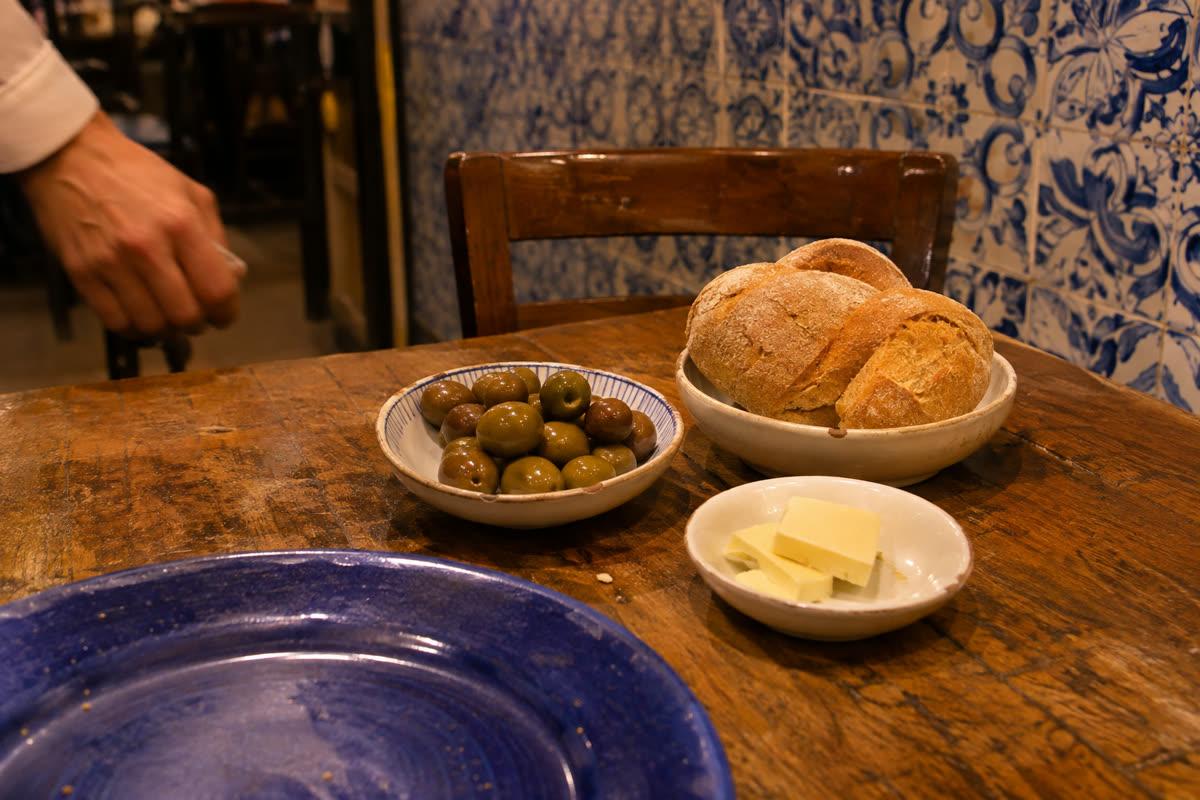 Gluten-free in Portugal: the couvert, pastelarias and what to askWhat «isento de glúten» means in Portugal, what you owe for the couvert, what restaurants must say about allergens, and what the celiac society advises.
Related guides
 Gluten-free and very low gluten on EU labels, and how allergens are highlightedWhat EU “gluten-free” and “very low gluten” claims permit, how cereals containing gluten are highlighted in ingredient lists, and the rules for loose food.
 Fine on bread in Europe? What it does and does not showWhat a trip where bread felt fine does and does not show about celiac disease, and how EU and US gluten-free label rules compare.
 Gluten-free in Denmark, Sweden, Norway, Finland and IcelandOne rule table for Denmark, Sweden, Norway, Finland and Iceland, with the regulator and society pages, the claim words, oats, rye and licorice.
 Gluten words on European food labels, language by languageFind the ingredient list, the gluten-cereal name and the gluten-free claim on a European pack in 11 languages, using words from the EU’s own texts.
Sources
- [1, 2, 3, 4, 5] European Commission (EUR-Lex), Implementing Regulation (EU) No 828/2014 on gluten-free and very low gluten statements, checked Nov 17, 2026.
- [6, 7, 8, 9, 10, 78] European Commission (EUR-Lex), Regulation (EU) No 1169/2011 on food information to consumers, Annex II, checked Nov 17, 2026.
- [11, 12, 13] European Commission (EUR-Lex), Implementing Regulation (EU) No 828/2014, Lithuanian text, checked Nov 17, 2026.
- [14] Lithuanian State Food and Veterinary Service (VMVT), News item: “Be cukrų”, “be glitimo”, “be laktozės” (13 August 2026), checked Nov 17, 2026.
- [15] Lithuanian State Food and Veterinary Service (VMVT), Allergens in unpackaged products and catering dishes, checked Nov 17, 2026.
- [16] Lithuanian State Food and Veterinary Service (VMVT), Food labelling (Maisto produktų ženklinimas), checked Nov 17, 2026.
- [17, 18, 19, 20, 21, 22, 23, 24, 25, 26] Estonian Agriculture and Food Board (PTA), Food labelling (Toidu märgistamine), checked Nov 17, 2026.
- [27] Estonian Agriculture and Food Board (PTA), Other foods (Muud toidud), checked Nov 17, 2026.
- [28, 29, 30, 31, 32] Estonian Coeliac Society (Eesti Tsöliaakia Selts), Services (English page), checked Nov 17, 2026.
- [33, 34, 35, 36, 37, 38, 39, 40, 41, 42, 43, 44, 45, 79] Estonian Coeliac Society (Eesti Tsöliaakia Selts), Allowed and forbidden foods on a gluten-free diet, by product group (2025 leaflet, in Estonian), checked Nov 17, 2026.
Read on 2026-11-17: in the leaflet’s table the row headed “ALKOHOLITA JOOGID” (non-alcoholic drinks) lists Kali in the column of forbidden products (“Keelatud toidukaubad”).
- [46, 47, 48, 49, 50, 51] Estonian Coeliac Society (Eesti Tsöliaakia Selts), Gluten-free catering leaflet for hospitals (2018, in Estonian), checked Nov 17, 2026.
- [52, 53] Visit Estonia, An introduction to Estonian cuisine, checked Nov 17, 2026.
- [54] Association of European Coeliac Societies (AOECS), Certificate of membership: Eesti Tsöliaakia Selts, checked Nov 17, 2026.
- [55, 56, 57, 58, 59, 60, 61, 62] Celiac Society of Latvia (Dzīve bez glutēna), Home (English page), checked Nov 17, 2026.
Read on 2026-11-17: the table headed “Useful Latvian label words” lists Gluten (Glutēns, lipeklis), Wheat (Kvieši), Barley (Mieži), Rye (Rudzi), Oats (Auzas), Flour (Milti) and Starch (Ciete).
- [63, 64] Celiac Society of Latvia (Dzīve bez glutēna), Where to eat (English page), checked Nov 17, 2026.
- [65] Association of European Coeliac Societies (AOECS), Certificate of membership: Dzīve bez glutēna, checked Nov 17, 2026.
- [66, 67, 68, 80] Latvian Cabinet of Ministers, Cabinet Regulation No. 595: requirements for information on unpackaged food (in Latvian), checked Nov 17, 2026.
- [69, 70] celotajs.lv (Rye Road brochure), Rye Road: travel around Latvia and explore the rye grain’s journey (brochure), checked Nov 17, 2026.
- [71, 72] Lithuania Travel, Cepelinai: Lithuania’s famous dish, checked Nov 17, 2026.
Read on 2026-11-17: the page describes cepelinai as grated and riced potatoes around a meat, dry curd cheese or mushroom filling, served with sour cream sauce and bacon bits; it names no flour, starch or other dough ingredient.
- [73] Association of European Coeliac Societies (AOECS), Members of the Association of European Coeliac Societies, checked Nov 17, 2026.
Read on 2026-11-17: under “European Member Societies” the list names Eesti Tsöliaakia Selts; under “Other coeliac societies”, which the page says “are not members of AOECS”, it names for Lithuania the “Lithuanian Coeliac and Gluten Intolerant Association www.begliuteno.lt”.
- [74] begliuteno.lt (Lithuanian Coeliac and Gluten Intolerant Association), Front page (“Dienoraštis: Be Gliuteno”), checked Nov 17, 2026.
Read on 2026-11-17: the front page shows diary posts in Lithuanian, the newest dated May 13, 2018 (a meatball recipe); it shows no gluten-free restaurant card and no eating-out page.
- [75, 76] US Food and Drug Administration, Questions and Answers on the Gluten-Free Food Labeling Final Rule, checked Nov 17, 2026.
- [77] European Union, EU countries (member states list), checked Nov 17, 2026.
Read on 2026-11-17: the page lists Estonia, Latvia and Lithuania each as an “EU Member State since 2004”.