Fine on bread in Europe? What it does and does not show
Short answer
A symptom-free trip on bread does not show that the bread was lower in gluten, or that gluten did no harm to someone with celiac disease: NIDDK says people with celiac disease who have no symptoms can still develop complications over time if they do not get treatment2. We found no study comparing gluten in European and US wheat12, 13, and the EU and the US both set the limit for a gluten-free claim at 20 parts per million29, 30. For people with self-reported gluten or wheat sensitivity, trials have tested expectation, fructans and wheat species as explanations for symptoms, not European against US wheat16, 18, 23.
Part of Gluten basics and myths, 13 guides

Key points
- NIDDK says celiac disease symptoms vary widely, and that people with celiac disease who have no symptoms can still develop complications over time if they do not get treatment1, 2.
- In one 14-day gluten-challenge study of 20 adults with coeliac disease, symptoms were back at baseline by day 28 while antibody titres had risen markedly6, 9.
- We found no study that compares gluten in European and US wheat12, 13; trials in people with self-reported gluten or wheat sensitivity tested expectation, fructans and wheat species instead17, 21, 24.
- The EU and the US both use 20 parts per million for a gluten-free claim29, 30, but the EU counts oats in its definition of gluten32 and the US rule does not list oats among gluten-containing grains15.
- The EU allergen list names rye, barley and oats as well as wheat42; the US list of major food allergens names wheat46.
If you have celiac disease: why “I felt fine” is not a test
NIDDK describes the symptoms of celiac disease as varying widely, and says a person may have symptoms that come and go1. It also says people with celiac disease who have no symptoms can still develop complications over time if they do not get treatment2.
Two studies show how symptoms and the markers of celiac disease can part ways. In a community study that tested blood from residents under 50 of Olmsted County, Minnesota, who had no prior diagnosis, the authors found no typical symptoms or classic consequences of diagnosed celiac disease (diarrhea, anemia or fracture) associated with undiagnosed celiac disease3, 4. They concluded that it appeared clinically silent, with long-term outcomes not yet determined5. The same abstract also reports associations of undiagnosed celiac disease with hypothyroidism and with lower cholesterol and ferritin levels55.
In a gluten-challenge study of 20 adults with biopsy-proven coeliac disease, participants ate 3 or 7.5 g of gluten a day for 14 days6. By day 14, biopsies showed a significant fall in the ratio of villous height to crypt depth and a rise in intraepithelial lymphocytes7, 8. Gastrointestinal symptoms rose by day 3 and were back at baseline by day 28, after the 14-day challenge, by which time antibody titres had risen markedly9.
These studies cannot say how any one person will react to one meal. NIDDK says celiac disease is not diagnosed based on symptoms alone10, and that doctors do not recommend starting a gluten-free diet before diagnostic testing, because the diet can affect test results11.
Is wheat in Europe different from wheat in the US?
In a Europe PMC phrase search and a PubMed search we did not find a study that compares the gluten in European and US wheat, or how people respond to each12, 13. A missing study does not show the wheat is the same; it means there is no comparison to cite either way.
The two rules define wheat by species, not by where it is grown. The EU defines wheat as any Triticum species14, and FDA’s rule counts wheat, including any species of the genus Triticum, as a gluten-containing grain, along with rye and barley15.
Self-reported gluten or wheat sensitivity: what trials have tested
Three trials enrolled people with self-reported sensitivity to gluten or wheat, with celiac disease ruled out, and tested possible reasons for their symptoms16, 18, 23. None of the three compared European with US wheat16, 18, 23.
| Trial | What was compared | What it found |
|---|---|---|
| Expectancy trial (2024) | Whether people expected gluten-containing or gluten-free oat bread, crossed with whether the oat bread actually contained gluten56 | The combination of expectancy and actual gluten had the largest effect on symptoms, which the authors read as a nocebo effect; an additional effect of gluten could not be ruled out17 |
| Fructan trial (2018) | 59 people on a self-instituted gluten-free diet received gluten (5.7 g), fructans (2.1 g) or placebo in muesli bars, each for 7 days18, 19 | Overall IBS-type symptom scores (GSRS-IBS) were significantly higher with fructans than with gluten, and did not differ between gluten and placebo20, 21 |
| Wheat species and fermentation trial (2024) | Bread made from bread wheat, spelt or emmer, yeast-fermented in one study and sourdough-fermented in the other, with 20 people in each23 | Most people had some symptoms with at least one bread, but as a group there were no differences between grains in either study24 |
The authors of the fructan trial note that foods with gluten often contain fructans, which they describe as a type of fermentable oligo-, di-, monosaccharides and polyols22.
These trials say nothing about celiac disease, where NIDDK says consuming gluten triggers the abnormal immune system response that causes the disease25.
Sourdough and long fermentation: what one study tested
One 2004 study tested a specific recipe: a sourdough made from a mixture of wheat (30%) and nontoxic oat, millet and buckwheat flours, started with lactobacilli and fermented for 24 hours26.
Two breads containing about 2 g of gluten, one made with baker’s yeast and one with lactobacilli and their cytoplasmic extracts, were used in a double-blind acute challenge of 17 patients with celiac sprue27, 28. Thirteen of the 17 showed a marked alteration of intestinal permeability after the baker’s yeast bread. After the sourdough bread, the same 13 had values that did not differ significantly from baseline, and the other 4 did not respond to either bread28.
That is one small study of one recipe, and it says nothing about a loaf bought in a bakery or café. For those, our sourdough verdict shows what makers and certifiers say.
EU and US gluten-free label rules side by side
Both set the limit for a gluten-free claim at 20 parts per million. The EU text allows no more than 20 mg of gluten per kg of food as sold29; FDA’s text requires any unavoidable gluten to be below 20 ppm, which it restates as below 20 mg per kg30. The wording differs: the EU says “no more than” 20 mg/kg and FDA says “below” 20 ppm, and the table shows further differences.
| Question | European Union | United States |
|---|---|---|
| The rule | Commission Implementing Regulation (EU) No 828/2014, applied from 20 July 201631 | 21 CFR 101.91, FDA’s gluten-free labeling rule30 |
| Which grains count as gluten | Gluten means a protein fraction from wheat, rye, barley, oats or their crossbred varieties and derivatives32 | Gluten-containing grains are wheat, rye, barley and their crossbred hybrids; oats are not on that list15 |
| Oats | Oats in a gluten-free food must be specially produced, prepared or processed to avoid contamination by wheat, rye, barley or their crossbreds, and cannot exceed 20 mg/kg33 | Oats labeled gluten-free must contain less than 20 ppm gluten; FDA says they do not have to be certified34 |
| A second claim | ‘Very low gluten’ is allowed where the food contains an ingredient made from wheat, rye, barley, oats or their crossbreds that was specially processed to reduce gluten, at no more than 100 mg/kg35. Coeliac UK says no foods in the UK currently carry that wording, but products in other European countries may36 | FDA’s rule defines “gluten-free” and applies the same requirements to three other phrases; we found no “very low gluten” claim in the rule’s text37 |
| What it covers | Information to consumers on the absence or reduced presence of gluten in food38; its preamble says this should help people choose a varied diet when eating inside or outside the home39 | Packaged foods; FDA recommends that restaurants making a “gluten-free” claim on their menus follow its definition40, 41 |
Allergen labeling: emphasized grains in the EU, a Contains line in the US
For gluten the two allergen lists differ. EU law lists cereals containing gluten, namely wheat, rye, barley, oats, spelt, kamut or their hybridised strains, among the substances that must be labeled42, 43. In the ingredient list, each must be emphasised through a typeset that clearly distinguishes it from the rest of the list, for example by font, style or background colour44. That item of the list carries exceptions, such as wheat based glucose syrups including dextrose and wheat based maltodextrins45.
The US list of major food allergens names wheat, not barley or rye46. US law lets a maker name the allergen in a line that starts with the word Contains, printed immediately after or adjacent to the ingredient list47. Barley and rye are not on that list, so a Contains line is not required to name them46.
EU law also makes allergen information mandatory for food offered for sale without prepackaging, or packed at the consumer’s request48, 57, which covers the Annex II substances such as cereals containing gluten. Member states may adopt national measures on the means through which that information is made available49.
What to check on a package or menu abroad
- On a packaged food, look for the words ‘gluten-free’: in the EU the statement may only be made where the food as sold contains no more than 20 mg/kg of gluten29. A statement such as ‘suitable for coeliacs’ may accompany it50.
- Read the ingredient list for grains printed in a distinct typeset44, and remember that the allergen list has exceptions such as wheat based glucose syrups45.
- Treat ‘very low gluten’ as a different claim from ‘gluten-free’: it allows up to 100 mg/kg35.
- If a gluten-free product contains oats, the EU rule requires specially produced oats33.
- At a counter or on a menu, ask for the allergen information. EU law makes it mandatory for food sold without prepackaging48, 57, and member states may set how it is given49. Coeliac UK suggests booking restaurants in advance and requesting gluten free meals, then speaking to the chef or front of house staff on arrival to confirm that they have been arranged51.
- Carry food you can rely on. Coeliac UK suggests working out what you can rely on in an emergency and packing emergency gluten free snacks52, and, in its notes on gluten free products abroad, says bread and pasta are frequently found in large branches of supermarkets and health food shops, often under the Diet section53.
At home, our verdicts for bread, pasta, pizza, croissants, couscous and sourdough show what makers and certifiers say about each food. A label abroad is a separate check.
Planning the next trip
Coeliac UK says it has travel guides for over 50 countries, with translations of useful phrases54. Our own country guides cover Italy, France, Spain and Portugal, and the travel hub collects them all.
Verdicts in this guide
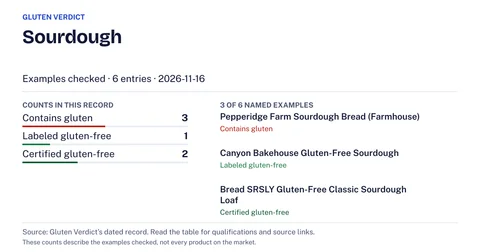


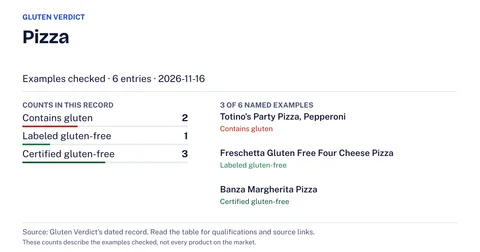
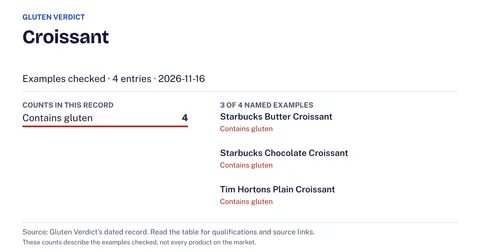
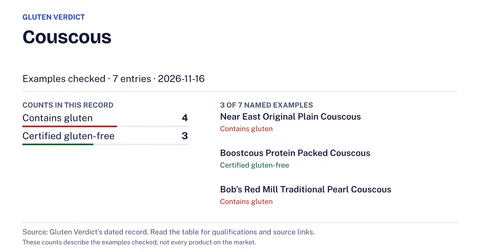
Questions people ask
Do the EU and the US use the same gluten-free limit?
For the number, yes: the EU text allows no more than 20 mg/kg29 and FDA’s rule requires unavoidable gluten to be below 20 ppm30. The EU also has a ‘very low gluten’ statement, up to 100 mg/kg, for foods with specially processed ingredients35.
Is European wheat lower in gluten than American wheat?
We did not find a study that compares them12, 13. Both rules define wheat by species14, 15.
Can celiac disease cause no symptoms?
NIDDK says people with celiac disease who have no symptoms can still develop complications over time if they do not get treatment2.
More in Gluten basics and myths
 What in wheat bothers people if it is not gluten?The non-gluten candidates for wheat symptoms (fructans, ATIs, wheat allergy), the trial or review behind each, and what limits it.
 Glyphosate, lectins and “wheat belly”: three wheat claims checkedWhere the glyphosate, wheat lectin and “wheat belly” claims come from, what the reviews found, and what NIDDK and FDA’s gluten-free rule say.
 Spelt, Kamut, Durum and Einkorn: Every Kind of Wheat Has GlutenDurum, semolina, spelt, einkorn, kamut, farro: which wheat words on a US label count as gluten, and what the FDA rule and the sources say about each.
 Did modern wheat get worse? What the variety studies show on glutenWhat studies of old and modern wheat varieties show on gluten, and what they say about spelt, einkorn and ancient wheats and celiac disease.
 Why gluten problems seem more common: what the evidence separatesGluten problems seem everywhere. Studies separate three things: cases found, cases that exist, and people avoiding gluten.
 What gluten is, which grains carry it and what “gluten-free” meansA plain definition of gluten, the grains that carry it, look-alike words such as malt and wheat starch, and what a US gluten-free label means.
Related guides
 How the 20 ppm gluten-free limit was chosen, and by whomWho set the 20 ppm gluten-free limit and when: the 2004 law, FDA's 2013 rule and its stated reasons, the 2020 follow-up rule, and Codex and EU wording.
 Gluten-free myths about labels and food, checked against the rulesNatural, organic, zero gluten, fermenting and oats: each gluten-free myth checked against the page that states the rule, with the wording and read date.
 Celiac disease vs gluten intolerance: three conditions, three diagnosesHow celiac disease, non-celiac gluten sensitivity and wheat allergy differ in mechanism, diagnosis and diet, with a source behind every point.
 Gluten-free bread, buns and wraps: what the package tells youHow to tell a gluten-free bread, bun or wrap from a wheat look-alike: certification mark, maker’s claim or ingredient list, in a fixed order.
Sources
- [1, 2, 25] NIDDK (National Institutes of Health), Symptoms & Causes of Celiac Disease, checked Nov 17, 2026.
- [3, 4, 5, 55] Gastroenterology (via PubMed), Prevalence and Morbidity of Undiagnosed Celiac Disease From a Community-Based Study, checked Nov 17, 2026.
- [6, 7, 8, 9] Gut (via PubMed), Kinetics of the histological, serological and symptomatic responses to gluten challenge in adults with coeliac disease, checked Nov 17, 2026.
- [10, 11] NIDDK (National Institutes of Health), Diagnosis of Celiac Disease, checked Nov 17, 2026.
- [12] Europe PMC, Search: “European wheat” AND “American wheat” AND gluten, checked Nov 17, 2026.
Read on 2026-11-17: a Europe PMC search for the phrases “European wheat” and “American wheat” together with the word gluten returned a hit count of 0.
- [13] PubMed (NCBI E-utilities), Search: wheat gluten Europe United States, checked Nov 17, 2026.
Read on 2026-11-17: the ten PubMed records returned for the terms wheat, gluten, Europe and United States were read by title (for example “Gluten-Associated Medical Problems” and a study of consumer views on genome editing in agriculture); none of the ten titles describes a comparison of gluten in European and US wheat.
- [14, 29, 31, 32, 33, 35, 38, 39, 50] European Commission (EUR-Lex), Commission Implementing Regulation (EU) No 828/2014 on information to consumers on the absence or reduced presence of gluten in food, checked Nov 17, 2026.
- [15, 30, 37] US Food and Drug Administration, 21 CFR 101.91 Gluten-free labeling of food (eCFR), checked Nov 17, 2026.
Read on 2026-11-17: the text of 21 CFR 101.91 defines the claim “gluten-free” and applies the same requirements to the claims “no gluten,” “free of gluten” and “without gluten”; the text contains no “very low gluten” claim.
- [16, 17, 56] Lancet Gastroenterology & Hepatology (via PubMed), The effect of expectancy versus actual gluten intake on gastrointestinal and extra-intestinal symptoms in non-coeliac gluten sensitivity, checked Nov 17, 2026.
- [18, 19, 20, 21, 22] Gastroenterology (via PubMed), Fructan, Rather Than Gluten, Induces Symptoms in Patients With Self-Reported Non-Celiac Gluten Sensitivity, checked Nov 17, 2026.
- [23, 24] American Journal of Clinical Nutrition (via PubMed), Two randomized crossover multicenter studies investigating gastrointestinal symptoms after bread consumption in individuals with noncoeliac wheat sensitivity, checked Nov 17, 2026.
- [26, 27, 28] Applied and Environmental Microbiology (via PubMed), Sourdough bread made from wheat and nontoxic flours and started with selected lactobacilli is tolerated in celiac sprue patients, checked Nov 17, 2026.
- [34, 40, 41] US Food and Drug Administration, Questions and Answers on the Gluten-Free Food Labeling Final Rule, checked Nov 17, 2026.
- [36] Coeliac UK, Gluten free food labelling law explained, checked Nov 17, 2026.
- [42, 43, 44, 45, 48, 49, 57] European Commission (EUR-Lex), Regulation (EU) No 1169/2011 on the provision of food information to consumers, Annex II, checked Nov 17, 2026.
Read on 2026-11-17: Annex II, item 1 (cereals containing gluten) lists four exceptions: wheat based glucose syrups including dextrose; wheat based maltodextrins; glucose syrups based on barley; and cereals used for making alcoholic distillates including ethyl alcohol of agricultural origin.
- [46, 47] US Food and Drug Administration, Food Allergen Labeling and Consumer Protection Act of 2004 (FALCPA), checked Nov 17, 2026.
- [51, 52, 53, 54] Coeliac UK, Travelling with coeliac disease, checked Nov 17, 2026.