Gluten-free in Central Europe: the rules in five countries and where wheat hides in the dishes
Short answer
The word “gluten-free” on a pack means no more than 20 mg of gluten per kg of food as sold, under an EU rule that is directly applicable in every Member State1, 2, and Switzerland writes the same figure into its own ordinance3. Check in this order:
- Packs: look for the national word for gluten-free. The pages we read give the limit behind it as 20 mg/kg in Czechia5, Hungary6, Poland7 and Switzerland8, and as 20 ppm in Austria4. The registered crossed ear can be used only under licence9.
- Menus: each country sets how a restaurant gives the gluten information. Poland’s inspectorates say the information should be available to the consumer directly, not only on asking10, 11; Austria, Hungary and Switzerland accept a spoken answer under conditions12, 13, 14.
- Dishes: the society pages we read name the same places for wheat: breading15, 16, dumplings and dough15, 17, flour-thickened soups and sauces18, 19 and malt drinks20, 21.
- Ask where the wheat enters the dish, not only whether it has gluten: the coating, the dough, the thickener, the fryer.
Part of Travel: Europe, 19 guides

Key points
- The limit is the same number in all five countries: no more than 20 mg of gluten per kg for a gluten-free statement1, 3.
- In Czechia a dish labeled “bez lepku” is held to 20 mg/kg22, and the inspection authority reported in January 2022 two meals that failed its laboratory test23.
- Restaurants must give allergen information, and cereals containing gluten are on the allergen list24, 25, 45, but the form differs: Poland’s inspectorates say it should be available to the consumer directly, not only on asking10, 11; Austria accepts a spoken answer from trained staff12.
- The Austrian, Czech, Hungarian, Polish and Swiss societies we read each name flour-thickened soups and sauces or breading among the places gluten sits15, 18, 16, 26, 19.
- A crossed ear drawing is not always the licensed mark: the Polish society says producers may use their own symbol if it differs from the licensed one27.
Which rule covers a gluten-free pack in each country?
The EU rule on gluten statements says the statement “gluten-free” may be made only where the food as sold to the final consumer contains no more than 20 mg/kg of gluten1. The regulation is binding in its entirety and directly applicable in all Member States2.
A second statement, “very low gluten”, has a limit of 100 mg/kg and is for food made from wheat, rye, barley or oats ingredients that were specially processed to reduce gluten28. Oats in a food presented as either statement must be specially produced to avoid contamination by wheat, rye or barley, and their gluten cannot exceed 20 mg/kg29.
Switzerland sets the figure in its own ordinance. Article 41 of the federal ordinance on food information (LIV) allows “glutenfrei” at no more than 20 mg/kg3 and “sehr geringer Glutengehalt” at no more than 100 mg/kg30, and the federal food office (FSVO) restates the 20 mg limit on its labeling page8.
| Country | What the page we read says | Page |
|---|---|---|
| Austria | The national celiac society calls 20 ppm the legal limit for gluten-free products4 and refers to EU Regulation 828/2014 in its oats guidance31 | Österreichische Arbeitsgemeinschaft Zöliakie |
| Czechia | The inspection authority repeats the EU wording: no more than 20 mg/kg5 | SZPI |
| Hungary | An inspector of the national food chain office states the same 20 mg/kg for “gluténmentes”6 | NÉBIH presentation |
| Poland | The national society’s guide counts foods as gluten-free when gluten does not exceed 20 ppm (20 mg per kg)7 | Polskie Stowarzyszenie Osób z Celiakią |
| Switzerland | The ordinance and the federal food office both give 20 mg/kg3, 8 | Fedlex, FSVO |
US comparison: FDA’s rule requires any unavoidable presence of gluten in a food labeled gluten-free to be less than 20 ppm32, where the EU and Swiss texts say no more than 20 mg/kg1, 3. Our EU labeling guide and labeling laws by country cover the wording.
Advisory lines beside a gluten-free claim are read differently by FDA and in one Hungarian inspector’s presentation. FDA does not prohibit a voluntary advisory such as “made in a facility that also processes wheat” beside a gluten-free claim if it is truthful and not misleading33. A Hungarian food-chain inspector’s presentation gives as an example that “gluten-free” together with “made in a plant that also uses gluten” on one label misleads consumers34. See may-contain labels by country.
Which regulator and society pages to read, by country
These are the pages we opened on 2026-11-17. A society page is the society’s own advice, not law.
| Country | Pages we read | What they cover |
|---|---|---|
| Austria | Health ministry FAQ on allergen information for unpackaged food; Österreichisches Lebensmittelbuch, Codex chapter A 5; Österreichische Arbeitsgemeinschaft Zöliakie: Urlaub & Gastronomie, Glutenfreie Ernährung, Das Symbol | Written or spoken allergen information35; letter codes for allergens36; the society’s view of Austrian dishes15 and of the licensed symbol37 |
| Czechia | SZPI: gluten labeling and the 2022 restaurant inspection; Společnost pro bezlepkovou dietu (celiak.cz); Sdružení celiaků ČR (celiaci.cz) | The 20 mg/kg wording and how restaurants give allergen information5, 38; flour in Czech soups and sauces18; the licensed crossed ear39 |
| Hungary | NÉBIH guide for caterers; decree 36/2014 (XII. 17.) FM; Magyar Cöliákia Egyesület: Mit ehetek/vásárolhatok? | Information before the order40; spoken or written13; the society on rántott hús, soups and beer16, 41 |
| Poland | IJHARS: unpackaged food; a regional inspectorate article for restaurateurs; Polskie Stowarzyszenie Osób z Celiakią i na Diecie Bezglutenowej: practical guide, eating out, the licence page | Allergen information a consumer can read without asking10; the society’s table of foods that contain gluten17; the licensed mark42 |
| Switzerland | Fedlex: LIV; FSVO: food labels and loose food; IG Zöliakie: A–Z, shopping, host leaflet, eating abroad | The 20 mg/kg ordinance3; spoken allergen information14; the society on malt drinks, fondue and sauces21, 43, 19 |
Allergen information on the menu: written, spoken or both
EU law makes allergen information mandatory for food offered without prepackaging24, and “mass caterer” in the same regulation includes restaurants25. The mandatory allergens are those in Article 9(1)(c)44, and cereals containing gluten head the Annex II list45. Member States may decide the means and form of that information46, and the table shows how the five countries use that room. Our European restaurant rules guide compares more countries.
| Country | What the source says |
|---|---|
| Austria | Written or spoken35. Spoken answers come from trained staff, with a visible notice that the information is available on request12. If letter codes are used, the Austrian food code recommends a fixed assignment with a legend36; the letter A stands for cereals containing gluten47, and the society says menus usually mark gluten ingredients with A48 |
| Czechia | SZPI: a list in the menu or on the customer’s request from staff38. The society page says restaurants must name gluten as allergen number 1 and the specific cereal49 |
| Hungary | The caterer chooses spoken or written13; the decree says the guest has to be told before the purchase40. For spoken information, the basis can be a document on the dish, which must be shown to the guest on request50, and a notice must say where to get the information51 |
| Poland | The national inspectorate’s page on unpackaged food says the consumer should be able to read the information without asking the shop’s staff, and a QR code alone is not enough10, 52. A regional inspectorate article calls oral answers on request incorrect practice in restaurants11 |
| Switzerland | Written is the principle; spoken is allowed when a visible written notice says so and the staff hold the information in writing or a knowledgeable person can give it at once14, 53, 54 |
The EU duty is about ingredients and processing aids still present in the finished food44. The Hungarian caterer guide says everyday catering has no premises that ensure complete freedom from allergen ingredients and no separate kitchens for allergen-free dishes55. Our advice: ask for the written list or the notice before you order, and where the answer is spoken, ask whether it comes from a recipe record.
In Czechia the gluten-free label is held to a number on dishes too: SZPI says the words “bez lepku” may be used for a dish only when it holds no more than 20 mg/kg22. In January 2022 it reported two meals sold as gluten-free that failed its laboratory test, one of them found at 70,9 mg/kg of gluten23.
Breaded cutlets: schnitzel and other coated, fried meat
The Austrian society lists breaded food (“Paniertem”) among the traditional dishes it calls not necessarily a paradise for people with celiac disease15, and says some venues offer a gluten-free schnitzel56. The Hungarian society says rántott hús made the traditional way is off limits for people with gluten sensitivity, and stays so with the coating removed16.
The Polish society’s table puts breadings for meat and fish, and breaded dishes, in its “contains gluten” column26. Its eating-out advice: if you hear that the meat or fish is not coated in breadcrumbs, ask whether it was rolled in flour57, and ask for fried food cooked in fat in which no gluten-containing dish was fried before58. The Swiss society tells hosts not to reuse oil that fried batter and breaded food for fries59.
For Czechia we cite the regulator’s tests of dishes sold as gluten-free, in the section on menus above. Our verdict page for breadcrumbs covers the ingredient.
Dumplings, dough and noodles
| Country | What the source names |
|---|---|
| Austria | Knödel among the dishes of traditional Austrian cooking that it calls not necessarily a paradise for people with celiac disease15; Knödel, Teigwaren and Mehlspeisen among the foods the society lists as made from gluten grains60 |
| Czechia | In the society’s seminar slides, the example allergen declaration for a houskový knedlík lists wheat flour among its ingredients61 |
| Hungary | The caterer guide’s example for tojásos galuska: the egg is obvious from the name, but milk and gluten still have to be declared62. The society says a soup is off limits even if wheat-flour pasta is taken out of it16 |
| Poland | Pierogi, pyzy, kopytka, naleśniki and makaron in the society’s “contains gluten” column17 |
| Switzerland | The host leaflet’s list of forbidden Mehlspeisen: Ravioli, Tortellini, Spätzli, Gnocchi, Knödel and more19 |
Where we have a verdict, it links here: dumplings, gnocchi and pancakes. The point of these lists is what to ask about the dough.
Goulash, soups and sauces: flour as the thickener
The pages we read name the thickening step. The Austrian society lists bound soups and sauces (“gebundene Suppen und Soßen”) among traditional dishes it calls not necessarily a paradise for people with celiac disease, and adds that many cooks do not bind soups or use cornstarch15, 63. The Czech society says flour is used in soups, sauces and vegetable dishes18.
In its advice for cooking at home, the Hungarian society says to make the rántás, the flour roux, with gluten-free flours64. The Polish society’s table puts vegetables “zasmażane albo zagęszczane mąką” in its “contains gluten” column26. The Swiss society lists flour-bound sauces as forbidden and sauces bound with maize or potato starch as allowed19; its English kitchen card lists “Sauces or soups bound with flour” among what is not allowed65.
So for goulash, gulyás or any stew, ask how it was thickened. That is our advice, drawn from the pages above. Our verdicts: soup and gravy.
Strudel, cakes and other pastry
The Austrian society’s list of gluten-grain foods includes Gebäck, Mehlspeisen, Kuchen, Kekse and Waffeln60, and its page on Austrian cooking names Strudel and sweet Mehlspeisen15. The Polish society’s table names ciasta, ciastka and drożdżówki17. The Swiss host leaflet names Käsekuchen and Wähen19.
This guide does not rule on trdelník, lángos or pączki; ask what the dough is made of. Our verdicts: cake, cheesecake, donuts and bread.
Beer, malt drinks and spirits
| Country | What the source says |
|---|---|
| Austria | Malt and products containing malt, such as Ovomaltine, Malzkaffee, cornflakes and beer, contain gluten20 |
| Hungary | Beers made from traditional barley malt always have gluten residue, usually above the 20 mg/kg limit41 |
| Poland | Piwo sits in the “contains gluten” column; piwo bezglutenowe, cider, wine and pure spirits such as vodka and rum sit in the column for foods without gluten66 |
| Switzerland | Beer is listed as containing gluten67; products with a large share of malt extract, for example Ovomaltine, are not allowed in a gluten-free diet21 |
We cite no Czech society statement on beer. Our verdicts: beer and vodka, and the ingredient page on malt extract.
The crossed ear: a licensed mark or just a picture
The Crossed Grain Trademark is a registered trademark that can be used under licence on food and drink that meet the AOECS standard9. The national celiac societies license it in their own countries37, and AOECS says the 20 ppm limit applies to packaged food and to food sold in restaurants and catering68.
| Country | Licensor and conditions the society states |
|---|---|
| Austria | Österreichische Arbeitsgemeinschaft Zöliakie; an annual audit by an independent body is a condition69; the registration number sits under the symbol70 |
| Czechia | Sdružení celiaků ČR holds the licence from AOECS39; products must meet 20 mg/kg with a certificate from an accredited laboratory71 |
| Poland | The Polish society says it alone certifies and licenses the symbol in Poland42; a plant must pass an audit72 |
| Switzerland | IG Zöliakie releases licensed products; each carries a licence number such as CH-XXX-XXX73; the society’s host leaflet says the licensed mark may not be used in the restaurant trade74 |
We did not read a Hungarian society page on licensing, so the table leaves Hungary out. A crossed ear on a pack can be a drawing rather than the licensed mark: the Polish society says a producer may use any symbol of its own if it is clearly different from the licensed one27. SZPI says that where a crossed ear is shown to mean gluten-free, the words “bez lepku” must appear on the pack too75.
Switzerland: what is different
Switzerland’s gluten-free limit is the same number as the EU’s3, 1, but the text is Swiss law, and mandatory label information must be in at least one of the country’s official languages76.
Two Swiss details about unintended gluten are worth knowing. First, for food sold loose, the ordinance says there is no need to flag unintended mixing77. Second, under Article 11 an unintended-gluten notice is required when the share of gluten-containing cereal exceeds or could exceed 200 mg of gluten per kg or litre of ready-to-eat food78, 79; below that, a notice may be given voluntarily80.
On fondue, the Swiss society’s host leaflet says that for cheese fondue everyone should get gluten-free bread, or the guest with celiac disease should have a separate caquelon43; it also lists fondue among cheese preparations that can contain a gluten ingredient81. For Ovomaltine, see the drinks section above.
The Swiss society says standard sausages such as Cervelat and Bratwurst should be gluten-free by traditional recipe82; our sausage verdict covers the ingredient list.
Two retailers describe their own ranges. Migros says it has all own-brand allergy products certified by Service Allergie Suisse83 and keeps no list of every product suited to a gluten-free diet84. Coop says all its gluten-free products also carry the crossed ear in a circle85.
What to ask, and where to get a card
- On a pack, look for the national word for gluten-free; on a licensed crossed ear, look for the number under it, which is the registration number in Austria70 and the licence number in Switzerland73.
- At the table, ask for the written allergen list or the notice that says the answer is spoken, and ask where a spoken answer comes from.
- Name the entry point of wheat in the dish you want: the coating, the dough, the thickener, the malt.
- Ask about the pan, the pot and the fryer. The Polish society asks for fat in which no breaded food was fried58.
- Carry a card in the local language. The Swiss society recommends kitchen cards in the local language86 and publishes an English kitchen card65; the Polish society sends a leaflet in more than ten languages to people who join87. We print no translated phrases here; use a society’s card.
Where a cuisine is heavy in sauces and breading, the Swiss society says it suits a gluten-free diet less than others88.
Verdicts in this guide
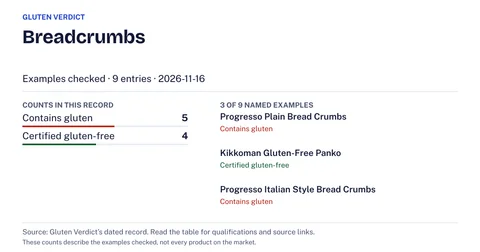 BreadcrumbsContains glutenchecked Nov 16, 2026
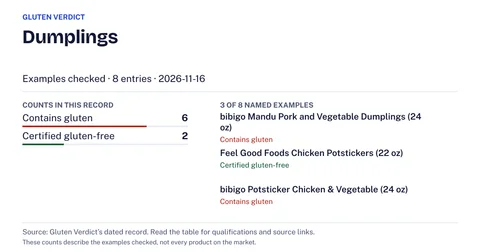 DumplingsContains glutenchecked Nov 16, 2026
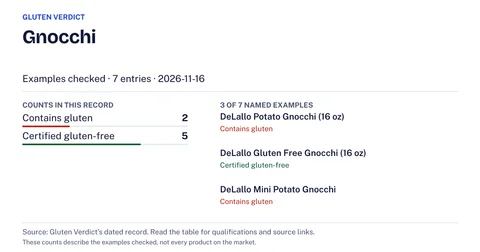 GnocchiDepends on the product2 of 7 products we checked contain gluten: DeLallo Potato Gnocchi (16 oz) and DeLallo Mini Potato Gnocchichecked Nov 16, 2026
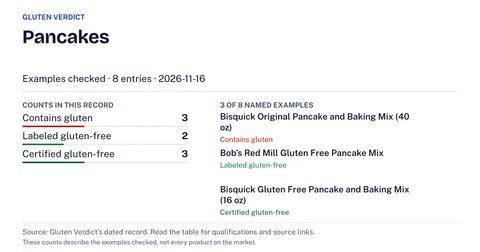 PancakesContains glutenchecked Nov 16, 2026
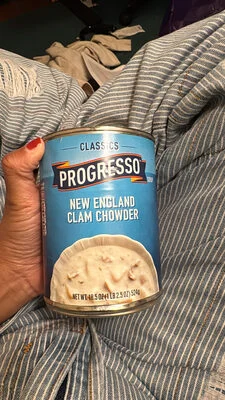 SoupDepends on the product3 of 8 products we checked contain gluten: Campbell’s Condensed Tomato Soup (10.75 oz), Campbell’s Condensed Cream of Mushroom Soup (10.5 oz), and Progresso Traditional Chicken Noodlechecked Nov 16, 2026
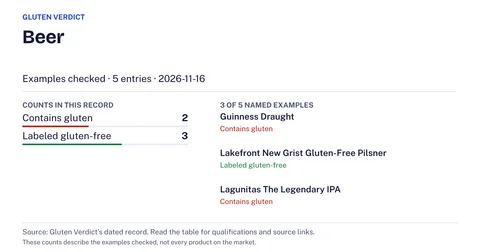 BeerDepends on the product2 of 5 products we checked contain gluten: Guinness Draught and Lagunitas The Legendary IPAchecked Nov 16, 2026
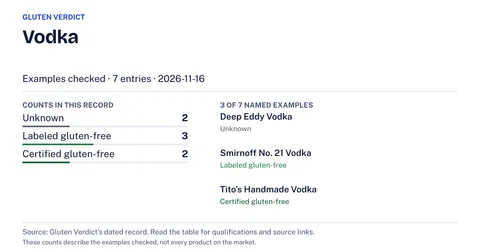 VodkaDepends on the productchecked Nov 16, 2026
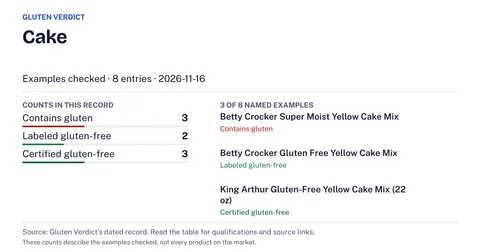 CakeContains glutenchecked Nov 16, 2026
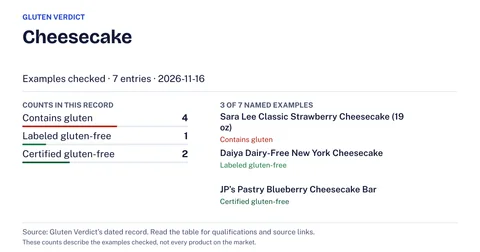 CheesecakeDepends on the product4 of 7 products we checked contain glutenchecked Nov 16, 2026
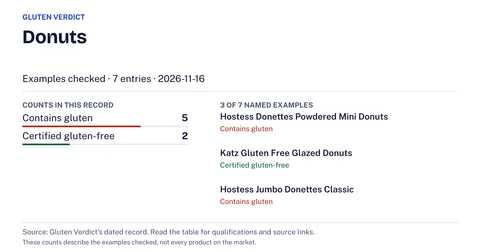 DonutsContains glutenchecked Nov 16, 2026
 BreadContains glutenchecked Nov 16, 2026
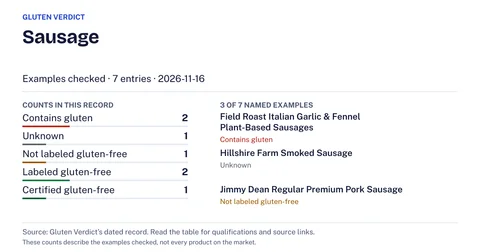 SausageDepends on the product2 of 7 products we checked contain gluten: Field Roast Italian Garlic & Fennel Plant-Based Sausages and Tofurky Plant-Based Italian Sausagechecked Nov 16, 2026
Questions people ask
Is the Swiss gluten-free limit different from the EU one?
Both texts allow “gluten-free” at no more than 20 mg of gluten per kg1, 3. Switzerland sets the figure in its own ordinance, Article 41 of the LIV3.
Can a restaurant in Poland answer allergen questions only out loud?
The national inspectorate’s page on unpackaged food says the consumer should be able to read the information without asking the shop’s staff, and that a QR code alone is not enough10, 52. A regional inspectorate article calls oral answers on request incorrect practice in restaurants11.
Do Czech restaurants have to tell me about gluten?
SZPI says restaurants must make allergen information available, for example as a list in the menu or on request from staff38. A dish called “bez lepku” must hold no more than 20 mg/kg22.
More in Travel: Europe
 Gluten-free in Estonia, Latvia and Lithuania: label words, rye bread and dumplingsHow Estonia, Latvia and Lithuania word gluten-free claims, where rye, barley and wheat sit in local dishes, and which official pages to check.
 Gluten-free in Croatia and the Balkans: which rule applies where, and where wheat enters the dishesWhich gluten-free rule applies in Croatia, Serbia, Bosnia and Montenegro, how to read the claim, and where wheat enters burek, ćevapi and palačinke.
 Gluten-free in Ireland: labels, pub rules, Guinness and the Crossed Grain symbolWhat Irish labels, pub allergen rules and the Crossed Grain symbol say about gluten, and what Guinness lists, so a US traveler knows what to check.
 Gluten-free in Germany: what “glutenfrei” and German allergen rules tell youHow to read “glutenfrei” and German allergen rules, spot wheat in pretzels and Spätzle, and ask a restaurant for its allergen information.
 Gluten-free in the Netherlands and Belgium: labels, fryers, waffles and beerWhat glutenvrij and sans gluten mean on a pack, what Dutch and Belgian counters must tell you, and the fryer, waffle and beer questions to ask.
 Gluten-free in Turkey: reading labels and menusTurkey’s gluten-free label rule, where wheat enters a Turkish menu (bulgur, şehriye, flour, mixes), and who to ask. Sources are Turkish and linked.
Related guides
 Gluten-free and very low gluten on EU labels, and how allergens are highlightedWhat EU “gluten-free” and “very low gluten” claims permit, how cereals containing gluten are highlighted in ingredient lists, and the rules for loose food.
 Fine on bread in Europe? What it does and does not showWhat a trip where bread felt fine does and does not show about celiac disease, and how EU and US gluten-free label rules compare.
 What a European restaurant must tell you about gluten, country by countryWhether restaurants in France, Germany, Austria, Italy, Spain and the UK must show allergens in writing or may answer aloud, and what to ask.
 Gluten-free logos outside the US: who issues each one and what it requiresTell a certifier’s gluten-free logo from a maker’s own: who issues Crossed Grain, Coeliac Australia’s and Celiac Canada’s marks, and the limit each sets.
Sources
- [1, 2, 28, 29] European Commission (EUR-Lex), Commission Implementing Regulation (EU) No 828/2014 on information on the absence or reduced presence of gluten in food, checked Nov 17, 2026.
- [3, 30, 53, 54, 77, 78, 79, 80] Swiss Federal Council (Fedlex), SR 817.022.16, Verordnung des EDI betreffend die Information über Lebensmittel (LIV), Art. 41, checked Nov 17, 2026.
- [4, 37, 69, 70] Österreichische Arbeitsgemeinschaft Zöliakie, Glutenfrei-Symbol: Das Symbol, checked Nov 17, 2026.
- [5, 38, 75] SZPI (Czech Agriculture and Food Inspection Authority), Označování potravin z hlediska obsahu lepku, checked Nov 17, 2026.
- [6, 34] NÉBIH (Hungarian National Food Chain Safety Office) inspector’s presentation (Az allergén jelölés szabályai és hatósági tapasztalatok, 2024-04-25), Az allergén jelölés szabályai és hatósági tapasztalatok, checked Nov 17, 2026.
- [7, 17, 26, 66] Polskie Stowarzyszenie Osób z Celiakią i na Diecie Bezglutenowej, Celiakia i dieta bezglutenowa: praktyczny poradnik, checked Nov 17, 2026.
Read on 2026-11-17: in the guide’s table “Podział produktów ze względu na zawartość glutenu” (Tabela 2), the row “Produkty zbożowe”, column “Zawierają gluten”, names makaron pszenny, makaron żytni, pierogi, pyzy, kopytka, naleśniki, pieczywo, ciasta, ciastka, drożdżówki, pizza and bułka tarta.
Read on 2026-11-17: in the same table, the row “Mięso, ryby, jaja”, column “Zawierają gluten”, names panierki do mięs i ryb oraz potrawy panierowane; the row for vegetables names warzywa zasmażane albo zagęszczane mąką, panierowane.
Read on 2026-11-17: in the same table, the row “Napoje”: the column “Nie zawierają glutenu” names czyste alkohole (wódka, rum itp.), wino, piwo bezglutenowe and cydr; the column “Zawierają gluten” names piwo.
- [8, 76] Swiss Federal Food Safety and Veterinary Office (FSVO), Information on food labels, checked Nov 17, 2026.
- [9, 68] AOECS (Association of European Coeliac Societies), Gluten Free Certification, checked Nov 17, 2026.
- [10, 52] Inspekcja Jakości Handlowej Artykułów Rolno-Spożywczych (IJHARS), Znakowanie żywności nieopakowanej, checked Nov 17, 2026.
- [11] Wojewódzki Inspektorat Jakości Handlowej Artykułów Rolno-Spożywczych w Olsztynie, Jakie obowiązki informacyjne wobec konsumentów mają restauratorzy (2024), checked Nov 17, 2026.
- [12, 35] Austrian health ministry (verbrauchergesundheit.gv.at), FAQ zur Allergeninformationsverordnung für unverpackte Lebensmittel, checked Nov 17, 2026.
- [13, 50, 51, 55, 62] NÉBIH (Hungarian National Food Chain Safety Office), Segédlet vendéglátó vállalkozásoknak arról, hogy miként tájékoztassák vendégeiket a felszolgált/kiszolgált ételek allergén összetevőiről?, checked Nov 17, 2026.
- [14] Swiss Federal Food Safety and Veterinary Office (FSVO), Informationen im Offenverkauf, checked Nov 17, 2026.
- [15, 48, 56, 63] Österreichische Arbeitsgemeinschaft Zöliakie, Zöliakie: Urlaub & Gastronomie, checked Nov 17, 2026.
- [16, 41, 64] Magyar Cöliákia Egyesület, Mit ehetek/vásárolhatok?, checked Nov 17, 2026.
- [18, 49] Společnost pro bezlepkovou dietu (celiak.cz), Stravování a restaurace, checked Nov 17, 2026.
- [19, 43, 59, 74, 81] IG Zöliakie der Schweiz, Merkblatt „Glutenfreie Ernährung“ für Hotels, Restaurants und Gemeinschaftsgastronomie, checked Nov 17, 2026.
Read on 2026-11-17: the table column “Verbotene Nahrungsmittel (glutenhaltig)” lists “Mehlspeisen wie Pizza, Ravioli, Tortellini, Spätzli, Gnocchi, Käsekuchen, Wähen, Pasteten, Knödel etc.”, “Panierte Speisen” and “Saucen mehlgebunden”; the column “Erlaubte Nahrungsmittel (glutenfrei)” answers with gluten-free breadcrumbs and with sauces bound with maize or potato starch.
Read on 2026-11-17: the table row “Käsezubereitungen wie Fondue, Streichkäse etc. können eine glutenhaltige Zutat enthalten (**)”, with the footnote “(**) immer die Zutatendeklaration überprüfen”.
- [20, 31, 60] Österreichische Arbeitsgemeinschaft Zöliakie, Glutenfreie Ernährung, checked Nov 17, 2026.
- [21, 67, 82] IG Zöliakie der Schweiz, Zöliakie von A-Z, checked Nov 17, 2026.
- [22, 23] SZPI (Czech Agriculture and Food Inspection Authority), Potravinářská inspekce zjistila lepek v „bezlepkových“ pokrmech v restauracích (24. 1. 2022), checked Nov 17, 2026.
Read on 2026-11-17: the page, dated 24. 01. 2022, reports two samples that failed: a meal named “Fazolky s panýrem ve smetanové omáčce”, labeled “bezlepek” and found to hold 70,9 mg/kg of gluten, and a meal named “BEJKN & ČÍZ v bezlepkovém pečivu” found at 36,1 mg/kg, with a separate sample of its gluten-free bread at 105 mg/kg.
- [24, 25, 44, 45, 46] European Commission (EUR-Lex), Regulation (EU) No 1169/2011 on the provision of food information to consumers (Article 44), checked Nov 17, 2026.
- [27, 72] Polskie Stowarzyszenie Osób z Celiakią i na Diecie Bezglutenowej, Licencja na używanie znaku Przekreślonego Kłosa (przekreslonyklos.pl), checked Nov 17, 2026.
- [32, 33] US Food and Drug Administration, Questions and Answers on the Gluten-Free Food Labeling Final Rule, checked Nov 17, 2026.
- [36, 47] Austrian health ministry (verbrauchergesundheit.gv.at), Österreichisches Lebensmittelbuch, Codexkapitel A 5: Kennzeichnung, Aufmachung, checked Nov 17, 2026.
Read on 2026-11-17: the table headed “Allergeninformation gemäß Codex-Empfehlung” (page 11) pairs the letter A with “glutenhaltiges Getreide” (cereals containing gluten).
- [39, 71] Sdružení celiaků ČR (celiaci.cz), Symbol přeškrtnutého klasu, checked Nov 17, 2026.
- [40] Nemzeti Jogszabálytár (Hungarian legal database), 36/2014. (XII. 17.) FM rendelet az élelmiszerekkel kapcsolatos tájékoztatásról, checked Nov 17, 2026.
- [42] Polskie Stowarzyszenie Osób z Celiakią i na Diecie Bezglutenowej, Certyfikacja produktów bezglutenowych: Przekreślony Kłos, checked Nov 17, 2026.
- [57, 58, 87] Polskie Stowarzyszenie Osób z Celiakią i na Diecie Bezglutenowej, Bezglutenowe jedzenie na mieście i w podróży (15.06.2023), checked Nov 17, 2026.
- [61] Společnost pro bezlepkovou dietu, Společné stravování (seminar slides, 20 May 2023), checked Nov 17, 2026.
- [65] IG Zöliakie der Schweiz, Gastrokarte (English): With this information you can inform the kitchen and service staff, checked Nov 17, 2026.
- [73] IG Zöliakie der Schweiz, Einkaufen, checked Nov 17, 2026.
- [83, 84] Migros, Merkblatt: Glutenintoleranz / Zöliakie (July 2026), checked Nov 17, 2026.
- [85] Coop, Free From – for enjoyment and well-being, checked Nov 17, 2026.
- [86, 88] IG Zöliakie der Schweiz, Glutenfrei im Ausland, checked Nov 17, 2026.