Gluten-free in Scotland: the rule, haggis, oatcakes, pies and whisky
Short answer
In Scotland, “gluten-free” means the UK rule: no more than 20 mg of gluten per kg of food as sold, and the same terms apply to restaurant food1, 2. Food Standards Scotland, not the FSA, is the body behind Scottish guidance, and local authorities enforce the allergen rules3, 4, 5. Judge each Scottish food by where its cereal sits:
- Haggis, oatcakes and porridge: the oats. In UK law oats count as a gluten cereal, and oats in a gluten-free food must be specially produced and at no more than 20 mg/kg6, 7.
- Pies, sausage, batter and soups: FSS lists pastry, batter, breadcrumbs, processed meat, sauces and soups as places wheat and other gluten cereals turn up8.
- Scotch broth: barley, which is a gluten cereal, is on Baxters’ ingredient list9, 6.
- Whisky: Coeliac UK says distillation removes any trace of gluten from spirits; beer is different10, 11.
- Gluten-free limit
- No more than 20 mg of gluten per kg of food as sold for “gluten-free”, and no more than 100 mg/kg for “very-low gluten”, as FSS’s technical guidance sets it out for Scotland19, 1
- Set by
- Commission Implementing Regulation (EU) No 828/2014, as published on legislation.gov.uk for the UK, applied in Scotland through Food Standards Scotland guidance63, 19
- Oats
- Oats in a food presented as gluten-free must be specially produced, prepared and/or processed to avoid contamination by wheat, rye, barley or their crossbred varieties, and their gluten cannot exceed 20 mg/kg7; oats are also one of the cereals containing gluten on the allergen list6
- Celiac society
- Coeliac UK
Part of Travel: Europe, 19 guides

Key points
- Oats are inside the UK definition of gluten and on its allergen list, which is not how FDA treats them12, 6, 13.
- The allergen list in Scotland names wheat, rye, barley and oats; FDA’s FALCPA definition of a major food allergen names wheat6, 14.
- A gluten-free product made with oats still names “oats” in its ingredients15.
- Cereals used to make distilled spirits are excepted from the cereals-containing-gluten allergen, while a gluten removed beer made from barley must say it contains barley6, 16.
- For loose food, allergen information must be available before purchase, on a menu, chalkboard, shelf label or from staff17.
Who sets and checks the gluten-free rule in Scotland
Food Standards Scotland (FSS) was set up in April 2015 as Scotland’s public food body3. The Food Standards Agency (FSA) works across England, Wales and Northern Ireland and describes FSS as the equivalent public body for Scotland4, 18.
The gluten-free rule itself is the UK one. FSS’s technical guidance, which lists Scotland as the nation it applies to, says a “gluten-free” statement may only be made where the food as sold contains no more than 20 mg/kg of gluten, and “very-low gluten” at no more than 100 mg/kg19, 1. The regulation behind it, as legislation.gov.uk publishes it for the UK, says the same for “gluten-free”20. Coeliac UK states the UK limit as 20 parts per million (ppm)21.
In Scotland, local authority environmental health departments are responsible for enforcing the allergen rules and wider food information requirements5.
FSS’s guidance is dated May 2023 and gives May 2024 as its next scheduled review22. Check FSS’s site for a newer edition before relying on a detail. For the UK as a whole, see our UK travel guide and UK labeling guide.
| Question | United States (FDA) | Scotland |
|---|---|---|
| Gluten-free limit | Unavoidable gluten must be less than 20 ppm23 | No more than 20 mg/kg of gluten in the food as sold20 |
| Oats | Treated like any other non-gluten-containing grain: oats labeled gluten-free must contain less than 20 ppm gluten13 | Named among the cereals containing gluten6; oats in a gluten-free food must be specially produced to avoid contamination by wheat, rye or barley, and their gluten cannot exceed 20 mg/kg7 |
| Allergen list | FALCPA’s definition of a major food allergen names wheat; barley, rye and oats are not named in it14 | Wheat, rye, barley and oats are listed together as cereals containing gluten6 |
| Restaurant and loose food | The rule applies to packaged foods; FDA recommends that restaurants making a gluten-free claim follow its definition24 | The gluten-free terms apply to all foods, including non-prepacked foods such as those served in restaurants2 |
What a Scottish pack, counter or menu has to tell you
Food businesses must tell consumers if the food they sell contains any of the 14 allergens that UK law requires to be declared25. Gluten is one of the 14, and FSS’s list names wheat (spelt and Khorasan included), rye, barley and oats8. How the information reaches you depends on how the food is sold:
- Prepacked food: the allergen is emphasised in the ingredient list so that it stands out26.
- Prepacked for direct sale (PPDS), such as a sandwich wrapped on the premises: since 1 October 2021 the pack carries the product name and a full list of ingredients27. FSS gives sandwiches, wrapped deli counter goods and boxed salads as examples28.
- Loose food, such as a meal in a restaurant: the allergen information must be available before you buy, on a menu, chalkboard or shelf label, or from a member of staff speaking to you17.
A business must give you that information; FSS notes it does not have to make a separate meal29.
On wording, FSS’s guidance says no statements other than “gluten-free” and “very-low gluten” may describe the absence or reduced presence of gluten30. Two Coeliac UK marks sit on top of the legal wording. Coeliac UK says food products certified under its Crossed Grain trademark have been through extra checks, including checking gluten analysis certificates and independent audits31. A GF symbol on a venue’s menu tells you, in Coeliac UK’s words, that the dish is gluten free according to the law and that the caterer meets all requirements of its Gluten Free Standard32.
Coeliac UK points out that the law does not specify that tests have to be done to prove foods are gluten free, though it recognises that good practice will involve testing33.
Haggis, oatcakes and porridge: the oats question
In US rules, oats are not one of the named gluten grains, so the question on a pack is whether the oats are labeled gluten-free34, 13. UK law puts oats inside its definition of gluten12 and on its allergen list6. That is a difference you may meet on a Scottish pack.
It also means a gluten-free product made with oats still names them. FSS’s guidance says that when gluten free oats are used in a gluten free product, the word “oats” would still need to be emphasised and declared15. Seeing “oats” emphasised in the ingredients of a product that says gluten-free is therefore expected, not a contradiction. Our guide to gluten-free oats versus regular oats covers the US side.
Haggis. Macsween describes its haggis as lamb, beef, oats, onions and spices35, and adds that each haggis maker has a slightly different recipe36. Its gluten-free haggis uses gluten free oats as an alternative to the original’s oats37 and is, the maker says, certified by Coeliac UK38. A butcher’s or restaurant’s haggis is a separate question: ask what it contains.
Oatcakes and porridge. Nairn’s says its gluten free oatcakes are made with gluten free oats in a dedicated gluten free bakery, and it calls its standard oatcakes a “wheat free” range39. Nairn’s itself sets the gluten free oatcakes apart from that wheat free range, so look for the gluten-free statement on the pack you are buying. Coeliac UK says uncontaminated oats that test at 20 ppm or less may be labelled gluten free40, and the regulation requires that oats in a food presented as gluten-free must have been specially produced to avoid contamination7. Coeliac UK notes that oat products are often labelled with terms such as ‘pure oats’ or ‘organic’ oats41, and that these terms do not tell you whether or not the product is gluten free42. For the plain grain, see our oatmeal verdict.
Pastry, sausage, batter and broth: where the cereal sits
FSS’s list of where gluten cereals turn up works as a map for a Scottish menu: batter, breadcrumbs, bread, processed meat products, pastry, sauces, soups and fried foods dusted with flour8. Use it to decide what to ask.
| Food | Where a gluten cereal can sit | What to ask or check |
|---|---|---|
| Pies, bridies and sausage rolls | If the dish has a pastry case or a processed meat filling, both are on FSS’s list8 | What the pastry and the filling are made with. Our pie crust verdict shows the usual form. |
| Sausages and other processed meat | Processed meat products and breadcrumbs are on FSS’s list8 | The ingredient list or the maker. Our sausage and breadcrumbs verdicts show how products differ. |
| Fish supper | Batter, and fried foods dusted with flour, are on FSS’s list8 | The batter, and whether the fryer or utensils are specifically used for gluten free options43. See fish and chips and potatoes. |
| Scotch broth | Baxters’ Scotch Broth lists pearl barley (6%) among its ingredients9; barley is one of the cereals containing gluten6 | Any broth made with barley. |
| Soups and stews, thickened or not | Soups and sauces are on FSS’s list8 | What thickens it. See our soup verdict. |
Baxters’ own page describes its Scotch Broth as chock-full with barley, potatoes, mutton and beef44, and its page says allergens, including cereals containing gluten, are shown in bold in the ingredients45.
We found no regulator or charity page on the recipes of Scotch pies, bridies, cullen skink, stovies, tattie scones, Lorne sausage or black pudding, so this guide does not say what is in them. Ask what coats, thickens or binds the dish.
Whisky, beer and cider
Coeliac UK says that even when a cereal that contains gluten is used as an ingredient, all spirits are distilled during manufacture and this process removes any trace of gluten10. It lists cider, wine, sherry, spirits, port and liqueurs as gluten free46. The allergen rules also except cereals used for making alcoholic distillates from the cereals-containing-gluten allergen6.
Beer is different. Coeliac UK says beer, lagers, stouts and ales contain varying amounts of gluten and are not suitable for a gluten free diet, though gluten free options exist11. A beer sold as gluten free, whether naturally gluten free or gluten removed, can only be labelled that way at 20 ppm or less, and a gluten removed beer made from barley must state that it ‘contains barley’16. See our beer verdict.
Coeliac UK says drinks above 1.2% alcohol by volume do not have to list all ingredients, but if they contain an allergen, including gluten containing cereals, they must declare it on the packaging, for example ‘contains wheat’ or ‘contains barley’47. A drink whose name already contains the allergen’s name, such as ‘wheat beer’, does not have to state it64. In the US, FDA’s gluten-free rule does not cover labels that TTB regulates48; our whiskey verdict sets out the US position.
Ferries, self-catering and long journeys: what to carry and what to book
Coeliac UK warns that gluten free choices can be limited at some airports, train stations, motorway service stations and on ferries, and suggests planning ahead and taking snacks for the journey49. For a self-catering stay it suggests taking some supplies to keep you going while you find out what is available locally50.
- Book accommodation and restaurants in advance and ask for gluten free meals at the same time51.
- When booking a flight, train, coach or ferry, ask for gluten free meals at the time of booking52.
- On arrival, speak to the chef or front of house to confirm the meals have been arranged53.
- Carry emergency snacks in case of delays or cancellations54.
- If you plan to bring sealed gluten free packs from home, Coeliac UK says to check with your airline or tour operator whether they can be brought into the country you are visiting55, because some countries are extremely strict on plant based products56.
We found no regulator or charity page that lists gluten-free supplies by Highland town or island, so this guide names no shops or venues.
What to say at a counter
These steps come from FSS’s advice on eating out with allergies and Coeliac UK’s tips for eating out.
- Call ahead and ask for a manager or a chef, so they understand your dietary requirements and the risk of cross-contamination57.
- Be very clear about your allergy or intolerance and give examples of the foods that make you ill58.
- On arrival, explain your dietary restrictions to a member of staff so your requirements are understood as a health necessity and not a dietary choice59.
- Ask how the food is handled and cooked, and whether cross-contact from cooking equipment or ingredients is possible60.
- Name the fryer, glaze and sauce: check that cooking methods such as the fryer and utensils are specifically used for gluten free options43, and remind staff about glazes, sauces and cooking oils61.
- If you have any doubt about staff understanding your dietary needs, FSS says not to eat at the restaurant62.
Verdicts in this guide
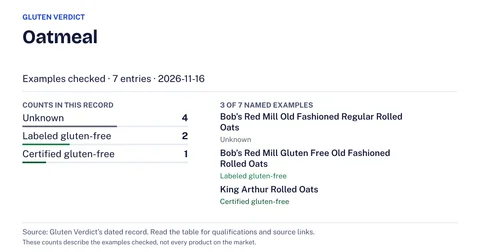 OatmealDepends on the productchecked Nov 16, 2026
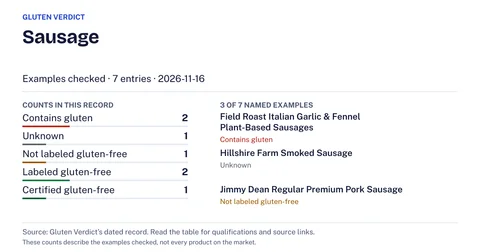 SausageDepends on the product2 of 7 products we checked contain gluten: Field Roast Italian Garlic & Fennel Plant-Based Sausages and Tofurky Plant-Based Italian Sausagechecked Nov 16, 2026
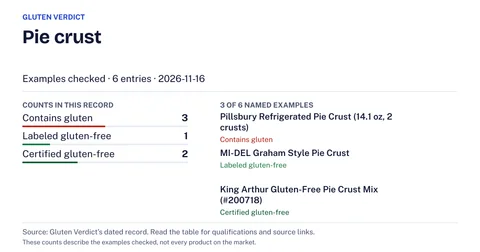 Pie crustContains glutenchecked Nov 16, 2026
 SoupDepends on the product3 of 8 products we checked contain gluten: Campbell’s Condensed Tomato Soup (10.75 oz), Campbell’s Condensed Cream of Mushroom Soup (10.5 oz), and Progresso Traditional Chicken Noodlechecked Nov 16, 2026
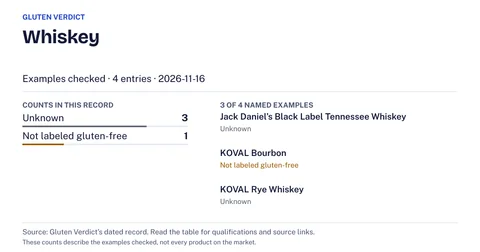 WhiskeyDepends on the productchecked Nov 16, 2026
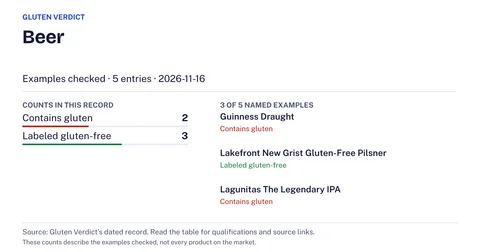 BeerDepends on the product2 of 5 products we checked contain gluten: Guinness Draught and Lagunitas The Legendary IPAchecked Nov 16, 2026
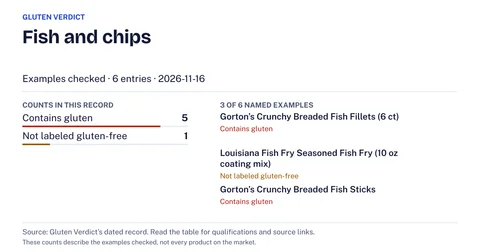 Fish and chipsDepends on the product5 of 6 products we checked contain glutenchecked Nov 16, 2026
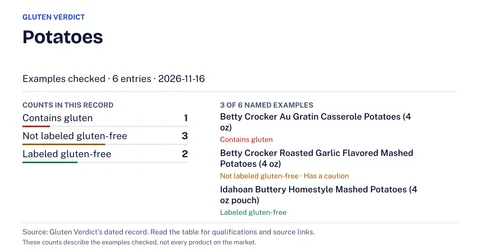 PotatoesNaturally gluten-free1 of 6 products we checked contains gluten: Betty Crocker Au Gratin Casserole Potatoes (4 oz)checked Nov 16, 2026
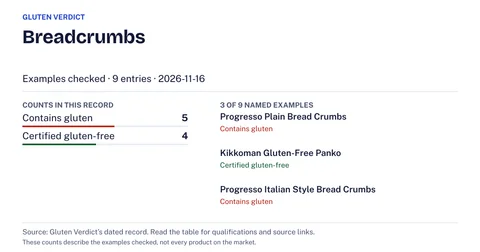 BreadcrumbsContains glutenchecked Nov 16, 2026
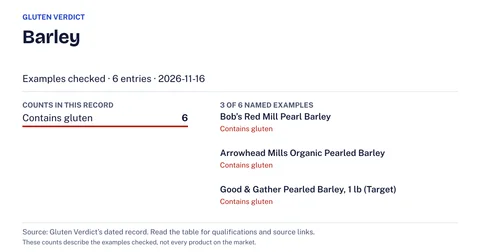 BarleyContains glutenchecked Nov 16, 2026
Questions people ask
Is the gluten-free rule in Scotland the same as in the rest of the UK?
Yes, on the limit: FSS’s guidance for Scotland gives the same 20 mg/kg limit as the regulation legislation.gov.uk publishes for the UK1, 20.
Is haggis gluten-free?
Macsween describes its haggis as lamb, beef, oats, onions and spices35. Macsween’s gluten-free haggis uses gluten free oats and is, the maker says, certified by Coeliac UK37, 38. Another maker’s or a restaurant’s haggis needs its own check.
Is Scotch whisky gluten-free?
Coeliac UK says spirits are distilled and that this removes any trace of gluten, even when a gluten-containing cereal is the ingredient10.
More in Travel: Europe
 Gluten-free in the UK: allergen rules, the Crossed Grain mark and pub and chip-shop foodHow a British pack and menu differ from a US one: the 20 mg/kg rule, 14 allergens, Crossed Grain versus venue accreditation, and chip-shop condiments.
 Gluten-free in Central Europe: the rules in five countries and where wheat hides in the dishesWhich gluten-free rule covers a pack in Austria, Czechia, Hungary, Poland and Switzerland, and where wheat enters schnitzel, dumplings and sauces.
 Gluten-free in Ireland: labels, pub rules, Guinness and the Crossed Grain symbolWhat Irish labels, pub allergen rules and the Crossed Grain symbol say about gluten, and what Guinness lists, so a US traveler knows what to check.
 Gluten-free in Portugal: the couvert, pastelarias and what to askWhat «isento de glúten» means in Portugal, what you owe for the couvert, what restaurants must say about allergens, and what the celiac society advises.
 Gluten-free in Estonia, Latvia and Lithuania: label words, rye bread and dumplingsHow Estonia, Latvia and Lithuania word gluten-free claims, where rye, barley and wheat sit in local dishes, and which official pages to check.
 Gluten-free in Croatia and the Balkans: which rule applies where, and where wheat enters the dishesWhich gluten-free rule applies in Croatia, Serbia, Bosnia and Montenegro, how to read the claim, and where wheat enters burek, ćevapi and palačinke.
Related guides
 UK gluten-free labelling: the legal rules, Natasha’s Law and the Crossed GrainWhat UK law requires on allergen and gluten-free labels, what Natasha’s Law added for food packed on site, and how the Crossed Grain mark differs.
 Gluten-free oats by country: where the claim is allowed and where it is barredWhether oats can carry a gluten-free claim in the US, Canada, EU, UK, Australia and New Zealand, in each regulator’s own words.
 Gluten-free labeling in Canada: the claim, the gluten-source declaration and oatsHow Health Canada's gluten-free claim works, how gluten sources and oats must be declared on a Canadian pack, and how it differs from the FDA rule.
 Gluten-free in New Zealand: the shared food code, oats, Marmite and the borderWhat a US visitor needs for gluten-free food in New Zealand: the shared Australian claim, oats, Marmite, Coeliac NZ marks and border declaration.
Sources
- [1, 2, 5, 6, 15, 19, 22, 30] Food Standards Scotland, Food Allergen Labelling and Information Requirements Technical Guidance (May 2023), checked Nov 17, 2026.
Read on 2026-11-17: the guidance's front matter lists “Applicable to which UK Nations” as Scotland.
- [3] Food Standards Scotland, Our remit, checked Nov 17, 2026.
- [4, 18] Food Standards Agency, About us, checked Nov 17, 2026.
- [7, 12, 20, 63] legislation.gov.uk, Commission Implementing Regulation (EU) No 828/2014 (UK version), checked Nov 17, 2026.
- [8] Food Standards Scotland, Managing allergens, checked Nov 17, 2026.
- [9, 44, 45] Baxters, Scotch Broth, checked Nov 17, 2026.
- [10, 11, 16, 46, 47, 64] Coeliac UK, Alcohol, checked Nov 17, 2026.
- [13, 23, 24, 34, 48] US Food and Drug Administration, Questions and Answers on the Gluten-Free Food Labeling Final Rule, checked Nov 17, 2026.
- [14] US Food and Drug Administration, Food Allergen Labeling and Consumer Protection Act of 2004 (FALCPA), checked Nov 17, 2026.
- [17, 25, 26] Food Standards Scotland, Allergen labelling, checked Nov 17, 2026.
- [21, 33] Coeliac UK, Gluten and the Law, checked Nov 17, 2026.
- [27, 28] Food Standards Scotland, Prepacked for direct sale, checked Nov 17, 2026.
Read on 2026-11-17: the list headed “What are PPDS foods?” gives as examples sandwiches placed into packaging by the food business and sold from the same premises, wrapped deli counter goods such as cheese and meats, and boxed salads placed on a refrigerated shelf prior to sale.
- [29, 58, 60, 61, 62] Food Standards Scotland, Eating out with allergies, checked Nov 17, 2026.
- [31] Coeliac UK, Look out for our Crossed Grain symbol, checked Nov 17, 2026.
- [32] Coeliac UK, Gluten free accredited venues, checked Nov 17, 2026.
- [35, 36] Macsween, What is haggis?, checked Nov 17, 2026.
- [37, 38] Macsween, Gluten Free Haggis, checked Nov 17, 2026.
- [39] Nairn’s Oatcakes, Gluten free oatcakes, checked Nov 17, 2026.
- [40, 41, 42] Coeliac UK, Oats and the gluten free diet, checked Nov 17, 2026.
- [43, 57, 59] Coeliac UK, Hints and tips for eating out, checked Nov 17, 2026.
- [49, 50, 51, 52, 53, 54, 55, 56] Coeliac UK, Travelling with coeliac disease, checked Nov 17, 2026.