How the 20 ppm gluten-free limit was chosen, and by whom
Short answer
The US limit of less than 20 parts per million (ppm) gluten was set by FDA, in a final rule published in the Federal Register on August 5, 20131, 2, 57. FDA's stated reasons are that 20 ppm was the lowest level validated test methods could reliably detect across foods, that a much lower limit would have removed many products from the market, and that it found no evidence that foods under 20 ppm would pose a risk of adverse health effects for the large majority of people with celiac disease28, 25, 26, 31. The rule took effect on September 4, 2013, and labels had to comply by August 5, 20143.
Part of Gluten basics and myths, 13 guides

Key points
- A 2004 law directed the Secretary of Health and Human Services to define “gluten-free”, but FDA says the law did not require it to set a threshold level, so the 20 ppm figure comes from FDA's rulemaking5, 6.
- FDA proposed the 20 ppm criterion in January 2007 and finalized it in August 2013, after a draft threshold report, a public meeting announced for August 2005 and a 2011 reopening of the comment period15, 16, 1, 10, 12, 18.
- FDA also looked at a much lower level: its own hazard assessment estimated levels of concern of 0.01 to 0.06 ppm, which FDA said may be conservative and highly uncertain24.
- FDA said it would reevaluate the 20 ppm level if future data indicate it is not sufficiently protective and methods that reliably detect gluten below 20 ppm become available33.
- The 2020 rule on fermented and hydrolyzed foods did not change the definition; it added how compliance is checked63, 69.
The dates at a glance
Each row names the document, so you can open it. The Federal Register entries are cited to the copy the US Government Publishing Office hosts.
| Date | What happened | Document |
|---|---|---|
| August 2, 2004 | Congress enacts the Food Allergen Labeling and Consumer Protection Act (FALCPA); section 206 directs HHS to issue a rule defining “gluten-free”5 | FALCPA, Public Law 108-282 |
| June 17, 2005 | FDA announces its draft report on thresholds for food allergens and gluten10 | 70 FR 35258 |
| July 13 to 15, 2005 | FDA announces that its Food Advisory Committee will hold a public meeting to evaluate the draft report11 | Announced in the Federal Register |
| August 19, 2005 | FDA announces a public meeting for this date on gluten-free food labeling12 | 70 FR 41356 |
| March 2006 | The revised report is dated March 200614, 52 | FDA, Approaches to Establish Thresholds |
| January 23, 2007 | FDA publishes the proposed rule15 | 72 FR 2795 |
| August 3, 2011 | FDA reopens the comment period and announces its hazard assessment, the Gluten Report18 | 76 FR 46671 |
| August 5, 2013 | The final rule is published1 | 78 FR 47154 |
| September 4, 2013 | The final rule takes effect3 | 78 FR 47154 |
| August 5, 2014 | Compliance date for the final rule3 | 78 FR 47154 |
| November 18, 2015 | FDA proposes compliance rules for fermented, hydrolyzed and distilled foods68 | 80 FR 71990 |
| July 2015 to August 2016 | FDA's surveillance sampling assignment59 | FDA sampling page |
| August 13, 2020 | FDA publishes the final rule on fermented or hydrolyzed foods66 | 85 FR 49240 |
| October 13, 2020 and August 13, 2021 | That rule takes effect on the first date; its compliance date is the second67 | 85 FR 49240 |
| January 22, 2026 | FDA publishes a request for information on a citizen petition about gluten labeling and cross-contact79 | 91 FR 2781 |
One date differs by source. FDA's sampling page says the final rule was issued on August 2, 201362; the Federal Register copy is dated August 5, 20131, and FDA counted the 12-month compliance period from the date of publication46.
What the US had before 2013, and what Congress asked for
In the 2013 rule's own words, there was no current regulatory definition of the “gluten-free” claim in the United States4.
Congress asked for one. FALCPA was enacted on August 2, 200451, and its section 206 directs the Secretary of Health and Human Services to issue a rule to define, and permit use of, the term “gluten-free” on food labels5. The Act's text called for a proposed rule not later than 2 years after enactment and a final rule not later than 4 years after50. The final rule was published in August 20131, which is later than that four-year mark (our arithmetic).
What the Act did not do is pick a number. FDA states that FALCPA does not require it to establish a threshold level for gluten6. The 20 ppm figure therefore comes from FDA's rulemaking, not from the statute. For how the Contains line and the gluten-free claim work together on a package today, see how to read a US food label for gluten and the allergen Contains line and wheat, barley and rye.
What FDA reviewed before choosing a number
FDA set up an internal, interdisciplinary Threshold Working Group to review the scientific literature on a threshold level for gluten7. Its report, dated March 2006, is on FDA's site52. The report says each approach has strengths and weaknesses and that applying each is limited by the data available53. It also notes that deciding not to set a threshold at that time was an option implicit in its discussion54.
The report presented four ways to set a threshold22. One was analytical methods-based: the threshold follows the sensitivity of the methods used to verify compliance8. A second calculated a level from human challenge studies with an uncertainty factor22. The report found the risk-assessment approach could not be used, because of too little data from human clinical trials and on exposure, and that the statutorily derived approach was not viable without applicable statutory provisions9. FDA's 2007 proposal used the analytical methods-based approach23. Separately, FDA ran its own assessment in which it reviewed human challenge studies, exposure data and other information to estimate risk at very low gluten levels21.
The 2005 to 2007 steps
FDA announced the draft report on June 17, 200510. FDA announced that its Food Advisory Committee would hold a public meeting on July 13 to 15, 2005 to evaluate it11. FDA also announced a public meeting for August 19, 2005, and received more than 2,400 comments about that meeting or its questions12, 13. The revised report and FDA's response to comments are dated March 200614.
The proposed rule followed on January 23, 200715. It already carried the 20 ppm figure: a food could not contain an ingredient processed to remove gluten if using it left 20 ppm or more gluten in the food, and it could not contain 20 ppm or more gluten16.
The 2011 hazard assessment and the lower numbers
After the proposal, FDA completed a health hazard assessment of gluten exposure in people with celiac disease and sent the resulting Gluten Report to scientific experts for peer review17. The report's full title is Health Hazard Assessment for Gluten Exposure in Individuals With Celiac Disease: Determination of Tolerable Daily Intake Levels and Levels of Concern for Gluten20. On August 3, 2011, FDA reopened the comment period to announce the report and invite comments on it18. FDA received nearly 2,000 submissions in response to the proposed rule and the 2011 notice19.
That report produced much lower numbers than 20 ppm. FDA wrote that the estimated gluten levels of concern for people with celiac disease range from 0.01 to 0.06 ppm20, 24, and added that this estimation of risk may be conservative and highly uncertain24.
Why 20 ppm, in FDA's own words
FDA gave its reasons in the 2013 rule's responses to comments and has repeated the main one on its question-and-answer page55. Four stand out. This section reports FDA's reasoning; it is not advice for any one person.
- Test methods. FDA wrote that 20 ppm is currently the lowest level at which analytical methods have been scientifically validated to reliably and consistently detect gluten across a range of food matrices28, and that 20 ppm remains the level that can reliably and consistently be detected in a variety of food matrices29. Its question-and-answer page says methods validated to reliably detect gluten below 20 ppm were not available when the rule was written55.
- Keeping gluten-free foods on shelves. FDA agreed with comments that industry might be unable to consistently meet a limit below 1 ppm, and that such a level could not then be verified with scientifically valid methods25. It agreed that a much lower limit would remove many products that met the 20 ppm criterion, or discourage new ones26, and said fewer labeled foods would be detrimental to people already challenged by long-term adherence to a gluten-free diet27.
- Its reading of the evidence. FDA wrote that the research so far and its Gluten Report support a conclusion that most people with celiac disease can tolerate food containing variable trace amounts of gluten30, and that there was no evidence that foods under 20 ppm would pose a risk of adverse health effects for the large majority of people with celiac disease31. It also said it disagreed with comments claiming clear evidence of people eating food at or above 20 ppm without adverse effect32. Its question-and-answer page adds that some researchers and some epidemiological evidence suggest most people with celiac disease can tolerate trace amounts, including levels under 20 ppm56.
- Consistency with other standards. FDA's 2011 notice indicated that the under-20-ppm part of the criteria was consistent with approaches taken by Codex and by European Commission Regulation (EC) No 41/200938. In the final rule it also added the equivalent figure of 20 mg of gluten per kg of food to further harmonize with those standards36.
FDA left the door open. It said it would reevaluate the 20 ppm level if future data indicate the level is not sufficiently protective and methods that reliably detect gluten below 20 ppm become available33, and it noted that lowering the level would make it far more difficult for makers to label foods gluten-free34. It also said that future research and improved data may lead it to revisit its conclusion31.
A concentration, not a dose
FDA stresses that 20 ppm is a concentration rather than an absolute quantity of gluten in a food. Its example: at 20 ppm, a 28.35 gram (1-ounce) portion of food would contain 0.567 mg of gluten35. For more on what the figure means in a serving, see the FDA gluten-free rule explained.
What the 2013 rule sets, and when it applied
The final rule defines “gluten-free” for voluntary use on food labels2. The number is part of the definition in 21 CFR 101.91 in two ways. Any unavoidable gluten in a food bearing the claim must be below 20 ppm, which the text gives as below 20 mg per kg of food57. And an ingredient derived from a gluten grain and processed to remove gluten, with wheat starch as the rule's example, cannot be used if it leaves 20 ppm or more gluten in the food58. See our wheat starch page for the ingredient itself.
FDA set the compliance date at August 5, 201445. It said 12 months from publication was enough time for makers to review their products or remove the claim from labels of foods that did not comply46.
FDA's first checks
FDA ran a sampling assignment of products labeled gluten-free from July 2015 to August 201659. It tested 702 samples from three commodity groups (cereals, grain bars and flours), covering more than 250 types of products. Five samples from one product source were over 20 ppm, which FDA reports as a product-based rate of compliance greater than 99.5 percent60. FDA says its later sampling did not find levels that violated the regulation61. That is one assignment in three food groups, not a count of every gluten-free product60.
Fermented and hydrolyzed foods: the 2015 proposal and the 2020 rule
The 2013 rule left one question open. FDA said it planned to propose a rule on its compliance approach for fermented or hydrolyzed products47, and in the meantime intended to exercise enforcement discretion for FDA-regulated beers already making a gluten-free claim48, 49.
FDA proposed that rule on November 18, 201568 and published the final rule on August 13, 202066. It took effect on October 13, 2020, with a compliance date of August 13, 202167. FDA's summary says the rule covers foods such as yogurt, sauerkraut, pickles, cheese, green olives, FDA-regulated beers and wines, and hydrolyzed plant proteins65.
- Gluten proteins in fermented and hydrolyzed foods are no longer intact and cannot currently be adequately detected and quantified by testing, so FDA decides compliance from the maker's records that the food was gluten-free before fermentation or hydrolysis64.
- For distilled foods, FDA says it will verify the absence of protein with methods that reliably detect protein or protein fragments71.
- The 2013 enforcement discretion for beers is no longer valid48, 70.
- The definition of “gluten-free” did not change63, 69.
Where a food we check falls in this area, its verdict lists the sources we read. See beer, miso, soy sauce and malt vinegar.
Codex, the EU and Canada on one table
The US figure sits beside international ones, and FDA's 2013 rule compared them directly. We opened the EU regulation and the European Commission's page ourselves. We could not open the Codex standard or Health Canada's page, so those rows rest on FDA's description and a 2026 review.
| Body | Document | The limit, as that source words it |
|---|---|---|
| Codex Alimentarius (FAO and WHO) | Standard for Foods for Special Dietary Use for Persons Intolerant to Gluten (Codex Standard 118-1979). FDA's 2013 rule cites a 2008 copy39; a 2026 review says it was first issued in 1979 and last revised in 201578 | FDA: 20 mg of gluten per kg of product, equivalent to 20 ppm37. The 2026 review: less than 20 mg gluten/kg, adopted following clinical challenge studies and risk assessments77 |
| European Union | Commission Regulation (EC) No 41/2009 of January 20, 200940, repealed from July 20, 201676; replaced by Implementing Regulation (EU) No 828/2014, applying from 20 July 201673. The Commission says the new regulation did not change the substantial rules for gluten-free statements75 | No more than 20 mg/kg of gluten in the food as sold to the final consumer72 |
| Canada | Health Canada's position, described by FDA as stated in June 201242 | FDA: food labeled gluten-free not containing more than 20 ppm gluten41 |
| United States | 21 CFR 101.91, from the 2013 final rule1 | Any unavoidable gluten below 20 ppm gluten57 |
Two differences FDA pointed out in 2013 are worth knowing. The wording differs: FDA read Codex and the EU as saying gluten may not exceed 20 mg/kg, while the US rule says less than 20 ppm, and FDA did not consider that difference significant43. And FDA noted that Codex, the EU regulation, the Australia New Zealand code and Health Canada include oats as gluten-containing grains, whereas the US rule does not44. For oats on a US label, see our oatmeal verdict.
The EU regulation's own preamble says the Codex standard should be taken appropriately into consideration for its purposes74.
What FDA is asking about now
On January 22, 2026, FDA published a request for information about a citizen petition from Celiac Journey. The petition asks FDA to require all ingredients with gluten to be listed by name in the ingredient list and to require controls on cross-contact with gluten-containing grains79. FDA asked for comments by March 23, 202680. The notice's mentions of 20 ppm restate the existing rule81. We have not read any later FDA step, so check the docket named in the notice for what followed.
Verdicts in this guide
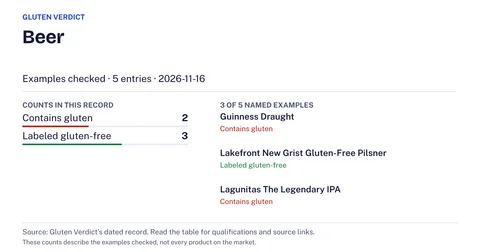 BeerDepends on the product2 of 5 products we checked contain gluten: Guinness Draught and Lagunitas The Legendary IPAchecked Nov 16, 2026
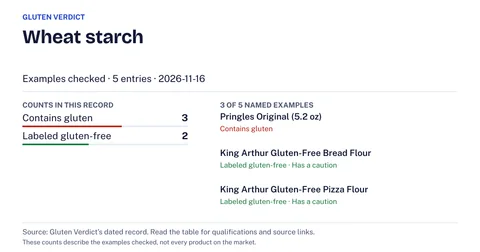 Wheat starchDepends on the product3 of 5 products we checked contain gluten: Pringles Original (5.2 oz), Jiffy Corn Muffin Mix, and Chex Mix Bold Garlic and Herbchecked Nov 16, 2026
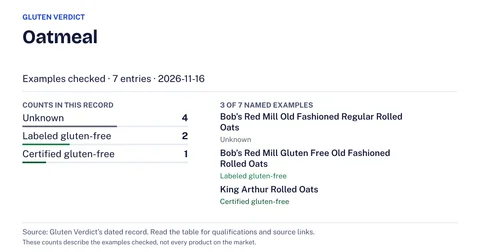 OatmealDepends on the productchecked Nov 16, 2026
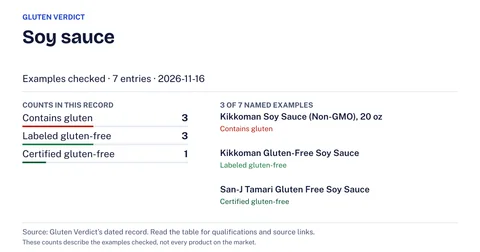 Soy sauceDepends on the product3 of 7 products we checked contain gluten: Kikkoman Soy Sauce (Non-GMO), 20 oz; San-J Organic Shoyu Soy Sauce; and Lee Kum Kee Premium Soy Sauce (No Preservatives Added)checked Nov 16, 2026
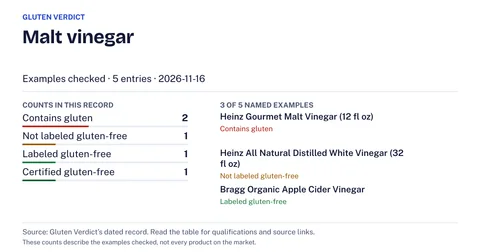 Malt vinegarContains glutenchecked Nov 16, 2026
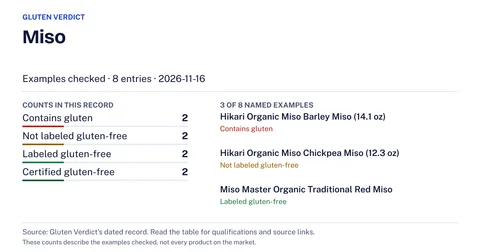 MisoDepends on the product2 of 8 products we checked contain gluten: Hikari Organic Miso Barley Miso (14.1 oz) and Hikari Miso Soup Akadashi (12 servings, 7.0 oz)checked Nov 16, 2026
Questions people ask
Who decided on 20 ppm?
FDA, in a final rule published in the Federal Register on August 5, 20131, 2, 57. A 2004 law directed the Secretary of Health and Human Services to define “gluten-free”5 but, FDA says, did not require a threshold level6.
Did FDA copy the Codex number?
FDA's 2007 proposal already used 20 ppm16. FDA's 2011 notice described the under-20-ppm part as consistent with approaches taken by Codex and European Commission Regulation (EC) No 41/200938, and it added the equivalent 20 mg/kg figure to harmonize with those standards36. Its stated reasons also include test methods and food availability28, 26.
Was a lower limit considered?
FDA's hazard assessment estimated levels of concern of 0.01 to 0.06 ppm, which FDA said may be conservative and highly uncertain24. FDA also agreed that a limit below 1 ppm could not, as of the final rule, be verified through scientifically valid analytical methods25.
Has the limit changed since 2013?
The 2020 rule on fermented and hydrolyzed foods did not change the definition63. FDA's January 2026 request for information restates the 20 ppm criterion when it describes the existing rule81.
Is 20 ppm the amount of gluten a person eats?
No. FDA calls it a concentration; the amount depends on how much food is eaten, and in FDA's example a 1-ounce portion at 20 ppm holds 0.567 mg35.
More in Gluten basics and myths
 What gluten is, which grains carry it and what “gluten-free” meansA plain definition of gluten, the grains that carry it, look-alike words such as malt and wheat starch, and what a US gluten-free label means.
 Gluten-free myths about labels and food, checked against the rulesNatural, organic, zero gluten, fermenting and oats: each gluten-free myth checked against the page that states the rule, with the wording and read date.
 Why gluten problems seem more common: what the evidence separatesGluten problems seem everywhere. Studies separate three things: cases found, cases that exist, and people avoiding gluten.
 Zein, avenin and gluten: how corn and oats differ from wheatIs zein gluten? How FDA’s rule defines gluten, what “corn gluten” and avenin are, and why a gluten-free label matters for oats.
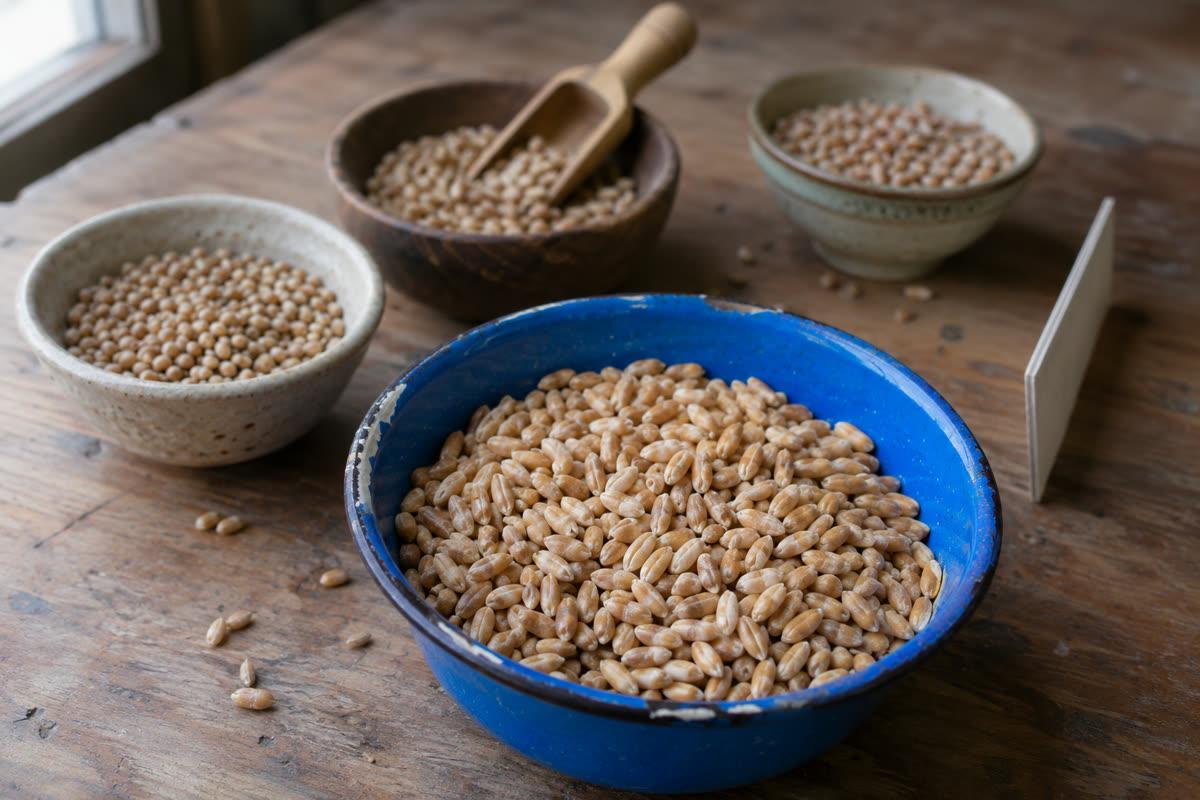 Spelt, Kamut, Durum and Einkorn: Every Kind of Wheat Has GlutenDurum, semolina, spelt, einkorn, kamut, farro: which wheat words on a US label count as gluten, and what the FDA rule and the sources say about each.
 Is gluten in everything? Where it starts and where it gets addedSort your pantry into foods that start without gluten, foods where it is added as an ingredient, and foods that pick it up by contact.
Related guides
 How to read a US food label for glutenWhere gluten shows up on a US food label: the gluten-free claim, the Contains line, the ingredient list and may-contain lines, and what each means.
 Fine on bread in Europe? What it does and does not showWhat a trip where bread felt fine does and does not show about celiac disease, and how EU and US gluten-free label rules compare.
 The FDA gluten-free rule: what 21 CFR 101.91 requires and what 20 ppm measuresWhat FDA’s gluten-free rule requires, which claim words it covers, what 20 ppm means for a portion of food, and how FDA checks that a claim holds.
 How much gluten causes damage: what dose studies show and what 20 ppm meansWhat dose studies in celiac disease measured, how 20 ppm converts to milligrams for a real portion, and what FDA’s limit is and is not.
Sources
- [1, 2, 3, 4, 5, 6, 7, 8, 9, 10, 11, 12, 13, 14, 15, 16, 17, 18, 19, 20, 21, 22, 23, 24, 25, 26, 27, 28, 29, 30, 31, 32, 33, 34, 35, 36, 37, 38, 39, 40, 41, 42, 43, 44, 45, 46, 47, 48, 49] Federal Register (copy published by the US Government Publishing Office), Food Labeling; Gluten-Free Labeling of Foods (final rule, 78 FR 47154, August 5, 2013), checked Nov 17, 2026.
Read on 2026-11-17: the list of approaches the Thresholds Report presented names four: analytical methods-based; a second that calculates a level from the No Observed Adverse Effect Level in human challenge studies, with an uncertainty factor; risk assessment-based; and statutorily derived.
- [50, 51] US Food and Drug Administration, Food Allergen Labeling and Consumer Protection Act of 2004 (FALCPA), checked Nov 17, 2026.
- [52, 53, 54] US Food and Drug Administration, Approaches to Establish Thresholds for Major Food Allergens and for Gluten in Food (March 2006), checked Nov 17, 2026.
- [55, 56] US Food and Drug Administration, Questions and Answers on the Gluten-Free Food Labeling Final Rule, checked Nov 17, 2026.
- [57, 58] Electronic Code of Federal Regulations, 21 CFR 101.91 Gluten-free labeling of food, checked Nov 17, 2026.
- [59, 60, 61, 62] US Food and Drug Administration, Gluten-Free Food Product Surveillance Sampling, checked Nov 17, 2026.
- [63, 64, 65] US Food and Drug Administration, FDA Issues Final Rule on Gluten-Free Labeling of Fermented and Hydrolyzed Foods (constituent update, August 12, 2020), checked Nov 17, 2026.
- [66, 67, 68, 69, 70, 71] Federal Register (copy published by the US Government Publishing Office), Food Labeling; Gluten-Free Labeling of Fermented or Hydrolyzed Foods (final rule, 85 FR 49240, August 13, 2020), checked Nov 17, 2026.
- [72, 73, 74] European Union (Official Journal), Commission Implementing Regulation (EU) No 828/2014 of 30 July 2014, checked Nov 17, 2026.
- [75, 76] European Commission, Gluten-free food, checked Nov 17, 2026.
- [77, 78] Popping et al., 2026 review, via Europe PMC, Gluten Analysis and Regulation: Scientific, Analytical, and Economic Dimensions of Gluten-Free Assurance, checked Nov 17, 2026.
- [79, 80, 81] Federal Register (copy published by the US Government Publishing Office), Labeling and Preventing Cross-Contact of Gluten for Packaged Foods; Request for Information (91 FR 2781, January 22, 2026), checked Nov 17, 2026.
Read on 2026-11-17: the notice describes the existing rule, stating that an ingredient processed to remove gluten counts if it results in 20 parts per million (ppm) or more gluten in the food, and that a gluten-free claim may only be made if any unavoidable presence of gluten in the food is below 20 ppm (21 CFR 101.91(a)(3)); the petition requests it describes are listing all gluten ingredients by name in ingredient lists and adding gluten to the list of allergens in FDA's Compliance Policy Guide Sec. 555.250.