Dating with celiac disease: when to tell, what to say, and what has been published about kissing
Short answer
Gluten Intolerance Group (GIG) advises letting a date know, before drinks or food are ordered, that you are gluten-free for health reasons2. In a survey of adults with biopsy-diagnosed celiac disease affiliated with Columbia University’s Celiac Disease Center, 47.2% shared their diagnosis between the first and third date and 43.2% before the first date1, 8. On kissing, one 2026 study found that only 2 of 20 gluten exposures tested above 20 ppm in saliva collected from the partner with celiac disease, and its authors report no increased risk of significant gluten transfer3, 4.
Part of Explaining celiac and everyday social life, 15 guides

Key points
- The Columbia survey reports 43.2% told before the first date, 47.2% between the first and third date and 9.6% later1.
- GIG advises telling a date before food or drinks are ordered2; a GIG writer offers example wording for suggesting a meal5.
- In the same survey, 81.3% of the 252 participants who answered preferred non-food activities for the first few dates6, 38.
- GIG’s 2021 kissing article said there was no scientific proof about kissing as a cross-contact risk, and an abundance of anecdotal evidence7.
- In the 2026 study, none of the saliva samples tested above 20 ppm when the partner drank 4 oz of water after eating the gluten load3.
When do people with celiac disease tell a date?
The numbers below come from a survey, published in 2022, of adults with biopsy-diagnosed celiac disease who are affiliated with the Celiac Disease Center at Columbia University8. The paper reports that 47.2% of participants shared their diagnosis between the 1st and 3rd date, 43.2% before the first date and 9.6% after the 4th date or once a relationship was established1.
Three things limit those numbers. Of the 5,249 people who opened the survey email, 538 fully completed it9, and respondents were primarily female (86.8%)10. The paper’s Table 2, which holds the timing figures, is restricted to the 271 respondents who were asked about their dating experience37. The figures describe those respondents, not everyone with celiac disease.
The paper’s authors tie the numbers to food. A date involving a meal will likely result in sharing the diagnosis, and some people may fear discouraging a potential partner before that partner gets to know them, so they may choose non-food activities first11. For others, they write, celiac disease may be a very important part of their identity that they want a potential partner to know about upfront12.
GIG’s advice is plainer: let your date know before ordering drinks or food that you are gluten-free for health reasons2.
Treat these as descriptions, not a rule. The right moment depends on you and on what the date involves.
What to put in the message
A guest writer for GIG suggests this wording, which names the need and offers a next step, if you have trouble bringing it up: “Hey, I’d love to go out to eat with you! I just need to make sure there are options for me, maybe we could look together?”5
If your date is choosing the restaurant, the same guest-writer article advises giving them a heads-up about your dietary needs13. It also suggests looking at the menu before deciding where to go, and calling ahead14.
Two sample lines in our own words, for a profile or a first message:
- “I have celiac disease, so I eat strictly gluten-free. Can we pick the place together?”
- “Heads-up before we plan food: I can’t eat gluten at all, and I’d like to check the menu ahead of time so we can just enjoy the evening.”
In the Columbia survey, 39.3% of the 252 participants who answered were uncomfortable explaining precautions to waiters in front of their date15, 38. If that is you, agree beforehand on who talks to the server, or call ahead. What to ask a kitchen is covered in our guides to where gluten hides in a restaurant kitchen and how to read a restaurant allergen chart.
Choosing a first date that does not center on food
In the Columbia survey, 81.3% of the 252 participants who answered preferred non-food activities for the first few dates, such as drinks, movies or hiking, over meals6, 38. The majority also preferred to select or suggest where the date would be held16.
GIG’s 2022 article gives a reason: one way to ease the stress is to spend time together without the complexities of navigating food17. Its list of date ideas that do not involve food:
- Nature walks, day hikes or geocaching18
- Concerts and shows18
- Board game night18
- Mini golf or frisbee golf18
- A museum, gallery, aquarium or zoo18
- A painting or pottery class18
For concerts, GIG notes that concession stands can be places where cross-contact with gluten is inevitable, and suggests events where you can bring your own refreshments19. If food is part of the date, it suggests offering to host the dinner and take charge of the menu and food preparation20.
Drinks and shared plates
GIG’s kissing article suggests asking your date whether they would take an alternative adult beverage that doesn’t contain gluten, and offering suggestions such as cider, distilled spirits, spiked seltzers or wine21. Where we have checked a drink, the verdict is on its page: beer, cider, wine, vodka and hard seltzer. Our gluten-free alcohol guide covers what US labels may say.
For shared plates, GIG’s 2026 article warns that shared chip bowls, dips, serving utensils and buffet tables can all introduce gluten into otherwise gluten-free foods22. One option is to say which dishes you will skip before they arrive.
Sauces can matter too: FDA says that, in general, when soy sauce is made from soybeans and wheat, or any other gluten-containing grain, it may not bear a gluten-free claim23. See our soy sauce verdict before you share a dish dressed with it.
Kissing: what has been published
This section uses two published items on kissing: a GIG article from 2021 and a study from 2026. GIG wrote that there is no scientific proof about kissing as a cross-contact risk, and an abundance of anecdotal evidence from celiac patients who claim to have been “glutened” through kissing7.
| Topic | What GIG says |
|---|---|
| Gluten left in the mouth | If someone eats or drinks anything containing gluten, including candy or gum, GIG says gluten particles could remain in their mouth for hours afterward24. |
| Beer | GIG says beer drinkers are mentioned often in online anecdotes as the culprits25. |
| Mouth hygiene | GIG suggests encouraging a date who ate or drank gluten to clean their mouth with gluten-free toothpaste, mouthwash and floss26. |
| Beards and moustaches | GIG says tooth brushing, rinsing and flossing do not address facial hair, and that beards and moustaches can trap gluten particles27. |
| Lip products | GIG says there is no data on the gluten content in lipsticks, and that even lipsticks made with ingredients derived from gluten-containing grains contain such small amounts of gluten as to be insignificant28. |
The 2026 study
A 2026 study in Gastroenterology tested gluten transfer between couples in which one partner has celiac disease. Its authors began from the point that data to support the kissing concern were lacking29.
The partner without celiac disease ate a gluten load of 10 crackers with 59,107 ppm, or 590 mg, of gluten30. In one protocol that partner waited 5 minutes before kissing; in the other, they drank 4 oz of water and then immediately kissed. Saliva was collected from the partner with celiac disease immediately after the kiss31.
Gluten was detectable in the saliva of the partner who ate it in all protocols, from 80 ppm to more than 25,000 ppm; in the saliva of the partners with celiac disease it ranged from under 5 ppm to 153.9 ppm32. Only 2 of the 20 gluten exposures tested above 20 ppm, the level the paper calls gluten free, and none of the saliva samples did when the partner had drunk 4 oz of water after eating the gluten load3.
The authors conclude that there was not an increased risk of significant gluten transfer when kissing, and that drinking 4 oz of water before kissing further reduces the risk4.
This is one study, and its abstract reports gluten in saliva, not symptoms33. It sits beside GIG’s 2021 advice; neither is a ruling on what is right for you.
How people feel about it: in the Columbia dating survey, 39.0% of participants were hesitant to kiss their partner because of celiac disease, females more than males (41.1% vs. 22.7%)34.
If you are dating someone with celiac disease
The sources we cite are written mostly for the person with celiac disease, not for the partner. Read from the partner’s side, they describe what that person may ask of you: GIG suggests they ask whether you would take an alternative adult beverage that doesn’t contain gluten21, and, if you ate or drank gluten, that they encourage you to clean your mouth with gluten-free toothpaste, mouthwash and floss26. In the 2026 study, the second protocol had the partner without celiac disease drink 4 oz of water before kissing31.
The Columbia survey found the majority of participants preferred to select or suggest where the date would be held16, so offering them the choice fits that. For cooking at home, see our guide to gluten cross-contact at home.
Verdicts in this guide
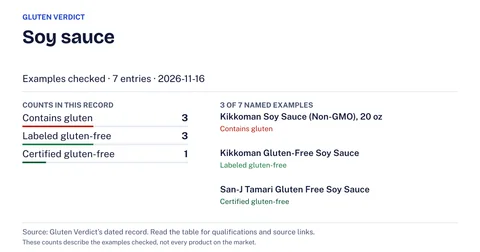 Soy sauceDepends on the product3 of 7 products we checked contain gluten: Kikkoman Soy Sauce (Non-GMO), 20 oz; San-J Organic Shoyu Soy Sauce; and Lee Kum Kee Premium Soy Sauce (No Preservatives Added)checked Nov 16, 2026
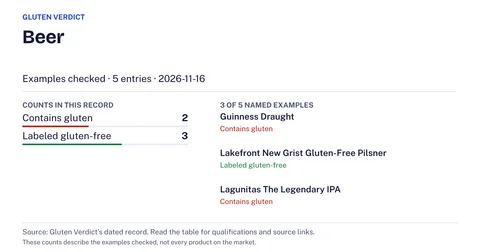 BeerDepends on the product2 of 5 products we checked contain gluten: Guinness Draught and Lagunitas The Legendary IPAchecked Nov 16, 2026
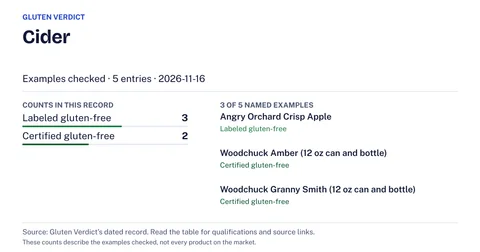 CiderNaturally gluten-freechecked Nov 16, 2026
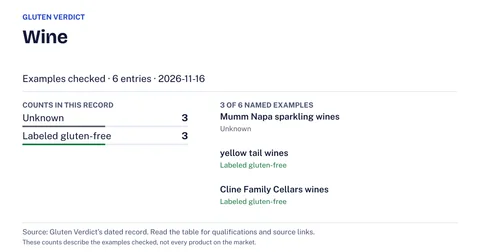 WineNaturally gluten-freechecked Nov 16, 2026
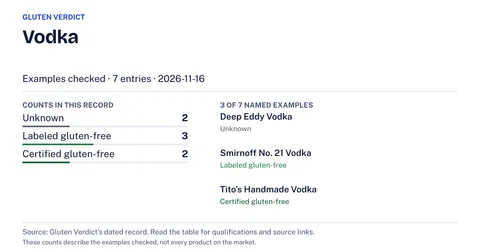 VodkaDepends on the productchecked Nov 16, 2026
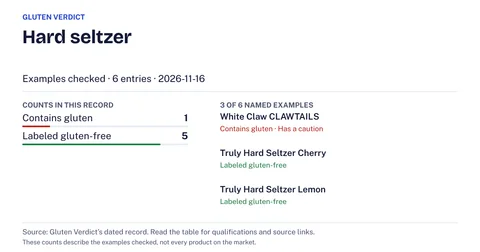 Hard seltzerDepends on the product1 of 6 products we checked contains gluten: White Claw CLAWTAILSchecked Nov 16, 2026
Questions people ask
Should I put celiac disease on a dating profile?
The Columbia survey reports what its respondents did: of those who had had an online dating profile, 14.1% included celiac disease on it35. The paper’s authors note that some people want a potential partner to know upfront12.
Can you get glutened from kissing?
One 2026 study measured gluten in saliva after kisses: only 2 of 20 exposures tested above 20 ppm, and its authors report no increased risk of significant gluten transfer3, 4. GIG’s 2021 article said there was no scientific proof about kissing as a cross-contact risk, and an abundance of anecdotal evidence7.
How many people with celiac disease say it affects dating?
In the Columbia survey, 44.3% of participants had dated with celiac disease, and 68.4% of those reported a major or moderate impact on their dating life36.
More in Explaining celiac and everyday social life
 How to explain celiac disease to friends and familyA three-sentence explanation of celiac disease, then sourced replies to the usual questions: allergy, fad, how strict, and what to cook.
 What to say to someone with celiac disease, and what to skipSentences to use, and ones to skip, when you cook for, eat out with or work beside someone with celiac disease, each tied to the fact behind it.
 How to tell a host or relative you have celiac diseaseWhat to send a host before the meal, the cross-contact rule in one sentence, questions to ask about a dish, bringing your own, and how to pass on a dish.
 When your partner has celiac disease: gluten-free home or split kitchenChoose between a gluten-free home and a split kitchen, and find what to say at restaurants and to family, with NIH and charity sources.
 When a relative says a little gluten won’t hurt: what to say, and what to let goOne-line replies for the relative who scrapes off croutons or says one bite is fine, each with its source, plus what to push back on and what to let go.
 When gluten-free eating wears you down: fewer decisions, same rulesEase gluten-free burnout with routines: check each product once, set a standing plan for eating out, and know which rules stay fixed.
Related guides
 Gluten-free alcohol: what US beer, spirits, wine and cider labels may sayWhich US alcohol labels may say gluten-free, who sets the wording, and how beer, spirits, wine, cider and hard seltzer differ, each rule sourced.
 Gluten cross-contact at home: where it happens and what to do about itHow gluten reaches gluten-free food at home, whether to separate, wash or ask for each route, and which rules have lab data behind them.
 Gluten-free at a holiday dinner, potluck or cookout as a guestHow a guest with celiac disease can message the host, bring a dish, serve first at a buffet and decide when to eat only their own food.
 Alcohol and celiac disease: what a gluten-free label does and does not settleWhether a drink has gluten and whether alcohol suits a person with celiac disease are two questions. What the sources say, and what to ask a clinician.
Sources
- [1, 6, 8, 9, 10, 11, 12, 15, 16, 34, 35, 36, 37, 38] PubMed Central (Digestive Diseases and Sciences, 2022), Impact of Celiac Disease on Dating, checked Nov 17, 2026.
Read on 2026-11-17: Table 2 gives n = 252 for “Preference for first dates” (205 chose drinks/activities, 81.3%) and for “Comfortable explaining precautions to waiters in front of date” (99 answered No, 39.3%).
- [2, 7, 21, 24, 25, 26, 27, 28] Gluten Intolerance Group, 7 Things to Know about Kissing Gluten-Free, checked Nov 17, 2026.
- [3, 4, 29, 30, 31, 32, 33] PubMed (Gastroenterology, 2026), A Prospective Study of Gluten Transfer Through Kissing in Celiac-Discordant Couples (abstract), checked Nov 17, 2026.
Read the abstract on 2026-11-17: it names saliva and urine tests in its methods; its results paragraph reports saliva levels only, and no symptom results appear in the abstract.
- [5, 13, 14, 22] Gluten Intolerance Group, Going out Gluten free: Dates, Parties and Everything in Between (guest writer), checked Nov 17, 2026.
- [17, 18, 19, 20] Gluten Intolerance Group, Going On a Gluten-Free Date, checked Nov 17, 2026.
Read on 2026-11-17: the list of date ideas that do not involve food names nature walks, day hikes or geocaching; concerts and shows; board game night; mini golf or frisbee golf; a museum, gallery, aquarium or zoo; and a painting or pottery class.
- [23] US Food and Drug Administration, Questions and Answers on the Gluten-Free Food Labeling Final Rule, checked Nov 17, 2026.