Folic acid in gluten-free foods: how to check the label
Short answer
US rules require folic acid in flour sold as enriched flour1, but fortification is not mandatory outside some standardized foods2. The Gluten Intolerance Group says very few gluten-free grain products are modified to add vitamins and minerals3. So check the package in three places:
- The ingredient list. FDA says to look for “folic acid” in parentheses on the label4, and two wheat products name it that way29, 30.
- A vitamins and minerals line apart from the ingredients, as on the Rice Chex product page5, 6.
- The Nutrition Facts panel, where folic acid appears in parentheses after the total folate7.
Part of Nutrition and combining diets, 24 guides

Key points
- Fortification is not mandatory in the US except for some standardized foods, and makers are not required to enrich their products2, 8.
- In the makers’ pages we read, the gluten-free flours and mix name no folic acid9, 10, 11, 12, and one gluten-free cereal names it6.
- A flour can be fortified with “vitamin B” and still not name folic acid: King Arthur’s gluten-free flour lists niacinamide, thiamin and riboflavin, not folic acid13, 10.
- If the Nutrition Facts panel gives a percentage for folate but no folic acid in parentheses, FDA says folic acid has not been added14.
- CDC says people with an MTHFR gene variant can process all types of folate, including folic acid15.
Folate or folic acid: what is the difference?
CDC says the two terms are often used interchangeably, but folate is the general name for all the different types of vitamin B916. Folic acid is a type of folate that is used in supplements and fortified foods17.
FDA describes folic acid as a form of folate that can be added to foods during manufacturing18. That is why a label can show both words: folate for the total, and folic acid, in parentheses, for the part that was added7.
CDC says folic acid is the only type of folate shown to help prevent neural tube defects (NTDs)17, which it describes as major birth defects of a baby's brain and spine19. This guide reports what the agencies say. It gives no advice for any one person.
What does the US enrichment rule require?
The standard for enriched flour sets the amount: 0.7 milligrams of folic acid in each pound, alongside thiamin, riboflavin, niacin and iron1.
Outside that kind of standard, nothing forces a maker to add it. FDA says folic acid fortification is not mandatory in the U.S. except for some standardized foods2, and that manufacturers are not required to enrich their products8. CDC describes the mandate as covering cereal grains20.
FDA’s list of foods fortified with folic acid names enriched breads, flours, pastas, rice and cornmeal, fortified corn masa flour, and certain fortified breakfast cereals21.
Unenriched wheat flour is sold too. King Arthur’s unbleached all-purpose flour lists wheat flour and an enzyme, and no added vitamins22.
Are gluten-free products enriched?
The Gluten Intolerance Group (GIG) writes that gluten-containing grain products are commonly enriched or fortified, but very few gluten-free grain products are modified to add these nutrients. It adds that someone who relied on enriched products and switches to non-enriched ones can become nutrient deficient3.
A 2019 article by Mitchell and colleagues raises a related issue from the policy side. The authors note that some people, such as those with a gluten allergy or intolerance, cannot consume the enriched grains23, and they argue that fortification across all grains, with and without gluten, should be considered24.
One Canadian study looked at the food purchases of households with a child who has celiac disease. Its authors write that the lack of mandated folate enrichment of gluten-free grains in Canada has been suspected of contributing to suboptimal folate intake among children with celiac disease25, and report that of the folate-rich foods consumed, which included legumes and gluten-free breakfast cereals, few were fortified with folate26. That study is Canadian, so treat it as background, not as a measure of products on US shelves.
GIG also notes that celiac disease can damage the small intestine and reduce the absorption of certain vitamins and minerals27, and its list of the most commonly affected nutrients includes folate28.
How to check a package for folic acid
- Read the ingredient list for “folic acid”. FDA’s advice is to look for “folic acid” in parentheses on the label4; Bob’s Red Mill’s wheat flour and Bisquick Original both list it in parentheses after the flour29, 30.
- Check for a vitamins and minerals line apart from the ingredients. On the Rice Chex page, the ingredients line lists grains, sugar, salt, molasses and vitamin E as a preservative5, and a separate vitamins and minerals line names folic acid6.
- On the Nutrition Facts panel, find folate, shown in mcg DFE31. FDA says that if any of it comes from folic acid, that amount is listed in micrograms in parentheses7.
- If the panel gives a percentage for folate but no folic acid in parentheses, FDA says folic acid has not been added14.
- Do not read a vitamin B claim as folic acid. King Arthur says its Measure for Measure flour is fortified with iron, calcium and vitamin B13; the packaging lists a blend of calcium carbonate, niacinamide, reduced iron, thiamin hydrochloride and riboflavin, and does not name folic acid10.
A label is a snapshot. Recipes change, so the package in your hand has the final word.
What we read on makers’ pages
We read these pages on 2026-11-17, setting wheat products beside gluten-free ones from the same maker where we could. This is a snapshot of eight products, not a survey and not a ranking.
| Product | What the page lists | Folic acid named? |
|---|---|---|
| Bob’s Red Mill Unbleached White All-Purpose Flour (wheat; see flour) | Wheat flour with niacin, reduced iron, thiamine mononitrate, riboflavin and folic acid29 | Yes29 |
| Bisquick Original Pancake and Baking Mix (wheat) | Enriched flour bleached: wheat flour, niacin, iron, thiamin mononitrate, riboflavin, folic acid30 | Yes30 |
| King Arthur Unbleached All-Purpose Flour (wheat) | Unbleached hard red wheat flour and an enzyme22 | No22 |
| Bob’s Red Mill Gluten Free 1-to-1 Baking Flour | Rice, sorghum, potato and tapioca flours or starches, and xanthan gum9 | No9 |
| King Arthur Gluten-Free Measure for Measure Flour | A vitamin and mineral blend of calcium carbonate, niacinamide, reduced iron, thiamin hydrochloride and riboflavin10 | No10 |
| Bisquick Gluten Free Pancake & Baking Mix | Rice flour, sugar, leavening, modified potato starch, salt, xanthan gum11 | No11 |
| Krusteaz Gluten Free All Purpose Flour | Sorghum, brown rice, millet, rice and quinoa flours, modified food starch, xanthan gum12 | No12 |
| Rice Chex (carries a gluten-free claim32) | Ingredients: whole grain rice, rice, sugar, salt, molasses, vitamin E (mixed tocopherols). A separate vitamins and minerals line names minerals and several vitamins6 | Yes6 |
In this set, the gluten-free flours and the mix name no folic acid9, 10, 11, 12, while the gluten-free cereal does6. Each verdict page says whether its product is gluten-free; this table says only what the maker listed. For how the flour blends differ, see our gluten-free flour guide.
Corn masa and corn tortillas
FDA says it has no standard of identity for corn masa flour, neither enriched nor unenriched33. CDC notes that FDA allowed voluntary folic acid fortification of corn masa flour in 201634, and FDA’s list of fortified foods includes fortified corn masa flour used for tortillas and tamales21.
Whether a given tortilla has folic acid added is therefore a question for its ingredient list. Whether it is gluten-free is a separate one: see corn tortillas.
What CDC says about MTHFR variants
CDC notes that you may have heard that people with an MTHFR variant should avoid folic acid and take other types of folate. It says this is not true35: people with an MTHFR gene variant can process all types of folate, including folic acid15.
CDC adds that common MTHFR variants, such as MTHFR C677T, are not a reason to avoid folic acid36. Questions about your own genetics or lab results belong with a clinician.
Supplements and the gluten-free rule
FDA’s gluten-free rule applies to FDA-regulated packaged foods, including dietary supplements37. A gluten-free claim on a vitamin and the form of folate it contains are separate questions.
CDC notes that some vitamins now list other types of folate, such as 5-MTHF, instead of folic acid38, and says to check the Supplement Facts label to see whether a vitamin contains folic acid39.
What to bring to an appointment
CDC recommends that all women capable of becoming pregnant get folic acid daily, and says it can come from supplements or from foods where folic acid has been added40. How much is right for you is a clinician’s decision.
- The gluten-free breads, pastas, flours and cereals you eat most, and whether each names folic acid in the three places above.
- The Supplement Facts label of any vitamin you take, showing which form of folate it lists.
- Why you are asking: a planned pregnancy, a low lab result or a new diagnosis.
Verdicts in this guide
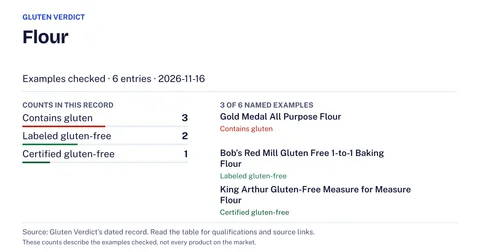 FlourContains glutenchecked Nov 16, 2026
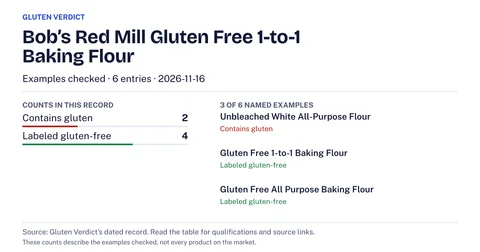 Bob’s Red Mill Gluten Free 1-to-1 Baking FlourLabeled gluten-free2 of 6 varieties we checked contain gluten: Unbleached White All-Purpose Flour and Whole Wheat FlourBob’s Red Mill Natural Foods · checked Nov 16, 2026
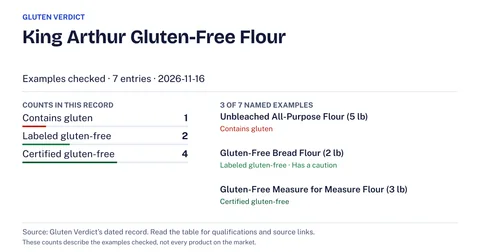 King Arthur Gluten-Free FlourCertified gluten-free1 of 7 varieties we checked contains gluten: Unbleached All-Purpose Flour (5 lb)Wheat warning on 2 of 7 varieties we checkedKing Arthur Baking Company · checked Nov 16, 2026
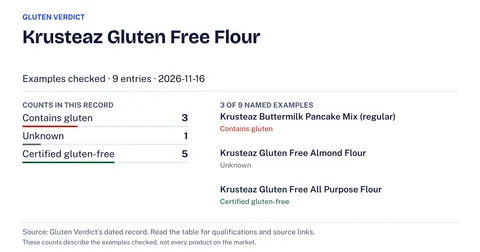 Krusteaz Gluten Free FlourCertified gluten-free3 of 9 varieties we checked contain gluten: Krusteaz Buttermilk Pancake Mix (regular), Krusteaz Honey Cornbread Muffin Mix (regular), and Krusteaz Pie Crust Mix (regular)Krusteaz · checked Nov 16, 2026
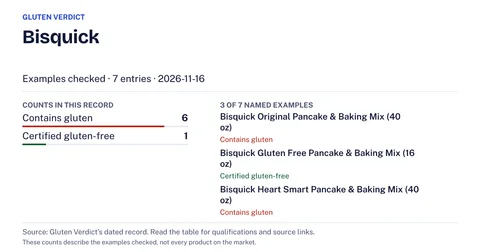 BisquickContains glutenGeneral Mills (Betty Crocker) · checked Nov 16, 2026
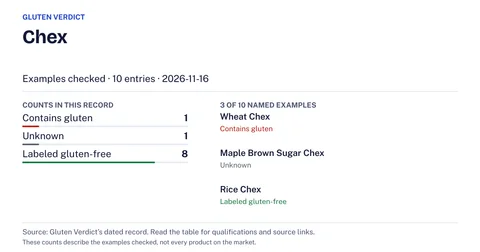 ChexLabeled gluten-free1 of 10 varieties we checked contains gluten: Wheat ChexGeneral Mills · checked Nov 16, 2026
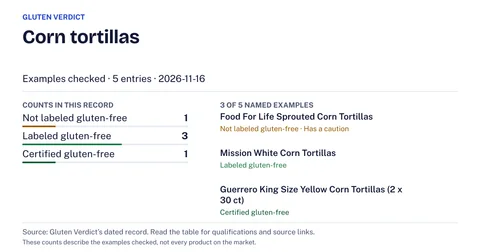 Corn tortillasDepends on the productchecked Nov 16, 2026
Questions people ask
Are gluten-free breads and pastas enriched with folic acid?
It varies by product, and the label shows which. The US rule requires folic acid in enriched flour1, fortification is not mandatory outside some standardized foods2, and GIG says very few gluten-free grain products are modified to add vitamins and minerals3. In the pages we read, four gluten-free flours and mixes named none9, 10, 11, 12; one gluten-free cereal did6. We did not read gluten-free bread or pasta pages.
Does enriched flour contain folic acid?
Yes. The standard for enriched flour sets 0.7 milligrams of folic acid in each pound1.
Is folate on a Nutrition Facts panel the same as folic acid?
No. The panel shows total folate, and if any of it comes from folic acid, that amount is listed in micrograms in parentheses7.
Should I avoid folic acid if I have an MTHFR variant?
CDC says the idea that people with an MTHFR variant should avoid folic acid is not true35. Questions about your own situation belong with a clinician.
More in Nutrition and combining diets
 Iron, B12 and B6 on a gluten-free diet: where they come from and how to check a labelWhich foods supply iron, B12 and B6, what US enrichment standards name, and how to check whether a gluten-free flour, bread or cereal is fortified.
 Gluten-free high-protein foods: where gluten hides in bars, powders, jerky and marinadesCheck each protein product type for its gluten trap: seitan, jerky, bars, powders, sausage and broth, with what makers say on their own pages.
 Is a gluten-free diet healthy if you do not have celiac disease?What a gluten-free label promises, what studies of gluten-free products and eaters report, and why testing comes before cutting gluten.
 Paleo or AIP After a Celiac Diagnosis: What the Evidence Does and Does Not SupportWhat celiac guidelines say about paleo, AIP and dropping corn, oats or dairy, and how to check a packaged paleo food for gluten.
 Gluten-free and dairy-free: how to check a US label for bothUS labels treat milk and gluten under different rules. How to read for both, which makers state both claims, and what to ask when eating out.
 Gluten-free for older adults: swallowing difficulty, small appetite and thickenersHow to check thickeners, nutrition drinks and soft foods for a gluten statement, what the IDDSI texture levels are, and whom to ask about swallowing.
Related guides
 Nutrient deficiencies in celiac disease: what the guidance names for checkingWhich nutrients a celiac guideline and a charity's clinician page name for checking, where reported deficiency figures differ, and questions to bring.
 Celiac disease and pregnancy: what the research reportsWhat studies report on celiac disease and pregnancy, what charities, NIDDK and the USPSTF say about care and folic acid, and a child's own risk.
 Prenatal vitamins and gluten: how to check the label and the maker’s statementHow to read a prenatal vitamin’s Other Ingredients list and gluten claim, what to ask the maker, and where folic acid and iron advice comes from.
 Gluten-free substitutes: the swap for each wheat ingredient and the label check it needsA lookup table of gluten-free swaps for wheat flour, pasta, bread, soy sauce, beer and more, with the one label check each swap needs.
Sources
- [1] eCFR (US Code of Federal Regulations), 21 CFR 137.165, Enriched flour, checked Nov 17, 2026.
- [2, 8, 33] US Food and Drug Administration, Fortifying Corn Masa Flour Products with Folic Acid, checked Nov 17, 2026.
- [3, 27, 28] Gluten Intolerance Group, I’m Gluten-Free. Am I Getting my Nutrients?, checked Nov 17, 2026.
Read on 2026-11-17: the list headed “The most commonly affected nutrients that may not absorb as well if you have CD are:” names iron, calcium, folate, vitamin B12 and the fat-soluble vitamins A, D, E and K.
- [4, 7, 14, 18, 21, 31] US Food and Drug Administration, Folate and Folic Acid on the Nutrition and Supplement Facts Labels, checked Nov 17, 2026.
- [5, 6, 32] Chex (General Mills), Rice Chex, checked Nov 17, 2026.
Read the Product Highlights on 2026-11-17: the list names 17g of whole grain rice per serving, good source of calcium, gluten-free, no artificial colors or flavors and no high fructose corn syrup.
- [9] Bob’s Red Mill, Gluten Free 1-to-1 Baking Flour, checked Nov 17, 2026.
Read the product description and ingredients on 2026-11-17: it names sweet white rice flour, whole grain brown rice flour, pearled white sorghum flour, potato starch, tapioca flour and xanthan gum, with no folic acid or other added vitamin.
- [10] King Arthur Baking Company, Gluten-Free Measure for Measure Flour, packaging PDF, checked Nov 17, 2026.
Read the packaging PDF on 2026-11-17: the ingredient list names rice flour, whole grain brown rice flour, sorghum flour, tapioca starch, potato starch, cellulose, a vitamin and mineral blend [calcium carbonate, niacinamide (vitamin B3), reduced iron, thiamin hydrochloride (vitamin B1), riboflavin (vitamin B2)], xanthan gum and cellulose gum; folic acid is not named.
- [11] Betty Crocker, Bisquick Gluten Free Pancake and Baking Mix, checked Nov 17, 2026.
Read the Ingredients section on 2026-11-17: it names rice flour, sugar, leavening (baking soda, sodium aluminum phosphate, monocalcium phosphate), modified potato starch, salt and xanthan gum, with no folic acid or other added vitamin.
- [12] Krusteaz, Gluten Free All Purpose Flour, checked Nov 17, 2026.
Read the Ingredients section on 2026-11-17: it names whole grain sorghum flour, brown rice flour, whole grain millet flour, rice flour, food starch-modified, whole grain quinoa flour and xanthan gum, with no folic acid or other added vitamin.
- [13] King Arthur Baking Company, Gluten-Free Measure for Measure Flour, checked Nov 17, 2026.
- [15, 35, 36] Centers for Disease Control and Prevention, MTHFR Gene Variant and Folic Acid Facts, checked Nov 17, 2026.
- [16, 17, 19] Centers for Disease Control and Prevention, About Folic Acid, checked Nov 17, 2026.
- [20, 34, 38, 39, 40] Centers for Disease Control and Prevention, Folic Acid: Sources and Recommended Intake, checked Nov 17, 2026.
- [22] King Arthur Baking Company, All-Purpose Flour, packaging PDF, checked Nov 17, 2026.
Read the packaging PDF on 2026-11-17: the ingredient line reads “Unbleached Hard Red Wheat Flour, Enzyme.” and names no folic acid or other added vitamin.
- [23, 24] Current Developments in Nutrition (PubMed), Not All Grains Are Created Equal: Gluten-Free Products Not Included in Mandatory Folate Fortification (Mitchell and colleagues, 2019), checked Nov 17, 2026.
- [25, 26] International Journal of Food Sciences and Nutrition (PubMed), Folate content of gluten-free food purchases and dietary intake are low in children with coeliac disease (Cyrkot and colleagues, 2020), checked Nov 17, 2026.
- [29] Bob’s Red Mill, Unbleached White All-Purpose Flour, checked Nov 17, 2026.
- [30] Betty Crocker, Bisquick Original Pancake and Baking Mix, checked Nov 17, 2026.
- [37] US Food and Drug Administration, Questions and Answers on the Gluten-Free Food Labeling Final Rule, checked Nov 17, 2026.