Gluten-free for older adults: swallowing difficulty, small appetite and thickeners
Short answer
Start with the product, not the product type: each thickener, nutrition drink and soft food makes its own gluten statement, or none25, 28, 32. Check, in this order:
- Ask which IDDSI texture level the clinician has set: the framework has eight levels, 0 to 7, with drinks at 0 to 4 and foods at 3 to 7, and the clinician makes the recommendation1, 2.
- Read the maker’s own page for each thickener by name and format. Kent’s pages, for one, disagree about its Thick-It purées26, 27.
- Check each nutrition drink the same way: Abbott says Ensure ready-to-drink shakes and drinks are gluten-free, and Nestlé says BOOST Original Drink is32, 34.
- Read the label of every soft or pureed food, and contact the company when you are unsure20, 36.
- Ask who handles which question: the NIDCD says a change in the ability to swallow is one to take to a physician, who may refer to a speech-language pathologist, and the NIDDK says a doctor or registered dietitian can guide what to eat and drink8, 19.
Part of Nutrition and combining diets, 24 guides

Key points
- Texture levels come from IDDSI’s eight-level framework, and the clinician decides which level a person needs1, 2.
- Thickener statements differ: Kent says Thick-It Original complies with FDA requirements for gluten free, but its pages disagree on purées and the two Clear Advantage thickener pages we read carry no gluten sentence25, 26, 27, 28, 29.
- Abbott says Ensure ready-to-drink shakes and drinks are gluten-free, and Nestlé says BOOST Original Drink is32, 34.
- The NIDDK says starches and thickeners in foods can be made from grains that contain gluten, so soft foods need their labels read18.
- The NIDCD says a person with a change in swallowing should consult a physician, who may refer to a speech-language pathologist; the NIDDK says a doctor or registered dietitian can guide what to eat and drink8, 19.
What the sources say about celiac disease at older ages
A 2016 narrative review in Clinical Medicine Insights: Gastroenterology says celiac disease has been increasingly recognized in older people despite a paucity of symptoms such as diarrhea and weight loss15. The same review says diagnosis may be delayed by limited symptoms, a low index of clinical suspicion, or diagnostic difficulties related to “important cognitive impairment”16, and that elderly patients sometimes are “scarcely adherent” to the diet17.
This page covers the food side: the gluten statements on the products that often come with swallowing difficulty or a small appetite. For symptoms at older ages, see celiac symptoms in teenagers and older adults.
This page reports what NIH agencies, charities, makers and a peer-reviewed review say. It gives no amounts, no supplement choices and no advice on which texture a person needs; those belong to the person’s clinician, dietitian or speech-language pathologist.
Swallowing difficulty and the texture levels clinicians use
Swallowing difficulty (dysphagia) has many possible causes and, the NIDCD says, happens most frequently in older adults6. The NIDCD lists thickened drinks among the changes some people need: people who cannot swallow thin liquids may need to add special thickeners to their drinks7.
Clinicians describe textures with the IDDSI framework, from the International Dysphagia Diet Standardisation Initiative. It has eight levels, 0 to 7: drinks are measured from Levels 0 to 4 and foods from Levels 3 to 71. IDDSI says the clinician is responsible for recommending foods or drinks for a particular patient, based on a comprehensive clinical assessment2.
| Level | As a drink | As a food |
|---|---|---|
| 0 | Thin3 | — |
| 1 | Slightly Thick3 | — |
| 2 | Mildly Thick3 | — |
| 3 | Moderately Thick3, 37 | Liquidised3 |
| 4 | Extremely Thick3, 37 | Pureed3 |
| 5 | — | Minced and Moist3 |
| 6 | — | Soft and Bite sized3 |
| 7 | — | Easy to Chew, or Regular3 |
IDDSI’s handouts add that pureed food (Level 4) may be used if a person is not able to bite or chew food or if tongue control is reduced5, and that its Level 3 liquidised-food handout says to seek help about nutrition when using that texture, to be sure of getting the right amount4.
Two questions follow, and they are separate: which level the clinician has set, and whether the products used to reach it carry a gluten statement. The next sections cover the second.
Thickeners: what each maker says about gluten
The NIDDK says many food ingredients and additives, including starches and thickeners, are made from grains that contain gluten18. That is a reason to read a thickener’s page and label like any other processed food. It is not a finding about any product below.
The table shows what each maker’s own page said on 2026-11-17. A maker’s statement is the maker’s; we did not test any product. For kitchen thickeners such as cornstarch and flour, see gluten-free thickeners.
| Product | What the maker’s page says |
|---|---|
| Thick-It Original and Thick-It Original Concentrated (Kent Precision Foods) | Kent says the products comply with the FDA requirements for gluten free, and that the ingredients (modified cornstarch and maltodextrin; modified cornstarch for the Concentrated) are derived from corn25. |
| Thick-It Clear Advantage thickener (Kent) | No sentence about gluten on its product page, which lists xanthan gum, maltodextrin and ascorbic acid28. Another Kent page calls the Clear Advantage Powder Food & Beverage Thickener “allergen-free”29. |
| Thick-It purées (Kent) | Kent’s product-facts page names eight purées as gluten-free26. Kent’s FAQ page says Thick-It Purees are not gluten-free27. |
| SimplyThick EasyMix | SimplyThick says it is free of major known allergens, a list that includes gluten30. |
| ThickenUp Clear (Nestlé Health Science) | The page’s “Suitable Diets” list includes Gluten-Free; its ingredients are maltodextrin, xanthan gum and potassium chloride31. |
Two of Kent’s own pages give different answers about purées26, 27, and the two Clear Advantage thickener pages we read carry no gluten sentence28, 29. Ask Kent which statement is current for the product in hand, and read the label on that container.
“Allergen-free” is not the same wording as “gluten-free”. The list of major food allergens in the Food Allergen Labeling and Consumer Protection Act, as FDA’s page reproduces it, names wheat, not barley or rye24, so ask what a maker’s allergen statement covers.
Where a US food carries a “gluten-free” claim, FDA’s definition applies: the food is inherently gluten free or has no ingredient that is a gluten-containing grain or derived from one that has not been processed to remove gluten, an ingredient processed to remove gluten must not bring the food to 20 parts per million or more, and any unavoidable gluten must be under 20 parts per million21. The claim is voluntary22, so a missing claim is a reason to ask, not a finding.
Nutrition drinks: what the makers say
Abbott’s Ensure Q&A page says Ensure ready-to-drink shakes and drinks are gluten-free32. Nestlé Health Science’s page for BOOST Original says BOOST Original Drink is gluten-free34. Each statement covers the line it names; a powder, another BOOST or Ensure product, or a flavor you have not checked needs its own look at the maker’s page and the label.
Abbott describes some Ensure products (Original, Plus and Complete) as designed to provide complete, balanced nutrition to help people gain or maintain healthy weight, particularly patients at risk of malnutrition or experiencing involuntary weight loss33. Whether a person should use one, how many and which type is for the clinician or dietitian.
A thickened nutrition drink has two makers behind it, so check both: the drink and the thickener each make their own statement.
Soft and pureed foods: read the label every time
For foods, the NIDDK says to carefully read food labels for grains that contain gluten and for ingredients or additives made from them20, and not to eat a food if you are unsure whether it contains gluten, contacting the company if possible36.
FDA says that unless a label also bears a “gluten-free” claim, consumers should not assume that a food with a statement such as “made with no gluten-containing ingredients” meets the requirements for the claim23.
Soft foods that come up often have verdicts here, each built from the sources it cites: soup, mashed potatoes, pudding, yogurt, smoothies, oatmeal and chicken broth. In each of them the answer depends on the product, so open the verdict, then read the package in your hand.
Care homes, hospitals and meal services: questions to ask
A kitchen has two orders to follow: the texture level and the gluten-free diet. Questions worth asking:
- Does the care plan name both the IDDSI level and the gluten-free diet?
- Which thickener does the kitchen use, and can we read its label and the maker’s statement?
- Are pureed meals made from fresh ingredients or bought as ready-made purées, and can we read the labels of the ready-made ones?
- Which nutrition drink is on the order, and has the dietitian checked its gluten statement?
- Who mixes thickened drinks, and are the scoops and containers kept apart from products that contain gluten?
For the order, the care plan and the tray, see gluten-free meals in nursing homes and assisted living.
A small appetite and unplanned weight loss
The NIA says changes in the body as people age can make some feel full sooner than when they were younger10. It lists less appetite, trouble getting out to buy food, pain when chewing or swallowing, and forgetting to eat as reasons some older adults lose weight unintentionally12. For swallowing issues it advises talking to a doctor about what might be causing them11.
If someone is losing weight rapidly without meaning to, the NIA says to consult a health care professional to find out if there is a medical cause13. Gluten Intolerance Group’s page on nutrition guidance for healthy aging lists eating enough protein even when appetite is smaller among the points for adults in midlife and beyond14. It gives no amounts here, and neither do we.
More on this: weight changes after a celiac diagnosis, gluten-free high-protein foods, nutrient gaps in celiac disease, a balanced gluten-free plate. Medicines and supplements raise their own gluten question: gluten in medications.
Who to involve
The NIDDK says a doctor or registered dietitian can guide a person with celiac disease on what to eat and drink to maintain a balanced diet19. For swallowing, an NIDCD fact sheet (2010, reprinted 2014) says a person with a sudden or gradual change in the ability to swallow should consult a physician, who may refer them to a speech-language pathologist8. ASHA says speech-language pathologists are the preferred providers of dysphagia services and part of an interprofessional team9.
In the UK, Coeliac UK advises people with questions about their balanced gluten-free diet to speak with their GP, a dietitian or its Helpline35.
Verdicts in this guide
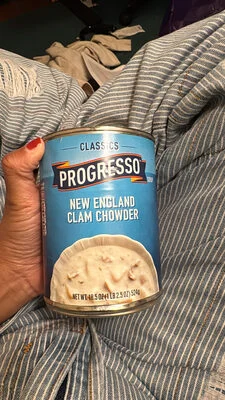 SoupDepends on the product3 of 8 products we checked contain gluten: Campbell’s Condensed Tomato Soup (10.75 oz), Campbell’s Condensed Cream of Mushroom Soup (10.5 oz), and Progresso Traditional Chicken Noodlechecked Nov 16, 2026
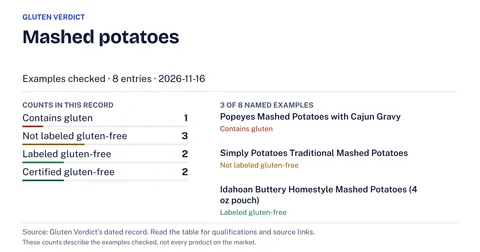 Mashed potatoesDepends on the product1 of 8 products we checked contains gluten: Popeyes Mashed Potatoes with Cajun Gravychecked Nov 16, 2026
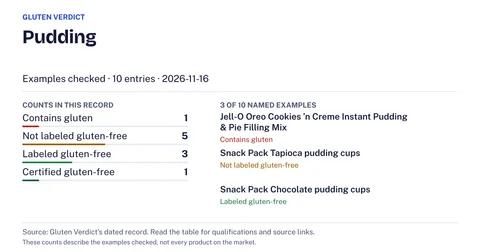 PuddingDepends on the product1 of 10 products we checked contains gluten: Jell-O Oreo Cookies ’n Creme Instant Pudding & Pie Filling Mixchecked Nov 16, 2026
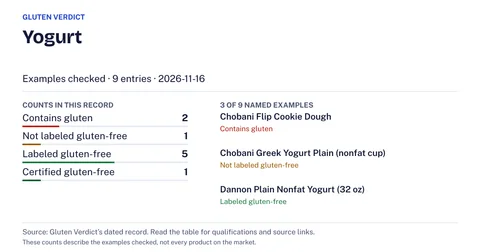 YogurtDepends on the product2 of 9 products we checked contain gluten: Chobani Flip Cookie Dough and Chobani Flip Cookies & Creamchecked Nov 16, 2026
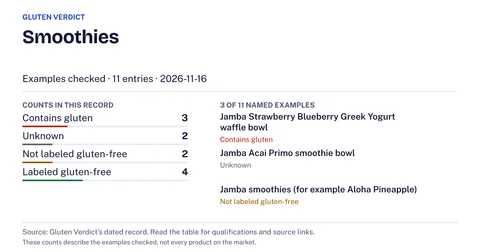 SmoothiesDepends on the product3 of 11 products we checked contain gluten: Jamba Strawberry Blueberry Greek Yogurt waffle bowl, Planet Smoothie Mountain Man Crunch, and Planet Smoothie Cookie Crusherchecked Nov 16, 2026
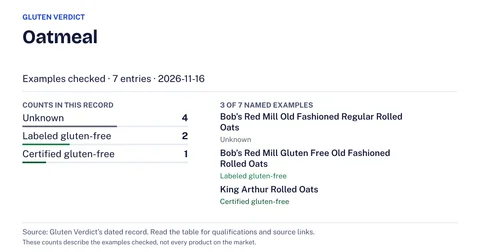 OatmealDepends on the productchecked Nov 16, 2026
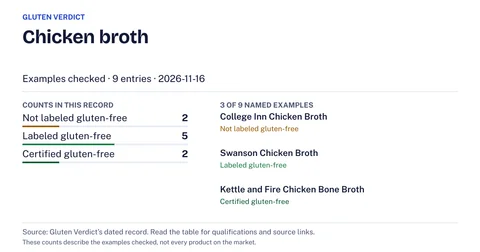 Chicken brothDepends on the productchecked Nov 16, 2026
Questions people ask
Is Thick-It gluten-free?
It depends on the product. Kent says Thick-It Original and Original Concentrated comply with the FDA requirements for gluten free25. Its pages differ on purées26, 27, and the Clear Advantage thickener page we read has no gluten sentence28.
Is SimplyThick gluten-free?
SimplyThick says SimplyThick EasyMix is free of major known allergens, a list that includes gluten30.
Is Ensure or BOOST gluten-free?
Abbott says Ensure ready-to-drink shakes and drinks are gluten-free32. Nestlé says BOOST Original Drink is gluten-free34.
More in Nutrition and combining diets
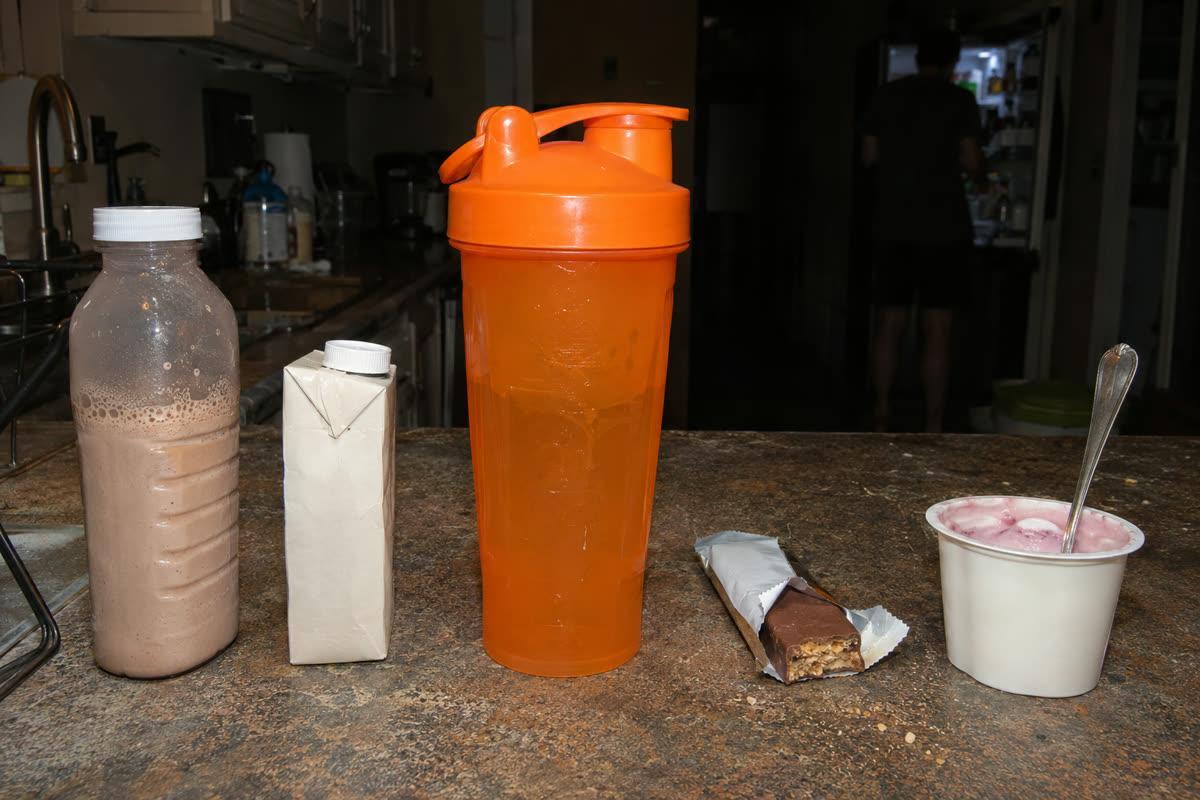 Gluten-free eating on a GLP-1 medication: what to read on shake, broth, bar and cup labelsHow to read a shake, broth, bar or cottage cheese cup for a gluten-free claim, a certifier mark and shared-equipment text while on a GLP-1 medication.
 What to eat after a celiac diagnosis: what the sources document and what they do notBone broth, collagen, glutamine or plain staples? What NIDDK, ACG and celiac charities document after a diagnosis, and what no page we read names.
 Weight gain or loss after a celiac diagnosis: what the research foundWhat two studies found about weight before and after a celiac diagnosis, what sources say about gluten-free foods, and what to bring to a dietitian.
 Vitamin D with celiac disease: reading a result and checking a supplement for glutenWhat a vitamin D blood result measures, the published reference levels and upper intake level, and how to check a supplement label for gluten.
 Gluten-free with type 2 diabetes or high cholesterol: where the plans overlapWhere a gluten-free plan and a diabetes or cholesterol plan agree, where packaged gluten-free foods cut across them, and what to ask a dietitian.
 Gluten-free high-protein foods: where gluten hides in bars, powders, jerky and marinadesCheck each protein product type for its gluten trap: seitan, jerky, bars, powders, sausage and broth, with what makers say on their own pages.
Related guides
 Nutrient deficiencies in celiac disease: what the guidance names for checkingWhich nutrients a celiac guideline and a charity's clinician page name for checking, where reported deficiency figures differ, and questions to bring.
 Gluten in medications: what the label, DailyMed and a pharmacist can showFDA’s gluten-free food rule does not cover drugs. Use the ingredient list, DailyMed, the maker and a pharmacist, and know what each can show.
 Gluten-free meals in a nursing home or assisted living: the rules and what to askWhich meal rules cover a nursing home or assisted living, what to ask on a tour, how to get a gluten-free diet into the care plan, and where to complain.
 Foods that contain gluten, aisle by aisle, and the label words that give them awayA store-order map of foods that contain gluten, which depend on the brand, and which need a cross-contact check, with the label words to look for.
Sources
- [1, 2] International Dysphagia Diet Standardisation Initiative (IDDSI), The IDDSI Framework, checked Nov 17, 2026.
- [3] International Dysphagia Diet Standardisation Initiative (IDDSI), IDDSI patient handouts for adults, checked Nov 17, 2026.
Read on 2026-11-17: the list headed “Adults (Updated Jan 2019)” names Level 0 - Thin, Level 1 - Slightly Thick, Level 2 - Mildly Thick, Level 3 - Moderately Thick, Level 3 - Liquidised, Level 4 - Extremely Thick, Level 4 - Pureed, Level 5 - Minced and Moist, Level 6 - Soft and Bite sized, Level 7 - Easy to Chew and Level 7 - Regular.
- [4, 5, 37] International Dysphagia Diet Standardisation Initiative (IDDSI), IDDSI consumer handouts for adults, all levels, checked Nov 17, 2026.
Read on 2026-11-17: the handout’s text calls Level 3 “Moderately Thick drinks” and Level 4 “Extremely Thick drinks”, and its contents list names “Food Level 3 – Liquidised” and “Level 4 – Pureed”.
- [6, 7, 8] National Institute on Deafness and Other Communication Disorders (NIDCD), Dysphagia (fact sheet, NIH Pub. No. 13-4307, October 2010, reprinted February 2014), checked Nov 17, 2026.
- [9] American Speech-Language-Hearing Association (ASHA), Adult Dysphagia (Practice Portal), checked Nov 17, 2026.
- [10, 11] National Institute on Aging (NIA), Overcoming Roadblocks to Healthy Eating, checked Nov 17, 2026.
- [12, 13] National Institute on Aging (NIA), Maintaining a Healthy Weight, checked Nov 17, 2026.
- [14] Gluten Intolerance Group (GIG), Nutrition Guidance for Healthy Aging: What’s New and Why It Matters, checked Nov 17, 2026.
- [15, 16, 17] Clinical Medicine Insights: Gastroenterology (PubMed Central), Elderly Onset Celiac Disease: A Narrative Review, checked Nov 17, 2026.
- [18, 19, 20, 36] US National Institute of Diabetes and Digestive and Kidney Diseases (NIDDK), Eating, Diet, & Nutrition for Celiac Disease, checked Nov 17, 2026.
- [21, 22, 23] US Food and Drug Administration, Questions and Answers on the Gluten-Free Food Labeling Final Rule, checked Nov 17, 2026.
- [24] US Food and Drug Administration, Food Allergen Labeling and Consumer Protection Act of 2004 (FALCPA), checked Nov 17, 2026.
- [25, 26] Kent Precision Foods Group (Thick-It), Thick-It product facts, checked Nov 17, 2026.
- [27] Kent Precision Foods Group (Thick-It), Kent Precision Foods Group FAQ (Personal Nutrition), checked Nov 17, 2026.
- [28] Kent Precision Foods Group (Thick-It), Product catalog: Thick-It Clear Advantage Instant Food and Beverage Thickener, checked Nov 17, 2026.
Read on 2026-11-17: the product page lists the ingredients as Xanthan Gum, Maltodextrin, Ascorbic Acid and an allergen line reading “None Based on FDA FALCPA (Food Allergen Labeling and Consumer Protection Act of 2004) Big 8 Allergens.” No sentence on the page states a gluten claim for this product; the page’s “Sort By: Dietary Concerns” bar lists Gluten Free as a filter, which is not a statement about this product.
- [29] Kent Precision Foods Group (Thick-It), Thick-It Clear Advantage Powder Food & Beverage Thickener, checked Nov 17, 2026.
- [30] SimplyThick, SimplyThick EasyMix is Gluten Free, checked Nov 17, 2026.
- [31] Nestlé Health Science (Nestlé Medical Hub), ThickenUp Clear Food & Drink Thickening Powder, checked Nov 17, 2026.
Read on 2026-11-17: under “Suitable Diets” the page lists Lactose-Free, Gluten-Free, Kosher and Halal, and its ingredients line reads Maltodextrin, Xanthan Gum, Potassium Chloride.
- [32, 33] Abbott (Ensure), Nutrition Questions & Answers, checked Nov 17, 2026.
- [34] Nestlé Health Science (BOOST), BOOST Original Balanced Nutritional Drink, checked Nov 17, 2026.
- [35] Coeliac UK, Keeping a balanced diet, checked Nov 17, 2026.