Is gluten in everything? Where it starts and where it gets added
Short answer
No. Gluten occurs naturally in wheat, rye, barley and crossbreeds of these grains1, so a kitchen sorts into three groups:
- Starts without gluten: fresh fruit and vegetables, meat, fish, poultry, eggs, milk, rice and potatoes, when plain2, 3.
- Gluten added as an ingredient: many starches, flavorings and thickeners are made from grains that contain gluten, and gluten may be found in candy, condiments, hot dogs and sausages, salad dressing and soups, so read the label4, 5.
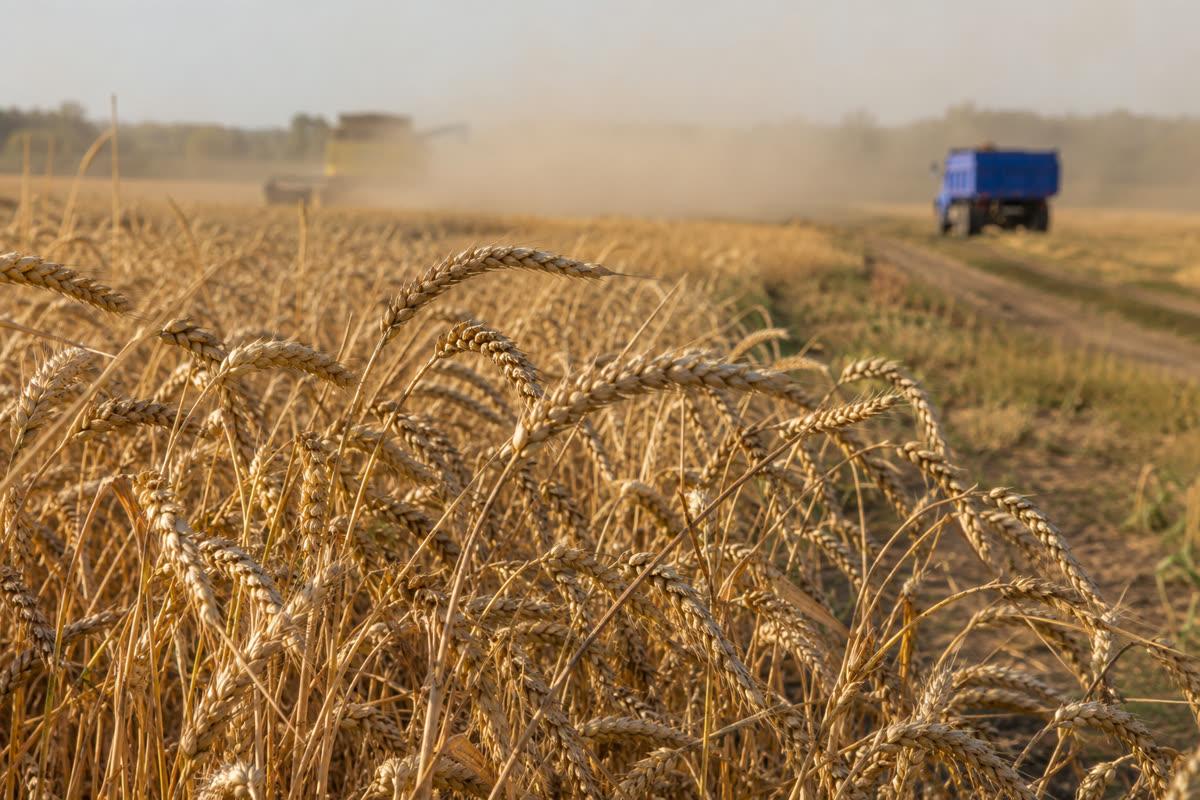
- Gluten picked up by contact: plain grains, legumes and seeds can meet gluten-containing grains in the field, in transport, in storage or on shared equipment6.
Part of Gluten basics and myths, 13 guides
Key points
- Single-ingredient foods such as fresh fruit and vegetables, eggs, milk, fish and poultry start without gluten3; a bare apple or egg with no gluten-free claim is expected, because FDA does not require the claim7.
- NIDDK says many ingredients and additives, such as flavorings, starches and thickeners, are made from grains that contain gluten, and are added to many processed foods, including boxed, canned, frozen, packaged or prepared ones4.
- Gluten can reach a food at any point from field to plate, which NIDDK calls cross-contact8.
- A “Contains” line names wheat; GIG notes there are no required warnings for barley or rye9.
Which foods start without gluten?
NIDDK lists meat, fish, fruits, vegetables, rice and potatoes as naturally gluten-free when they come without additives or some seasonings2. The Academy of Nutrition and Dietetics adds single-ingredient foods such as milk, butter, eggs, lentils, nuts, seeds, poultry, honey and water3.
FDA gives bottled spring water, fruits, vegetables and eggs as examples, and notes that a gluten-free claim is not required on a food package, so it may be missing even when the food has no gluten7. So a bare apple or an egg with no claim on it is what you would expect, not a red flag.
| Food group | Starts without gluten | Where gluten gets added |
|---|---|---|
| Fruit and vegetables | Fresh fruit and vegetables2, 3. Our verdicts: bananas, avocado, potatoes. | GIG says frozen vegetables with sauces, seasonings, add-ons or special shapes could contain wheat gluten10, and frozen seasoned fries could contain wheat flour11. |
| Meat, poultry, fish and eggs | Meat and fish2; poultry, fish and eggs3. Our verdicts: chicken, eggs. | GIG says sausage could contain rusk, and some specialty or plant-based sausages could contain wheat gluten12; sliced deli meats may contain added ingredients that could contain gluten as thickeners, such as wheat-derived dextrin or modified food starch13; some restaurants add pancake batter to scrambled eggs and omelets14. |
| Milk and dairy | Milk and butter3. Our verdict: milk. | Malt products such as malted milk powder are generally made from barley and contain gluten15. GIG says some cheeses have added flavors or other ingredients that could contain gluten, and some hard cheeses could be soaked in beer16. |
| Rice, corn and other grains | The Academy lists rice, wild rice, corn, sorghum, quinoa, millet, buckwheat, amaranth, teff and gluten-free oats among grains to add17. Our verdicts: rice, corn, quinoa. | GIG says seasoned rice can carry soy sauce solids, wheat flour or wheat starch18, and rice pilaf could be made with orzo, a small wheat pasta19. Plain grains can also pick up gluten by contact (see below). |
| Nuts, seeds and legumes | Lentils, nuts and seeds3. | GIG says plain, packaged nuts don’t typically contain gluten but to avoid nuts from bulk bins because of possible cross-contact20. It also says lentil flour should be labeled or certified gluten-free because of cross-contact risk21. |
Each row is a starting point, not a verdict on the product in your hand. For the packaged foods we have checked, every verdict, A to Z lists the sources we read and the date we read them.
Where gluten gets added as an ingredient
NIDDK says many food ingredients and additives, such as colorings, flavorings, starches and thickeners, are made from grains that contain gluten, and that these ingredients are added to many processed foods, including foods that are boxed, canned, frozen, packaged or prepared. It says gluten may therefore be found in candy, condiments, hot dogs and sausages, ice cream, salad dressing and soups4.
| Processed food | How gluten gets in | Our page |
|---|---|---|
| Soy sauce and teriyaki sauce | Traditionally made with fermented crushed wheat and soy22. | Soy sauce |
| Soup | Soup can be thickened with roux, a mixture of fat, usually butter, and flour23. | Soup |
| Gravy | The Academy lists gravy among foods where gluten may make an appearance24. | Gravy |
| Salad dressings | May contain malt vinegar, soy sauce or flour25. | — |
| Taco seasonings and spice blends | Certain brands of taco seasoning contain wheat26. | Spices |
| Corn flakes and crisp rice cereal | Some popular brands are made with malt from barley27. | — |
| Candy | The Academy lists candy among foods where gluten may appear24; GIG says red and black licorice typically contain wheat flour as a main ingredient28. | Candy canes |
| Broth and stock | Some powdered or packaged broths can contain gluten, such as yeast extract derived from barley29. | — |
| Meat substitutes and imitation crab | Seitan is made of wheat gluten30; some imitation crab may use wheat starch to bind31. | — |
The Academy of Nutrition and Dietetics says many foods on its own list, which includes soy sauce, soups and salad dressings, are available gluten-free as well, and that it is important to always check the label24. GIG calls its own list “by no means comprehensive”32, so treat the table as examples of how gluten gets in, not as the full set.
Where gluten arrives without being an ingredient
FDA says cross-contact, in the context of its gluten-free rule, generally refers to the unavoidable presence of gluten in a food due to contact with a gluten-containing food33. NIDDK says it can happen at any time: when foods are grown, processed, stored, prepared or served8.
On the way to the shelf, FDA says crop rotation and the shared use of harvesting and transport equipment and storage silos often bring gluten-containing grains into contact with other grains, legumes and seeds that are naturally free of gluten, and shared production equipment in a factory can do the same6. GIG makes the same point about any processed and packaged food34.
Places it shows up
- Fryers: GIG says fries from fast food restaurants are most likely fried in the same oil as gluten-containing foods35.
- Deli counters: GIG advises watching for cross-contact when deli workers use the same slicing machines for all products36.
- Bulk bins: GIG says to avoid nuts from bulk bins because of possible cross-contact20.
- Oats: the Academy says oats are gluten-free by nature but are often contaminated with other gluten-containing grains during processing37.
- Legume flours: GIG says lentil flour should be labeled or certified gluten-free because of cross-contact risk21.
FDA says that on foods that are free of gluten by nature but at higher risk of cross-contact, such as products made from grains, legumes and seeds, a gluten-free claim gives shoppers the expectation that any gluten present would be at less than 20 parts per million38. For those foods, look for the claim on the package.
Names and labels that mislead
- Buckwheat is not wheat: GIG calls it a gluten-free member of the rhubarb family39.
- Vinegar: GIG says malt vinegar is fermented and made from barley, and Chinese black vinegar could be made using wheat in addition to rice, while distilled vinegars made from gluten-containing grains are gluten-free after distillation40. FDA says malt vinegar cannot be used in foods that bear a gluten-free claim41. Our vinegar verdict has the detail.
- The Contains line: the 2004 allergen labeling law (FALCPA) lists wheat among the major food allergens and does not list barley or rye42. GIG notes that FDA-compliant labels carry no required warning for barley or rye9, so a Contains line with no wheat in it does not clear a food. Read the whole ingredient list.
How to check one item in a minute
- Look the food up in our verdicts: each one lists the sources we read and the date we read them.
- On the package, look for a gluten-free claim. Under FDA’s rule, foods labeled “gluten-free”, “no gluten”, “free of gluten” or “without gluten” must contain less than 20 parts per million of gluten43.
- Read the full ingredient list for wheat, barley, rye and ingredients made from them, as NIDDK advises5.
- If the label does not settle it, NIDDK’s celiac disease page says, where possible, to contact the company that makes the food or visit its website, and not to eat foods you are unsure about44.
- Check again when you buy the same product later: the Academy says to read all product labels each time you purchase a product, because the manufacturer may change an ingredient45.
Our gluten scanner looks for gluten ingredient names in a photo of a label or in pasted text. For the full label walkthrough, see how to read a US food label for gluten; for the contact side, see cross-contamination.
Verdicts in this guide
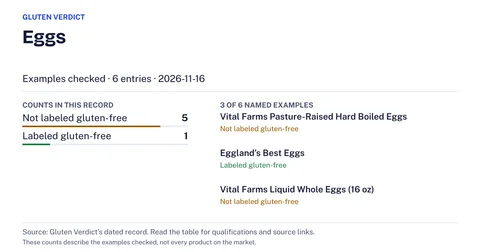 EggsNaturally gluten-freechecked Nov 16, 2026
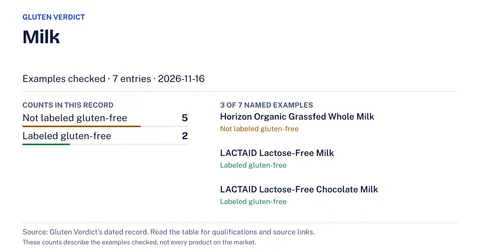 MilkNaturally gluten-freechecked Nov 16, 2026
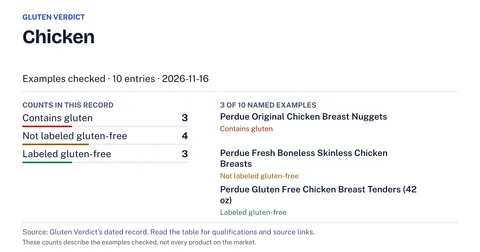 ChickenNaturally gluten-free3 of 10 products we checked contain gluten: Perdue Original Chicken Breast Nuggets, Bell & Evans Breaded Chicken Tenders, and Foster Farms Chicken Nuggets (33.6 oz)checked Nov 16, 2026
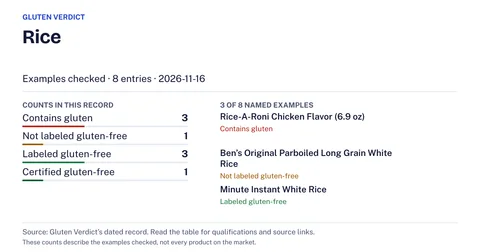 RiceNaturally gluten-free3 of 8 products we checked contain gluten: Rice-A-Roni Chicken Flavor (6.9 oz), Near East Original Rice Pilaf, and Ben’s Original Ready Rice Rice PilafBuy it labeled gluten-freechecked Nov 16, 2026
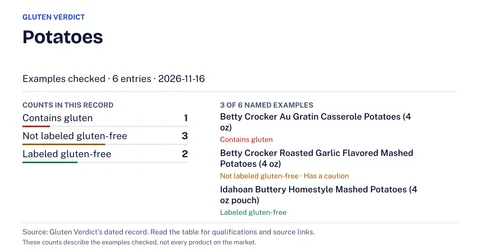 PotatoesNaturally gluten-free1 of 6 products we checked contains gluten: Betty Crocker Au Gratin Casserole Potatoes (4 oz)checked Nov 16, 2026
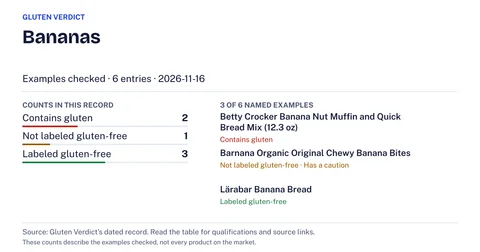 BananasNaturally gluten-free2 of 6 products we checked contain gluten: Betty Crocker Banana Nut Muffin and Quick Bread Mix (12.3 oz) and Bob’s Red Mill Chocolate Chip & Banana Pancake & Waffle Mixchecked Nov 16, 2026
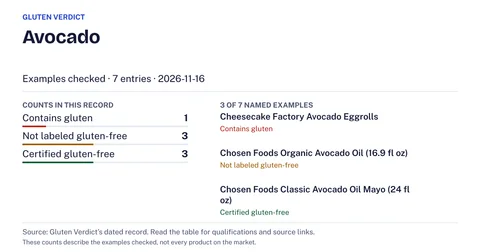 AvocadoNaturally gluten-free1 of 7 products we checked contains gluten: Cheesecake Factory Avocado Eggrollschecked Nov 16, 2026
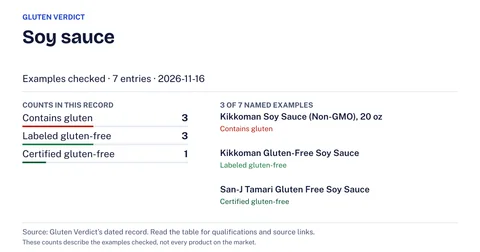 Soy sauceDepends on the product3 of 7 products we checked contain gluten: Kikkoman Soy Sauce (Non-GMO), 20 oz; San-J Organic Shoyu Soy Sauce; and Lee Kum Kee Premium Soy Sauce (No Preservatives Added)checked Nov 16, 2026
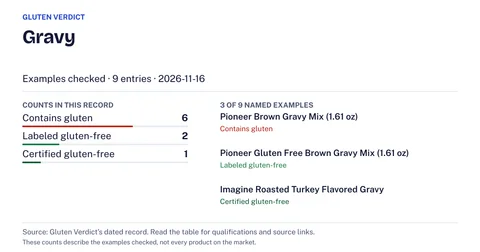 GravyDepends on the product6 of 9 products we checked contain glutenchecked Nov 16, 2026
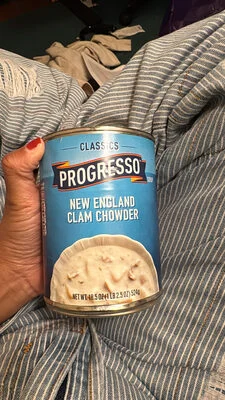 SoupDepends on the product3 of 8 products we checked contain gluten: Campbell’s Condensed Tomato Soup (10.75 oz), Campbell’s Condensed Cream of Mushroom Soup (10.5 oz), and Progresso Traditional Chicken Noodlechecked Nov 16, 2026
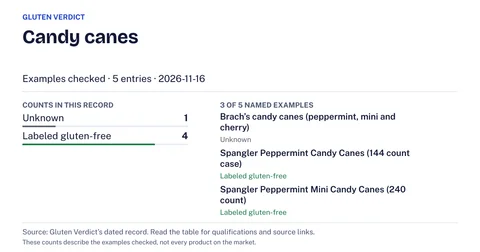 Candy canesDepends on the productchecked Nov 16, 2026
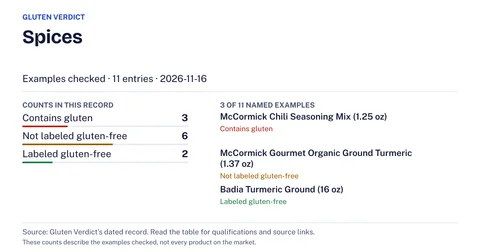 SpicesDepends on the product3 of 11 products we checked contain gluten: McCormick Chili Seasoning Mix (1.25 oz), Lawry’s Chili Spices & Seasonings Mix (1.48 oz), and McCormick Cheesy Taco Seasoning Mix (1.12 oz)checked Nov 16, 2026
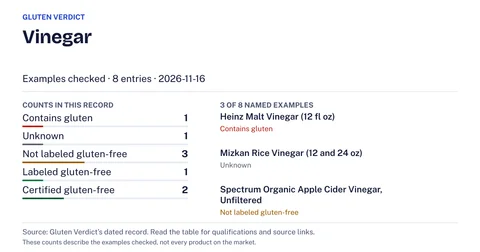 VinegarDepends on the product1 of 8 products we checked contains gluten: Heinz Malt Vinegar (12 fl oz)checked Nov 16, 2026
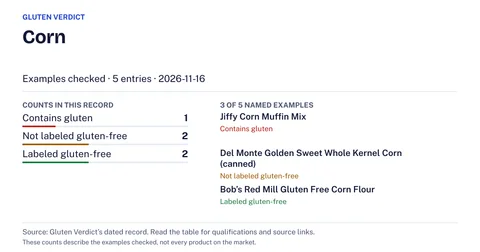 CornNaturally gluten-free1 of 5 products we checked contains gluten: Jiffy Corn Muffin Mixchecked Nov 16, 2026
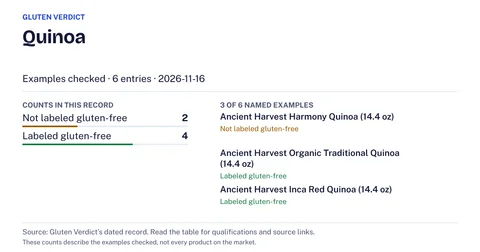 QuinoaNaturally gluten-freeBuy it labeled gluten-freechecked Nov 16, 2026
Questions people ask
Does all processed food have gluten?
No. NIDDK says gluten may be found in a variety of foods, including candy, condiments, hot dogs and sausages, ice cream, salad dressing and soups4, and the Academy of Nutrition and Dietetics says many of the foods it lists are available gluten-free as well24. A gluten-free claim has to meet FDA’s limit of less than 20 parts per million43.
Do plain fruits and vegetables need a gluten-free label?
No. FDA says a gluten-free claim is not required on a food package, so it may not appear even if the food is gluten-free7.
More in Gluten basics and myths
 What gluten is, which grains carry it and what “gluten-free” meansA plain definition of gluten, the grains that carry it, look-alike words such as malt and wheat starch, and what a US gluten-free label means.
 How the 20 ppm gluten-free limit was chosen, and by whomWho set the 20 ppm gluten-free limit and when: the 2004 law, FDA's 2013 rule and its stated reasons, the 2020 follow-up rule, and Codex and EU wording.
 Gluten-free myths about labels and food, checked against the rulesNatural, organic, zero gluten, fermenting and oats: each gluten-free myth checked against the page that states the rule, with the wording and read date.
 Zein, avenin and gluten: how corn and oats differ from wheatIs zein gluten? How FDA’s rule defines gluten, what “corn gluten” and avenin are, and why a gluten-free label matters for oats.
 Why gluten problems seem more common: what the evidence separatesGluten problems seem everywhere. Studies separate three things: cases found, cases that exist, and people avoiding gluten.
 Did modern wheat get worse? What the variety studies show on glutenWhat studies of old and modern wheat varieties show on gluten, and what they say about spelt, einkorn and ancient wheats and celiac disease.
Related guides
 Where wheat, barley and rye hide in processed food: 15 places to checkFifteen processed foods where wheat, barley or rye turn up, the label step that catches each, and what US allergen law does and does not flag.
 Gluten cross-contact at home: where it happens and what to do about itHow gluten reaches gluten-free food at home, whether to separate, wash or ask for each route, and which rules have lab data behind them.
 Certified or naturally gluten-free: when a seal mattersWhich naturally gluten-free foods are worth buying with a claim or seal: produce, grains, flours, oats and processed foods, with FDA rules and test data.
 Starting a gluten-free diet: testing first, then labels, oats and the kitchenWhat NIH and the celiac charities say about starting a gluten-free diet: testing first, which foods to start with, a US label check, oats and the kitchen.
Sources
- [1, 7, 43] US Food and Drug Administration, Gluten and Food Labeling, checked Nov 17, 2026.
- [2, 4, 5, 8, 44] NIDDK (National Institutes of Health), Eating, Diet, & Nutrition for Celiac Disease, checked Nov 17, 2026.
- [3, 15, 17, 24, 37, 45] Academy of Nutrition and Dietetics, Gluten-Free Diet: Building the Grocery List, checked Nov 17, 2026.
Read on 2026-11-17: the list in the “Build a Gluten-Free Grocery List” section names rice, wild rice, corn (maize, polenta, grits), sorghum, quinoa, millet, buckwheat, amaranth, teff and gluten-free oats.
- [6, 33, 38, 41] US Food and Drug Administration, Questions and Answers on the Gluten-Free Food Labeling Final Rule, checked Nov 17, 2026.
- [9, 10, 11, 12, 13, 14, 16, 18, 19, 20, 22, 23, 25, 26, 27, 28, 29, 30, 31, 32, 34, 35, 36, 40] Gluten Intolerance Group, 38 Foods Where Gluten May Be “Hidden”, checked Nov 17, 2026.
- [21, 39] Gluten Intolerance Group, 35+ Alternative Gluten-Free Grains and Flour Substitutes, checked Nov 17, 2026.
- [42] US Food and Drug Administration, Food Allergen Labeling and Consumer Protection Act of 2004 (FALCPA), checked Nov 17, 2026.