How to build a gluten-free emergency food supply
Short answer
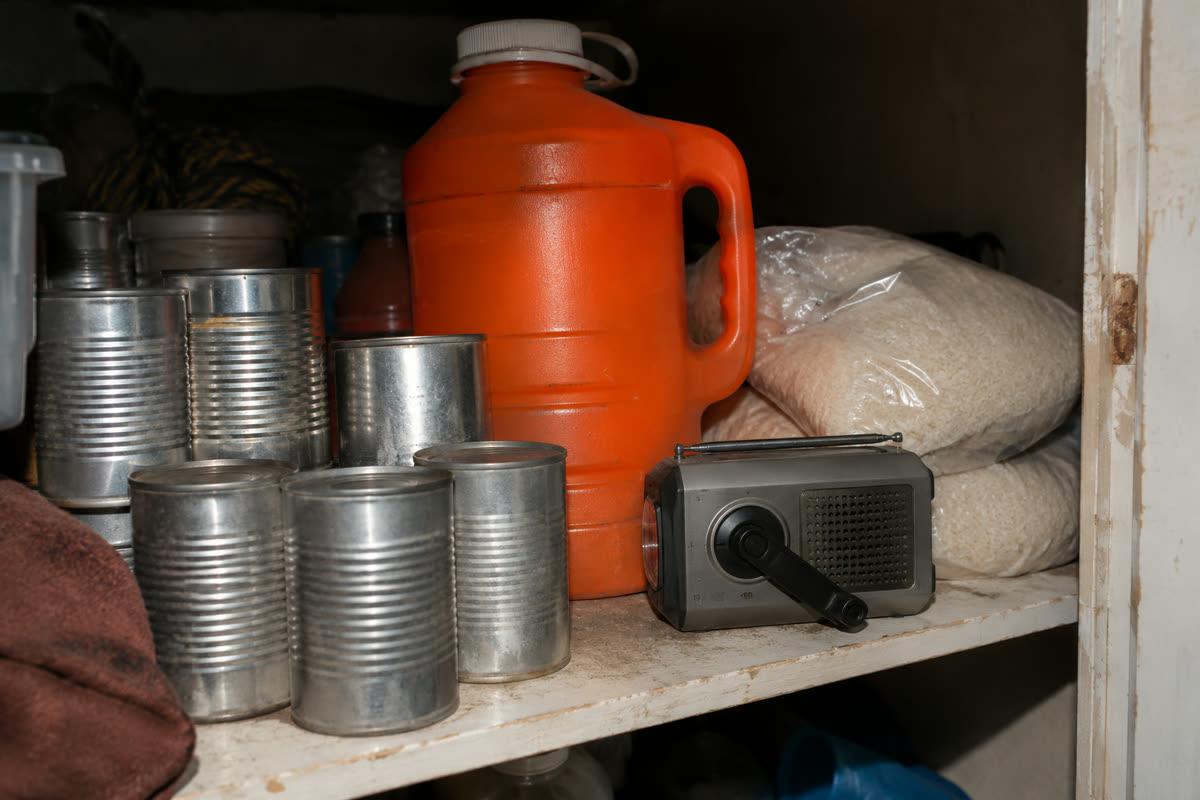
Stock shelf-stable foods whose gluten-free status you have confirmed on the label, read every pouch before you store it, and bring your own food to a shelter. Ready.gov says to take your emergency kit to a shelter even though shelters often provide food1, and the Gluten Intolerance Group says you are better off bringing your own even when emergency personnel say they can accommodate you2.
Part of Grocery shopping and meal planning, 15 guides
Key points
- Ready.gov says to remember any special dietary needs3, but its Food page and the Red Cross kit checklist name neither gluten nor celiac disease4, 5. The Gluten Intolerance Group says to confirm the gluten-free status of every food you store6.
- The Red Cross lists a 3-day food supply for an evacuation kit and a 2-week supply for home7. The Gluten Intolerance Group says to increase the evacuation supply if a shelter may have limited or no gluten-free food8.
- On a pouch, the claim, the certification logo, the Contains line, the ingredient list and any shared-facility line each answer a different question. FALCPA's list of major food allergens, which a Contains line draws on, names wheat but not barley or rye9.
- Shelf-life figures are the makers' own and come with storage conditions10, 11. Ready.gov still says to replace expired items and to re-think your needs every year12, 13.
What Ready.gov and the Red Cross say about special diets
The Red Cross survival-kit checklist asks for non-perishable, easy-to-prepare food: a 3-day supply for an evacuation kit and a 2-week supply for home7. It sets water at one gallon per person per day for the same two periods14.
Ready.gov says to store at least a several-day supply of non-perishable food, to choose foods your family will eat and to remember any special dietary needs3. Its planning page lists dietary needs among the household needs to assess15.
The two pages we read do not name gluten. Ready.gov's Food page uses neither the word gluten nor the word celiac4, and the Red Cross checklist has no dietary item5. This page therefore leans on the Gluten Intolerance Group's emergency-preparedness page, which says to confirm the gluten-free status of any food you store in your kits6.
Ready.gov's suggested food list includes dry cereal or granola, protein or fruit bars and peanut butter16. Treat that list as a starting point and swap each item for one whose label you have checked.
What to stock, food type by food type
The Gluten Intolerance Group sorts emergency foods by type, and notes that lightweight foods include freeze-dried, dehydrated, dried and tetra-packed items, while larger or heavier food includes anything in boxes or cans17. The table follows its list. The last column links our verdicts for the foods we have checked. For everyday shelf items, see also our starter pantry guide and grocery list guide.
| Food type | Forms the Gluten Intolerance Group lists | Our verdicts |
|---|---|---|
| Meat, poultry and fish | Cooked and ready-to-eat in cans, dehydrated, in shelf-stable pouches, or as jerky18 | Beef jerky, tuna salad |
| Beans and lentils | Cooked, in shelf-stable pouches, bags or cans18 | Lentils, chickpeas, refried beans |
| Vegetables and fruit | Vegetables canned or dehydrated in pouches; fruit dried in pouches or canned18 | No verdict linked |
| Milk and alternatives | Tetra-packed, shelf-stable, canned, dried or powdered18 | Coconut milk |
| Grain-based foods | Gluten-free crackers, shelf-stable wraps and tortillas, dry cereal and granola18 | Rice, rice cakes, oatmeal, popcorn |
| Bars, nuts and spreads | Energy or protein bars; nuts and seeds plus nut butter in jars or pouches18 | Peanut butter |
Ready-made cans are another place where the can decides: see our soup and chili verdicts. Honey and protein powder are two more pantry items we have checked.
Three label rules that apply to everything on the list
- A gluten-free claim is voluntary19, so foods that are gluten-free by nature, such as bottled spring water, fresh fruits and vegetables, or fresh seafood, may carry no claim20.
- Oats labeled gluten-free must contain less than 20 ppm of gluten, and FDA does not require them to be certified to carry the claim21.
- In general, soy sauce made from soybeans and wheat may not bear a gluten-free claim22, so read the ingredient list of sauce-flavored foods.
The Gluten Intolerance Group suggests avoiding very salty foods, because they make you thirstier and water may be in short supply23.
How to read a freeze-dried pouch or ready meal
Read the pouch in your hand, not only the maker's product page, and read five places. Each answers a different question.
- The gluten-free claim. On foods FDA regulates, “gluten-free”, “no gluten”, “free of gluten” and “without gluten” each mean less than 20 parts per million (ppm) of gluten24.
- A certification logo. FDA does not endorse any particular third-party certification program25. GFCO says it certifies physical products displaying its mark, not brands or manufacturing facilities26. Mountain House says its GFCO-certified meals can be identified by the Gluten-Free logo on the front of the packaging27.
- The Contains line. FALCPA's list of major food allergens includes wheat but not barley or rye9. Its Contains line is printed immediately after or next to the ingredient list28, or the label may instead name the allergen's source in parentheses within the ingredient list57. Barley and rye are not on that list, so a Contains line does not tell you about them or about malt, which is made from barley9, 29.
- The ingredient list. Look for wheat, barley, rye and malt, and for soy sauce. FDA says malt extract and malt syrup are made from barley that has not been processed to remove gluten29, and that, in general, soy sauce made from soybeans and wheat may not bear a gluten-free claim22. Our guide to wheat, barley and rye names lists the words to look for.
- Any shared-facility line. FDA allows a voluntary statement such as “made in a facility that also processes wheat” on a food that also carries a gluten-free claim, if the statement is truthful and not misleading30.
Meat and poultry labeling is generally regulated by USDA, and FDA's gluten-free rule does not apply to foods whose labeling USDA regulates31. Read the ingredient list on meat pouches and jerky with particular care.
A worked example: a maker's product page
Mountain House's page for its Pad Thai with Chicken pouch shows a “Gluten Free” badge, an ingredient list and a Contains line of sesame, soy and fish, with no may-contain or shared-equipment line32. That page is a starting point, and it does not replace the pouch you hold. Our pad thai verdict records what we read on the pad thai products we checked.
Buckets and multi-meal packs: check the line, not just the brand
ReadyWise's FAQ says milk, soy and wheat (gluten) are the common allergens in its products, and tells buyers to consult the labels for specific ingredients33. It also sells a separate gluten-free package of 84 entrée and breakfast servings34.
Legacy Food Storage sells a 60-serving gluten-free entree bucket that includes six gluten-free entrees35, and says that when demand is high or production schedules shift it may substitute select meals in the bucket36. That is a reason to read every pouch when a bucket arrives, and again at every refill.
A certification mark belongs to a product: GFCO says it does not certify brands or manufacturing facilities26. A brand with one certified pouch has not certified its other pouches or buckets on that basis alone26.
Write the product name and the date you read the maker's page on the bucket's lid or on your list. If a label or a page later differs, your dated note shows what you read and when.
Shelf life as each maker states it
These are the makers' own statements, read on 2026-11-17. Where a maker names storage conditions, they are in the maker's words.
| Maker | What it states | Condition it names |
|---|---|---|
| Mountain House | A 30-year taste guarantee10 | The guarantee depends on following its storage guidelines10; to maximize shelf life, store food unopened and avoid prolonged exposure to temperatures above 75°F (24°C)37 |
| ReadyWise | “Up to 25 Year Shelf-life”, with a promise about taste at 25 years38; its entrees or food items, when stored properly, “can often last for well over 20 years”39 | Its gluten-free 84-serving package can last up to 25 years “when stored properly”11 |
| Legacy Food Storage | No figure in the bucket's description, which says its freeze-dried food has a “very long term shelf life”41; a site-menu link under “Our Packaging” on the same page reads “Up to 25 Year Shelf Life”40 | None named on the bucket page we read58 |
Two cautions. Mountain House ties its figure to taste10, and ReadyWise's promise is also about taste at 25 years38. And the statements differ on rotation: Legacy says its packaging means you are free from the stress of rotating and replacing your food storage constantly41, while Ready.gov says to replace expired items as needed and to re-think your needs every year12, 13. The date on the pouch and your own yearly check decide.
Water, cooking and power: what a no-power kitchen needs
For outages, Ready.gov says to stock canned foods, dry mixes and other staples that do not require refrigeration, cooking, water or special preparation, and to include a manual can opener and eating utensils42. Freeze-dried meals need water: Mountain House says to just add hot water43, and ReadyWise says each individual serving requires 1 cup of water on average44. The Red Cross figure for water is one gallon per person per day14.
For cooking, Ready.gov notes that charcoal grills and camp stoves are for outdoor use only, and that commercially canned food may be eaten out of the can without warming45.
If floodwater reaches your cans
FDA says not to eat or drink anything that has touched flood water, including food packed in non-metal containers46. For cans, it says to remove the labels, wash the cans and dip them in a solution of 1 cup of unscented household (5.25% concentration) bleach in 5 gallons of water47. It also lists nonperishable food kept high on shelves, in case of flood, among its storm preparations48.
For a gluten-free household, a removed label also removes the ingredient list and any gluten-free claim. Before a storm, photograph the label of each can, or write the product name and the date you checked it on the lid with a permanent marker.
Rotation and storage
- Keep a list with one line per item: product, where you read its gluten-free statement or ingredient list, and the date you read it.
- Photograph the front and back of each pouch, including the date code. Mountain House asks for the date code from the package when it replaces a product under its guarantee49.
- Store canned food in a cool, dry place50 and boxed food in tightly closed plastic or metal containers51. To maximize shelf life, Mountain House says to store food unopened and avoid prolonged exposure to temperatures above 75°F (24°C)37.
- Keep the kit together. Ready.gov suggests airtight plastic bags and one or two easy-to-carry containers such as plastic bins or a duffel bag52. A bin marked for the gluten-free household keeps this supply apart from other stock.
- Once a year, re-read every label and refill. Ready.gov says to replace expired items as needed and to re-think your needs every year12, 13. Read the new pouch's label, not the old one's: Legacy says it may substitute meals in a bucket36.
At a shelter: what the agencies say and what to carry
Ready.gov says mass care shelters often provide water, food, medicine and basic sanitary facilities, and still tells you to take your emergency supply kit with you1. The Red Cross lists meals, snacks and water among the services at its shelters; the list does not mention gluten-free meals53.
The Red Cross asks you to tell staff on arrival about any specific needs for equipment, supplies or food, and says every effort will be made to accommodate them54. That is an effort, not a promise of gluten-free food. The Gluten Intolerance Group advises bringing your own food even if emergency personnel assure you they can accommodate your gluten-free needs, if only as a backup2.
Before any emergency, the Gluten Intolerance Group suggests contacting your local Red Cross or other shelters to ask whether they anticipate being able to provide gluten-free food55. To prepare for a shelter with limited or no gluten-free options, it says to increase the size of your evacuation food supply8.
What to carry
- Light food: the Gluten Intolerance Group lists freeze-dried, dehydrated, dried and tetra-packed foods as lightweight17. Freeze-dried meals still need water44, so plan for it.
- Your emergency kit, which appears on the Red Cross list of what to pack for one of its shelters56.
- A manual can opener and eating utensils42.
- Your dated list and the label photographs from the rotation step.
Questions to ask the shelter
- Will gluten-free meals be served, and who decides what is served?
- Can I keep and prepare my own food, and is there hot water?
- Is there a place to store my food apart from shared supplies?
- Who should I tell about my food needs when I arrive?
Verdicts in this guide
 Beef jerkyDepends on the product3 of 8 products we checked contain gluten: Jack Link’s Original Beef Jerky, Jack Link’s Teriyaki Beef Jerky, and Old Trapper Teriyaki Beef Jerky (bulk)checked Nov 16, 2026
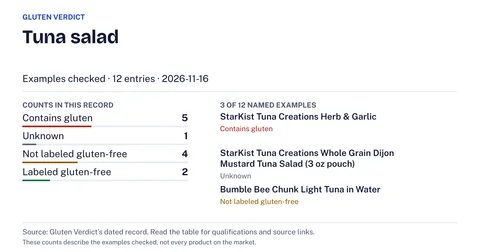 Tuna saladDepends on the product5 of 12 products we checked contain glutenchecked Nov 16, 2026
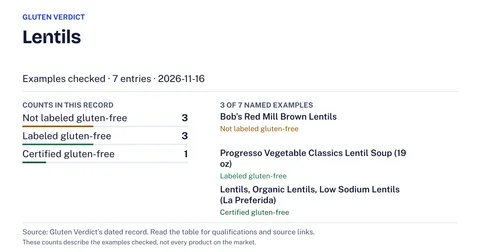 LentilsDepends on the productchecked Nov 16, 2026
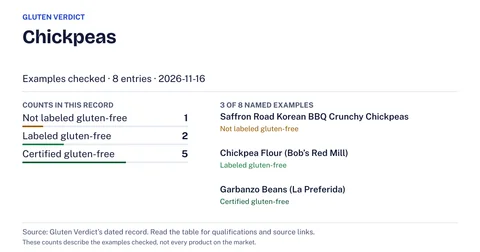 ChickpeasNaturally gluten-freechecked Nov 16, 2026
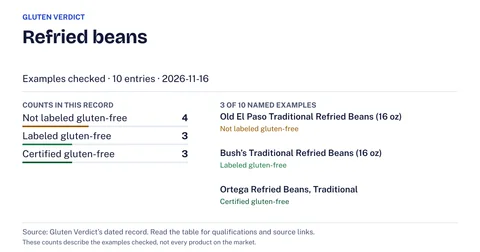 Refried beansDepends on the productchecked Nov 16, 2026
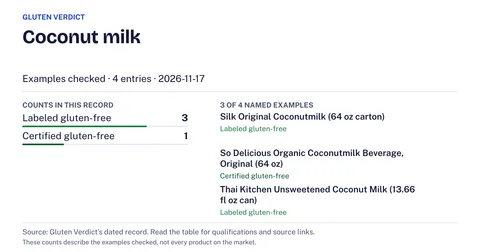 Coconut milkNaturally gluten-freechecked Nov 17, 2026
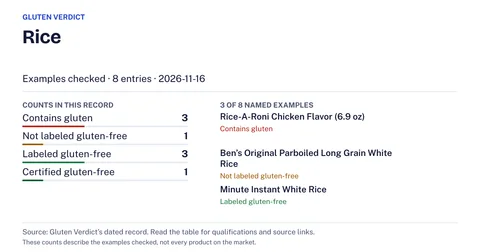 RiceNaturally gluten-free3 of 8 products we checked contain gluten: Rice-A-Roni Chicken Flavor (6.9 oz), Near East Original Rice Pilaf, and Ben’s Original Ready Rice Rice PilafBuy it labeled gluten-freechecked Nov 16, 2026
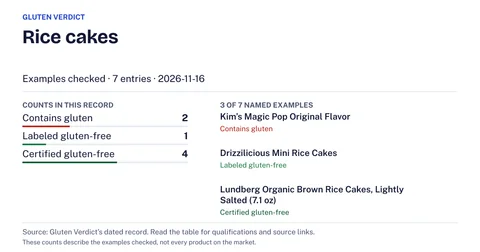 Rice cakesDepends on the product2 of 7 products we checked contain gluten: Kim’s Magic Pop Original Flavor and Kim’s Magic Pop Whole Wheat Flavorchecked Nov 16, 2026
 OatmealDepends on the productchecked Nov 16, 2026
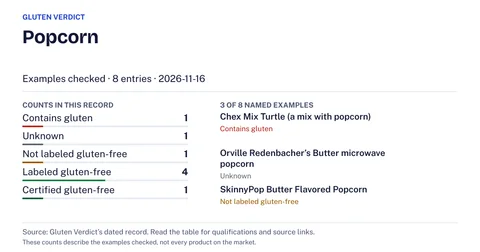 PopcornNaturally gluten-free1 of 8 products we checked contains gluten: Chex Mix Turtle (a mix with popcorn)checked Nov 16, 2026
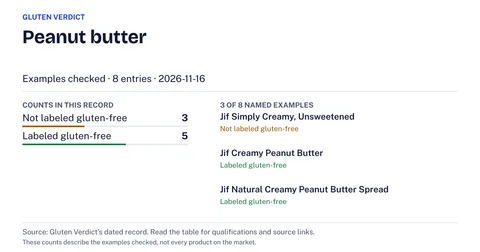 Peanut butterDepends on the productchecked Nov 16, 2026
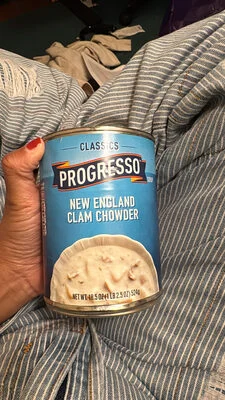 SoupDepends on the product3 of 8 products we checked contain gluten: Campbell’s Condensed Tomato Soup (10.75 oz), Campbell’s Condensed Cream of Mushroom Soup (10.5 oz), and Progresso Traditional Chicken Noodlechecked Nov 16, 2026
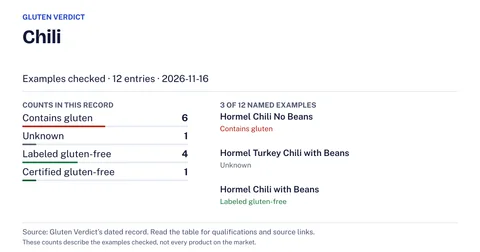 ChiliDepends on the product6 of 12 products we checked contain glutenchecked Nov 16, 2026
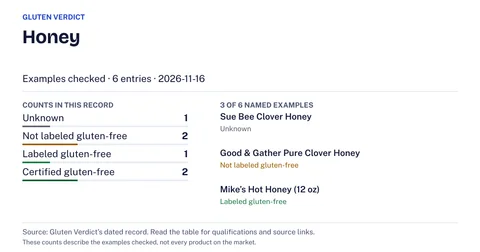 HoneyDepends on the productchecked Nov 16, 2026
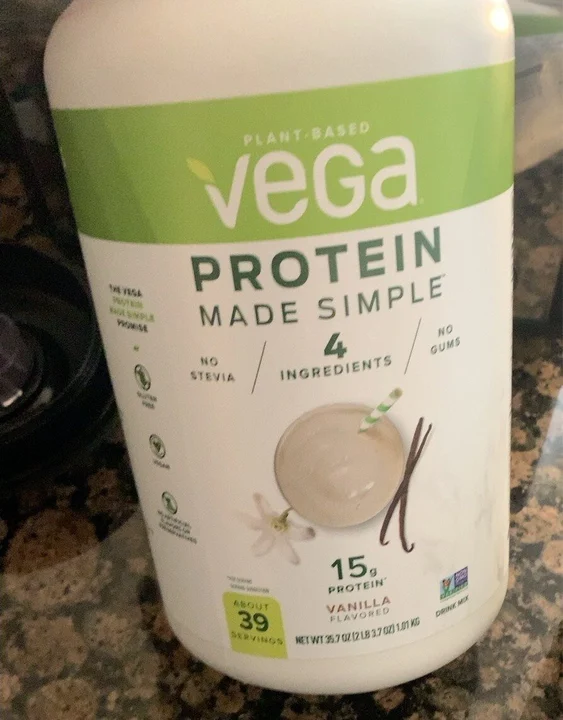 Protein powderDepends on the productchecked Nov 16, 2026
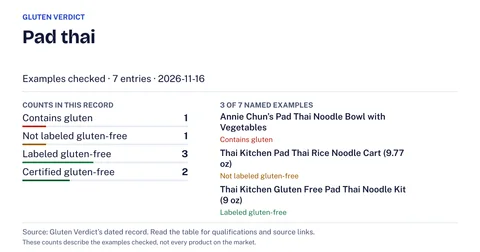 Pad thaiDepends on the product1 of 7 products we checked contains gluten: Annie Chun’s Pad Thai Noodle Bowl with Vegetableschecked Nov 16, 2026
Questions people ask
Can I count on a shelter to serve gluten-free food?
The Red Cross says every effort will be made to accommodate food needs you report on arrival54. The Gluten Intolerance Group still advises bringing your own food as a backup2.
If a company has one certified pouch, is its bucket certified too?
GFCO says it certifies physical products displaying its mark, not brands or manufacturing facilities26, so check the label of the bucket's own contents.
More in Grocery shopping and meal planning
 A gluten-free meal plan as a shopping template, by meal slotA weekly gluten-free shopping template: staples for each meal slot, the check each packaged item needs, and a ledger of when you last read each label.
 A gluten-free grocery list by aisle for US supermarketsAn aisle-by-aisle gluten-free grocery list for US stores: what needs no label, what needs a check, and what stays off the list.
 A starter gluten-free pantry: 30 shelf items and the label check for eachThirty shelf items for a first gluten-free pantry, tagged by the label check each needs, plus how to keep jars, toaster and colander apart at home.
 Gluten-free at the farmers market and in a CSA box: what to ask each producerWhich farmers market stalls and CSA add-ons need no label, which need questions, and the order to ask them, with what state cottage food rules cover.
 Packing a gluten-free work lunch from shelf-stable foodsWhat to pack for a gluten-free office lunch, which packaged items to label-check once, and how to use a shared fridge, microwave and toaster.
 Deli, bakery and bulk-bin counters on a gluten-free dietFor each store counter (deli, bakery, bulk bins, bars): skip it, ask first, or buy the packaged item, and what a store’s own statement tells you.
Related guides
 Freezing gluten-free food: what holds up, how to thaw it and how to keep it apartHow to freeze, label and thaw gluten-free food, which foods lose texture, and how to keep gluten-free packages apart in a shared freezer.
 How to check whether a packaged food is gluten-freeA four-step check for one packaged food: the claim, the ingredient and allergen lines, the maker’s dated page and the certifier’s directory.
 Gluten-free food for camping and hiking: pack lists and label checksPack gluten-free camping and hiking food by trip length, check pouch meals and bars against their labels, and run a shared camp kitchen.
 Gluten-free with type 2 diabetes or high cholesterol: where the plans overlapWhere a gluten-free plan and a diabetes or cholesterol plan agree, where packaged gluten-free foods cut across them, and what to ask a dietitian.
Sources
- [1] Ready.gov, Shelter, checked Nov 17, 2026.
- [2, 6, 8, 17, 18, 23, 55] Gluten Intolerance Group, Gluten-Free Emergency Preparedness, checked Nov 17, 2026.
Read on 2026-11-17: the list headed “Gluten-Free Food List” names meat, poultry and fish (cooked and ready-to-eat in cans, dehydrated to be reconstituted, in shelf-stable pouches, or as jerky); cooked beans and lentils (shelf-stable pouches, bags, or cans); vegetables (canned or dehydrated in pouches); fruits (dried in pouches or canned); milk and milk alternatives (tetra-packed, shelf-stable, canned, dried or powdered); grains and grain-based (gluten-free) foods (crackers, shelf-stable wraps and tortillas, dry cereal, granola); energy or protein bars; juice (canned, plastic-bottled or tetra-packed); and nuts and seeds plus nut butter in jars or pouches.
- [3, 4, 16, 42, 45] Ready.gov, Food (emergency food planning), checked Nov 17, 2026.
Read on 2026-11-17: the words “gluten” and “celiac” do not appear on the Food page; the only diet-related line is “Remember any special dietary needs.”
Read on 2026-11-17: the list of suggested emergency food supplies names ready-to-eat canned meats, fruits and vegetables with a can opener; protein or fruit bars; dry cereal or granola; peanut butter; dried fruit; canned juices; non-perishable pasteurized milk; high-energy foods; food for infants; and comfort/stress foods.
- [5, 7, 14] American Red Cross, Survival Kit Supplies, checked Nov 17, 2026.
Read on 2026-11-17: the “What Do You Need In A Survival Kit?” checklist and the lists after it name no gluten-free or dietary-restriction item.
- [9, 28, 57] US Food and Drug Administration, Food Allergen Labeling and Consumer Protection Act of 2004 (FALCPA), checked Nov 17, 2026.
- [10, 37, 49] Mountain House, Shelf life and 30-year taste guarantee, checked Nov 17, 2026.
- [11, 34, 39] ReadyWise, Gluten-Free Emergency Food Storage, checked Nov 17, 2026.
- [12, 13, 50, 51, 52] Ready.gov, Build a Kit, checked Nov 17, 2026.
- [15] Ready.gov, Make a Plan, checked Nov 17, 2026.
Read on 2026-11-17: under “Step 2: Assess Your Household Needs” the list of things to consider names different ages, responsibilities for assisting others, locations visited frequently, dietary needs, medical needs, disabilities or access and functional needs, languages spoken, cultural and religious considerations, pets or service animals, and households with school-aged children.
- [19, 20, 21, 22, 29, 30, 31] US Food and Drug Administration, Questions and Answers on the Gluten-Free Food Labeling Final Rule, checked Nov 17, 2026.
- [24, 25] US Food and Drug Administration, Gluten and Food Labeling, checked Nov 17, 2026.
- [26] Gluten Intolerance Group, How Does GFCO Certify Gluten-Free Food?, checked Nov 17, 2026.
- [27, 43] Mountain House, Gluten-Free Freeze Dried Meals, checked Nov 17, 2026.
- [32] Mountain House, Pad Thai with Chicken (pouch), checked Nov 17, 2026.
Read on 2026-11-17: the page for Pad Thai with Chicken (pouch) shows the badges “Dairy Free”, “Gluten Free”, “No Artificial Flavors”, “No Artificial Colors” and “Preservative Free”, an ingredient list, and a line “CONTAINS: Sesame, Soy, Fish (anchovies)”. It shows no may-contain or shared-equipment line.
- [33, 44] ReadyWise, 4 Week Emergency Food Supply (FAQ), checked Nov 17, 2026.
- [35, 36, 40, 41, 58] Legacy Food Storage, 60 Serving Gluten Free Entree Bucket, checked Nov 17, 2026.
Read on 2026-11-17: the text of the bucket page names no storage condition beside its “Up to 25 Year Shelf Life” link or its sentence on a “very long term shelf life”.
- [38] ReadyWise, 84 Serving Gluten Free Grab and Go Bucket, checked Nov 17, 2026.
- [46, 47, 48] US Food and Drug Administration, Protect Food and Water During Hurricanes and Other Storms, checked Nov 17, 2026.
- [53, 54, 56] American Red Cross, Find Open Shelters and Disaster Relief Services, checked Nov 17, 2026.
Read on 2026-11-17: the list under “What services are offered at Red Cross Shelters?” names meals, snacks and water among its items; it does not mention gluten-free meals.
Read on 2026-11-17: the list under “What should I pack when coming to a Red Cross Shelter?” names bedding, clothing, medications, a child’s comfort item and “Your emergency kit”.