Gifts for someone with celiac disease: what to give and what to write on the card
Short answer
Pick the first of these that fits the person:
- A gift that is not food. Gluten Intolerance Group (GIG) suggests books, small non-food stocking items and a label maker2, 6, 7.
- A gift card for a retailer that carries gluten-free items, so the person picks exactly what they want1.
- Food only after you ask, and only that exact product: a “gluten-free” claim means the maker says that food has less than 20 parts per million of gluten31.
- A card that says what you checked and when, not that the gift is gluten-free, because FDA puts responsibility for the claim on the manufacturer32.
Part of Holidays, weddings and celebrations, 16 guides
Key points
- GIG’s own gift ideas lean on books, small non-food items, a label maker and gift cards, and a gift card lets the person pick exactly what they want2, 6, 1.
- GFCO says it certifies physical products that display its mark, not brands or manufacturing facilities28.
- A hot cocoa page can list no wheat ingredient and still end with “May contain egg, tree nuts, and wheat”, and an herbal tea can list roasted barley first37, 38, 39.
- GIG says baking with gluten-containing flour in your own kitchen raises the risk of cross-contact for gluten-free food in the same space20.
- FDA’s gluten-free rule does not cover meat and poultry (USDA) or most alcoholic drinks (TTB), so a sausage or a bottle needs its own check36.
Start with the person, not the shop
The best information about what a person uses is the person. GIG gives this advice to hosts, “Ask your guests about favorite products and recipes”19, and tells friends and family that if they are not sure about products, to ask for recommendations16. The same step works for a gift.
A short message is enough: what would you like this year, do you share a kitchen with people who eat gluten, and which brands do you already buy? If the gift is meant to be a surprise, stay with the non-food ideas and the gift card below.
Gifts that are not food
The first five rows repeat what the charity suggested, with its words beside each idea; the last row is our idea, built on a GIG cross-contact tip. It is not a ranking.
| Idea | What GIG says |
|---|---|
| Books and magazine subscriptions | Books can be helpful guides with practical tips, whether the person was recently diagnosed or has avoided gluten for years2. |
| A cookbook | GIG suggests a cookbook focused on gluten-free cooking and baking11, and says to look for cookbooks written with people with celiac disease in mind rather than books on trendy diets, which may not be as careful about small amounts of gluten3. |
| Socks, a book, jewelry | GIG suggests small gifts that are not food-related for a stocking6. |
| A label maker | GIG’s reason: it makes it easier to label dedicated gluten-free appliances when you share a kitchen7. |
| A virtual baking class for a child | GIG’s 2020 guide names virtual gluten-free baking classes as a gift for kids4. |
| A second colander, sifter or waffle iron (our idea, not GIG’s) | GIG does not suggest these as gifts. Its cross-contact article says items like these are more difficult to clean thoroughly and should not be shared between gluten-free and non-gluten-free use, if possible21. Ask first whether the person shares a kitchen. |
Whatever you choose, add a handwritten note. GIG’s small-business gift post suggests including non-food items and a personal note13.
Lip balm, lotion and other personal care gifts
GIG’s own pages differ here, so ask the person before you buy. Its stocking-stuffer post suggests lip balm9 and says anything that could be accidentally ingested is good to have gluten-free8. The same post lists ingredient names to watch out for in personal care products10.
Another GIG page says personal care products are not part of the FDA gluten-free labeling regulation24 and that most people on a gluten-free diet do not need to be concerned about gluten in products applied to the skin25. A third GIG page puts the main concern on a topical that gets into the mouth23, and says medical research to date does not show that gluten applied to the skin causes a reaction related to celiac disease22.
Read together, those pages point to lip products and anything used near the mouth (our reading, not a GIG rule). If you give one, ask what the person already uses. GIG’s FAQ points to the GFCO Product Finder for people who prefer gluten-free versions26.
Gift cards: let the person choose
GIG’s 2020 gift guide suggests a card for a local retailer that carries gluten-free items, so the person picks out exactly what they want1. The one check is yours to make, not the product’s: does the person shop there?
For a restaurant card, the same logic holds: choose a place the person already eats, or ask.
- GIG’s advice to friends is to pick a restaurant with gluten-free options, and it names GFFS-validated establishments as one example15. GIG says GFFS accredits restaurants and food services that adhere to strict gluten-free standards14.
- GIG’s cross-contact article tells diners to call ahead and speak directly with the restaurant’s staff or management to assess the risk of cross-contact27.
- Our restaurants pages read each chain’s own allergen guide.
If the gift has to be food: ask, then check that exact product
This page recommends no product. The check is the same every time and works on one box, bag or jar at a time.
- Ask the person which products they already buy19.
- Find that exact product’s own label or maker page. FDA’s rule is that any food carrying “gluten-free”, “no gluten”, “free of gluten” or “without gluten” must contain less than 20 parts per million of gluten31, and the manufacturer is responsible for using the claim accurately32.
- Read the full ingredient list as well. FDA says malt extract and malt syrup are derived from barley that has not been processed to remove gluten34.
- If you are relying on a certification mark, look for the mark on the package. GFCO says it certifies physical products displaying its mark, not brands or manufacturing facilities28, and its Product Finder says a listed product is certified only if it also carries a mark29: a listed product whose packaging has no mark is not certified30. FDA does not endorse any particular certification program33.
- Write down the product name and the date you checked it. Read the package in your hand as well.
Meat and alcohol follow other rules. FDA’s gluten-free rule does not apply to foods whose labeling USDA or TTB regulates: USDA generally meats, poultry and certain egg products; TTB most alcoholic beverages36. For a bottle, see our alcohol guide and gluten-removed beer explained.
Baked and homemade gifts
GIG tells friends and family that if a gluten-free friend skips your homemade cookies or brings their own dish to a potluck, “it’s not about you—it’s about their health”18. On the same page, GIG lists cross-contact among the important things to know: even a crumb from shared butter or a cutting board can trigger symptoms in someone with celiac disease17. GIG’s hosting advice adds that baking with gluten-containing flour in your own kitchen means a higher risk of cross-contact for gluten-free food in the same space20.
GIG’s DIY gift post does suggest making gluten-free treats such as homemade granola bars or energy balls, and adds that you might consider writing down exactly what you used and how you made them12. If the person asks you to bake, send that note with the gift. If they have not asked, give something bought; that part is our advice, not GIG’s.
For the baked foods we have checked, see our verdicts on cookies and gingerbread and the holiday cookie tray guide.
Hot chocolate, tea and coffee sets: read each one
A gift set bundles several products, and each one needs its own reading. Two maker pages show why a brand name or a quick look is not enough:
- Ghirardelli’s Double Chocolate Hot Cocoa Mix page lists ingredients with no wheat in the list37, then adds “May contain egg, tree nuts, and wheat.”38
- Celestial Seasonings’ Roastaroma Herbal Tea page lists roasted barley as its first ingredient39.
FDA’s gluten-free rule does not prohibit a voluntary line such as “made in a facility that also processes wheat” on a food that also carries a gluten-free claim, if the statement is truthful and not misleading35. Whether a line like that matters is the person’s call, so ask.
Our verdicts for hot chocolate, Swiss Miss hot chocolate, tea and coffee show what each maker’s own pages said, with the date we read them. A set with several flavors is several products: check every one.
Candy
A holiday shape, pack or box is its own product, so we keep that check in one dated page, seasonal candy by holiday, rather than a list of boxes here.
What to write on the card
Write what you did, not what the gift is. FDA says the manufacturer that uses a gluten-free claim is responsible for it32, so leave that claim to the label. Lines you can adapt:
- Gift card: “Spend this on whatever you would pick for yourself.”
- Non-food gift: “No food in this one, on purpose.”
- Food, after you asked: “You told me you buy [product]. This is that one. I read the maker’s page on [date], and the label is on the package for you to read too.”
- Homemade, only if they asked: “Made with: [every ingredient and brand]. Made in a kitchen where [describe].”
Verdicts in this guide
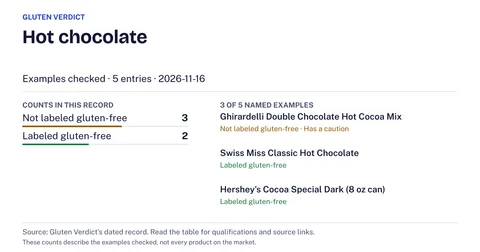 Hot chocolateDepends on the productchecked Nov 16, 2026
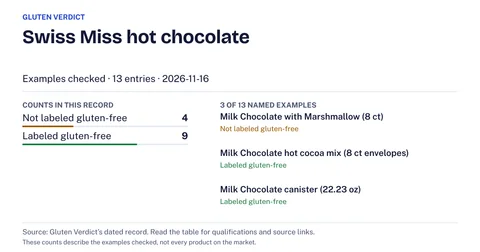 Swiss Miss hot chocolateLabeled gluten-freeConagra Brands · checked Nov 16, 2026
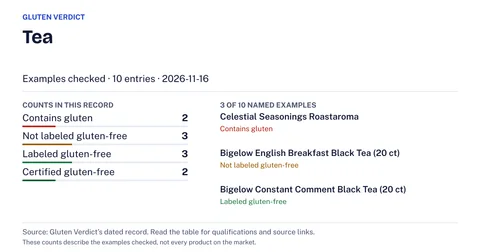 TeaDepends on the product2 of 10 products we checked contain gluten: Celestial Seasonings Roastaroma and Celestial Seasonings Sugar Cookie Sleigh Ridechecked Nov 16, 2026
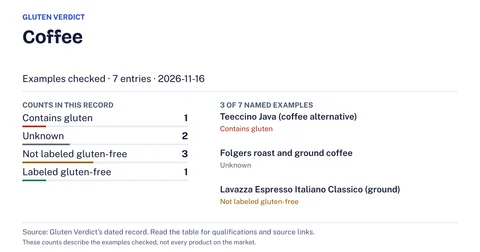 CoffeeDepends on the product1 of 7 products we checked contains gluten: Teeccino Java (coffee alternative)checked Nov 16, 2026
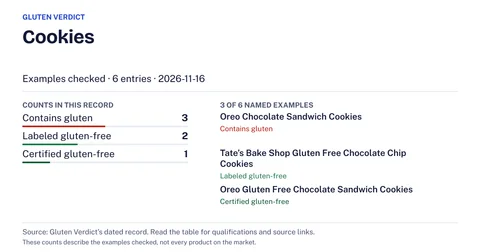 CookiesContains glutenchecked Nov 16, 2026
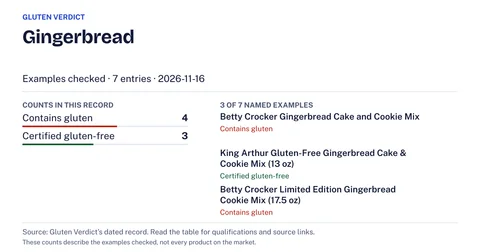 GingerbreadContains glutenchecked Nov 16, 2026
Questions people ask
Can I give wine, beer or spirits to someone with celiac disease?
FDA’s gluten-free rule does not cover most alcoholic beverages, which TTB regulates36. Check the drink itself and ask the person; our alcohol guide covers how alcohol labels work.
Is a gift basket from a shop that sells gluten-free food enough?
GIG’s gift guide describes a DIY basket assembled from hand-picked, certified gluten-free goodies5. A basket from a shop is several products: read each one the way the check above describes.
More in Holidays, weddings and celebrations
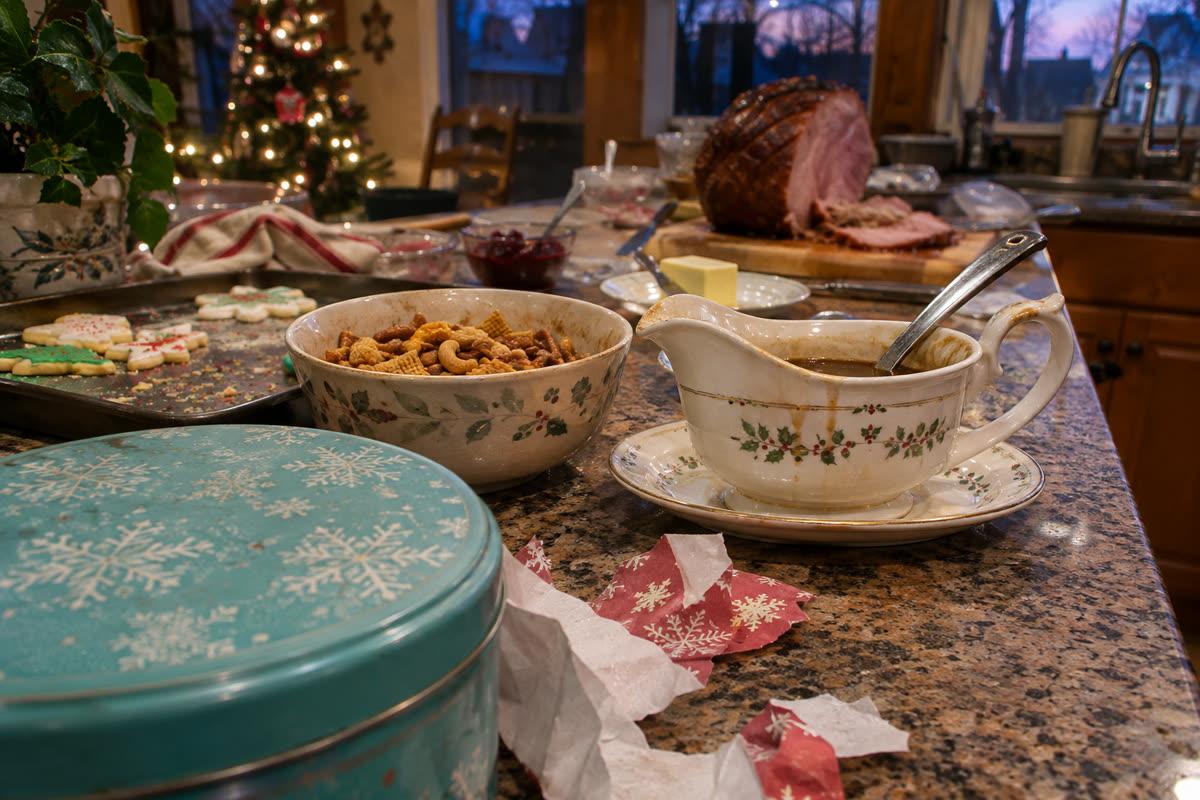 Gluten-free Christmas table: ham glaze, gravy, eggnog, snack mix and cookie trayCheck the ham glaze packet, gravy, eggnog, Chex Mix and cookie tray against the makers' own pages, and learn which agency covers a ham label.
 Ordering a gluten-free birthday cake: what to ask the bakeryBakery, labeled packaged cake or your own? The questions to ask a bakery that also bakes wheat, and how to cut and serve the cake at the party.
 Gluten-free wedding catering: what to ask the caterer and the cake bakerQuestions for a wedding caterer and cake baker, what a real answer sounds like, a tasting checklist and what to put in the contract for a celiac guest.
 Hosting a gluten-free party: a menu and cross-contact planPlan a mixed party table for a guest with celiac disease: what to ask, which store-bought items to check, and how to keep dishes apart.
 Eating at a wedding with celiac disease: what to write, who to call and what to askA wedding guest with celiac disease: the RSVP line, the caterer call, the questions to ask and when to rely on your own food.
 Teal pumpkins, non-food treats and candy swaps for a gluten-free HalloweenWhat a teal pumpkin means, what to put in a non-food bowl, how to run a candy swap for a gluten-free child, and a note to send a party host.
Related guides
 Holiday candy and gluten: how to check each piece, Halloween to Valentine’s DayA holiday shape or fun-size bag can differ from the full-size candy. Check seasonal candy against its wrapper, maker page and certifier, with dated cases.
 Starting a gluten-free diet: testing first, then labels, oats and the kitchenWhat NIH and the celiac charities say about starting a gluten-free diet: testing first, which foods to start with, a US label check, oats and the kitchen.
 How to read a US food label for glutenWhere gluten shows up on a US food label: the gluten-free claim, the Contains line, the ingredient list and may-contain lines, and what each means.
 Certified or naturally gluten-free: when a seal mattersWhich naturally gluten-free foods are worth buying with a claim or seal: produce, grains, flours, oats and processed foods, with FDA rules and test data.
Sources
- [1, 2, 3, 4, 5] Gluten Intolerance Group, Last-Minute Gluten-Free Gift Guide (December 8, 2020), checked Nov 17, 2026.
- [6, 7, 8, 9, 10] Gluten Intolerance Group, Gluten-Free Stocking Stuffers: Thoughtful Gifts for Your Loved Ones This Holiday Season, checked Nov 17, 2026.
Read on 2026-11-17: the list headed “Watch out for ingredients such as:” names Avena sativa; Secale cereale (rye) seed flour; Hydrolyzed malt extract; Triticum vulgare; Hydrolyzed wheat gluten; Phytosphingosine extract; and Samino peptide complex.
- [11, 12] Gluten Intolerance Group, DIY Gluten-Free Gift Ideas, checked Nov 17, 2026.
- [13, 14] Gluten Intolerance Group, Delightful and Delicious: Gluten-Free Gifts To Support Small Businesses, checked Nov 17, 2026.
- [15, 16, 17, 18] Gluten Intolerance Group, I heart my gluten-free friends and family: how to show love and support, checked Nov 17, 2026.
- [19, 20] Gluten Intolerance Group, Tips for entertaining your gluten-free family and friends this holiday season, checked Nov 17, 2026.
- [21, 22, 23] Gluten Intolerance Group, 25 Ways Cross-Contact Could Happen (And How to Avoid It), checked Nov 17, 2026.
- [24, 25, 26] Gluten Intolerance Group, Is there gluten-free labeling on personal care products such as shampoos and conditioners, lotions, cosmetics, etc.? (FAQ), checked Nov 17, 2026.
- [27] Gluten Intolerance Group, 7 Tips for Avoiding Gluten Cross-Contact at Home, checked Nov 17, 2026.
- [28] Gluten Intolerance Group, How Does GFCO Certify Gluten-Free Food?, checked Nov 17, 2026.
- [29, 30] Gluten-Free Certification Organization, GFCO Product Finder, checked Nov 17, 2026.
- [31, 32, 33] US Food and Drug Administration, Gluten and Food Labeling, checked Nov 17, 2026.
- [34, 35, 36] US Food and Drug Administration, Questions and Answers on the Gluten-Free Food Labeling Final Rule, checked Nov 17, 2026.
- [37, 38] Ghirardelli Chocolate Company, Double Chocolate Hot Cocoa Mix (Case of 8 Cartons), checked Nov 17, 2026.
- [39] Celestial Seasonings, Roastaroma Herbal Tea, checked Nov 17, 2026.