Calcium and magnesium on a gluten-free, dairy-free diet
Short answer
Without dairy, NIH lists calcium in some vegetables, canned fish with bones and fortified foods such as tofu and milk substitutes1, and magnesium in green leafy vegetables, legumes, nuts, seeds and whole grains8. FDA says a plant milk’s nutrient profile varies with its plant source, processing and added ingredients40, so the carton is where you see whether calcium was added:
- Find calcium on the Nutrition Facts panel, where FDA says it is required to be listed2.
- Look in the ingredient list for a calcium compound such as calcium carbonate3 or tricalcium phosphate47; a list of only water and almonds names none4.
- Compare the amounts across cartons, as FDA’s page for readers suggests5.
Part of Nutrition and combining diets, 24 guides

Key points
- NIH says approximately 72% of calcium intakes in the United States come from dairy products and foods with added dairy ingredients, so dairy is the largest source in that average6.
- NIH says people who avoid dairy typically need to eat foods fortified with calcium or take supplements to obtain recommended amounts; what that means for you is a question for your clinician or dietitian7.
- Plant milks differ: Silk’s Original Almondmilk page lists calcium carbonate, while Elmhurst’s Unsweetened Milked Almonds page lists only filtered water and almonds3, 4.
- NIH lists green leafy vegetables, legumes, nuts, seeds and whole grains as good magnesium sources, and names celiac disease among the conditions whose chronic diarrhea and fat malabsorption can lead to magnesium depletion over time8, 9.
- NIH says tofu processed with other salts than a calcium salt does not provide significant amounts of calcium; Nasoya’s ingredient list names calcium sulfate10, 11.
What changes when dairy leaves the diet?
NIH’s calcium fact sheet says milk, yogurt and cheese contain high amounts of calcium12, and that approximately 72% of calcium intakes in the United States come from dairy products and foods with added dairy ingredients6. It lists people who avoid dairy, including those with lactose intolerance, a milk allergy and vegans, as having a higher risk of inadequate calcium intakes because dairy products are rich sources of calcium13.
The same sheet says those who avoid dairy can obtain calcium from nondairy sources, such as some vegetables, canned fish with bones, or fortified foods14, and adds that these individuals typically need to eat foods fortified with calcium or take supplements to obtain recommended amounts7. What that means for one person is a question for a clinician or dietitian.
Celiac disease adds a second layer. The Gluten Intolerance Group (GIG) says celiac disease can interfere with the body’s ability to absorb nutrients such as calcium and vitamin D15. NIDDK says that a gluten-free diet started without advice from a doctor or registered dietitian may not provide enough of the nutrients you need, such as fiber, iron and calcium16. NIH adds that vitamin D is required for calcium to be absorbed in the gut by active transport17; our guide on vitamin D deficiency in celiac disease covers that side.
Intake studies point the same way, within limits. A systematic review and meta-analysis of nutrient intakes in people with celiac disease on a gluten-free diet reported that calcium, magnesium and iron intakes were particularly insufficient in adolescence18. In one Canadian study, food records from 35 participants following a gluten-free diet19 showed mean calcium intake lower than recommended20.
Reference numbers on labels and fact sheets
NIH’s sheets give Recommended Dietary Allowances and Adequate Intakes of 1,000 to 1,200 mg of calcium for adults, depending on age21, and 310 to 420 mg of magnesium for adults, depending on age, sex and life stage22. They are reference values, not a target we can set for you. The percent Daily Value on a label is measured against 1,300 mg of calcium23 and 420 mg of magnesium24 for adults and children age 4 years and older.
Related guides: bone density and osteoporosis in celiac disease, nutrient deficiencies in celiac disease, celiac disease and lactose intolerance and eating gluten-free and dairy-free.
Which non-dairy foods contain calcium?
NIH names certain vegetables (kale, broccoli, Chinese cabbage), canned sardines and salmon with bones, and foods fortified with calcium, such as many fruit juices, milk substitutes, tofu and cereals1. It adds that most grains do not have high amounts of calcium unless they are fortified25. GIG’s list of calcium foods for readers with celiac disease names tofu and tempeh, fortified dairy alternatives, and almonds, chia seeds and sesame seeds among others26; sesame seeds also come as tahini, and our tahini verdict covers the jars by maker.
| Food and serving (NIH’s wording) | Calcium (mg) | What to check |
|---|---|---|
| Orange juice, calcium fortified, 1 cup | 34927 | Only the calcium-fortified kind. Our orange juice verdict covers gluten. |
| Soymilk, calcium fortified, 1 cup | 29927 | Cartons differ: see the panel table below. Gluten: soy milk. |
| Sardines, canned in oil, with bones, 3 ounces | 32527 | The bones are in the listed portion. |
| Tofu, firm, made with calcium sulfate, ½ cup | 25327 | NIH counts tofu processed with a calcium salt; tofu processed with other salts does not provide significant amounts10. Gluten: tofu. |
| Salmon, pink, canned, solids with bones, 3 ounces | 18127 | With bones. |
| Tofu, soft, made with calcium sulfate, ½ cup | 13827 | Same calcium-salt note as firm tofu. |
| Soybeans, cooked, ½ cup | 13127 | |
| Spinach, boiled, drained, ½ cup | 12327 | NIH: absorption of calcium is only 5% for spinach, against 27% for milk28. |
| Turnip greens, fresh, boiled, ½ cup | 9927 | |
| Kale, fresh, cooked, 1 cup | 9427 | NIH: calcium from kale, broccoli and cabbage is similar in bioavailability to milk, though the amount per serving is much lower29. |
| Chia seeds, 1 tablespoon | 7627 | |
| Chinese cabbage (bok choi), raw, shredded, 1 cup | 7427 | |
| Beans, pinto, canned, drained, ½ cup | 5427 |
Serving sizes differ from row to row, so the milligrams are not a ranking. NIH says the absorption of calcium from dairy products and fortified foods is about 30%30, and that certain compounds in plants, such as oxalic acid and phytic acid, can decrease calcium absorption31.
To look up a food that is not here, NIH points to USDA’s FoodData Central, which lists the nutrient content of many foods, with a list of foods containing calcium arranged by nutrient content and by food name32. USDA describes it as its comprehensive source of food composition data33.
The foods in the table are described in their plain form. A marinated tofu or a can of fish in sauce is a different product, so read its label with the steps in how to read a US food label for gluten.
Where does magnesium come from on this diet?
NIH says good sources of magnesium include green leafy vegetables, legumes, nuts, seeds, whole grains and certain beverages, and that magnesium may be added to some breakfast cereals and other fortified foods8. It also says refining grains in ways that remove the germ and bran substantially lowers the magnesium content34.
| Food and serving (NIH’s wording) | Magnesium (mg) |
|---|---|
| Pumpkin seeds, roasted, 1 ounce | 15635 |
| Chia seeds, 1 ounce | 11135 |
| Almonds, dry roasted, 1 ounce | 8035 |
| Spinach, boiled, ½ cup | 7835 |
| Cashews, dry roasted, 1 ounce | 7435 |
| Peanuts, oil roasted, ¼ cup | 6335 |
| Soymilk, plain or vanilla, 1 cup | 6135 |
| Black beans, cooked, ½ cup | 6035 |
| Edamame, shelled, cooked, ½ cup | 5035 |
| Peanut butter, smooth, 2 tablespoons | 4935 |
| Rice, brown, cooked, ½ cup | 4235 |
The table’s brown rice row is one place to start on whole grains; our verdicts cover rice, quinoa, buckwheat and millet. NIH adds that tap, mineral and bottled waters can also be sources of magnesium, but the amount varies by source and brand36.
Magnesium is not always on the panel. NIH says FDA does not require food labels to list magnesium content unless magnesium has been added to the food37. Silk’s Original Almondmilk panel lists 15 mg3, while the Oatly Original panel we read has no magnesium line38. Amounts also differ from NIH’s reference rows: NIH lists 61 mg for plain or vanilla soymilk35, and Silk’s Original Soymilk panel lists 40 mg39. The carton in your hand is the one to read.
NIH lists celiac disease among the conditions whose chronic diarrhea and fat malabsorption can lead to magnesium depletion over time9. Whether your own magnesium needs attention is a question for your clinician.
How do I tell whether a plant milk is fortified with calcium?
FDA says the nutrient profile of plant-based milk alternatives varies depending on the plant source, processing methods, and added ingredients40. So the milk’s name tells you little; the carton does:
- Find the calcium line on the Nutrition Facts panel. FDA lists calcium among the nutrients required to be listed2.
- Read the ingredient list for a calcium compound. The makers’ pages below name calcium carbonate, calcium phosphate, tricalcium phosphate, dicalcium phosphate or calcium sulfate. A list that stops at water and almonds names none4.
- Compare amounts across cartons, using the same serving size. FDA tells readers to check the Nutrition Facts label on milk and plant-based beverages and compare nutrient amounts5.
| Product (maker’s page) | Calcium on the Nutrition Facts panel | Calcium compound in the ingredient list |
|---|---|---|
| Silk Original Almondmilk | 470 mg, 35% of the daily value3 | Calcium carbonate3 |
| Silk Original Soymilk | 470 mg, 35%39 | Calcium phosphate and calcium carbonate39 |
| Silk Original Oatmilk | 470 mg, 35%41 | Calcium carbonate41 |
| Silk Original Coconutmilk | 470 mg, 35%42 | Calcium carbonate42 |
| Silk Unsweet Cashewmilk | 470 mg, 35%43 | Calcium carbonate43 |
| Almond Breeze Unsweetened Original Almondmilk | 460 mg, 35%44 | Calcium carbonate44 |
| Califia Farms Unsweetened Almondmilk | 470 mg, 35%45 | Calcium carbonate45 |
| Oatly Original Oatmilk | 350 mg, 25%38 | Calcium carbonate, tricalcium phosphate, dicalcium phosphate38 |
| Planet Oat Original Oatmilk | 350 mg, 25%46 | Calcium carbonate46 |
| Good Karma Unsweetened Flaxmilk + Protein | 290 mg, 20%47 | Tricalcium phosphate47 |
| Ripple Refrigerated Original Milk (pea) | No Nutrition Facts panel for this product in the page text we read48 | Tricalcium phosphate48 |
| DREAM Ricemilk Original with Calcium & Vitamin D | No amount in the page text we read49 | Tricalcium phosphate49 |
| DREAM Ricemilk Original Classic | Not read (no calcium in the name) | None named: organic ricemilk, oil and sea salt50 |
| Elmhurst Unsweetened Milked Almonds | Not read | None named: filtered water and almonds4 |
| Nasoya Organic Extra Firm Tofu (not a drink) | Not read | Calcium sulfate and magnesium chloride11 |
These are single products from the pages we read; a brand’s other flavors, sizes and shelf-stable versions can differ, and makers change recipes. The carton in your hand has the final word.
FDA notes that the Dietary Guidelines for Americans currently include only fortified soy beverages in the dairy group because they have key nutrients similar to those found in milk, and that other plant-based beverages are not included51. FDA also says almond- or oat-based products may contain calcium and be consumed as a source of calcium, but they are not in the dairy group because their overall nutritional content is not similar to milk and fortified soy beverages52.
Fortification says nothing about gluten. For that, read our verdicts for almond milk, cashew milk, coconut milk, flax milk, hemp milk, pea milk, rice milk, soy milk and oat milk, and our guide to oat milk and other plant milks.
Are gluten-free breads and cereals fortified?
Not by default. NIH says most grains do not have high amounts of calcium unless they are fortified25. In the Canadian study of 35 adults on a gluten-free diet, the authors report that most commercial cereals and breads (65%) were unenriched53. A narrative review of children with celiac disease says gluten-free products often show reduced fortification compared with gluten-containing equivalents54.
So check a gluten-free bread’s or cereal’s own panel for calcium before counting it as a source. Our guides on fiber and on iron, B12 and B6 cover other nutrients on a gluten-free diet.
Supplement labels and the gluten-free rule
FDA’s questions and answers say its gluten-free regulation applies to FDA-regulated packaged foods, including dietary supplements55. Our guide on whether vitamins are gluten-free goes further.
NIH explains how to read the amount: the Supplement Facts panel lists elemental calcium, so you do not need to calculate it from the form56, and for magnesium it declares the elemental amount, not the weight of the whole compound57.
NIH says magnesium may interact with certain medications, such as oral bisphosphonates, tetracyclines and quinolone antibiotics, and that some medications, including diuretics and proton pump inhibitors, can affect magnesium status58. It says people who take medications regularly should discuss their magnesium intakes with their health care providers59.
Whether to take a supplement at all is for a clinician. Coeliac UK, a UK charity, says that if you feel you may need supplements you should speak to your doctor or dietitian60.
Bone health: what the sources say, and what to ask a clinician
A review of dietary and non-dietary management of osteoporosis in adult-onset celiac disease says impaired bone mineral density is a frequent complication of the disease61 and that optimal dietary treatment and an adequate supply of calcium and vitamin D are the cornerstones for the reduction in fracture risk62. Coeliac UK says a calcium rich gluten free diet is important to help keep bones healthy and reduce the risk of osteoporosis63.
GIG says it is important for people with celiac disease to consider a bone mineral density test about a year after starting a gluten-free diet64. NIDDK says a doctor or registered dietitian can guide you on what to eat and drink to maintain a balanced diet65. Our guide on bone density and osteoporosis in celiac disease goes into the testing and the evidence.
Questions to bring to an appointment
- Has my bone health been checked since my diagnosis, and when should it be checked again?
- Do my blood tests say anything about calcium, vitamin D or magnesium?
- Could a dietitian review my dairy-free, gluten-free eating plan?
- Do any of my medicines interact with calcium or magnesium?
- Do I need a supplement, and if so which form?
This page reports what NIH, the charities and published reviews say. It is not advice for any one person.
Verdicts in this guide
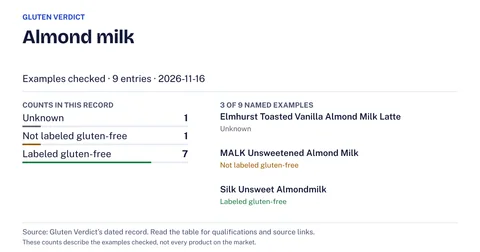 Almond milkNaturally gluten-freechecked Nov 16, 2026
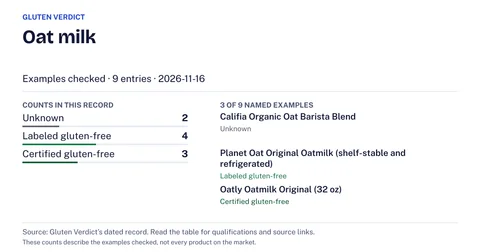 Oat milkDepends on the productchecked Nov 16, 2026
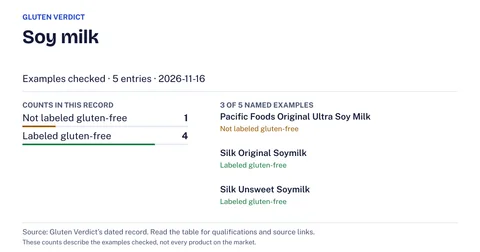 Soy milkNaturally gluten-freechecked Nov 16, 2026
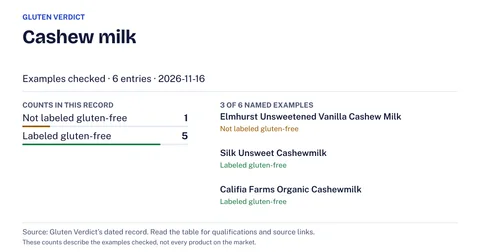 Cashew milkNaturally gluten-freechecked Nov 16, 2026
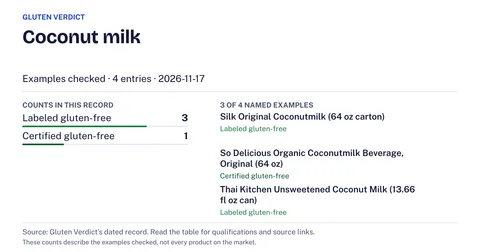 Coconut milkNaturally gluten-freechecked Nov 17, 2026
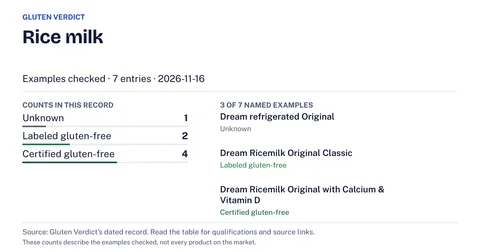 Rice milkDepends on the productchecked Nov 16, 2026
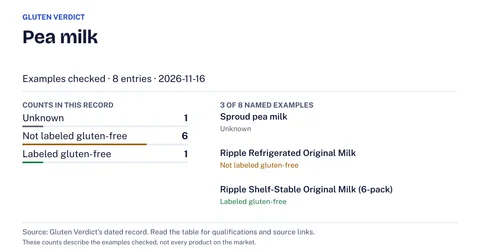 Pea milkNaturally gluten-freechecked Nov 16, 2026
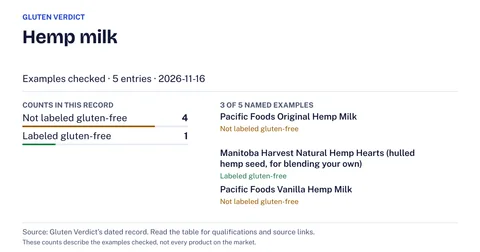 Hemp milkNaturally gluten-freechecked Nov 16, 2026
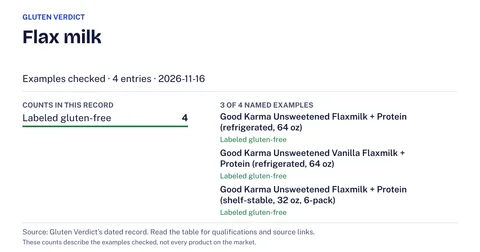 Flax milkNaturally gluten-freechecked Nov 16, 2026
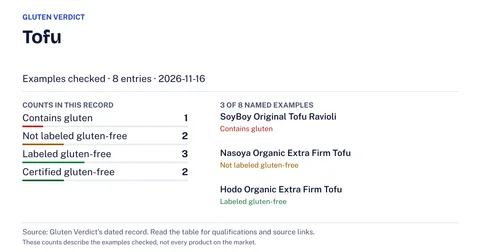 TofuDepends on the product1 of 8 products we checked contains gluten: SoyBoy Original Tofu Raviolichecked Nov 16, 2026
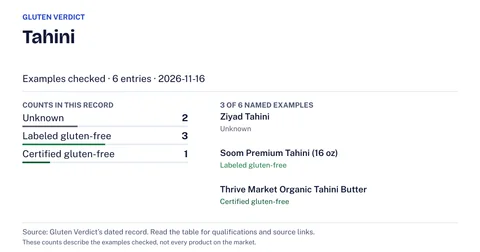 TahiniDepends on the productchecked Nov 16, 2026
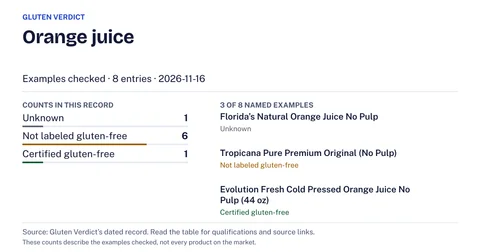 Orange juiceDepends on the productchecked Nov 16, 2026
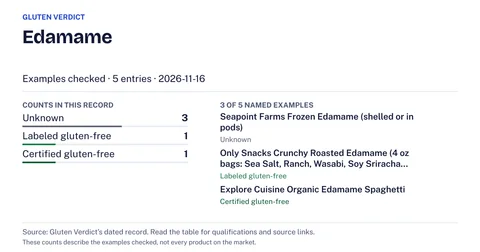 EdamameNaturally gluten-freechecked Nov 16, 2026
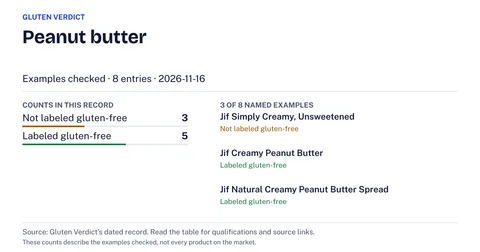 Peanut butterDepends on the productchecked Nov 16, 2026
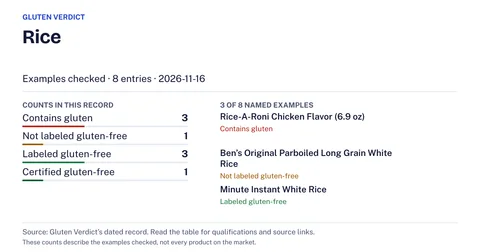 RiceNaturally gluten-free3 of 8 products we checked contain gluten: Rice-A-Roni Chicken Flavor (6.9 oz), Near East Original Rice Pilaf, and Ben’s Original Ready Rice Rice PilafBuy it labeled gluten-freechecked Nov 16, 2026
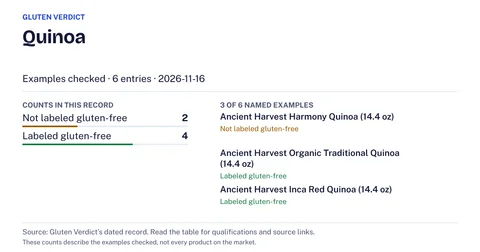 QuinoaNaturally gluten-freeBuy it labeled gluten-freechecked Nov 16, 2026
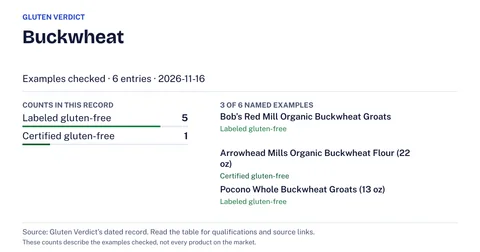 BuckwheatNaturally gluten-freeBuy it labeled gluten-freechecked Nov 16, 2026
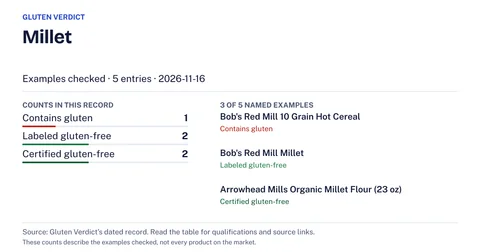 MilletNaturally gluten-free1 of 5 products we checked contains gluten: Bob's Red Mill 10 Grain Hot CerealBuy it labeled gluten-freechecked Nov 16, 2026
Questions people ask
Is every plant milk fortified with calcium?
No. Silk’s Original Almondmilk page lists calcium carbonate3, while Elmhurst’s Unsweetened Milked Almonds page lists only filtered water and almonds4. DREAM’s ricemilk comes both ways: the version named “with Calcium & Vitamin D” lists tricalcium phosphate49, and the Original Classic names no calcium compound50.
Does tofu contain calcium?
It depends on how it was made. NIH’s table counts tofu processed with a calcium salt, and says tofu processed with other salts does not provide significant amounts of calcium10. Nasoya’s Organic Extra Firm Tofu page lists calcium sulfate and magnesium chloride11.
Does spinach count as a calcium source?
NIH lists 123 mg for half a cup of boiled spinach27, and says absorption of calcium is only 5% for spinach, against 27% for milk28.
Is calcium from fortified foods absorbed as well as calcium from dairy?
NIH says the absorption of calcium from dairy products and fortified foods is about 30%30.
More in Nutrition and combining diets
 Gluten-free and dairy-free: how to check a US label for bothUS labels treat milk and gluten under different rules. How to read for both, which makers state both claims, and what to ask when eating out.
 Vitamin D with celiac disease: reading a result and checking a supplement for glutenWhat a vitamin D blood result measures, the published reference levels and upper intake level, and how to check a supplement label for gluten.
 Fiber on a gluten-free diet: where it drops and what fills the gapCheck the fiber on gluten-free breads and pastas against the US Daily Value, and see which gluten-free whole foods charities list to add more.
 Reading a US label for gluten and another food allergyHow to read a US food label for gluten and a second allergen: what the Contains line, gluten-free claim and may-contain lines each cover.
 Rice and arsenic on a gluten-free diet: what FDA saysWhat FDA says about arsenic in rice, which gluten-free staples are rice-based, and the cooking and variety tips FDA and celiac charities give.
 Gluten-free vegetarian protein: what to check on beans, lentils, tofu and tempehWhat to read on beans, lentils, tofu, tempeh and meat substitutes when you are vegetarian and gluten-free: stray grain, added grains, sauces and batters.
Related guides
 Celiac disease and bone density: who is scanned, how to read the report and what recovery looks likeWhen guidelines advise a bone density scan in celiac disease, how a T-score or Z-score is read by age, and what published studies show about recovery.
 Nutrient deficiencies in celiac disease: what the guidance names for checkingWhich nutrients a celiac guideline and a charity's clinician page name for checking, where reported deficiency figures differ, and questions to bring.
 Gluten-free and vegan: where wheat hides in plant-based foodSpot wheat gluten in vegan meat substitutes and sauces, ask the right questions at a restaurant, and see where the charities send you for nutrition.
 Oat milk and other plant milks: what to check for glutenWhy oat milk is the plant milk to check for gluten, what a gluten-free claim and a certifier’s mark mean, and how almond, soy and other milks compare.
Sources
- [1, 6, 7, 10, 12, 13, 14, 17, 21, 23, 25, 27, 28, 29, 30, 31, 32, 56] NIH Office of Dietary Supplements, Calcium: Fact Sheet for Health Professionals, checked Nov 17, 2026.
Read on 2026-11-17: the table headed “Table 2: Calcium Content of Selected Foods” lists, in milligrams per serving: orange juice, calcium fortified, 1 cup, 349; soymilk, calcium fortified, 1 cup, 299; sardines, canned in oil, with bones, 3 ounces, 325; tofu, firm, made with calcium sulfate, ½ cup, 253; salmon, pink, canned, solids with bones, 3 ounces, 181; tofu, soft, made with calcium sulfate, ½ cup, 138; soybeans, cooked, ½ cup, 131; spinach, boiled, drained, ½ cup, 123; turnip greens, fresh, boiled, ½ cup, 99; kale, fresh, cooked, 1 cup, 94; chia seeds, 1 tablespoon, 76; Chinese cabbage (bok choi), raw, shredded, 1 cup, 74; beans, pinto, canned, drained, ½ cup, 54.
- [2, 5, 51] US Food and Drug Administration, Using the Nutrition Facts Label to Choose Milk and Plant-Based Beverages, checked Nov 17, 2026.
- [3] Silk (Danone North America), Silk Original Almondmilk, checked Nov 17, 2026.
Read on 2026-11-17: the Nutrition Facts panel (serving size 1 cup, 240ml) lists calcium 470mg (35% of the daily value) and magnesium 15mg (4%); the ingredient list names calcium carbonate in a “Vitamin and Mineral Blend”.
- [4] Elmhurst 1925, Unsweetened Almond Milk (Unsweetened Milked Almonds), checked Nov 17, 2026.
- [8, 9, 22, 24, 34, 35, 36, 37, 57, 58, 59] NIH Office of Dietary Supplements, Magnesium: Fact Sheet for Health Professionals, checked Nov 17, 2026.
Read on 2026-11-17: the table headed “Table 2: Magnesium Content of Selected Foods” lists, in milligrams per serving: pumpkin seeds, roasted, 1 ounce, 156; chia seeds, 1 ounce, 111; almonds, dry roasted, 1 ounce, 80; spinach, boiled, ½ cup, 78; cashews, dry roasted, 1 ounce, 74; peanuts, oil roasted, ¼ cup, 63; soymilk, plain or vanilla, 1 cup, 61; black beans, cooked, ½ cup, 60; edamame, shelled, cooked, ½ cup, 50; peanut butter, smooth, 2 tablespoons, 49; rice, brown, cooked, ½ cup, 42.
- [11] Nasoya, Extra Firm Tofu, checked Nov 17, 2026.
- [15, 26, 64] Gluten Intolerance Group, Boosting Bone Health in Celiac Disease, checked Nov 17, 2026.
Read on 2026-11-17: the list that follows “You can find calcium in a variety of foods” names beans (tempeh, tofu, and white beans); cooked dark leafy greens (bok choy, collard greens, spinach, and kale); fortified dairy alternatives; fruit (dates, fortified orange juice, and oranges); nuts and seeds (almonds, chia seeds, and sesame seeds); seafood (canned sardines, canned salmon with bones, and shrimp); starchy vegetables (acorn squash, potatoes, and sweet potatoes); and vegetables (asparagus, broccoli, and Brussels sprouts).
- [16, 65] National Institute of Diabetes and Digestive and Kidney Diseases (NIDDK), Eating, Diet, & Nutrition for Celiac Disease, checked Nov 17, 2026.
- [18] European Journal of Clinical Nutrition (abstract on PubMed), Nutrient intakes in adult and pediatric coeliac disease patients on gluten-free diet: a systematic review and meta-analysis, checked Nov 17, 2026.
- [19, 20, 53] PeerJ (abstract on PubMed), Food sources of energy and nutrients among Canadian adults following a gluten-free diet, checked Nov 17, 2026.
- [33] US Department of Agriculture, FoodData Central, checked Nov 17, 2026.
- [38] Oatly, Oatly Original Oatmilk (32 oz), checked Nov 17, 2026.
Read on 2026-11-17: the Nutrition Facts panel (1 cup, 240ml) lists calcium 350mg (25% of the daily value) and no magnesium line; the ingredient list names calcium carbonate, tricalcium phosphate and dicalcium phosphate.
- [39] Silk (Danone North America), Silk Original Soymilk, checked Nov 17, 2026.
Read on 2026-11-17: the Nutrition Facts panel (serving size 1 cup, 240ml) lists calcium 470mg (35% of the daily value) and magnesium 40mg (10%); the ingredient list names calcium phosphate and calcium carbonate in a “Vitamin and Mineral Blend”.
- [40, 52] US Food and Drug Administration, Plant-Based Milk and Animal Food Alternatives, checked Nov 17, 2026.
- [41] Silk (Danone North America), Silk Original Oatmilk, checked Nov 17, 2026.
Read on 2026-11-17: the Nutrition Facts panel (serving size 1 cup, 240ml) lists calcium 470mg (35% of the daily value) and magnesium 10mg (2%); the ingredient list names calcium carbonate in a “Vitamin and Mineral Blend”.
- [42] Silk (Danone North America), Silk Original Coconutmilk, checked Nov 17, 2026.
Read on 2026-11-17: the Nutrition Facts panel (serving size 1 cup, 240ml) lists calcium 470mg (35% of the daily value) and magnesium 20mg (4%); the ingredient list names calcium carbonate in a “Vitamin and Mineral Blend”.
- [43] Silk (Danone North America), Silk Unsweet Cashewmilk, checked Nov 17, 2026.
Read on 2026-11-17: the Nutrition Facts panel (serving size 1 cup, 240ml) lists calcium 470mg (35% of the daily value) and magnesium 10mg (2%); the ingredient list names calcium carbonate in a “Vitamin and Mineral Blend”.
- [44] Blue Diamond Growers, Unsweetened Original Almondmilk (Almond Breeze), checked Nov 17, 2026.
Read on 2026-11-17: the Nutrition Facts panel (serving size 1 cup, 240mL) lists calcium 460 mg (35% of the daily value) and magnesium 15 mg (4%); the ingredient list names calcium carbonate.
- [45] Califia Farms, Unsweetened Almondmilk, checked Nov 17, 2026.
Read on 2026-11-17: the Nutrition Facts panel (serving size 8 fluid ounces, 240 milliliters) lists calcium 470 milligrams (35% of the daily value) and no magnesium line; the ingredient list names calcium carbonate.
- [46] Planet Oat, Original Oatmilk (refrigerated), checked Nov 17, 2026.
Read on 2026-11-17: the Nutrition Facts panel (serving size 1 Cup, 240mL) lists calcium 350mg (25% of the daily value) and no magnesium line; the ingredient list names calcium carbonate.
- [47] Good Karma Foods, Unsweetened Flaxmilk + Protein, 64 oz, checked Nov 17, 2026.
Read on 2026-11-17: the Nutrition panel (serving size 1 cup, 240 mL) lists calcium 290mg (20% of the daily value) and no magnesium line; the ingredient list names tricalcium phosphate.
- [48] Ripple Foods, Ripple Refrigerated Original Milk, checked Nov 17, 2026.
Read on 2026-11-17: the ingredient list names tricalcium phosphate; the page text has no Nutrition Facts panel for this product. A comparison chart on the page gives 455 mg calcium for Ripple, and its footnote refers to Ripple Kids Original, so we do not state an amount for this product.
- [49] Dream (SunOpta), DREAM Ricemilk Original with Calcium & Vitamin D, checked Nov 17, 2026.
Read on 2026-11-17: the page names the product “with Calcium & Vitamin D”, lists “Excellent source of Calcium and Vitamin D” among its benefits, and its ingredient list names tricalcium phosphate; no calcium amount appears in the page text.
- [50] Dream (SunOpta), DREAM Ricemilk Original Classic, checked Nov 17, 2026.
- [54] Nutrients (abstract on PubMed), Celiac Disease as a Model of Intestinal Malnutrition: Mechanisms and Nutritional Management, checked Nov 17, 2026.
- [55] US Food and Drug Administration, Questions and Answers on the Gluten-Free Food Labeling Final Rule, checked Nov 17, 2026.
- [60, 63] Coeliac UK, Calcium and Vitamin D: Gluten Free Diet Guide, checked Nov 17, 2026.
- [61, 62] Nutrients (abstract on PubMed), The Dietary and Non-Dietary Management of Osteoporosis in Adult-Onset Celiac Disease: Current Status and Practical Guidance, checked Nov 17, 2026.