Gluten-free school lunches and classroom snacks: a checklist for parents
Short answer
Pack only items you can prove, and check five things:
- Each item is a fresh fruit or vegetable18, or a packaged food with a “gluten-free” claim (FDA’s rule: any unavoidable gluten under 20 parts per million) or a certifier’s mark on that very package1, 2.
- Read the whole label every time you buy, because the claim is voluntary and ingredients may change3, 4.
- Keep the lunch apart from gluten-containing food and utensils, and clean hands with soap and water or wipes5, 34, 6.
- Talk to the teacher, ask to hear about classroom food activities ahead of time, and leave a basket of your own snacks7, 8.
- Where the school’s own meals fit better, federal rule 7 CFR 210.10 requires meal modifications for a child with a disability that restricts the diet9.
Part of Kids, school, college and family, 21 guides
Key points
- A “gluten-free” claim is voluntary, and FDA tells consumers with celiac disease to read and scrutinize labels either way3, 10.
- FDA says manufacturers may include a certification logo and endorses no certification program; the Gluten Intolerance Group says its GFCO program certifies physical products that display the mark, not brands or facilities11, 12.
- FDA’s list of the nine major food allergens names wheat, not barley or rye, so malt can sit behind a Contains line with no wheat on it: Kellogg says Rice Krispies do not list wheat as an allergen but are not labeled gluten free because of malt13, 14.
- Oats labeled gluten-free must contain less than 20 ppm of gluten, and NIDDK says that if you do eat oats, make sure they are gluten-free15, 16.
- For a school meal, the federal rule requires modifications for a child with a disability that restricts the diet, and, for the school to be reimbursed when the modified meal departs from the meal pattern, a written medical statement9, 17.
What counts as proof for a lunchbox item
Sort every item into one of three kinds before it goes in the box. The kind decides what you check.
| Kind of item | What the proof is | What it does not settle |
|---|---|---|
| A plain single food, such as fresh fruit or vegetables | FDA gives fresh fruits and vegetables as examples of foods that are by nature free of gluten; their producers may choose not to label them “gluten-free”18. | Foods made from grains, legumes and seeds are different: FDA says they are at higher risk of gluten cross-contact, so a claim on them tells shoppers that any gluten present would be under 20 ppm19. |
| A packaged food with a “gluten-free” claim | The maker is stating that the food meets FDA’s rule: no gluten-containing grain as an ingredient, no ingredient made from one unless processed to remove gluten and the food stays under 20 ppm, and any unavoidable gluten under 20 ppm1. | FDA does not require makers to test for the claim, though they are responsible for compliance20. |
| A packaged food with a certifier’s mark | The package carries a third-party program’s certification logo. Makers may print a certification logo if its use is truthful and not misleading11. The Gluten Intolerance Group (GIG) says GFCO certifies physical products displaying its mark, not brands or manufacturing facilities12. | FDA does not endorse, accredit or recommend any particular program11. GIG’s account of GFCO is a threshold of 10 ppm of gluten or less21. |
To check a GFCO claim, look the product up in GFCO’s Product Finder. The Finder says a product is considered certified if it appears on its list and carries one of its marks, and that a listed product whose packaging does not carry the mark is not certified22, 2. So the proof belongs to the package in the lunchbox, not to the brand name printed on it.
Reading a snack label: the usual surprises
A claim is voluntary3, so a package without one tells you to read the rest. NIDDK’s tips for shopping at home include the same step: read food labels for wheat, barley and rye and for ingredients or additives made from them23.
| What you see | What to do | Why |
|---|---|---|
| Oats, oat bars, granola (oatmeal, granola bars) | Look for a gluten-free claim on the oats themselves. | Oats labeled gluten-free must contain less than 20 ppm of gluten, and need not be certified to carry the claim15. NIDDK: if you do eat oats, make sure they are gluten-free16. |
| Malt, malt extract, malt syrup, malt flavor (malt extract, Rice Krispies) | Treat malt as barley. A cereal or bar with malt flavor needs a gluten-free claim to go in the box. | FDA: malt extract and malt syrup come from barley that has not been processed to remove gluten24. |
| Wheat starch (wheat starch) | Look for the claim; without one, leave it out. | A gluten-free food may contain it only when it was processed to remove gluten and the food stays under 20 ppm1. |
| Flour with wheat in the brackets, or graham flour (Ritz, graham crackers) | Leave it out unless the package itself carries a gluten-free claim or certifier mark. | A food labeled gluten-free cannot be intentionally made with wheat, rye or barley25. Ritz Original’s maker page lists unbleached enriched flour made from wheat flour26; Honey Maid graham crackers’ page ends its list with “CONTAINS: WHEAT, SOY.”27. |
The Contains line is not the whole label
FDA’s list of the nine major food allergens includes wheat; barley and rye are not on it13. A label can therefore list no wheat and still contain barley malt. Kellogg’s own FAQ shows the effect: its Rice Krispies and other cereals “do not list wheat as an allergen but are not labeled gluten free because they contain malt”14. Our guide to reading a US food label goes through the rest of the label.
May-contain lines and “no gluten ingredients”
FDA allows a voluntary advisory line such as “made in a facility that also processes wheat” on a food that also carries a gluten-free claim, if the line is truthful and not misleading28. When a package has one and you are unsure, NIDDK’s advice is not to eat foods when you are not sure they contain gluten and, if possible, to contact the company29.
“Made with no gluten-containing ingredients” is not a gluten-free claim. FDA says that unless the label also bears a “gluten-free” claim, consumers should not assume the food meets the requirements for it30.
Snacks that often turn up in lunchboxes have their own verdicts, each showing the sources we read and the date we read them: Goldfish, Cheez-Its, Ritz crackers, graham crackers, Nutri-Grain bars, pretzels, popcorn, peanut butter, granola bars, oatmeal and Rice Krispies.
A one-page list of checked products for the teacher
A list lets a teacher or a substitute pick from products you have already checked instead of guessing. Date every line: GIG advises confirming each time you shop that the foods you choose are gluten-free, and notes that ingredients may change4.
| Product, size and flavor as printed | What the package says | Claim or mark you saw | Date you read it |
|---|---|---|---|
| (copy the name from the package) | (paste the ingredient list and the Contains line) | (the exact “gluten-free” wording, a certifier’s mark, or none) | (the day you read the package in your hand) |
- Copy the product name, size and flavor exactly as printed on the package.
- Paste the ingredient list and the Contains line, or photograph them. Our gluten scanner looks for gluten names in a photo of the label or in pasted text.
- Write what proves it: the claim’s exact words, or the certifier’s mark. If you used GFCO’s list, confirm that the package also carries the mark2.
- Write the date, and read the label again when you buy the next box.
- Note any may-contain or shared-facility line and what you decided about it; FDA allows such a line beside a gluten-free claim28.
Keep it to what you have checked. A product that is not on the list is not in the lunchbox.
Containers, utensils and the shared lunch table
NIDDK defines cross-contact as foods or products that contain gluten coming into contact with gluten-free foods31, and says it can occur at any time, including when foods are prepared or served32. That is why the lunch travels with its own gear.
- At home, NIDDK’s advice is to store and prepare gluten-free food separately from family members’ food that contains gluten5. GIG says thorough cleaning of cooking equipment and utensils with soap and water is sufficient for most items33.
- GIG names double-dipping, using the same serving utensil in both types of food, as one of the most common ways gluten crumbs get into gluten-free food34. Pack spreads in a fresh container, not a knife passed between jars.
- GIG says commercial wet wipes, wet cloths with detergent, and soap and water remove food proteins from hands, while hand sanitizer and dry towels often leave residue behind6. Send wipes in the lunchbox.
- Send the utensils, napkin and any plate the child needs, so nothing at the table comes from a shared pile.
Our kitchen setup guide covers the home side of the same problem.
Classroom snacks and treats other families bring
GIG’s school-year advice is to talk to the teacher about your child’s needs and ask to hear at least a week in advance about any classroom activity that involves food7. GIG also suggests packing a basket of gluten-free snacks the teacher can have on hand when a food activity comes up, so the child is covered and does not feel left out8.
Stock the basket only with products from your dated list. For baked treats, GIG suggests making a large batch at home and freezing the pieces individually, so one can be defrosted for an event35.
Treats other families bring fall into two groups. A packaged treat has a label: read it as in the label table above, and do not rely on the front of the box, since FDA tells consumers with celiac disease to read and scrutinize labels10. A homemade or unwrapped treat has no label to read, so the child eats from the basket instead.
For events away from the classroom, GIG’s tip is that you may wish to bring your own gluten-free food when you do not know the host very well36. A written plan that names classroom food, parties and trips is the subject of our 504 plan guide.
When the cafeteria is the better route
GIG notes that not every cafeteria is able to handle celiac disease or other restricted diets37. If the cafeteria can meet the diet, or daily packing is not working, the federal school-meal rule sets out a route for a child with a disability that restricts the diet.
Section 210.10(m) of 7 CFR says school food authorities must make meal modifications, including substitutions in lunches and afterschool snacks, for children with a disability and whose disability restricts their diet9. The modification must be related to the disability and offered at no additional cost to the child or household38.
- For reimbursement when a modified meal does not meet the meal pattern requirements, the school food authority must obtain a written medical statement signed by a state-licensed healthcare professional, and the rule sets July 1, 2025 as the date by which it must also accept one signed by a registered dietitian17.
- The statement must give enough information about the child’s dietary restrictions, such as foods to be omitted and recommended alternatives, if appropriate39.
- The school food authority must make sure parents, guardians and children have notice of the procedure for requesting a modification40. Ask the school for it.
Our 504 plan and school meal guide covers how to ask and where to complain. Whichever route you choose, the dated list still applies to everything packed from home.
Verdicts in this guide
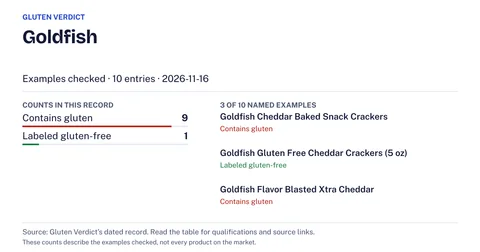 GoldfishContains glutenPepperidge Farm · checked Nov 16, 2026
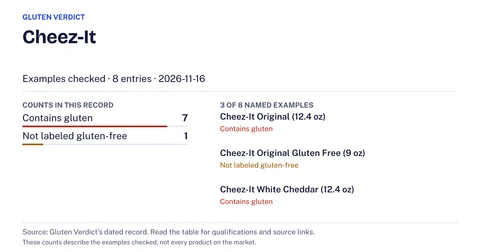 Cheez-ItContains glutenCheez-It · checked Nov 16, 2026
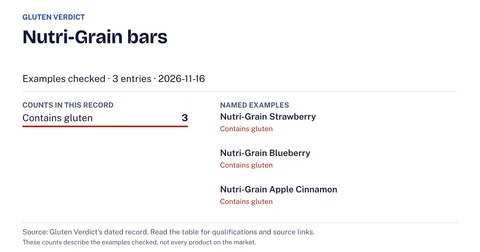 Nutri-Grain barsContains glutenKellogg’s · checked Nov 16, 2026
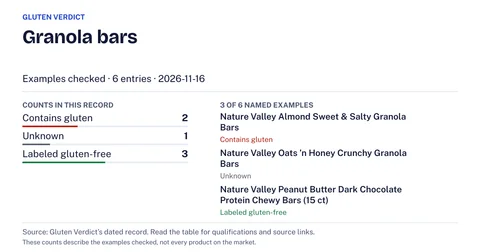 Granola barsDepends on the product2 of 6 products we checked contain gluten: Nature Valley Almond Sweet & Salty Granola Bars and Nature Valley Cinnamon Brown Sugar Soft-baked Oatmeal Squareschecked Nov 16, 2026
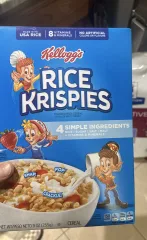 Rice KrispiesContains glutenWK Kellogg Co · checked Nov 16, 2026
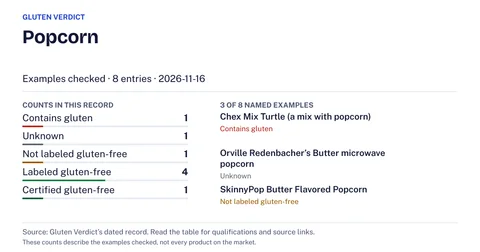 PopcornNaturally gluten-free1 of 8 products we checked contains gluten: Chex Mix Turtle (a mix with popcorn)checked Nov 16, 2026
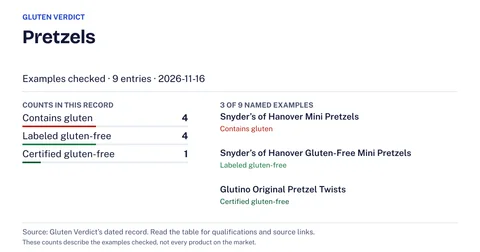 PretzelsDepends on the product4 of 9 products we checked contain glutenchecked Nov 16, 2026
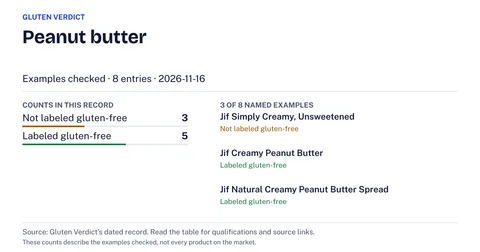 Peanut butterDepends on the productchecked Nov 16, 2026
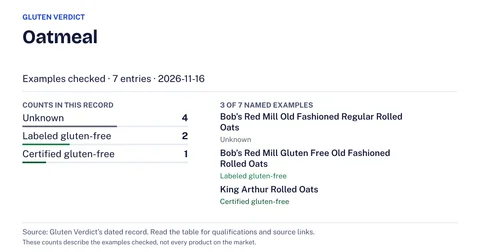 OatmealDepends on the productchecked Nov 16, 2026
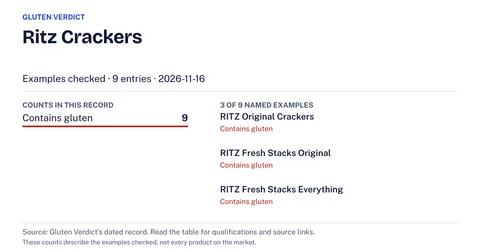 Ritz CrackersContains glutenMondelez International · checked Nov 16, 2026
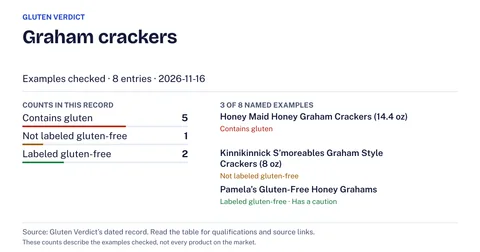 Graham crackersContains glutenchecked Nov 16, 2026
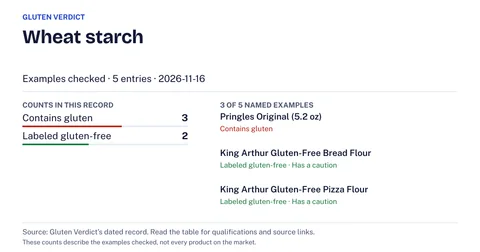 Wheat starchDepends on the product3 of 5 products we checked contain gluten: Pringles Original (5.2 oz), Jiffy Corn Muffin Mix, and Chex Mix Bold Garlic and Herbchecked Nov 16, 2026
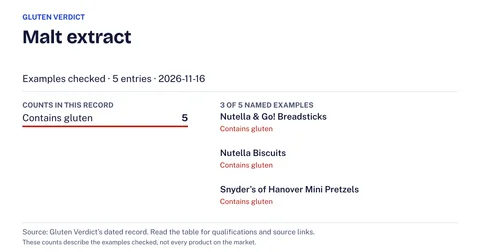 Malt extractContains glutenchecked Nov 16, 2026
Questions people ask
Is a “gluten-free” claim on the package enough?
It is a start: the maker is stating the food meets FDA’s rule, with any unavoidable gluten under 20 ppm1. FDA still tells consumers with celiac disease to read and scrutinize labels10, and makers are not required to test for the claim20.
What does the school need from me for a cafeteria meal?
Under 7 CFR 210.10, a written medical statement signed by a state-licensed healthcare professional, where the modified meal does not meet the meal pattern; the rule sets July 1, 2025 as the date by which a registered dietitian’s statement must also be accepted17. It must say which foods to omit and recommend alternatives if appropriate39.
More in Kids, school, college and family
 Youth sports with a gluten-free kid: team snacks, the coach and tournament weekendsA parent’s plan for team snacks, sports drinks, a coach card and tournament weekends with a gluten-free child, with a source for each claim.
 Why Goldfish, Cheez-It and Nutri-Grain contain gluten, and what a swap has to showSee the wheat ingredient in Goldfish, Cheez-It and Nutri-Grain in each maker's words, then check any swap against a gluten-free claim or certifier mark.
 A care sheet for the babysitter or grandparent of a child with celiac diseaseA one-page care sheet for a babysitter or grandparent: the checked foods, the kitchen cross-contact points, what to do after an exposure, and whom to call.
 Teaching a child to read gluten-free labels, one skill at a timeFour label skills to teach a gluten-free child in order, a cupboard practice game, and the questions an adult still answers.
 Sleepaway camp, Scouts and school trips for a gluten-free child: what to ask and what to sendWhat to ask a camp, Scout unit or school in writing, what goes on the health form, what food to send, and where gluten-free camps run.
 Going gluten-free as a family: choose the household rule, then fix the kitchenAll gluten-free, shared with rules or split: what NIDDK, the charities and one small study say, plus rules for siblings and visiting relatives.
Related guides
 A 504 plan and school meal rules for celiac disease: what to ask for and where to complainMeal substitution or a 504 plan for a child with celiac disease: what each rule says, what the medical statement must hold, and where to complain.
 Talking to your child’s teacher about celiac disease: a script, a one-page sheet and the classroom questionsA two-minute script, a one-page sheet, a template email and the classroom questions about snacks, crafts and trips, drawn from US celiac charity guidance.
 How to read a US food label for glutenWhere gluten shows up on a US food label: the gluten-free claim, the Contains line, the ingredient list and may-contain lines, and what each means.
 What “may contain wheat” and “made in a facility with wheat” mean on a US labelHow to read “may contain wheat”, shared-facility and shared-equipment lines on US labels, with and without a gluten-free claim, and what to check next.
Sources
- [1, 3, 10, 11, 15, 18, 19, 20, 24, 25, 28, 30] US Food and Drug Administration, Questions and Answers on the Gluten-Free Food Labeling Final Rule, checked Nov 17, 2026.
- [2, 22] GFCO (Gluten-Free Certification Organization), GFCO Product Finder, checked Nov 17, 2026.
- [4] Gluten Intolerance Group, Gluten-Free School Lunch Ideas and Tips, checked Nov 17, 2026.
- [5, 16, 23, 29, 31, 32] NIDDK, National Institutes of Health, Eating, Diet, & Nutrition for Celiac Disease, checked Nov 17, 2026.
- [6, 35] Gluten Intolerance Group, Navigating School Parties and Community Events this Fall, checked Nov 17, 2026.
- [7, 8, 37] Gluten Intolerance Group, No Gluten, No Problem: A Parent’s Guide to School Year Eating, checked Nov 17, 2026.
- [9, 17, 38, 39, 40] eCFR (US Code of Federal Regulations), 7 CFR 210.10: Meal requirements for lunches and requirements for afterschool snacks, checked Nov 17, 2026.
- [12] Gluten Intolerance Group, How Does GFCO Certify Gluten-Free Food?, checked Nov 17, 2026.
- [13] US Food and Drug Administration, The FASTER Act: Sesame Is the Ninth Major Food Allergen, checked Nov 17, 2026.
Read on 2026-11-17: the list headed “The nine major food allergens are:” names milk, eggs, fish, crustacean shellfish, tree nuts, peanuts, wheat, soybeans and sesame; barley and rye are not on it.
- [14] WK Kellogg Co, Frequently asked questions, checked Nov 17, 2026.
- [21, 33, 34, 36] Gluten Intolerance Group, 25 Ways Cross-Contact Could Happen (And How to Avoid It), checked Nov 17, 2026.
- [26] Mondelez International (Snackworks), RITZ Original Crackers, checked Nov 17, 2026.
- [27] Mondelez International (Snackworks), HONEY MAID Honey Graham Crackers, checked Nov 17, 2026.