A care sheet for the babysitter or grandparent of a child with celiac disease
Short answer
Leave the caregiver one page and a shelf of food you have already checked, so no label is left for them to judge. Young children may not be able to tell an adult that they feel ill, so the facts have to be on paper1. The page holds:
- The rule for food: only what is on the checked shelf, and no eating anything whose ingredients nobody can verify5, 6.
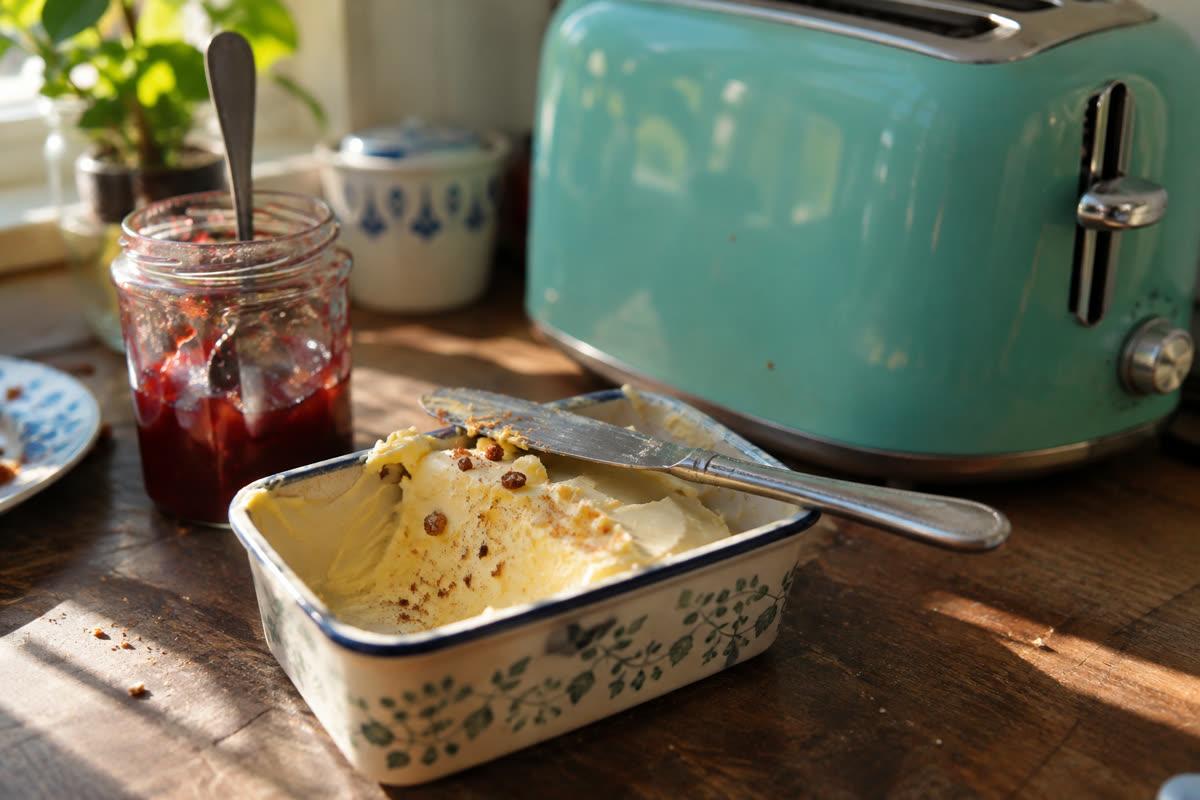
- The places in that kitchen where the Celiac Disease Foundation says cross-contact can occur: the toaster, colander, cutting boards, flour sifters and shared spreads32.
- What to do if the child eats gluten, and who decides what happens next.
- Phone numbers, plus the allergist's written plan if the child also has a food allergy67.
Part of Kids, school, college and family, 21 guides
Key points
- Many young children cannot say they feel ill, and GIG tells childcare workers to check with the parents of a gluten-free child instead of taking a risk1, 2.
- NIDDK's advice for people with celiac disease is not to eat a food when unsure whether it contains gluten, so "no label, no eating" belongs at the top of the sheet5.
- Soap and water was the most consistently effective way to remove gluten in one study of hands and tables in classrooms53.
- A celiac exposure and a wheat allergy reaction have very different causes, and a child can have both60, 62.
Why a caregiver needs a page, not a talk at the door
A talk at the door depends on the caregiver remembering it at dinnertime. A page on the refrigerator does not.
GIG's guidance for childcare workers says that many young children cannot say they feel ill and will not think twice about mentioning a leftover cracker eaten off the snack table1. The same page tells adults to check with the parents of a gluten-free child instead of taking a risk2.
A host who does not live gluten-free may also be less watchful than you are. GIG notes that younger children, others in the household and visitors who understand dietary needs less well may not be as vigilant about avoiding cross-contact3.
Small amounts matter even when nothing shows. GIG says even the smallest amount of gluten can cause damage to the small intestine without causing obvious symptoms4. So the sheet asks the caregiver to tell you about any slip, even if the child seems fine.
This guide is written for the parent. It reports what NIDDK, FDA, FARE, the celiac charities and one peer-reviewed study say, and it gives no medical advice for your child. Your child's own doctor decides what a caregiver does after an exposure.
The seven lines on the sheet
Keep it to one page, in large type, with the numbers at the bottom. A fill-in version, with a few extra lines, is at the end of this guide. The seven lines:
- The one rule. "Only food from the shelf. No label, no eating."
- Who the child is. Name, age, and one plain sentence: celiac disease, so no wheat, barley, rye or malt, not even a small amount.
- Foods already checked. Each food by name and brand, where it is kept, and the date you read the package.
- Foods to avoid. The everyday ones the child may ask for, named plainly, so the caregiver does not have to guess.
- The kitchen points. Toaster, spreads, colander, pans, boards, flour, towels.
- If the child eats gluten. Stop, keep the package, write down what and when, and call you.
- Contacts. You, a second adult, the child's doctor, and 911, plus any allergy plan.
The foods to avoid are the usual ones. The Celiac Disease Foundation lists pasta, breads, crackers (it names goldfish), cereal and granola, and pancakes among common foods that contain gluten7. Our verdicts show how each one looks on real packages: bread, pasta, Goldfish, cereal, pancakes and chicken nuggets, where the answer depends on the brand and the breading.
What counts as proof on a package
Decide this at home, once, so the caregiver never has to. NIDDK's advice for people with celiac disease is not to eat a food when you are unsure whether it contains gluten, and to contact the maker if possible5. The Celiac Disease Foundation says the same about a food whose ingredients cannot be verified: do not eat it6.
| What you see | What it tells you | What it does not |
|---|---|---|
| A "gluten-free" claim | On foods FDA regulates, the claim is voluntary8, and a food bearing it must meet FDA's definition, including less than 20 ppm for any unavoidable gluten9. | The rule does not apply to foods whose labeling USDA or TTB regulates70; see how to read a food label for gluten. |
| A certifier mark such as GFCO | GIG says GFCO-certified food meets a threshold of 10 ppm of gluten or less10. | Look for the mark on each product you stock. |
| A Contains line | Wheat is one of the major allergens that the law covers11. | The list names wheat but not barley or rye11, and a wheat-free product can still contain rye or barley-based ingredients12, so a Contains line without wheat is not proof. |
| "Wheat-free" | The food has no wheat. | A wheat-free product can still contain spelt, rye or barley-based ingredients12. |
| A plain single food with no label, such as fresh fruit | FDA says makers of foods that are by nature free of gluten may choose not to label them13. | A cut, seasoned or prepared version is a different food. |
| No label at all, or a loose item | Nothing you can check. | Leave it out of the shelf and say so on the sheet. |
Oats need their own line. GIG says people with celiac disease should only eat oats that are certified, or at least labeled, gluten-free, and generally only in small amounts14. If you stock oatmeal, name the exact box on the sheet.
For packaged foods we have checked, each verdict shows what the maker's pages said and the date we read them, for example peanut butter, mayonnaise, ketchup, hot dogs and popcorn. Recipes change, so the package in your hand has the final word.
The caregiver's kitchen: where gluten can get onto a child's food
The Celiac Disease Foundation names these places where cross-contact can occur: toasters used for gluten-free and regular bread, colanders, cutting boards, flour sifters, shared containers, and condiments that get contaminated by double-dipping32. For each, the sheet should give one instruction that a tired adult can follow.
| Point | What to write on the sheet | What the sources say |
|---|---|---|
| Toaster | No toast for the child from the family toaster. Use a toaster bag or foil, or skip toast. | GIG says toasters are virtually impossible to clean thoroughly and suggests toaster bags15, and warns that errant gluten crumbs can end up on gluten-free bread16. A preliminary study reported by the Celiac Disease Foundation found gluten-free bread stayed under 20 ppm after a shared toaster17; its senior author still recommends following your celiac care team's guidelines18. |
| Butter, jam, peanut butter, mayonnaise | The child has their own jar, or a squeeze bottle. Nobody dips a knife that touched bread. | GIG says to avoid double-dipping utensils into a reusable jar19, and gives the example of a mayonnaise knife going back into the jar20. Squeeze bottles are GIG's suggestion for avoiding utensil cross-contact21. Our verdicts: butter, mayonnaise. |
| Colander or strainer | Use the child's own, or none: pasta is drained another way, or the child eats a different food. | GIG says strainers and colanders hold gluten in crevices that are very difficult to clean22. The National Celiac Association recommends a dedicated one23. In the preliminary 2019 study reported by the Celiac Disease Foundation, gluten-free pasta cooked in water used for regular pasta sometimes reached as high as 115 ppm24. |
| Pans, utensils, boards | Washed in hot soapy water first. Worn plastic, wooden or non-stick items are not used. | GIG says cleaning with soap and water is sufficient for most items25, and warns that worn plastic, wooden or non-stick items may develop grooves that collect gluten26. |
| Flour in the air and on counters | No baking with wheat flour while the child's food is being made. Wipe the counter first. | The National Celiac Association says not to prepare gluten-free and gluten-containing items with flour at the same time, because flour can cover many surfaces and items27. |
| Microwave and grill | Wipe the microwave first. On the grill, the child's food goes on foil. | GIG advises wiping a shared microwave after each use28, and tin foil as a quick fix on a grill29. |
| Sponge, dish towel | Paper towel for the child's dishes and hands. | GIG says shared kitchen towels pose minimal risk only when used on thoroughly washed dishes or hands, and otherwise suggests separate towels or paper towels30. |
| Fridge and pantry | The child's food on a top shelf or in a closed, labeled bin. | GIG advises a separate area on an upper shelf in the pantry and refrigerator31. |
The evidence on some of these is mixed: the 2019 study was preliminary17, and the charities still advise the stricter steps. Because the sheet is for a few hours or a weekend and not a lifetime, it takes the cheap, clear version of each (foil, a bag, a paper towel, a labeled jar) and does not ask a grandparent to buy a second kitchen. For a longer stay, the evidence on shared kitchens and how to set up a kitchen go deeper.
Grandparents: the cooking conversation
With a grandparent, the sheet is also a conversation about a kitchen and a way of loving a grandchild. GIG's advice for talking to a family host is to start with appreciation, which it says helps the talk feel collaborative rather than demanding33.
What to cover, from GIG's guidance for guests, adapted to a grandchild:
- Say why in plain words. GIG notes that many people think gluten-free simply means leaving out the bread, so a little context goes a long way34.
- Ask how meals will be served, whether sauces, gravies and seasonings are made from scratch, and whether the host would be comfortable sharing ingredient labels35.
- Ask about separate serving utensils, and serving the child's plate first before anything else touches the table37.
- Come with food: GIG says it never hurts to arrive prepared with a dish, a snack or a small meal of your own39.
A script you can adapt: "Thank you for having her. I have stocked the shelf in your fridge with everything she eats, and the sheet says what to do if something is not on it. A crumb from a shared knife matters for her. Can we make the first dinner together?"
If a grandparent gets defensive, GIG's note is that it most often comes from worry about getting it wrong rather than from a lack of care, and that a warm tone and a thank-you can settle things quickly36. For a grandparent who loves to bake, see baking gluten-free when others bake with wheat and cooking for a gluten-free guest.
A shelf and a bin of the child's own food
The most reliable way to keep a caregiver from judging a label is to leave no judgment to make. Stock a shelf or a closed, labeled bin that holds everything the child will eat, and put the same list on the sheet.
- Label it. GIG suggests labels on food, and even on utensils and cookware, when in doubt38.
- Pack sealed, whole packages, so nobody has to tell a gluten-free box from a regular one by shape.
- Add the child's own plate, cup and utensils: GIG says bringing your own plate and utensils is a simple way to avoid cross-contact from shared dishes40.
- Keep the list on the bin lid and the sheet the same, with the date you read each package.
Choose foods your own kitchen already uses. Our guides on school lunch swaps and breakfast labels list what to read on the package.
Sleepovers and overnight stays: breakfast, medicines and toothpaste
An overnight stay adds things a dinner does not. NIDDK lists products that can be hidden sources of gluten if used around the mouth or moved from hands to mouth: children's modeling dough such as Play-Doh, cosmetics, lipstick, lip gloss and lip balm, skin and hair products, and toothpaste and mouthwash41.
- Toothpaste and lip balm: pack the ones you have checked. NIDDK says that if a label does not say what is in a product, you can ask the maker for an ingredients list43.
- Medicines: NIDDK says medicines are rare sources of gluten and that any gluten in one is likely to be in very small amounts42. The sheet still lists which medicines the child takes and who gives them, and see how to check a medicine for gluten and children's medicines.
- Sunscreen: GIG warns that sunscreen on hands and face can lead to ingestion, and says parents should check theirs and childcare workers should apply it to gluten-free children before others44. GIG adds that the main concern with any topical is when it gets into the mouth45.
- Breakfast: send it, so no toaster, griddle or cereal box is involved.
For a party hosted by other parents, GIG suggests reaching out to the host about food options or offering to bring a gluten-free dish to share47; the same step is a reasonable one before a sleepover. The Celiac Disease Foundation has a handout, "How to Support a Friend with Celiac Disease", that it describes as a great one to share with a student's school and their friends' families48.
If there are other children, the sheet should say that nobody feeds the gluten-free child from their plate. GIG says childcare workers should make sure children do not feed other children or put their hands in a gluten-free child's mouth or on their food46.
Hands, play dough and craft supplies
GIG's childcare guide lists craft supplies that contain wheat unless the package says otherwise: play dough, finger paint, paper mache, craft paste, macaroni, bird seed and sunscreen49. The Celiac Disease Foundation says children may touch their mouths or eat after handling wheat-based play dough50. Our guide: play dough, paste and art supplies.
One study measured how much gluten reached gluten-free bread rubbed on children's hands and tables after common activities. The children in the study did not have celiac disease57. With Play-Doh, a three-ounce container held 32,253 ppm gluten, yet all 30 bread samples rubbed on hands after five minutes of play tested below 20 ppm51. A baking project looked very different: all 29 samples rubbed on hands afterward were above 20 ppm52.
Washing mattered. The study's three methods were soap and water, water alone and an antibacterial wet wipe54. The authors concluded that soap and water was consistently the most effective, although other methods did as well in some scenarios53. After the baking project, of the ten table samples still above 20 ppm, eight came from tables washed with water alone55. Even for the low-risk materials, the authors wrote that children should be required to wash their hands after use and that workspaces should be cleaned, especially if food will be eaten in the same space56.
For the sheet: "If the child, or anyone else, has handled flour, dough or paste, wash the child's hands with soap and water before any food or drink, and wipe the table." The study was done in classrooms, with children who did not have celiac disease, so it informs the sheet and does not settle it.
If the child eats gluten: what to write down and whom to call
This part of the sheet is deliberately plain, because the caregiver needs steps and the decision belongs to you and the child's doctor. The guide gives no thresholds and no treatments.
- Stop the food. Keep the package or take a photo of the ingredient list.
- Write down what the child ate, how much, and the time.
- Call the parent right away, even if the child seems fine, because gluten can cause damage without obvious symptoms4.
- Write down anything the child says or shows, with the time. Do not give a remedy unless the parent says to.
GIG says recovery from an exposure varies from person to person and depends on how much gluten was eaten58. It also says there is no data to support that activated charcoal binds gluten, and none showing that glutenase-type products are effective59, which is why the sheet says to give no remedy unless you say so. Our guides on what to do after being glutened, a child glutened at school and keeping a symptom and food diary cover the follow-up for you.
Celiac exposure is not the same emergency as a wheat allergy reaction
FARE says wheat allergy and celiac disease are both adverse food reactions, but their underlying causes are very different60. FARE describes celiac disease as an autoimmune disease, in which antibodies produced in response to gluten cause inflammation and damage to the lining of the small intestine69. Wheat allergy is an allergic reaction that can range from hives to anaphylaxis, and even very small amounts of wheat can cause one61. A child can have both: GIG notes that a person can have a wheat allergy and have celiac disease62.
For a child who also has a diagnosed food allergy, the allergist's written plan is the sheet's most important page. FARE's Food Allergy & Anaphylaxis Emergency Care Plan is signed by a physician and includes emergency contact information67, and FARE says to keep it where others can find it and to make sure they understand what to do68.
FARE says the first symptoms of an allergic reaction usually appear between a few minutes and two hours after exposure to a food66. Its list of severe symptoms covers the lungs, heart, throat, mouth, skin, gut and mental state63. Its instructions for a severe reaction are to use epinephrine at the first sign, or as prescribed64, and to call 911 and say that epinephrine was used65.
| Compare | Celiac exposure | Wheat allergy reaction |
|---|---|---|
| What it is | An autoimmune disease; gluten damages the lining of the small intestine69. | An immune reaction to wheat that can range from hives to anaphylaxis61. |
| What the caregiver does | Follow the steps above and call the parent. | Follow the allergist's written plan for that child67. |
| Who decides | You and the child's doctor. | The allergist's plan, and 911 for severe symptoms65. |
If your child has no wheat or food allergy, write "no known food allergy" on the sheet. Do not copy another child's allergy plan.
A fill-in version of the sheet
Copy this into a document, fill it in and print it. Everything in brackets is yours to write.
| Line | Write here |
|---|---|
| Child's name and age | [name, age] |
| In one sentence | [Celiac disease. No wheat, barley, rye or malt, not even a small amount.] |
| The one rule | [Only food from the shelf. No label, no eating.] |
| Where the checked food is | [shelf, bin, fridge, date stocked] |
| Foods already checked | [food, brand, date read, one line each] |
| Foods to avoid | [bread, pasta, crackers, cereal, pancakes, nuggets, and anything unlabeled] |
| Kitchen points | [toaster: bag or foil; spreads: own jar; colander: own or none; paper towel; no flour while cooking] |
| Hands and crafts | [soap and water before any food; no play dough or paste unless I say it is gluten-free] |
| Medicines, toothpaste, sunscreen | [which, who gives them, when] |
| If the child eats gluten | [stop, keep the package, write down what, how much and when, call parent] |
| Food allergy | [none known] or [allergist's plan attached] |
| Parent phone | [number] |
| Second adult | [name, number] |
| Child's doctor | [name, number] |
| Emergency | 911 for any emergency |
| Sheet read together on | [date, with caregiver's initials] |
Walk the caregiver through the page once, in the kitchen where they will be, and re-read it with them each time. Related: a first-week plan for a newly diagnosed child, helping a gluten-free child feel included and childcare and preschool.
Verdicts in this guide
 BreadContains glutenchecked Nov 16, 2026
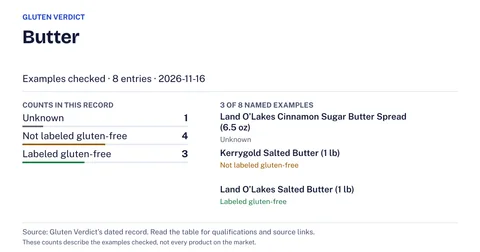 ButterNaturally gluten-freechecked Nov 16, 2026
 PastaContains glutenchecked Nov 16, 2026
 OatmealDepends on the productchecked Nov 16, 2026
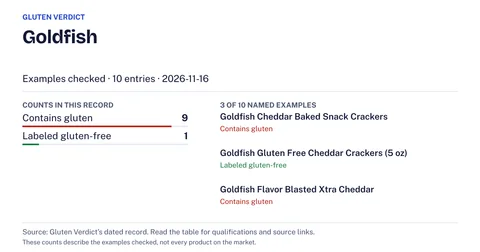 GoldfishContains glutenPepperidge Farm · checked Nov 16, 2026
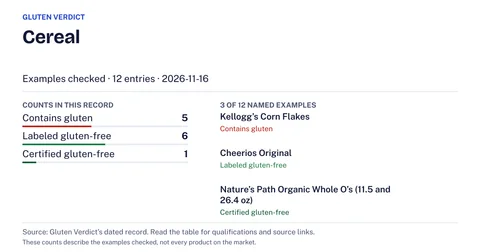 CerealDepends on the product5 of 12 products we checked contain glutenchecked Nov 16, 2026
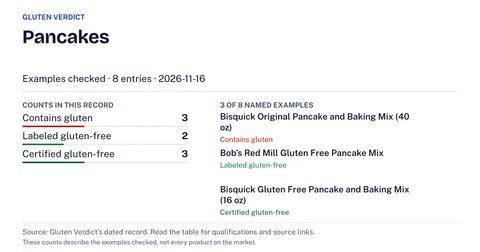 PancakesContains glutenchecked Nov 16, 2026
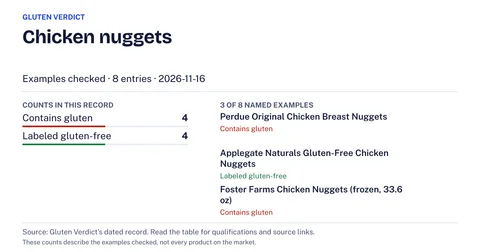 Chicken nuggetsDepends on the product4 of 8 products we checked contain glutenchecked Nov 16, 2026
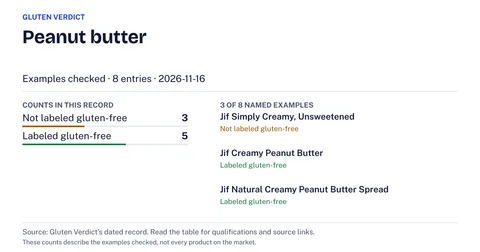 Peanut butterDepends on the productchecked Nov 16, 2026
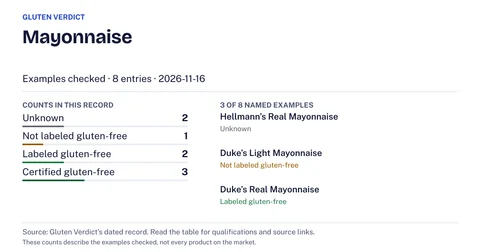 MayonnaiseNaturally gluten-freechecked Nov 16, 2026
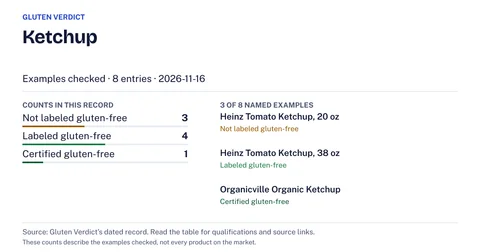 KetchupDepends on the productchecked Nov 16, 2026
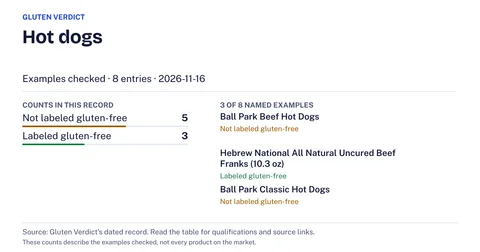 Hot dogsDepends on the productchecked Nov 16, 2026
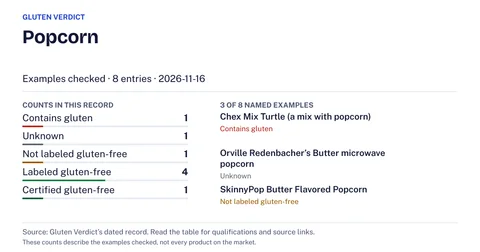 PopcornNaturally gluten-free1 of 8 products we checked contains gluten: Chex Mix Turtle (a mix with popcorn)checked Nov 16, 2026
Questions people ask
What if the babysitter is unsure about a food?
The sheet's rule answers it: no label, no eating. NIDDK's advice for people with celiac disease is not to eat foods when unsure whether they contain gluten5, and the Celiac Disease Foundation says to leave out a food whose ingredients cannot be verified6.
Does the grandparent need a second toaster?
GIG advises toaster bags or a separate toaster15. A preliminary study reported by the Celiac Disease Foundation found no significant transfer with a shared toaster, and its senior author still recommends following the care team's guidelines17, 18. Foil or a toaster bag is the low-cost version for a short stay.
Is hand sanitizer enough after play dough or baking?
The study tested soap and water, water alone and an antibacterial wet wipe54. It does not list alcohol hand sanitizer among its methods. Soap and water was the most consistently effective53.
Should a babysitter cook for the child at all?
For an evening, the simplest sheet leaves a meal the child can eat as it is, so no cooking is needed. If cooking is unavoidable, the kitchen table above lists the points to cover.
More in Kids, school, college and family
 Your child has celiac disease: a first-week plan for the kitchen, labels, school and talking to your childThe first week after a child’s celiac diagnosis, in order: the diet plan, first labels, kitchen, two school routes, talking to your child and follow-up.
 Teaching a child to read gluten-free labels, one skill at a timeFour label skills to teach a gluten-free child in order, a cupboard practice game, and the questions an adult still answers.
 A gluten-free child who refuses food: what to track and when to ask the doctorHow to tell ordinary picky eating from a pattern to raise with your child’s doctor or dietitian, what ARFID is, and a one-week log to bring.
 A gluten-free care plan for daycare and preschoolWrite a one-page gluten-free care plan for daycare or preschool, ask the right questions on a tour, and see which government rule covers each program.
 Going gluten-free as a family: choose the household rule, then fix the kitchenAll gluten-free, shared with rules or split: what NIDDK, the charities and one small study say, plus rules for siblings and visiting relatives.
 A 504 plan and school meal rules for celiac disease: what to ask for and where to complainMeal substitution or a 504 plan for a child with celiac disease: what each rule says, what the medical statement must hold, and where to complain.
Related guides
 Helping a gluten-free child feel included at the table, at parties, in class and at restaurantsOne plan for each place a gluten-free child gets singled out: the table, parties, class and restaurants, with a sentence the child can say.
 A gluten-free kid at a birthday party: the host text, the cake knife and the snack tableA parent’s plan for a celiac child at a party or sleepover: the host text, own food, cake and snack-table cross-contact, and hand washing.
 Your child ate gluten at school: what to record, what to email, what to ask forWhat the sources say about a school gluten exposure: celiac versus wheat allergy, what to record, a follow-up email template and what to ask for.
 Gluten cross-contact at home: where it happens and what to do about itHow gluten reaches gluten-free food at home, whether to separate, wash or ask for each route, and which rules have lab data behind them.
Sources
- [1, 2, 44, 46, 49] Gluten Intolerance Group, Pre-School, Childcare, and Gluten Risks, checked Nov 17, 2026.
Read on 2026-11-17: the list headed “Craft Supplies That Contain Wheat (Unless otherwise stated on package)” names playdough, finger paint, paper mache, craft paste, macaroni, bird seed and sunscreen.
- [3, 30] Gluten Intolerance Group, Should I be concerned about using the same dish/hand towels and pot holders as family members in my household who handle gluten-containing food? (FAQ), checked Nov 17, 2026.
- [4, 21, 31] Gluten Intolerance Group, Celiac Disease in Children, checked Nov 17, 2026.
- [5] US National Institute of Diabetes and Digestive and Kidney Diseases (NIDDK), Eating, Diet, & Nutrition for Celiac Disease, checked Nov 17, 2026.
- [6, 7, 12, 32, 50] Celiac Disease Foundation, Sources of Gluten, checked Nov 17, 2026.
Read on 2026-11-17: the list headed “Common Foods That Contain Gluten” names pastas (raviolis, dumplings, couscous, gnocchi); noodles; breads and pastries; crackers (pretzels, goldfish, graham crackers); baked goods (cakes, cookies, pie crusts, brownies); cereal and granola; breakfast foods (pancakes, waffles, french toast, crepes, biscuits); breading and coating mixes; croutons; sauces and gravies; flour tortillas; beer; and anything else that uses “wheat flour” as an ingredient.
Read on 2026-11-17: the list headed “Places where cross contact can occur” names toasters used for both gluten-free and regular bread; colanders; cutting boards; flour sifters; fried foods cooked in oil shared with breaded products; shared containers including improperly washed containers; foods from bulk bins; and condiments such as butter, peanut butter, jam, mustard and mayonnaise that may become contaminated when utensils used on gluten-containing food are double-dipped.
- [8, 9, 13, 70] US Food and Drug Administration, Questions and Answers on the Gluten-Free Food Labeling Final Rule, checked Nov 17, 2026.
- [10, 14, 20, 25, 38, 45] Gluten Intolerance Group, 25 Ways Cross-Contact Could Happen and How to Avoid It, checked Nov 17, 2026.
- [11] US Food and Drug Administration, Food Allergen Labeling and Consumer Protection Act of 2004 (FALCPA), checked Nov 17, 2026.
- [15, 19, 22, 26] Gluten Intolerance Group, 7 Tips for Avoiding Gluten Cross-Contact at Home, checked Nov 17, 2026.
- [16, 28, 29] Gluten Intolerance Group, Appliances and the Risk of Cross-Contamination, checked Nov 17, 2026.
- [17, 18, 24] Celiac Disease Foundation, Preliminary Study Suggests That Risk of Gluten Transfer in Common-Cooking Activities May Be Lower Than Previously Thought (news, 2019), checked Nov 17, 2026.
- [23, 27] National Celiac Association, Dedicated Gluten-Free Kitchen (Ask the Expert, reviewed June 2026), checked Nov 17, 2026.
Read on 2026-11-17: the list that follows “Below are items that are too hard to clean or porous, and we recommend using a dedicated gluten-free version:” names strainer/colander; sifter; cast iron pans; bread maker, sandwich maker and waffle iron; fryolator and air fryer; and toaster (or use foil in a toaster oven).
- [33, 34, 35, 36, 37, 39, 40] Gluten Intolerance Group, A Seat at the Table: Talking to Family About Your Gluten-Free Needs (November 2026), checked Nov 17, 2026.
- [41, 42, 43] US National Institute of Diabetes and Digestive and Kidney Diseases (NIDDK), Treatment for Celiac Disease, checked Nov 17, 2026.
Read on 2026-11-17: the list under “Other products can be hidden sources of gluten” names children’s modeling dough, such as Play-Doh; cosmetics; lipstick, lip gloss, and lip balm; skin and hair products; toothpaste and mouthwash; and communion wafers.
- [47] Gluten Intolerance Group, Supporting Gluten-Free Kids at Parties: What Teens and Parents Need to Know (October 2025), checked Nov 17, 2026.
- [48] Celiac Disease Foundation, Resources for K-12 Students, checked Nov 17, 2026.
- [51, 52, 53, 54, 55, 56, 57] Journal of Pediatric Gastroenterology and Nutrition, via PubMed Central, A Quantitative Assessment of Gluten Cross-Contact in the School Environment for Children With Celiac Disease (Weisbrod et al., 2020), checked Nov 17, 2026.
- [58, 59] Gluten Intolerance Group, I’ve been “glutened.” How long will it take me to recover, and is there anything I can do to speed up my recovery? (FAQ), checked Nov 17, 2026.
- [60, 61, 69] Food Allergy Research and Education (FARE), Wheat Allergy, checked Nov 17, 2026.
- [62] Gluten Intolerance Group, Celiac Disease, Non-Celiac Gluten Sensitivity or Wheat Allergy: What is the Difference?, checked Nov 17, 2026.
- [63, 64, 65, 66] Food Allergy Research and Education (FARE), Recognizing and Treating Reaction Symptoms, checked Nov 17, 2026.
Read on 2026-11-17: the list headed “Severe symptoms include” names, by body part, lung (shortness of breath, wheezing, repetitive cough); heart (pale, blue, faint, weak pulse, dizzy); throat (tight, hoarse, trouble breathing/swallowing); mouth (significant swelling of the tongue or lips); skin (many hives over body, widespread redness); gut (repetitive vomiting or severe diarrhea); and psychological (feeling something bad is about to happen, anxiety, confusion).
- [67, 68] Food Allergy Research and Education (FARE), Food Allergy & Anaphylaxis Emergency Care Plan, checked Nov 17, 2026.