Going gluten-free as a family: choose the household rule, then fix the kitchen
Short answer
A household with a gluten-free child can remove gluten entirely or keep it; the Gluten Intolerance Group describes both and says that if anyone keeps eating gluten, taking steps to prevent cross-contact is essential1. What the sources advise under each rule:
- All gluten-free: gluten is eliminated from the household entirely1.
- Shared kitchen with rules: a separate gluten-free area on an upper shelf, one counter area for gluten-free preparation, and thorough cleaning of shared cookware2.
- Split kitchen: gluten-free food is stored and prepared separately from the other family members’ food that contains gluten3, and the Gluten Intolerance Group says colanders, which it calls hard to clean, should not be shared if possible4.
Part of Kids, school, college and family, 21 guides
Key points
- The sources we read describe the three set-ups and do not rank them; the Gluten Intolerance Group notes that going entirely gluten-free may not be healthy for every family member who does not need the diet, because gluten-free diets can lack nutrients5.
- NIDDK says researchers have found no evidence that a gluten-free diet promotes better health or weight loss for the general population6, and that packaged gluten-free foods tend to cost more7.
- The spots the sources name are the shared jar, the toaster, the colander and the pasta water: the Gluten Intolerance Group names double-dipping as one of the most common ways crumbs reach gluten-free food8, and in one small study34 cooking gluten-free pasta in shared water was the riskiest of the three scenarios its authors tested9.
- NIDDK says that avoiding gluten before testing may make test results inaccurate10, and that blood relatives of people with celiac disease should talk with their doctor about being tested51.
All gluten-free, shared with rules or split: how to choose
The sources we read describe the choice and do not rank the options. The Gluten Intolerance Group (GIG) describes two set-ups: it says some households with gluten-free children eliminate gluten entirely while others keep eating it1, and that every person in the house needs to understand the condition and where gluten comes from11. “Split kitchen” is our label for the separate storage and preparation that NIDDK advises3.
| Set-up | What changes | What the sources say |
|---|---|---|
| All gluten-free | No gluten-containing food in the house. Visitors and meals out still need a rule (covered below). | GIG: “not for every household”, and it may not be healthy for family members who do not need the diet, because gluten-free diets can lack nutrients5. NIDDK: no evidence of better health or weight loss in the general population6; some packaged gluten-free foods may be higher in fat and sugar12. |
| Shared kitchen with rules | Gluten stays. Gluten-free food gets its own shelf, its own counter area and cleaned cookware. | GIG: a separate area on an upper shelf of the pantry or refrigerator, one counter area for gluten-free preparation, and thorough cleaning of shared cookware2. |
| Split kitchen | Separate storage and preparation, and separate equipment for the items that are hard to clean. | NIDDK: store and prepare gluten-free foods separately from other family members’ foods that contain gluten3. GIG: colanders, sifters and waffle irons should not be shared if possible4; a separate toaster is an option13. |
Three things to weigh are who cooks, how much gluten-containing food the rest of the family wants at home, and how much cleaning the household will keep up. The habits in the rest of this guide apply to all three. The rule is also long-term: NIDDK says people with celiac disease need to follow a gluten-free diet for life14.
Testing and gluten in the diet. NIDDK says that if you avoid gluten before you have testing, the test results may not be accurate10. The last section covers what the sources say about relatives; who is tested and when is a question for a doctor.
Week one: the pantry and the labels
For a child’s first weeks, the GIG suggests starting with gluten-free versions of foods the child already enjoys15. On the packages you bring home, FDA’s rule says foods carrying the label “gluten-free”, “no gluten”, “free of gluten” or “without gluten” must contain less than 20 parts per million of gluten16.
- Foods with no swap needed: NIDDK lists meat, fish, fruits, vegetables, rice and potatoes, without additives or some seasonings, as naturally gluten-free17. FDA notes that such a food may not carry a gluten-free claim, because the claim is not required18.
- Packaged foods with a gluten-free claim: the 20 parts per million rule above applies to them16.
- Packaged foods with no claim: NIDDK advises reading labels for gluten grains and the ingredients made from them19, and not eating a food when you are unsure whether it contains gluten20.
Our guide to reading a US food label covers the Contains line, malt and may-contain lines. For common staples, each verdict lists the pages we read and the date we read them: butter, peanut butter, pasta, bread, cereal, rice and oatmeal.
Cross-contact fixes in a shared kitchen
NIDDK defines cross-contact as what happens when foods or products that contain gluten come into contact with gluten-free foods21. The GIG says the risk is real in a kitchen where both kinds of food are stored and prepared22. The table gives the charity advice next to what one small study measured; they do not agree on every item.
| Item | What the sources say |
|---|---|
| Pantry and fridge | GIG: put gluten-free packages above the gluten-containing ones and keep them securely packaged23. When in doubt, label food, utensils and cookware24. |
| Spreads and condiment jars | GIG: one of the most common ways gluten crumbs get into gluten-free food is “double-dipping”, the use of the same serving utensil in both types of food8. See our verdicts for butter and peanut butter. |
| Toaster | GIG: crumbs can end up on gluten-free bread; it suggests toaster bags or a separate toaster13. In one small study, toasting in a shared toaster was not associated with gluten transfer above 20 ppm, and four samples had detectable gluten between 5.1 ppm and 8.3 ppm25. See bread. |
| Pasta pot and colander | One small study: pasta cooked in water used for gluten-containing pasta had gluten in every sample (33.9 ppm to 115.7 ppm), and rinsing the cooked pasta brought it under 20 ppm26. GIG: colanders are hard to clean and should not be shared if possible4. See pasta. |
| Pots, knives, utensils | GIG: cleaning with soap and water is sufficient for most items27. The same study found rinsing pots with water alone as effective as scrubbing with soap and water28, and that all three knife washing methods it tried removed gluten29. |
| Dishwasher | GIG: if the dishwasher effectively removes food particles and cleans thoroughly, a shared load is fine30. |
| Pot holders and towels | GIG: separate pot holders are a good idea and will not break the bank31. |
The study’s authors say diet guides from professional societies, hospitals and advocacy groups suggest dedicated toasters and give conflicting advice on dedicated utensils32. They also say cross-contact will vary between kitchens33, and list small sample size among the study’s limits34. We report both: the charity advice is the cautious default, and the study is one data point on how much is transferred.
Siblings and cousins: simple rules for sharing food
The GIG notes that kids pick up cues from their family about the gluten-free diet, so a positive, encouraging attitude matters35. These rules come from the habits above; post them where everyone can read them.
- Gluten-free food has its own place. Gluten-free packages go above the gluten-containing ones, kept securely packaged23.
- A utensil goes with its jar. A knife that has touched wheat bread does not go back into a shared jar8.
- Crumbs get wiped. Prep and cooking surfaces are wiped often, and always after preparing dishes with gluten-containing ingredients36.
- Label it. Mark gluten-free food, utensils and cookware24.
- Gluten-free snacks can be shared out: the GIG suggests extras so a child’s friends can find out how gluten-free food tastes37. Coming the other way, NIDDK’s advice is not to eat a food when you are unsure whether it contains gluten20.
- Siblings can cook together. The GIG says cooking with your child builds basic skills and an understanding of how to avoid cross-contact38.
Cooking for both at the same time
One way to cut the work is a single meal built on foods that are gluten-free as they are: NIDDK lists meat, fish, fruits, vegetables, rice and potatoes without additives or some seasonings17, so the pasta, bread or other gluten-containing item is the part to cook in its own pan; for pasta water and colanders, see the table above. The appliance advice from the GIG:
- Oven: the GIG says to bake or broil gluten-free and gluten-containing items separately when you can, and otherwise to put the gluten-free items on the higher rack39.
- Air fryer: the GIG says not to use the same one for gluten-free and gluten-containing cooking40.
- Bread machine: the GIG says to use a dedicated gluten-free machine and not to bake both kinds of bread in the same one41.
- Microwave: the GIG calls wiping it down after each use a good practice when it is shared with gluten-containing foods42.
Grandparents, cousins and holidays
The GIG’s advice for play dates and sleepovers is to talk to the other parents ahead of time about the child’s needs and give them a list of foods the child can and cannot eat43. NIDDK’s advice for social gatherings is to let the host know and find out whether gluten-free food will be available44. The GIG adds that at an event where you do not know the host well, you may wish to bring your own gluten-free food45.
For a grandparent or relative who will cook or host, send the short rules from the section above and our kitchen setup guide. If a relative downplays it, see when a relative says a little gluten won’t hurt; for a party, a gluten-free kid at a birthday party; and for the conversation itself, how to explain celiac disease to friends and family.
What it costs
NIDDK says packaged gluten-free foods tend to cost more than the same foods that have gluten7. In an all-gluten-free house that difference applies to every packaged food the household swaps; in the other two set-ups it applies to the items bought for the gluten-free eater. We give no price figures here because we hold no dated shelf-price data for these foods, and a number without a date would be a guess. For where the money goes, see gluten-free on a budget.
Weeks two to twelve: what to review
Treat the first rule as a trial and look again after a few weeks. NIDDK says a doctor or registered dietitian can guide what to eat and drink to keep the diet balanced46, and that you may find support groups helpful as you and your child adjust to a gluten-free lifestyle47; the GIG says a group lets you and your child meet other families with similar experiences48.
- Is the shelf rule holding, and are the jars and utensils still labeled?
- Has the toaster, colander or pasta-water decision turned into an argument or a habit?
- Does every adult who cooks know the rule, including the ones who visit?
- Is the household still happy with its set-up, or does another one fit better now?
A weekly kitchen routine turns the review into ten minutes on one day.
Other family members: what the sources say about testing
The Celiac Disease Foundation (CDF) says first-degree relatives of people with celiac disease, meaning parents, siblings and children, have a 1 in 10 risk, compared with 1 in 100 in the general population49. In its list of associated conditions for which testing is recommended in children with no or mild symptoms, the CDF names a family member with celiac disease50. NIDDK says doctors in the United States do not routinely screen people for celiac disease, but blood relatives of people with celiac disease should talk with their doctor about their chances of getting the disease to see if they should be tested51.
The CDF also says you must be on a gluten-containing diet for antibody (blood) testing to be accurate52. This guide does not say who in your family should be tested; NIDDK’s advice is that blood relatives talk with their doctor51.
Verdicts in this guide
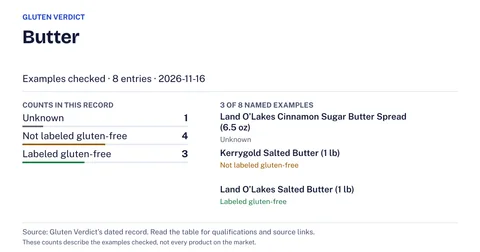 ButterNaturally gluten-freechecked Nov 16, 2026
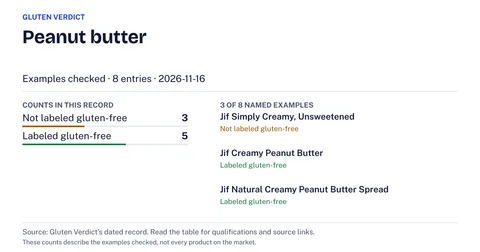 Peanut butterDepends on the productchecked Nov 16, 2026
 PastaContains glutenchecked Nov 16, 2026
 BreadContains glutenchecked Nov 16, 2026
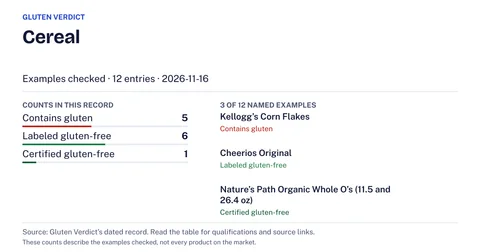 CerealDepends on the product5 of 12 products we checked contain glutenchecked Nov 16, 2026
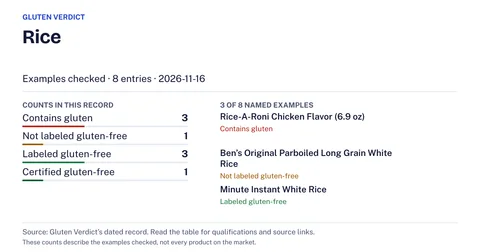 RiceNaturally gluten-free3 of 8 products we checked contain gluten: Rice-A-Roni Chicken Flavor (6.9 oz), Near East Original Rice Pilaf, and Ben’s Original Ready Rice Rice PilafBuy it labeled gluten-freechecked Nov 16, 2026
 OatmealDepends on the productchecked Nov 16, 2026
Questions people ask
Does the whole family have to go gluten-free when one child has celiac disease?
The sources we read describe options rather than a requirement. The Gluten Intolerance Group says some households eliminate gluten and others keep eating it, and that those who keep it must take steps to prevent cross-contact1. NIDDK advises storing and preparing gluten-free foods separately from other family members’ foods that contain gluten3.
Do we need a second toaster?
The GIG says crumbs can end up on gluten-free bread and suggests toaster bags or a separate toaster13. One small study found no gluten transfer above 20 ppm from shared toasters, with four samples between 5.1 ppm and 8.3 ppm25; its authors list small sample size among the study’s limits34.
Can siblings share the gluten-free child’s snacks?
The GIG suggests sending extras so friends can taste gluten-free food37. Keep the packages and jars separate so that crumbs and shared utensils do not travel the other way8.
Should brothers and sisters be tested before the whole house goes gluten-free?
That is a question for a doctor, and this guide does not answer it. NIDDK says blood relatives of people with celiac disease should talk with their doctor about being tested51. The sources also say testing relies on a gluten-containing diet: NIDDK says avoiding gluten before testing may make results inaccurate10, and the CDF says antibody testing requires one52.
More in Kids, school, college and family
 Your child has celiac disease: a first-week plan for the kitchen, labels, school and talking to your childThe first week after a child’s celiac diagnosis, in order: the diet plan, first labels, kitchen, two school routes, talking to your child and follow-up.
 Gluten-free in a college dorm: the fridge, microwave, toaster and roommate rulesHow to set up a shared dorm room or kitchen for gluten-free living: fridge, microwave, toaster, sponges, a roommate script and how to ask for housing help.
 A 504 plan and school meal rules for celiac disease: what to ask for and where to complainMeal substitution or a 504 plan for a child with celiac disease: what each rule says, what the medical statement must hold, and where to complain.
 A care sheet for the babysitter or grandparent of a child with celiac diseaseA one-page care sheet for a babysitter or grandparent: the checked foods, the kitchen cross-contact points, what to do after an exposure, and whom to call.
 A gluten-free child who refuses food: what to track and when to ask the doctorHow to tell ordinary picky eating from a pattern to raise with your child’s doctor or dietitian, what ARFID is, and a one-week log to bring.
 A gluten-free care plan for daycare and preschoolWrite a one-page gluten-free care plan for daycare or preschool, ask the right questions on a tour, and see which government rule covers each program.
Related guides
 Setting up a gluten-free kitchen: what to replace, wash or shareWalk each kitchen zone and decide, item by item, what to replace, what to wash and what a mixed household can keep sharing, with charity sources.
 Gluten cross-contact at home: where it happens and what to do about itHow gluten reaches gluten-free food at home, whether to separate, wash or ask for each route, and which rules have lab data behind them.
 Gluten-free on a budget: what costs extra and what does notSort a gluten-free shopping list into plain foods, foods that need a statement and packaged substitutes, then compare costs and check each claim.
 Starting a gluten-free diet: testing first, then labels, oats and the kitchenWhat NIH and the celiac charities say about starting a gluten-free diet: testing first, which foods to start with, a US label check, oats and the kitchen.
Sources
- [1, 2, 11, 15, 35, 37, 38, 43, 48] Gluten Intolerance Group, Transitioning Your Child to a Gluten-Free Diet, checked Nov 17, 2026.
- [3, 6, 7, 10, 12, 14, 17, 19, 20, 21, 44, 46, 47] National Institute of Diabetes and Digestive and Kidney Diseases (NIDDK), Eating, Diet, & Nutrition for Celiac Disease, checked Nov 17, 2026.
- [4, 5, 8, 23, 24, 27, 36, 45] Gluten Intolerance Group, 25 Ways Cross-Contact Could Happen (And How to Avoid It), checked Nov 17, 2026.
- [9, 25, 26, 28, 29, 32, 33, 34] Gastroenterology (PubMed Central author manuscript), Preparation of Gluten-Free Foods Alongside Gluten-Containing Food May Not Always Be as Risky for Celiac Patients as Diet Guides Suggest (Weisbrod and colleagues, 2020), checked Nov 17, 2026.
- [13, 30, 39, 40, 41, 42] Gluten Intolerance Group, Appliances: Risks of Cross-Contact, checked Nov 17, 2026.
- [16, 18] US Food and Drug Administration, Gluten and Food Labeling, checked Nov 17, 2026.
- [22, 31] Gluten Intolerance Group, FAQ: Same dish towels and pot holders as family members who handle gluten-containing food, checked Nov 17, 2026.
- [49, 52] Celiac Disease Foundation, Celiac Disease Screening, checked Nov 17, 2026.
- [50] Celiac Disease Foundation, Celiac Disease in Children, checked Nov 17, 2026.
Read on 2026-11-17: the list under “The first is to have an associated condition in which testing for celiac disease is recommended” names a family member with celiac disease, type 1 diabetes, thyroid disease, IgA deficiency, juvenile chronic arthritis, Down syndrome (Trisomy 21), Williams syndrome and Turner syndrome.
- [51] National Institute of Diabetes and Digestive and Kidney Diseases (NIDDK), Diagnosis of Celiac Disease, checked Nov 17, 2026.