Glyphosate, lectins and “wheat belly”: three wheat claims checked
Short answer
For each claim, the review or survey we found reports limited evidence or does not support it5, 13, 23, and NIDDK says celiac disease is triggered by eating foods containing gluten26.
- Glyphosate: a 2013 paper proposed it as the most important causal factor in celiac disease and gluten intolerance1. A 2020 review concluded that glyphosate residues on food could cause dysbiosis, but found methodological weaknesses that make definitive conclusions about glyphosate’s influence on health through the gut microbiome impossible5.
- Wheat lectins: a 2024 review says the adverse effects of wheat germ agglutinin have mainly been studied in animals13, and a 2025 scoping review found no eligible studies of it in non-celiac wheat sensitivity21.
- Modern wheat and “wheat belly”: a survey of US data by a USDA researcher did not support the likelihood that wheat breeding raised the protein content of US wheat, which is proportional to gluten content23, 30.
Part of Gluten basics and myths, 13 guides
Key points
- The glyphosate claim starts as a proposal in a 2013 paper, whose own abstract says “we propose”1. The 2020 critical review we found says the research it covers cannot support definitive conclusions5.
- A 2024 review says the adverse effects of wheat germ agglutinin have mainly been studied in animals and that human dietary intake data are not available13, 16. A 2025 scoping review found no eligible studies of it in non-celiac wheat sensitivity21.
- FDA’s glyphosate page treats residues as a pesticide matter and does not mention gluten or celiac disease8, 11.
- Gluten, as 21 CFR 101.91 defines it, comes from wheat, rye and barley, and the section does not mention pesticides or lectins27, 28, 29.
What are the three claims, and where does each one start?
This guide takes three wheat claims one at a time and names, for each, the paper it starts from, the review we found that bears on it, and the kind of evidence involved. We did not use a book or a promotional page as a source.
- Glyphosate. A 2013 paper in Interdisciplinary Toxicology proposed that this herbicide is “the most important causal factor” in celiac disease and gluten intolerance1.
- Lectins. Wheat germ agglutinin (WGA) is a small lectin protein present exclusively in wheat-germ tissues12. A 2025 scoping review lists it, with gluten, fermentable carbohydrates, amylase/trypsin inhibitors (ATIs) and glyphosate, among the wheat-related compounds discussed as potential causative or contributing agents of non-celiac wheat sensitivity19.
- Modern wheat and “wheat belly.” A 2013 survey of US data was written in response to the suggestion that a rise in celiac disease might be attributable to an increase in the gluten content of wheat resulting from wheat breeding25.
Non-celiac wheat sensitivity (NCWS) is a symptomatic response to eating wheat and related grains in the absence of celiac disease or wheat allergy18. It is defined by the absence of celiac disease, so a finding about NCWS is not a finding about celiac disease. Our guide on what in wheat bothers people if it is not gluten covers the NCWS candidates, and celiac disease versus gluten intolerance covers the difference.
Glyphosate: what the 2013 paper proposed and what the 2020 review found
The 2013 proposal
Samsel and Seneff’s 2013 paper presents itself as a proposal: the abstract says “we propose that glyphosate, the active ingredient in the herbicide, Roundup(®), is the most important causal factor in this epidemic”1.
The abstract’s arguments include that fish exposed to glyphosate develop digestive problems reminiscent of celiac disease2. The paper’s text adds that glyphosate use on US wheat rose sharply over the last decade, in step with the rise in celiac incidence3. Its Figure 1 plots hospital discharge diagnoses of celiac disease against glyphosate applications to wheat4. The passages we read offer a proposal, a finding in fish and a plot of two trends1, 2, 4; none of them is a trial in people.
The 2020 critical review
Barnett and Gibson’s 2020 critical review in Frontiers in Microbiology evaluated the literature on glyphosate’s effects on the gut microbiome5. Its abstract concludes that glyphosate residues on food could cause dysbiosis (an imbalance of gut bacteria). It adds that the research “suffers from numerous methodological weaknesses,” which make it “impossible to draw any definitive conclusions” about glyphosate’s influence on health through changes in the gut microbiome5. The review also states that all studies included in it are rodent studies7.
The review’s conclusion section adds that glyphosate “may be a critical environmental trigger” in several disease states associated with dysbiosis, including celiac disease32. The same section says the research suffers from methodological weaknesses including artificially high doses, insufficient duration, proprietary ingredients and an over reliance on animal models34.
The review does not cite the 2013 paper33, so it is not a test of that paper’s claim. What it says is that no definitive conclusion about health can be drawn from the glyphosate and gut-microbiome research it covers5, 7.
Read the wording closely: the review says residues “could cause” dysbiosis5 and that glyphosate “may be” a trigger in celiac disease32, not that they do or it is. It reports weak methods and rodent-only data5, 7, 34.
Where residues on wheat come from, and what FDA says
The 2020 review states that glyphosate is applied to wheat crops before harvest to encourage ripening, which it says results in higher residues in commercial wheat products within North America6.
FDA’s page on glyphosate treats residues as a pesticide matter. Its stated role is to ensure that residues on domestic and imported foods do not exceed the limits set by the US Environmental Protection Agency (EPA)8. Those limits are called tolerances: limits on the amount of a pesticide chemical residue a food can contain9. EPA has set them for glyphosate on a wide range of human and animal food crops, including grains, ranging from 0.1 to 400 parts per million10. The page does not mention gluten or celiac disease11.
Wheat lectins: what was tested, and in what
A 2024 review in Foods describes WGA as a small lectin protein present exclusively in the wheat-germ tissues12. Four points from its full text matter for the claim:
- Potential adverse effects of WGA intake have mainly been studied in animals13.
- The review cautions that in vitro observations must be distinguished from in vivo ones and from observations in a natural environment, and that results must be interpreted with care14.
- In in vivo experimental work it describes, toxicity of WGA for the normal gastrointestinal tract occurred at 7 g WGA per kg of body weight taken over a 10-day period, doses higher than those ingested regularly in the human diet15.
- It says data are not available on the mean dietary intake of WGA in humans, and that WGA is a heat-labile lectin, so it is assumed to lose its biological activity during baking or boiling16.
The same review also reports that some works have shown wheat lectins may have potential as a toxic compound and anti-nutritional factor able to induce negative effects on health, even at micromolar concentrations17.
The 2025 scoping review of NCWS triggers, in the American Journal of Gastroenterology, identified five hypothetical molecular triggers of NCWS, two of which were investigated in studies that met its inclusion criteria20. For ATIs, WGA and glyphosate, no eligible studies were found21. The authors concluded that the existing evidence is insufficient to justify restricting specific components of wheat in the management of NCWS22. That conclusion is about NCWS, not celiac disease18.
“Modern wheat” and “wheat belly”: did breeding raise gluten?
Kasarda’s 2013 paper was written in response to the suggestion that a rise in celiac disease might be attributable to an increase in the gluten content of wheat resulting from wheat breeding25. He surveyed data from the 20th and 21st centuries for the United States, and the results do not support the likelihood that wheat breeding has increased the protein content, proportional to gluten content, of US wheat23. The paper comes from a US Department of Agriculture research center30.
The paper also discusses other possible roles: changes in per capita consumption of wheat flour and the use of vital gluten as a food additive24. It is one survey of US data25, not a trial in people. The variety-by-variety comparisons are in our guide to modern versus old wheat and gluten, which we do not repeat here.
The three claims side by side
| Claim | Where it starts | Review we read | Kind of evidence | What stays open |
|---|---|---|---|---|
| Glyphosate causes celiac disease or gluten intolerance | A 2013 hypothesis paper1 | 2020 critical review of glyphosate and the gut microbiome5 | A proposal whose abstract cites findings in fish, and a plot of two trends2, 4. The review covers rodent studies only7. | The review says definitive conclusions about glyphosate’s influence on health through the gut microbiome are impossible5. |
| Wheat lectins such as WGA damage the gut | A lectin protein in wheat germ, described in a 2024 review12 | The same 2024 review13 | Mainly animal studies13. In vitro results must be read with care14. | Data on the mean dietary intake of WGA in humans are not available16. |
| Lectins or glyphosate trigger non-celiac wheat sensitivity | Discussed as potential causes19 | 2025 scoping review20 | No eligible studies of ATIs, WGA or glyphosate21 | Insufficient evidence to justify restricting specific wheat components22 |
| Modern wheat breeding raised gluten | A suggestion about wheat breeding and celiac incidence25 | Kasarda’s 2013 USDA survey23 | A survey of US data from the 20th and 21st centuries23 | Flour consumption and added vital gluten are discussed as other possible roles24 |
What none of this changes: the celiac trigger and the gluten-free label
NIDDK, part of the US National Institutes of Health, says celiac disease is triggered by eating foods containing gluten, a protein found naturally in wheat, barley and rye26. The page does not mention glyphosate, pesticides or lectins31.
The gluten-free label works the same way. In FDA’s rule, 21 CFR 101.91, a gluten-containing grain is wheat, rye or barley or a crossbred hybrid of them27. “Gluten” means the proteins that naturally occur in such a grain and may cause adverse health effects in people with celiac disease, with prolamins and glutelins as the examples the rule names28. We read the section on 2026-11-17 and found no mention of glyphosate, pesticides, herbicides or lectins in it29.
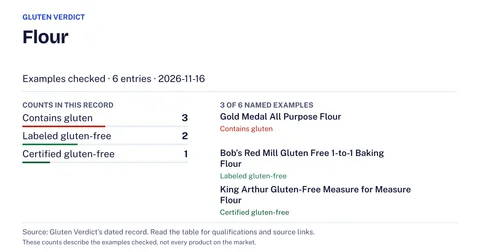
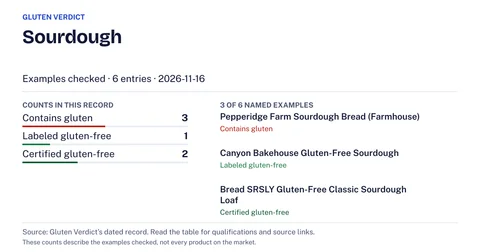
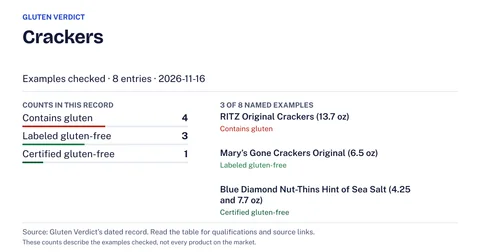
A residue worry and a gluten question are therefore separate questions with separate rules: FDA handles residues against EPA’s tolerances8, and the gluten-free rule handles gluten27. Our verdicts for wheat foods such as bread, flour, pasta, sourdough and crackers give each food’s status from its own sources, with the date we checked them.
Verdicts in this guide


Questions people ask
Does glyphosate cause celiac disease?
A 2013 paper proposed that glyphosate is the most important causal factor in celiac disease and gluten intolerance1. A 2020 critical review of the glyphosate and gut-microbiome literature found methodological weaknesses that make definitive conclusions about health impossible5. NIDDK says celiac disease is triggered by eating gluten26.
Are lectins in wheat harmful?
A 2024 review says potential adverse effects of wheat germ agglutinin have mainly been studied in animals13. It also describes in vivo experimental work in which toxicity occurred at doses higher than those ingested regularly in the human diet15, and reports that some works have shown wheat lectins may have potential as a toxic compound, even at micromolar concentrations17.
More in Gluten basics and myths
 Did modern wheat get worse? What the variety studies show on glutenWhat studies of old and modern wheat varieties show on gluten, and what they say about spelt, einkorn and ancient wheats and celiac disease.
 What in wheat bothers people if it is not gluten?The non-gluten candidates for wheat symptoms (fructans, ATIs, wheat allergy), the trial or review behind each, and what limits it.
 Spelt, Kamut, Durum and Einkorn: Every Kind of Wheat Has GlutenDurum, semolina, spelt, einkorn, kamut, farro: which wheat words on a US label count as gluten, and what the FDA rule and the sources say about each.
 Fine on bread in Europe? What it does and does not showWhat a trip where bread felt fine does and does not show about celiac disease, and how EU and US gluten-free label rules compare.
 Why gluten problems seem more common: what the evidence separatesGluten problems seem everywhere. Studies separate three things: cases found, cases that exist, and people avoiding gluten.
 What gluten is, which grains carry it and what “gluten-free” meansA plain definition of gluten, the grains that carry it, look-alike words such as malt and wheat starch, and what a US gluten-free label means.
Related guides
 Gluten-free myths about labels and food, checked against the rulesNatural, organic, zero gluten, fermenting and oats: each gluten-free myth checked against the page that states the rule, with the wording and read date.
 Celiac disease vs gluten intolerance: three conditions, three diagnosesHow celiac disease, non-celiac gluten sensitivity and wheat allergy differ in mechanism, diagnosis and diet, with a source behind every point.
 Certified or naturally gluten-free: when a seal mattersWhich naturally gluten-free foods are worth buying with a claim or seal: produce, grains, flours, oats and processed foods, with FDA rules and test data.
 Spelt, farro, Kamut, bulgur, couscous and freekeh: wheat under other namesWhich shop and menu names are wheat: spelt, farro, Kamut, einkorn, bulgur, couscous, freekeh and more, and what FDA’s rules say about them.
Sources
- [1, 2] Interdisciplinary Toxicology (via PubMed), Glyphosate, pathways to modern diseases II: Celiac sprue and gluten intolerance (Samsel and Seneff, 2013), abstract, checked Nov 17, 2026.
- [3, 4] Interdisciplinary Toxicology (via PubMed Central), Glyphosate, pathways to modern diseases II: Celiac sprue and gluten intolerance (Samsel and Seneff, 2013), full text, checked Nov 17, 2026.
- [5, 6] Frontiers in Microbiology (via PubMed), Separating the Empirical Wheat From the Pseudoscientific Chaff: A Critical Review of the Literature Surrounding Glyphosate, Dysbiosis and Wheat-Sensitivity (Barnett and Gibson, 2020), abstract, checked Nov 17, 2026.
- [7, 32, 33, 34] Frontiers in Microbiology (via PubMed Central), Separating the Empirical Wheat From the Pseudoscientific Chaff: A Critical Review of the Literature Surrounding Glyphosate, Dysbiosis and Wheat-Sensitivity (Barnett and Gibson, 2020), full text, checked Nov 17, 2026.
Read the full text and reference list on 2026-11-17: the name Samsel does not appear on the page, and the one reference naming Seneff is a 2019 paper on chronic kidney disease of unknown origin.
- [8, 9, 10, 11] US Food and Drug Administration, Questions and Answers on Glyphosate, checked Nov 17, 2026.
Read the page text on 2026-11-17: the words “gluten” and “celiac” do not appear on the page.
- [12] Foods (via PubMed), Wheat Germ Agglutinin (WGA): Its Nature, Biological Role, Significance in Human Nutrition, and Possibility to Be Used as Marker of Whole-Grain Status in Wheat-Based Foods (Carcea et al., 2024), abstract, checked Nov 17, 2026.
- [13, 14, 15, 16, 17] Foods (via PubMed Central), Wheat Germ Agglutinin (WGA): Its Nature, Biological Role, Significance in Human Nutrition, and Possibility to Be Used as Marker of Whole-Grain Status in Wheat-Based Foods (Carcea et al., 2024), full text, checked Nov 17, 2026.
- [18, 22] American Journal of Gastroenterology (via PubMed), Molecular Triggers of Non-celiac Wheat Sensitivity: A Scoping Review and Analysis (An et al., 2025), abstract, checked Nov 17, 2026.
- [19, 20, 21] American Journal of Gastroenterology (via PubMed Central), Molecular Triggers of Non-celiac Wheat Sensitivity: A Scoping Review and Analysis (An et al., 2025), full text, checked Nov 17, 2026.
- [23, 24, 25, 30] Journal of Agricultural and Food Chemistry (via PubMed), Can an increase in celiac disease be attributed to an increase in the gluten content of wheat as a consequence of wheat breeding? (Kasarda, 2013), abstract, checked Nov 17, 2026.
- [26, 31] NIDDK (National Institutes of Health), Definition & Facts for Celiac Disease, checked Nov 17, 2026.
Read the page text on 2026-11-17: the words “glyphosate”, “pesticide” and “lectin” do not appear on the page.
- [27, 28, 29] Electronic Code of Federal Regulations, 21 CFR 101.91 Gluten-free labeling of food, definition of gluten-containing grain, checked Nov 17, 2026.
Read the full text of § 101.91 on 2026-11-17: the section defines the “gluten-free” claim by gluten-containing grains and a limit of 20 ppm gluten; the words “glyphosate”, “pesticide”, “herbicide” and “lectin” do not appear in it.