Did modern wheat get worse? What the variety studies show on gluten
Short answer
The studies we read that compared older and modern wheat varieties did not find gluten or protein content rising1, 2, though one 2010 comparison found a celiac-related gluten fragment more often in modern European varieties3. In a German comparison, einkorn, emmer and spelt had more gluten than common wheat, not less4. Under FDA’s gluten-free rule, every species of wheat counts as a gluten-containing grain5.
Part of Gluten basics and myths, 13 guides
Key points
- The studies we read that measured protein or gluten in older and modern wheat did not find it rising; the German cultivar study found no change in gluten contents between 1891 and 20101, 2, 6.
- The evidence is not unanimous: a 2010 comparison found the Glia-α9 celiac epitope more often in modern European varieties, which a 2022 review calls preliminary research3, 7.
- Einkorn, emmer and spelt were not lower in gluten than common wheat: they had higher protein and gluten contents in one German comparison, though a 2022 review says not higher than modern durum wheat4, 25.
- FDA’s gluten-free rule defines wheat as any species of the genus Triticum, so a food labeled gluten-free cannot contain any wheat species as an ingredient5, 8.
- NIDDK says doctors do not recommend starting a gluten-free diet before diagnostic testing, because the diet can affect test results9.
What the claim says, and what “ancient” and “modern” mean
The claim runs like this: modern bread wheat has been bred to carry more gluten than the “ancient wheats”, and that helps explain today’s gluten problems. A 2022 review in Nutrition Bulletin records that it has been suggested that modern varieties of bread wheat have higher gluten contents than so-called ancient wheats10. The authors of one breeding study state the idea as breeding toward increased yield and resistance having possibly contributed to a higher immunostimulatory potential of modern wheat cultivars compared with old ones11.
Neither word has a fixed meaning. The review says there is no universally accepted definition of “ancient” and “modern” grains when applied to wheat, and that the terms are sometimes applied to older and modern types of bread and durum wheat12. It uses “ancient grains” more widely for einkorn, emmer, spelt and Khorasan wheat, types suggested to correspond to ones grown in antiquity and grown only in small volumes today13. Some studies below compare old and new varieties of one wheat; others compare species. The table says which.
The studies side by side
Each row names the paper, what it compared and what its authors reported. Two rows are reviews, marked as such.
| Study | What it compared | What it reported |
|---|---|---|
| van den Broeck and colleagues, 2010 (Theoretical and Applied Genetics) | 36 modern European wheat varieties and 50 landraces representing the varieties grown up to around a century ago14 | The Glia-α9 epitope was more common in the modern varieties and Glia-α20 less common; the authors wrote that modern breeding practices may have led to increased exposure to celiac disease epitopes3. |
| Kasarda, 2013 (Journal of Agricultural and Food Chemistry) | A survey of data from the 20th and 21st centuries for the United States2 | The results did not support the likelihood that wheat breeding increased the protein content, which is proportional to gluten content, of US wheat2. |
| Pronin and colleagues, 2020 (Journal of Agricultural and Food Chemistry) | 60 German winter wheat cultivars first registered between 1891 and 2010, grown in 3 years15 | Protein and gliadin contents trended down, glutenin rose, and there was no change in gluten contents; at the protein level the authors found no evidence of increased immunostimulatory potential of modern winter wheat1, 16. |
| Geisslitz and colleagues, 2019 (Foods) | 15 cultivars each of common wheat, spelt, durum wheat, emmer and einkorn, grown at four locations in Germany in the same year17 | Einkorn, emmer and spelt had higher protein and gluten contents than common wheat at all four locations4. |
| Shewry, 2018 (review, Journal of Cereal Science) | Published comparisons of the health benefits of ancient and modern wheats18 | Noted that studies have suggested health benefits of ancient wheats, but that the mechanisms are unclear and limited numbers of genotypes have been studied; concluded that further studies are urgently required19, 20. |
| Colombo and colleagues, 2021 (review, Foods) | Recent in vitro and in vivo studies on cereals whose toxicity for celiac patients is still controversial, including ancient wheats21, 22 | Some ancient wheat grains showed reduced in vitro toxicity, but to date are still considered toxic for celiac patients22. |
| Brouns and colleagues, 2022 (review, Nutrition Bulletin) | Analyses of ancient and modern wheats23 | Reported that the protein content of modern bread wheat has decreased over time, that ancient wheats contain more protein and gluten and more of many celiac-active epitopes than bread wheat, and that no single wheat type can be recommended as better for reducing the risks of or mitigating the severity of celiac disease23, 24. |
Do modern varieties carry more gluten?
Two studies looked at this directly. The German study analysed 60 winter wheat cultivars first registered between 1891 and 2010, grown in 3 years, and found protein and gliadin contents trending down, glutenin contents going up and no change in gluten contents15, 1. The US review reached a similar place from a different direction: its author found that the data did not support the likelihood that wheat breeding raised the protein content of US wheat, and protein content is proportional to gluten content2.
The 2022 review describes a third analysis, of 150 wheat varieties from seed banks grown, harvested and milled under identical conditions: protein content declined slightly from older to modern types6. The review adds that gluten makes up about 70%–80% of grain protein, so it is likely that gluten falls when protein does25.
These studies compare the grain, not how people respond to eating it15, 2. Gluten has two fractions, glutenin and gliadin, and the review calls gliadin the more important source of the fragments that may cause adverse reactions in the gut26, which is why the next question matters.
Do they carry more of the fragments that trigger celiac disease?
This is where the studies disagree. The 2010 comparison looked at two gluten fragments linked to celiac disease, Glia-α9 and Glia-α20, in 36 modern European varieties and 50 landraces14. It describes Glia-α9 as a major epitope recognized by the majority of celiac disease patients27. Glia-α9 was present more often in the modern varieties and Glia-α20 less often, and the authors suggested modern breeding practices may have led to increased exposure to celiac disease epitopes3. They also identified some modern varieties and landraces with relatively low contents of both28.
A later study of cultivars from 1891 to 2010 reached a different conclusion: its authors found no evidence at the protein level to support an increased immunostimulatory potential of modern winter wheat16. The 2022 review calls the 2010 result preliminary research and says more recent work shows wide variation in these epitopes within and between wheat types, with no clear differences between modern cultivars and older landraces7. It also cites a further analysis by Pronin and colleagues that, it says, confirmed that the ranges of celiac-active peptide contents in old and modern wheat cultivars overlap29.
So the fair reading of the variety studies is mixed on one fragment and flat on gluten content, not a clear rise3, 1, 7.
Ancient wheats: not lower in gluten than common wheat
The comparison that matters for spelt and einkorn runs across species, and it points the other way. In a set of 300 samples grown in Germany, einkorn, emmer and spelt had higher protein and gluten contents than common wheat at all four locations17, 4. Against modern durum wheat, the 2022 review says, their contents were not higher25. It states that gluten is present in all wheat grains and that all can induce celiac disease in genetically susceptible individuals30.
Spelt needs one more note. The review says the spelt grown today appears to derive from more recent hybridisation between hexaploid bread wheat and wild emmer, not from ancient spelt-like hulled wheat, and that modern commercial spelt has been bred in the same way as modern bread and pasta wheats31.
Reviews of the celiac question land in the same place. The 2021 review in Foods reported that some ancient wheat grains it names as Triticum monococcum, Triticum aestivum ssp. spelta and Kamut® showed reduced in vitro toxicity but, to date, are still considered toxic for celiac patients22. The 2022 review concluded that no single wheat type can be recommended as better for reducing the risks of or mitigating the severity of celiac disease24.
The rule that decides a US label is simpler still. FDA’s gluten-free rule defines a gluten-containing grain as wheat, including any species belonging to the genus Triticum, or rye, barley or their crossbred hybrids5, and its own example of a gluten-containing grain that cannot be an ingredient is spelt wheat8. For the wheat names on a label, see every kind of wheat has gluten.
Our verdicts for the foods people reach for as alternatives show what each source we read said, with the date: spelt, farro, bulgur, wheat starch, flour, bread and sourdough.
One trial that pointed to fructans rather than gluten
Some people follow a gluten-free diet on their own although celiac disease has been excluded32. One trial at Oslo University Hospital gave 59 people on a self-instituted gluten-free diet, for whom celiac disease had been excluded, gluten (5.7 g), fructans (2.1 g) or placebo, concealed in muesli bars, for 7 days, in a double-blind crossover32. The overall symptom score (GSRS-IBS) and the bloating score were significantly higher after fructans than after gluten33, and the overall score did not differ between gluten and placebo34. The authors concluded that fructans induced symptoms in this group35.
This was one trial, in people for whom celiac disease had been excluded. It says nothing about people with celiac disease32.
Did celiac disease become more common? What blood collected in 1948 to 1954 shows
The other half of the claim is that celiac disease became more common. One US study compared blood from 9133 healthy young adults at Warren Air Force Base, collected between 1948 and 1954, with samples from two recent groups in Olmsted County, Minnesota36. The blood was tested for tissue transglutaminase and, if abnormal, for endomysial antibodies37.
Of the 9133 people in the old group, 14 (0.2%) had undiagnosed celiac disease38. In the recent groups it was found in 68 (0.9%) and 46 (0.8%), which the authors report as 4.5-fold and 4-fold greater39. They concluded that the prevalence of undiagnosed celiac disease seems to have increased dramatically in the United States during the past 50 years40.
That finding is about people, not grain: the study’s abstract describes antibody tests and survival follow-up and reports no measurement of wheat varieties or wheat intake41. The variety studies above are what test one proposed cause.
What else changed: how much wheat, and how it is added
The US review looked at amounts as well as varieties. It reports that wheat flour intake per person per year, from all classes of wheat, reached a high of 220 lb (100 kg) in about 1900, fell to about 110 lb (50 kg) in 1970, rose to about 146 lb (66 kg) in 2000 and was about 134 lb (61 kg) in 200842.
It also looked at vital gluten, which is gluten washed out of wheat flour and often added to foods to improve their characteristics43. The author writes that it appears vital gluten consumption has tripled since 1977, and that it is difficult to say whether this contributes to more celiac disease, particularly compared with the much larger intake of gluten from wheat flour44.
Before cutting out gluten: what NIDDK says
If the claim has you thinking about dropping wheat, NIDDK, the US National Institute of Diabetes and Digestive and Kidney Diseases, says doctors do not recommend starting a gluten-free diet before diagnostic testing, because a gluten-free diet can affect test results9.
Verdicts in this guide
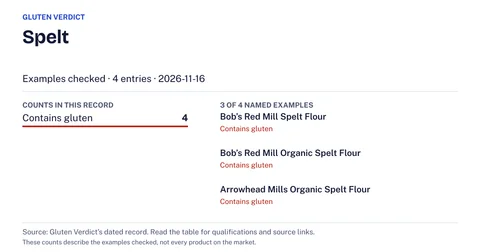 SpeltContains glutenchecked Nov 16, 2026
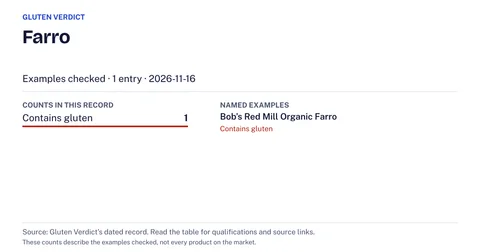 FarroContains glutenchecked Nov 16, 2026
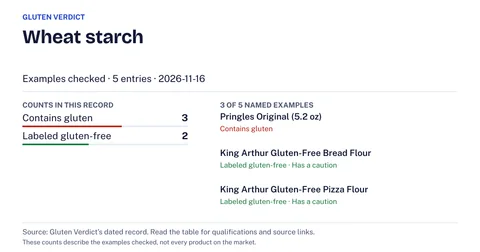 Wheat starchDepends on the product3 of 5 products we checked contain gluten: Pringles Original (5.2 oz), Jiffy Corn Muffin Mix, and Chex Mix Bold Garlic and Herbchecked Nov 16, 2026
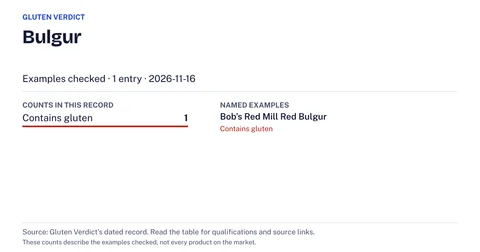 BulgurContains glutenchecked Nov 16, 2026
 BreadContains glutenchecked Nov 16, 2026
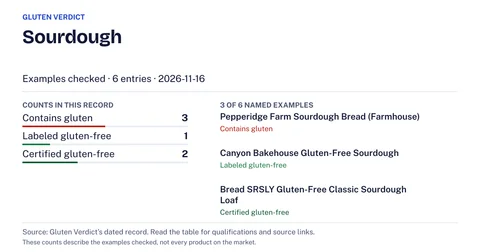 SourdoughContains glutenchecked Nov 16, 2026
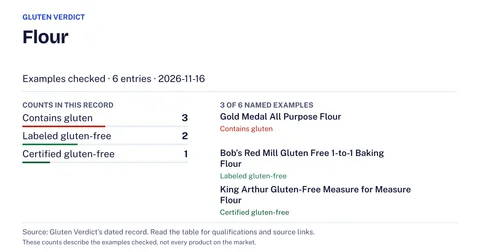 FlourContains glutenchecked Nov 16, 2026
Questions people ask
Does modern wheat have more gluten than old wheat?
In the studies we read, no. The German study of 60 cultivars from 1891 to 2010 found no change in gluten contents1, and the US data review did not support the idea that breeding raised protein content2. One 2010 study did find a celiac-related fragment, Glia-α9, more often in modern European varieties3.
Is einkorn or spelt lower in gluten than modern wheat?
Not lower than common wheat. In the German comparison of 300 samples, einkorn, emmer and spelt had higher protein and gluten contents than common wheat4; the 2022 review notes they were not higher than modern durum wheat25.
Can an ancient wheat be in a food labeled gluten-free?
Under FDA’s rule, a food labeled gluten-free cannot contain an ingredient that is a gluten-containing grain, and the rule’s example is spelt wheat8. Wheat is defined as any species belonging to the genus Triticum5.
Should I try a gluten-free diet before being tested for celiac disease?
NIDDK says doctors do not recommend starting a gluten-free diet before diagnostic testing, because the diet can affect test results9.
More in Gluten basics and myths
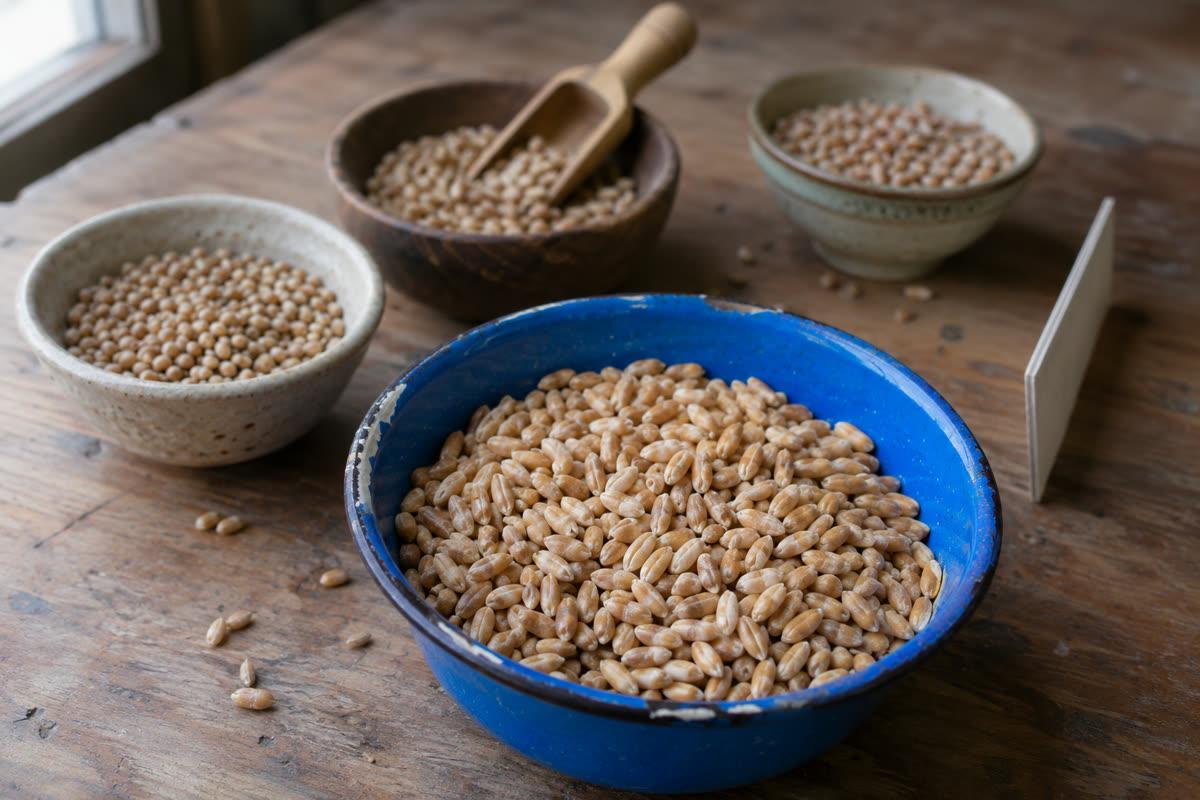 Spelt, Kamut, Durum and Einkorn: Every Kind of Wheat Has GlutenDurum, semolina, spelt, einkorn, kamut, farro: which wheat words on a US label count as gluten, and what the FDA rule and the sources say about each.
 What in wheat bothers people if it is not gluten?The non-gluten candidates for wheat symptoms (fructans, ATIs, wheat allergy), the trial or review behind each, and what limits it.
 Glyphosate, lectins and “wheat belly”: three wheat claims checkedWhere the glyphosate, wheat lectin and “wheat belly” claims come from, what the reviews found, and what NIDDK and FDA’s gluten-free rule say.
 What gluten is, which grains carry it and what “gluten-free” meansA plain definition of gluten, the grains that carry it, look-alike words such as malt and wheat starch, and what a US gluten-free label means.
 Fine on bread in Europe? What it does and does not showWhat a trip where bread felt fine does and does not show about celiac disease, and how EU and US gluten-free label rules compare.
 Why gluten problems seem more common: what the evidence separatesGluten problems seem everywhere. Studies separate three things: cases found, cases that exist, and people avoiding gluten.
Related guides
 Gluten-free myths about labels and food, checked against the rulesNatural, organic, zero gluten, fermenting and oats: each gluten-free myth checked against the page that states the rule, with the wording and read date.
 Spelt, farro, Kamut, bulgur, couscous and freekeh: wheat under other namesWhich shop and menu names are wheat: spelt, farro, Kamut, einkorn, bulgur, couscous, freekeh and more, and what FDA’s rules say about them.
 What gluten does in the gut: celiac disease, wheat allergy and gluten sensitivity comparedHow celiac disease, wheat allergy and non-celiac gluten sensitivity differ in the gut, and why testing comes before cutting out gluten.
 Wheat allergy tests vs celiac tests: which test answers which conditionWhich test answers which condition: celiac antibodies and biopsy versus wheat IgE, skin prick and food challenge, as ACG, NIAID, FARE and NIH say.
Sources
- [1, 11, 15, 16] Journal of Agricultural and Food Chemistry (via PubMed), Wheat Breeding from 1891 to 2010 Contributed to Increasing Yield and Glutenin Contents but Decreasing Protein and Gliadin Contents, checked Nov 17, 2026.
- [2] Journal of Agricultural and Food Chemistry (via PubMed), Can an increase in celiac disease be attributed to an increase in the gluten content of wheat as a consequence of wheat breeding?, checked Nov 17, 2026.
- [3, 14, 27, 28] Theoretical and Applied Genetics (via PubMed), Presence of celiac disease epitopes in modern and old hexaploid wheat varieties: wheat breeding may have contributed to increased prevalence of celiac disease, checked Nov 17, 2026.
- [4, 17] Foods (via PubMed), Comparative Study on Gluten Protein Composition of Ancient (Einkorn, Emmer and Spelt) and Modern Wheat Species (Durum and Common Wheat), checked Nov 17, 2026.
- [5, 8] US Food and Drug Administration (21 CFR 101.91, via eCFR), Gluten-free labeling of food, checked Nov 17, 2026.
- [6, 7, 10, 12, 13, 25, 26, 29, 31] Nutrition Bulletin (via PubMed Central), Do ancient wheats contain less gluten than modern bread wheat, in favour of better health? (full text), checked Nov 17, 2026.
- [9] NIDDK (National Institutes of Health), Diagnosis of Celiac Disease, checked Nov 17, 2026.
- [18, 19, 20] Journal of Cereal Science (via PubMed), Do ancient types of wheat have health benefits compared with modern bread wheat?, checked Nov 17, 2026.
- [21, 22] Foods (via PubMed), Ancient and Modern Cereals as Ingredients of the Gluten-Free Diet, checked Nov 17, 2026.
- [23, 24, 30] Nutrition Bulletin (via PubMed), Do ancient wheats contain less gluten than modern bread wheat, in favour of better health?, checked Nov 17, 2026.
- [32, 33, 34, 35] Gastroenterology (via PubMed), Fructan, Rather Than Gluten, Induces Symptoms in Patients With Self-Reported Non-Celiac Gluten Sensitivity, checked Nov 17, 2026.
- [36, 37, 38, 39, 40, 41] Gastroenterology (via PubMed), Increased prevalence and mortality in undiagnosed celiac disease, checked Nov 17, 2026.
Read the abstract on 2026-11-17: it describes antibody tests on sera collected from 1948 to 1954, 45 years of survival follow-up and prevalence in the cohorts; it reports no measurement of wheat varieties, wheat intake or gluten intake.
- [42, 43, 44] Journal of Agricultural and Food Chemistry (via PubMed Central), Can an increase in celiac disease be attributed to an increase in the gluten content of wheat as a consequence of wheat breeding? (full text), checked Nov 17, 2026.