Gluten-free myths about labels and food, checked against the rules
Short answer
Five common claims, each checked against the page that states the rule:
- “Natural” and “organic” are not gluten-free claims: the FDA page on “natural” and the USDA page on its organic rules do not mention gluten1, 2, 3, 4.
- A “gluten-free” claim limits any unavoidable gluten to below 20 parts per million (ppm); it does not mean none5.
- Fermenting and hydrolyzing do not remove gluten in FDA’s view, and a gluten-free claim on those foods rests on the maker’s records6, 7, 8.
- Oats can carry a gluten-free claim only at under 20 ppm of gluten, and certification is not required for the claim9.
- A Contains line names wheat but not barley or rye, so a list with no wheat does not clear a food10, 11.
Part of Gluten basics and myths, 13 guides
Key points
- FDA says it has no formal definition of “natural”; its longstanding policy is about nothing artificial or synthetic being added12, 1.
- FDA says it adopted the 20 ppm limit because it relies on validated test methods, and none validated for lower levels were available then13.
- Charities and NIDDK describe small amounts of gluten in different terms, so this guide shows their statements side by side instead of picking one14, 15.
- Distillation is treated differently from fermentation: where no validated test method is available for a distilled food, FDA checks for protein in the distilled component16.
- Malt extract, malt syrup and malt vinegar are made from barley, which is not on the law’s allergen list, so a Contains line without wheat does not clear them10, 11, 18.
How each claim is checked
Each claim below is paired with the page that states the rule or the finding. The source list quotes the wording and gives the date we read it. Where a statement comes from one charity or one agency, the text says whose it is. Rules are US rules unless a country is named.
Two limits. This guide does not rule on whether heat from cooking changes gluten, because none of the pages we read addresses it. It also does not check claims about autism, ADHD or arthritis. Statements about celiac disease are reported as what the named source says, not as advice for any one person.
Does “natural” or “organic” mean gluten-free?
No. Neither policy page mentions gluten. As of its page on the term (current as of 10/22/2018), FDA has not made rules defining “natural”12. Its policy treats the term as meaning that nothing artificial or synthetic has been added to a food that would not normally be expected to be in it1. The page on that policy does not mention gluten2.
“Organic” is a production and handling standard. USDA’s National Organic Program writes the rules for the production, handling, labeling and enforcement of USDA organic products3, and its page on those rules does not mention gluten4. The Gluten Intolerance Group (GIG) states it directly: organic status is unrelated to gluten-free status19.
Natural flavors and naturally gluten-free foods
GIG says “natural flavors” on a product that is not labeled or certified gluten-free could be made with a gluten-containing ingredient such as yeast extract grown on barley20.
“Naturally gluten-free” has a narrower meaning. GIG says it refers to the same quality as “inherently gluten-free”: by nature, and if unchanged, the food is gluten-free21. Raw fruits and vegetables qualify, although they could come into contact with gluten between growing and manufacturing22. FDA adds that for foods that are gluten-free by nature but at higher risk of cross-contact, such as products made from grains, legumes and seeds, a gluten-free claim gives consumers the expectation that any gluten present is under 20 ppm23.
Does “gluten-free” mean zero gluten?
No. The claim carries a limit of below 20 ppm, not zero. The regulation says any unavoidable presence of gluten in a food bearing the claim must be below 20 ppm, which it states as below 20 mg of gluten per kg of food5. NIDDK states the limit as less than 20 parts per million24.
FDA explains why the limit is not zero: when it wrote the rule, it relied on validated test methods, and none had been validated to detect gluten reliably below 20 ppm13. It also says the goal for any food labeled gluten-free is to contain no gluten or the lowest amount possible under 20 ppm25.
A certification logo is a separate layer. FDA lets makers print one if its use is truthful and not misleading26. GIG says the standard of its certification program, GFCO, is 10 ppm of gluten or less27. More in certified vs naturally gluten-free and how to read a food label.
Will a little gluten hurt?
The sources speak about different things, so this guide reports them rather than settling it. The charities describe what tiny amounts of gluten can do to a person with celiac disease. NIDDK and FDA describe the 20 ppm food limit and what most people with celiac disease tolerate.
| Source | What it says | Scope |
|---|---|---|
| Coeliac UK | Even very small amounts of gluten can be damaging to people with coeliac disease14. | People with coeliac disease; UK charity |
| Gluten Intolerance Group | Even tiny amounts of gluten can damage the intestinal cells of a person with celiac disease, even without obvious immediate symptoms28. | People with celiac disease; US charity |
| NIDDK | Less than 20 ppm is too small an amount to cause problems in most people with celiac disease15. | Most people with celiac disease; US federal agency |
| FDA | Some celiac disease researchers and some epidemiological evidence suggest most individuals with celiac disease can tolerate variable trace amounts, including levels under 20 ppm29. | Most individuals with celiac disease; US regulator |
FDA says people with celiac disease, especially those who may be sensitive to low levels of gluten, should seek the advice of their health care providers about which foods to eat30. For kitchen practice, see cross-contamination.
Does fermenting, hydrolyzing or distilling remove gluten?
Fermenting and hydrolyzing: no. Distilling: FDA treats it differently.
Fermented and hydrolyzed foods
FDA does not consider fermentation a process that removes gluten6, and says the same of hydrolysis7. GIG agrees that fermentation does not make a gluten-containing substance gluten-free31.
Because gluten tests cannot adequately detect gluten in these foods, FDA decides compliance from the maker’s records showing the food was gluten-free before fermentation or hydrolysis8. The rule covers yogurt, sauerkraut, pickles, cheese, green olives, FDA-regulated beers and wines, and hydrolyzed plant proteins32. A fermented or hydrolyzed food made from a gluten grain cannot carry the claim unless the grain was processed to remove gluten and the food was under 20 ppm before fermentation or hydrolysis33.
FDA applies this to specific foods. In general, soy sauce made from soybeans and wheat may not bear a gluten-free claim, though FDA notes that some soy sauces are made without wheat17. Malt vinegar is fermented from barley and cannot be used in a food that bears the claim18.
Gluten-removed beer
TTB allows a claim that a product fermented from gluten grains was processed, treated or crafted to remove gluten, if it carries a qualifying statement and the maker can document it34. That is not the gluten-free claim, which TTB authorizes where the product would be entitled to the claim under FDA’s definition35. GIG notes that stronger testing may still detect barley gluten in gluten-removed products36. See beer and gluten-removed beer explained.
Distilled foods
For distilled foods the regulation names a different check: when no validated test method is available because the food is distilled, FDA verifies the absence of protein in the distilled component16. For spirits distilled from gluten-containing grains, TTB allows the term “gluten-free” as long as good manufacturing practices are followed that prevent any gluten-containing material entering the final product55. GIG says distilled alcohol may be gluten-free, as long as no gluten-containing flavorings or additives are added after distillation37. Our verdicts for vodka and whiskey show what makers say about their own products, and the alcohol guide covers the rest.
Are oats always out, or always fine?
Neither. In the US, oats are not one of the gluten grains in FDA’s rule: any grain other than wheat, rye, barley or their hybrids can be labeled gluten-free if unavoidable gluten from cross-contact is under 20 ppm38. Oats labeled gluten-free must contain less than 20 ppm of gluten, and they do not have to be certified to carry the claim9.
Other countries differ. GIG says oats are not considered a source of gluten in many countries39, and that most European countries allow oats in products labeled gluten-free40. GIG adds that Australia and New Zealand include oats as a restricted grain, along with wheat, barley and rye, in gluten-free products produced or sold there41.
Why “always fine” is also wrong
GIG says gluten grains can still get into oats through wind, animals and human error before processing42. Processors use two main ways to avoid or remove that mixing43, and GFCO certification audits the processing and tests the oats multiple times44.
Separately, GIG notes that oats contain avenin, a storage protein with some similarities to the gluten in wheat, rye and barley45. It reports that research generally indicates avenin does not cause a reaction in the majority of people with celiac disease46, and that oats should be introduced in consultation with a healthcare team47. NIDDK likewise says to talk with a doctor or registered dietitian about whether to include oats and how much48.
Our pages: gluten-free oats vs regular oats, oatmeal and oat milk.
If wheat is not on the list, is the food gluten-free?
No. The 2004 US allergen labeling law (FALCPA) names wheat among the major food allergens, but its list does not include barley or rye10. A Contains line or an allergen mention can therefore be silent about barley, rye and what is made from them.
- Malt extract and malt syrup are made from barley that has not been processed to remove gluten11.
- Malt vinegar is fermented from barley, so it cannot be used in a food labeled gluten-free18.
- GIG says “natural flavors” on a product that is not labeled or certified gluten-free could be made with a gluten-containing ingredient such as yeast extract grown on barley20.
The reverse also happens. Under the regulation, an ingredient derived from a gluten grain and processed to remove gluten, such as wheat starch, is allowed in a food bearing the claim unless its use brings the food to 20 ppm or more of gluten49. Our verdicts: barley, malt vinegar, wheat starch. Name lists: wheat, barley and rye names on ingredient lists and malt on food labels.
Other claims, and where to read more
| Claim | What the source says | Where to read more |
|---|---|---|
| “A gluten-free diet is healthier.” | GIG: not true except for people with celiac disease, gluten sensitivity or other gluten-related disorders50. NIDDK: researchers have found no evidence that it promotes better health or weight loss for the general population51. | Not covered further here |
| “A gluten-free diet is good for weight loss.” | GIG: whether a diet promotes weight loss is not related to the presence or absence of gluten52. | Not covered further here |
| “May contain wheat” means it is not gluten-free. | FDA: a food whose label bears a gluten-free claim must comply with the rule whether or not it also has an advisory statement53. | May contain wheat labels |
| “Certified gluten-free” and “gluten-free” are the same. | FDA allows certification logos on labels26; GIG’s GFCO program uses 10 ppm or less27. | Certified vs naturally gluten-free |
| “Celiac disease is rare.” | Coeliac UK: research shows coeliac disease affects one in 100 people in the UK54. | Own guide in review |
Verdicts in this guide
 OatmealDepends on the productchecked Nov 16, 2026
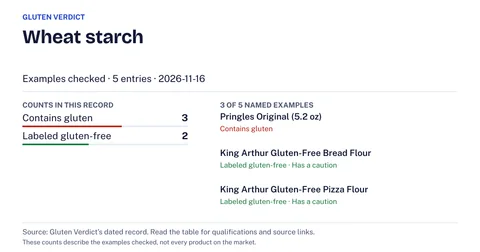 Wheat starchDepends on the product3 of 5 products we checked contain gluten: Pringles Original (5.2 oz), Jiffy Corn Muffin Mix, and Chex Mix Bold Garlic and Herbchecked Nov 16, 2026
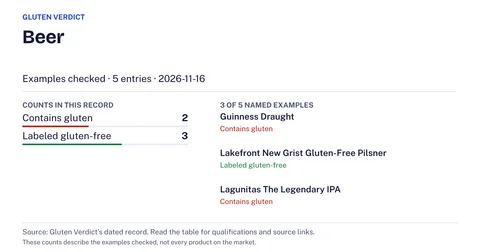 BeerDepends on the product2 of 5 products we checked contain gluten: Guinness Draught and Lagunitas The Legendary IPAchecked Nov 16, 2026
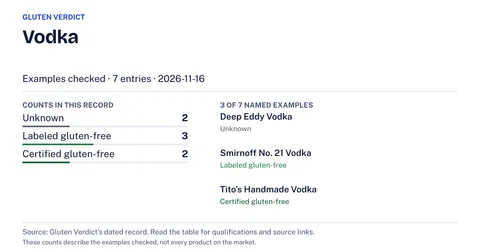 VodkaDepends on the productchecked Nov 16, 2026
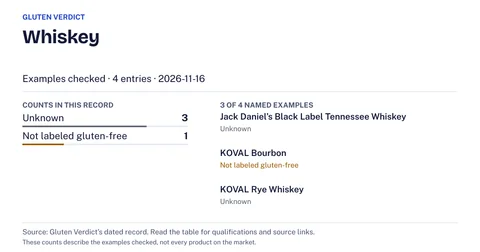 WhiskeyDepends on the productchecked Nov 16, 2026
 Soy sauceDepends on the product3 of 7 products we checked contain gluten: Kikkoman Soy Sauce (Non-GMO), 20 oz; San-J Organic Shoyu Soy Sauce; and Lee Kum Kee Premium Soy Sauce (No Preservatives Added)checked Nov 16, 2026
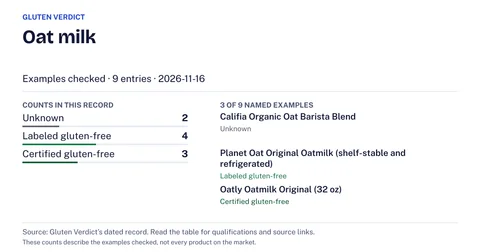 Oat milkDepends on the productchecked Nov 16, 2026
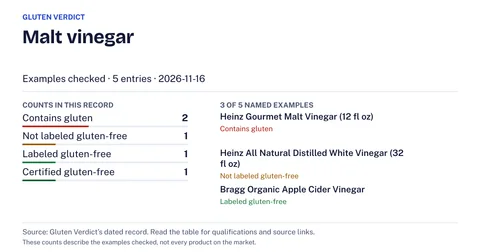 Malt vinegarContains glutenchecked Nov 16, 2026
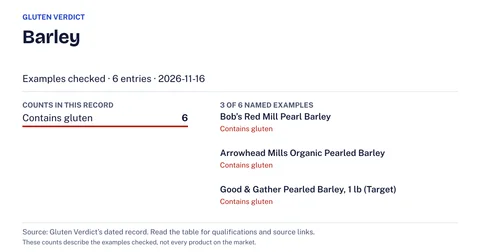 BarleyContains glutenchecked Nov 16, 2026
Questions people ask
Is a food labeled “natural” gluten-free?
Not by that word. On its page on the term (current as of 10/22/2018), FDA says it has not engaged in rulemaking for a formal definition of “natural”12, and its page on the term does not mention gluten2.
Is organic food gluten-free?
Organic status is unrelated to gluten-free status, according to GIG19.
Can a food made with a gluten grain carry a gluten-free claim after fermenting?
Only if the grain was processed to remove gluten and the food was under 20 ppm before fermentation33.
More in Gluten basics and myths
 What gluten is, which grains carry it and what “gluten-free” meansA plain definition of gluten, the grains that carry it, look-alike words such as malt and wheat starch, and what a US gluten-free label means.
 How the 20 ppm gluten-free limit was chosen, and by whomWho set the 20 ppm gluten-free limit and when: the 2004 law, FDA's 2013 rule and its stated reasons, the 2020 follow-up rule, and Codex and EU wording.
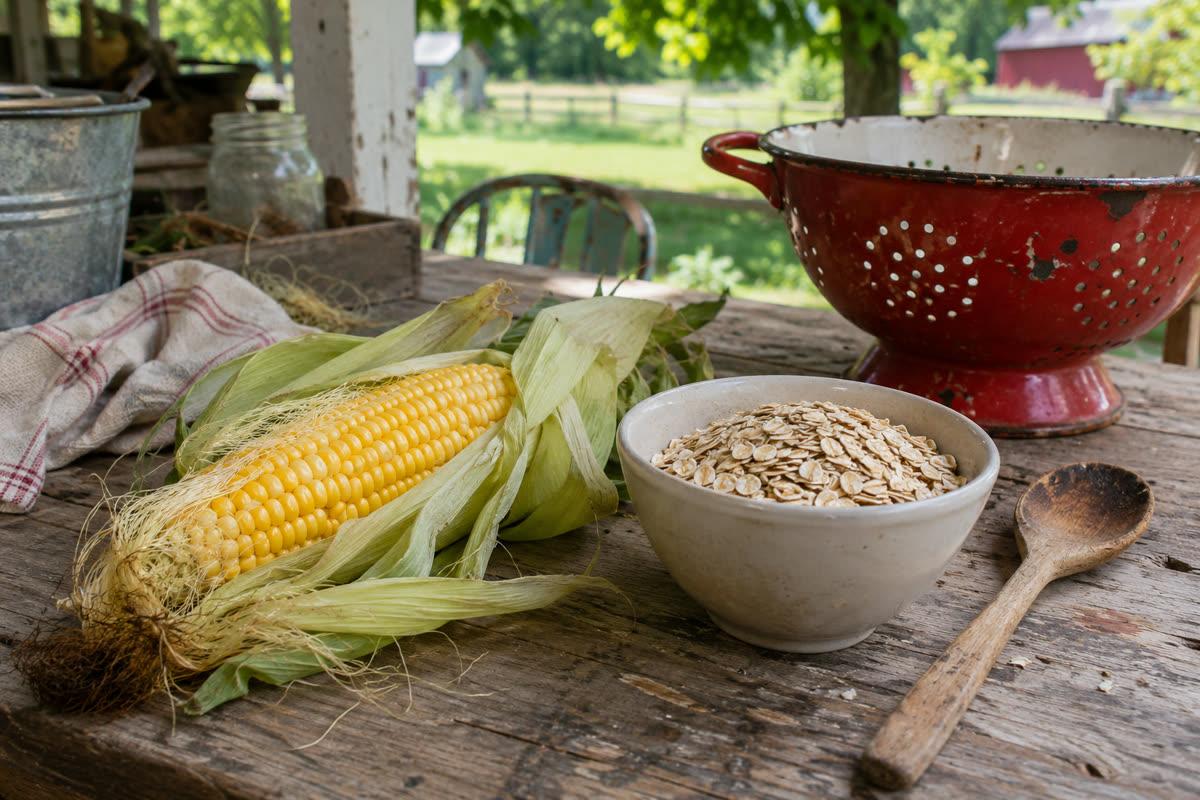 Zein, avenin and gluten: how corn and oats differ from wheatIs zein gluten? How FDA’s rule defines gluten, what “corn gluten” and avenin are, and why a gluten-free label matters for oats.
 Why gluten problems seem more common: what the evidence separatesGluten problems seem everywhere. Studies separate three things: cases found, cases that exist, and people avoiding gluten.
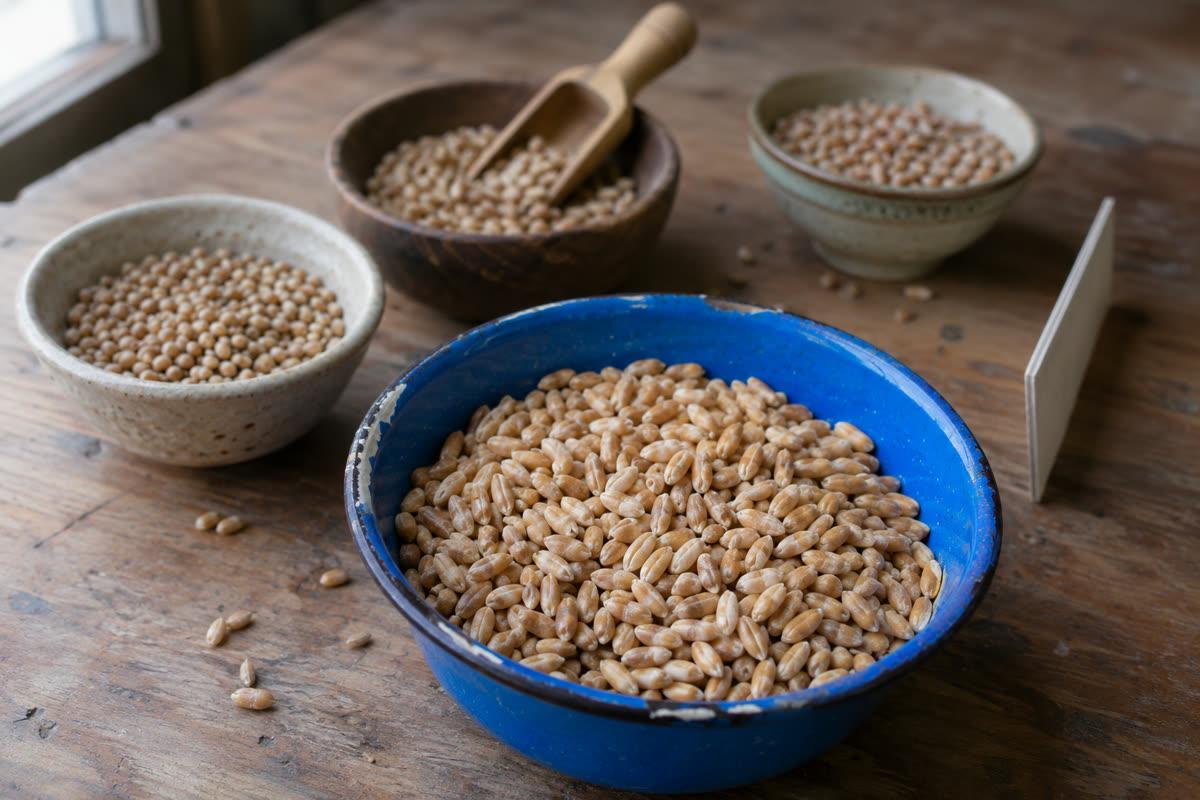 Spelt, Kamut, Durum and Einkorn: Every Kind of Wheat Has GlutenDurum, semolina, spelt, einkorn, kamut, farro: which wheat words on a US label count as gluten, and what the FDA rule and the sources say about each.
 Did modern wheat get worse? What the variety studies show on glutenWhat studies of old and modern wheat varieties show on gluten, and what they say about spelt, einkorn and ancient wheats and celiac disease.
Related guides
 Wheat-free, gluten-free and “no gluten ingredients”: what each label statement covers“Wheat-free”, “gluten-free” and “made with no gluten-containing ingredients” are three different statements. What each covers, and what to check.
 Does a gluten-free diet help you lose weight?What reviews, NIDDK and celiac charities report about a gluten-free diet and weight outside celiac disease, and what the substitute foods contain.
 Gluten and autism, ADHD or arthritis: what the research showsWhat reviews and trials report on gluten-free diets for autism, ADHD and arthritis, who ran them, how strong they are, and how celiac disease differs.
 How common is celiac disease? The figures people quote, and what each one counts1 in 100, 1 in 22 relatives, 3 percent of gene carriers: the group and study behind each celiac disease figure, and what studies say about a rise.
Sources
- [1, 2, 12] US Food and Drug Administration, Use of the Term Natural on Food Labeling, checked Nov 17, 2026.
Read on 2026-11-17: the page (footer: content current as of 10/22/2018) describes FDA’s policy on the term “natural” and its 2016 request for comments; the word “gluten” appears only in the site menu’s link “Gluten-Free Labeling of Foods”, not in the page text.
- [3, 4] US Department of Agriculture, Agricultural Marketing Service, Organic Regulations (National Organic Program), checked Nov 17, 2026.
Read on 2026-11-17: the page lists the USDA organic regulations (7 CFR Part 205), the Organic Foods Production Act, the program handbook and temporary variances; the word “gluten” does not appear on the page.
- [5, 16, 49] Electronic Code of Federal Regulations, 21 CFR 101.91 Gluten-free labeling of food, checked Nov 17, 2026.
- [6, 7, 9, 11, 13, 17, 18, 23, 25, 26, 29, 30, 33, 38, 53] US Food and Drug Administration, Questions and Answers on the Gluten-Free Food Labeling Final Rule, checked Nov 17, 2026.
- [8, 32] US Food and Drug Administration, FDA Issues Final Rule on Gluten-Free Labeling of Fermented and Hydrolyzed Foods, checked Nov 17, 2026.
- [10] US Food and Drug Administration, Food Allergen Labeling and Consumer Protection Act of 2004 (FALCPA), checked Nov 17, 2026.
- [14, 54] Coeliac UK, Common Coeliac Disease Myths Debunked, checked Nov 17, 2026.
- [15, 24, 48, 51] NIDDK (National Institutes of Health), Eating, Diet, & Nutrition for Celiac Disease, checked Nov 17, 2026.
- [19] Gluten Intolerance Group, Gluten-Free FAQ: organic lentils and gluten-free labeling, checked Nov 17, 2026.
- [20] Gluten Intolerance Group, Gluten-Free FAQ: natural flavors, checked Nov 17, 2026.
- [21, 22] Gluten Intolerance Group, Gluten-Free FAQ: inherently gluten-free vs naturally gluten-free, checked Nov 17, 2026.
- [27, 28, 50, 52] Gluten Intolerance Group, The Gluten-Free Diet: Facts and Myths, checked Nov 17, 2026.
- [31, 36, 37] Gluten Intolerance Group, Does Fermentation or Distillation Make a Product Gluten-Free?, checked Nov 17, 2026.
- [34, 35, 55] Alcohol and Tobacco Tax and Trade Bureau (TTB), TTB Ruling 2020-2: Gluten Content Statements in the Labeling and Advertising of Wine, Distilled Spirits, and Malt Beverages, checked Nov 17, 2026.
- [39, 40, 41, 42, 43, 44, 45, 46, 47] Gluten Intolerance Group, Are Oats and Oat Flour Gluten-Free?, checked Nov 17, 2026.