Is hing (asafoetida) gluten-free? How to read the jar
Short answer
Hing powder can be a blend, and the binder decides whether it carries gluten: India’s standard describes compounded asafoetida as asafoetida with gum arabic, edible starches or edible cereal flour2, and the Gluten Intolerance Group says hing is often processed with wheat6. Check three things on the jar in your hand:
- The binder in the ingredient line: wheat or wheat flour means the jar contains gluten, and on a label for an FDA-regulated US food wheat has to be declared32, 33, 36.
- Phrases such as “gluten friendly”, “wheat free” and “no gluten ingredients”: FDA treats “gluten-free” and three equivalent phrases as one claim and judges other terms about the absence of gluten case by case26, 27.
- “Batch tested”: it is the maker’s wording, FDA’s gluten-free rule does not require makers to test31, and the page we read gives no test figure17.
Part of Travel: Asia and the Middle East, 12 guides
Key points
- India’s standard caps starch in raw hing at 1%, while compounded hing is blended with gum arabic, edible starches or edible cereal flour2, 5.
- Seller pages read on 2026-11-17 showed rice flour (Rani), gum only (Pure Indian Foods), wheat flour at 60% (Kalustyan’s) and wheat (Ayurvedic Institute)11, 14, 21, 22.
- FDA’s gluten-free Q&A page does not mention “gluten friendly”; other terms about the absence of gluten are judged case by case27.
- A gluten-free claim on an imported, FDA-regulated food has to meet FDA’s rule30.
What hing is, and why the powder is a blend
Hing is asafoetida. India’s food standard defines it as the oleogumresin obtained from the rhizome and roots of Ferula plants1; one US seller describes it as the dried resin of a giant fennel-family plant10. Powder can be compounded: the same standard describes compounded asafoetida, called Bandhani Hing, as asafoetida blended with “gum arabic, edible starches or edible cereal flour”2. A 2026 Indian government release calls compounded hing an admissible category made by blending raw hing, gum arabic, starches and flours3.
The passage of the standard we read does not say which flour. Three organizations name hing as a place wheat turns up:
- The Gluten Intolerance Group says hing “is often processed with wheat” and could be used in chutneys, soups and sauces6.
- Beyond Celiac lists asafoetida as gluten-free but notes that “some brands are known to use wheat as a filler”7.
- Celiac India’s list of products that may have gluten hidden in them includes commercially available spice powder, “especially heeng”8. It adds that the answer depends on the manufacturer and on the regulations and practices of the country where the product is made9.
So the label question is not “is hing gluten-free” but “what is this jar’s binder”.
Six hing products, six ingredient lines
We read these seller pages on 2026-11-17 and copied the ingredient lines as printed there. They are web pages, not the jars; a recipe can change43, so the list on the jar in your hand is the one that counts. We rank no brand.
| Seller and product | Ingredient line on the page | Gluten wording on the page |
|---|---|---|
| Rani Brand, Asafetida (Hing) Ground, 3.75 oz | Asafoetida, Edible Gum, Rice Flour11 | Called “Gluten Friendly” in the title and “GLUTEN FREE” in the description12, 13 |
| Pure Indian Foods, Blue Label powder | Asafoetida (Hing), edible gum from acacia trees14 | “Batch-tested gluten-free”15 |
| Pure Indian Foods, Green Label powder | Same ingredients as Blue Label14, 15 | Described as not tested15; “No gluten ingredients. Processed in a facility that also handles gluten-containing ingredients”16 |
| Pure Indian Foods, Gold Label lumps | Pure Asafoetida (Hing)14 | “Batch Tested Gluten-Free”19 |
| Kalustyan’s house brand, Asafoetida (Hing) Powder w/ Wheat Flour | Wheat Flour (to prevent caking)(60%), Asafoetida (15%), Gum Arabic (stabilizer)21 | Wheat flour is in the product name and the ingredient line21 |
| Ayurvedic Institute store, Hing Asafoetida Compound, 1 oz | Asafoetida, wheat, gum arabic, rice, rice bran22 | “Please Note: Contains wheat”23; the web address says “wheat-free”24 |
Three things stand out. The Rani page names turmeric in its description sentence but not in its ingredient line11, 12; when a page disagrees with itself, the printed jar decides. The Kalustyan’s line shows how much of a compounded powder can be binder, with wheat flour listed at 60% and asafoetida at 15%21; that is one product, not a typical figure. And a web address that says “wheat-free” sat on a page that lists wheat22, 24, so a name is not an ingredient list.
Pure resin lumps versus powder
Pure Indian Foods sells lumps of resin and two powders whose only addition, it says, is “the minimum amount of edible gum (gum arabic)”18. Its directions for lumps are to grate a little with a microplane or crush a piece in a mortar and grind it20. Its page lists the lumps as “Pure Asafoetida (Hing)”14, one item where its powders list two14.
“Pure” is still a claim to check against the list. FSSAI’s standard caps starch in raw hing at a maximum of 1%5. On 29 August 2026 India’s FSSAI announced a prohibition-of-sale order after laboratory tests, and its release reports that six raw hing varieties from one maker’s unit contained between 15% and 32% starch5. The release does not say what the starch was made from, so it is not a gluten finding; it is one reason not to treat “raw” or “pure” as a substitute for reading the ingredient list.
“Gluten friendly”, “wheat free” and “batch tested”: what each promises
On an FDA-regulated food, “gluten-free” means the food is inherently gluten free or has no gluten-containing grain, no ingredient derived from one that was not processed to remove gluten, and no ingredient processed to remove gluten that results in 20 parts per million or more gluten; any unavoidable gluten must be under 20 parts per million25. FDA treats “free of gluten”, “without gluten” and “no gluten” the same way26. Other phrases are judged separately27. Our guide to low gluten, gluten removed and gluten friendly labels covers the wider set.
| Phrase | Where we saw it | What a reader can check |
|---|---|---|
| “Gluten-free” | Defined by FDA; used on the Rani description12 | FDA says a food labeled gluten-free cannot be intentionally made with wheat or a wheat-derived ingredient that was not processed to remove gluten29, and that an imported food making the claim must comply30. |
| “Gluten friendly” | Rani page title13 | FDA’s Q&A page does not name this term; it says other terms about the absence of gluten are evaluated case by case27. The Rani page gives no test result or definition13. |
| “Batch tested gluten-free” | Pure Indian Foods, Blue Label and Gold Label15, 19 | The seller’s own wording. The page gives no parts-per-million figure, method or laboratory17. FDA’s gluten-free rule does not require makers to test31. |
| “No gluten ingredients” | Pure Indian Foods, Green Label16 | FDA says that for a statement such as “made with no gluten-containing ingredients”, shoppers should not assume the food meets the gluten-free rule unless the label also carries the claim28. The same line mentions a facility that also handles gluten-containing ingredients16. |
| “Wheat free” | Web address of the Ayurvedic Institute page24 | The Celiac Disease Foundation says wheat-free products are not necessarily gluten-free35. Here the page lists wheat22. |
What the label has to tell you: US and India
On a jar sold in the US
When an FDA-regulated food contains a major allergen such as wheat, the label has to show it, either in a “Contains” line beside the ingredient list32 or by naming the source in parentheses after the ingredient33. Wheat is on the list of major food allergens in FALCPA, the 2004 law34. A binder of wheat flour should therefore appear on the label; the Celiac Disease Foundation counts anything that uses “wheat flour” as an ingredient among foods that contain gluten36. Barley and rye are not on that list34, which is one reason to read the whole ingredient line and not only the Contains line.
On a pack made in India
India’s labelling regulation requires cereals containing gluten, which it lists as wheat, rye, barley, oats and spelt (with a few listed exceptions, such as wheat-based glucose syrups), to be declared in a “Contains” statement under the cereal’s name38. India’s gluten-free standard says gluten free food consists of or is made of ingredients containing “rice, millets, ragi, pulses or legumes”, and that a product labelled gluten free must test below 20 mg/kg40, 41. Wheat is not among the ingredients that sentence names. A gluten-free product made in a plant that also makes gluten-containing products is to say “Processed in a plant where gluten containing products are manufactured”42, 47.
Compounded hing has its own grading and marking rules. India’s 1984 rules, which apply to compounded asafoetida produced in India, say every container shall indicate the approximate composition of edible starch or edible cereal flour used in compounding4. The rule says “edible cereal flour” without naming a cereal, so the ingredient line is where to find out which flour.
A spice blend with hing in it is a harder case. The same Indian labelling regulation says that where a compound ingredient is under 5 per cent of the food, its own ingredients, other than certain additives, “need not be declared”39. The same regulation’s allergen clause says allergenic foods and ingredients “shall be declared separately as Contains”38, so for a packed blend that lists hing, read the Contains line and ask the maker.
Where hing enters a dish, and what to ask
One maker says asafoetida is used a lot in dals, subzis and sambhars44; the Gluten Intolerance Group says hing could be used in chutneys, soups and sauces6. At home, the jar answers the question. In a restaurant or a relative’s kitchen, ask:
- Is hing used in this dish, and in the base of the dal, curry, chutney or soup?
- Is it compounded powder, and what is it compounded with?
- Can I see the jar or its ingredient line?
- Is there a pure or rice-flour hing in the kitchen that you can use for my dish?
If the jar cannot be read, the Celiac Disease Foundation’s advice is: “When unable to verify ingredients for a food item or if the ingredient list is unavailable do not eat it”37. A news item hosted on FSSAI’s site, reporting its guidance note, lists the line “if in doubt, leave it out”45.
For the rest of a menu, see Indian restaurant ordering and gluten-free India travel; for spice mixes, seasoning packets, bouillon and spice blends. Our verdict pages for related foods: spices, curry and lentils.
What we could not confirm
- We read seller pages, not jars. A web listing can differ from the pack in your hand, and recipes change43.
- No page we read gives a gluten test result in parts per million for any hing: the Rani page gives none13 and the Pure Indian Foods page gives none17.
- No regulator or charity page we read gives the share of compounded hing sold with wheat, so we give no share.
Verdicts in this guide
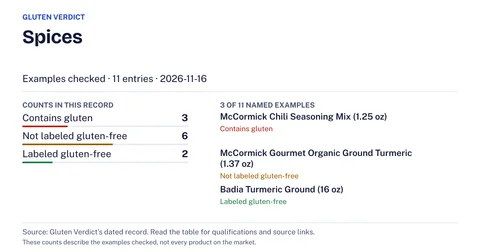 SpicesDepends on the product3 of 11 products we checked contain gluten: McCormick Chili Seasoning Mix (1.25 oz), Lawry’s Chili Spices & Seasonings Mix (1.48 oz), and McCormick Cheesy Taco Seasoning Mix (1.12 oz)checked Nov 16, 2026
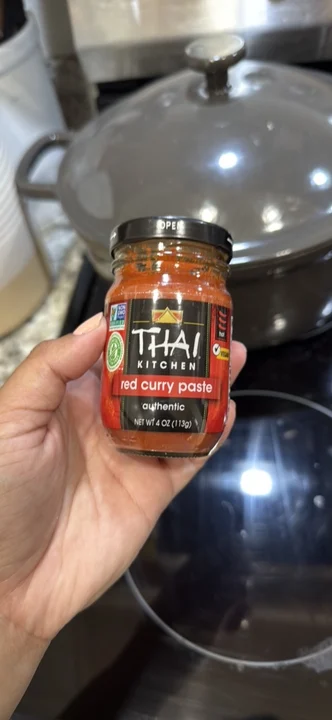 CurryDepends on the product2 of 11 products we checked contain gluten: S&B Golden Curry Mix, Mild (curry roux block) and S&B Golden Curry Sauce with Vegetables, Mild (pouch)checked Nov 16, 2026
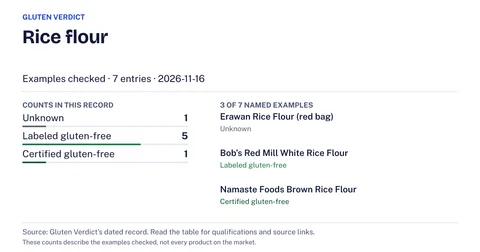 Rice flourNaturally gluten-freeBuy it labeled gluten-freechecked Nov 16, 2026
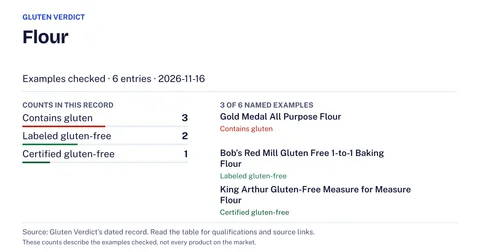 FlourContains glutenchecked Nov 16, 2026
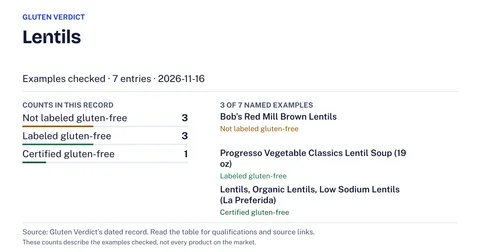 LentilsDepends on the productchecked Nov 16, 2026
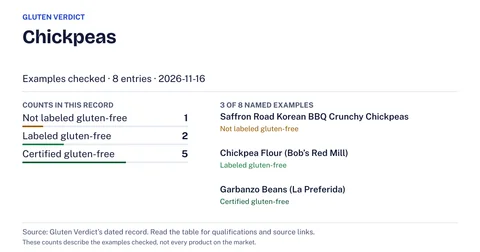 ChickpeasNaturally gluten-freechecked Nov 16, 2026
Questions people ask
Is asafoetida the same thing as hing?
Yes. Pure Indian Foods says asafoetida, also spelled asafetida, is known as hing, or heeng, in Hindi46.
Is pure asafoetida resin gluten-free?
Beyond Celiac lists asafoetida as gluten-free and warns that some brands use wheat as a filler7. Pure Indian Foods lists its lumps as “Pure Asafoetida (Hing)”14 and describes them as batch tested gluten-free19, but “pure” still has to match the ingredient list5.
Does a gluten-free claim on a hing jar from India count in the US?
If the jar is an FDA-regulated food sold in the US and makes a gluten-free claim, it must meet FDA’s gluten-free requirements30.
More in Travel: Asia and the Middle East
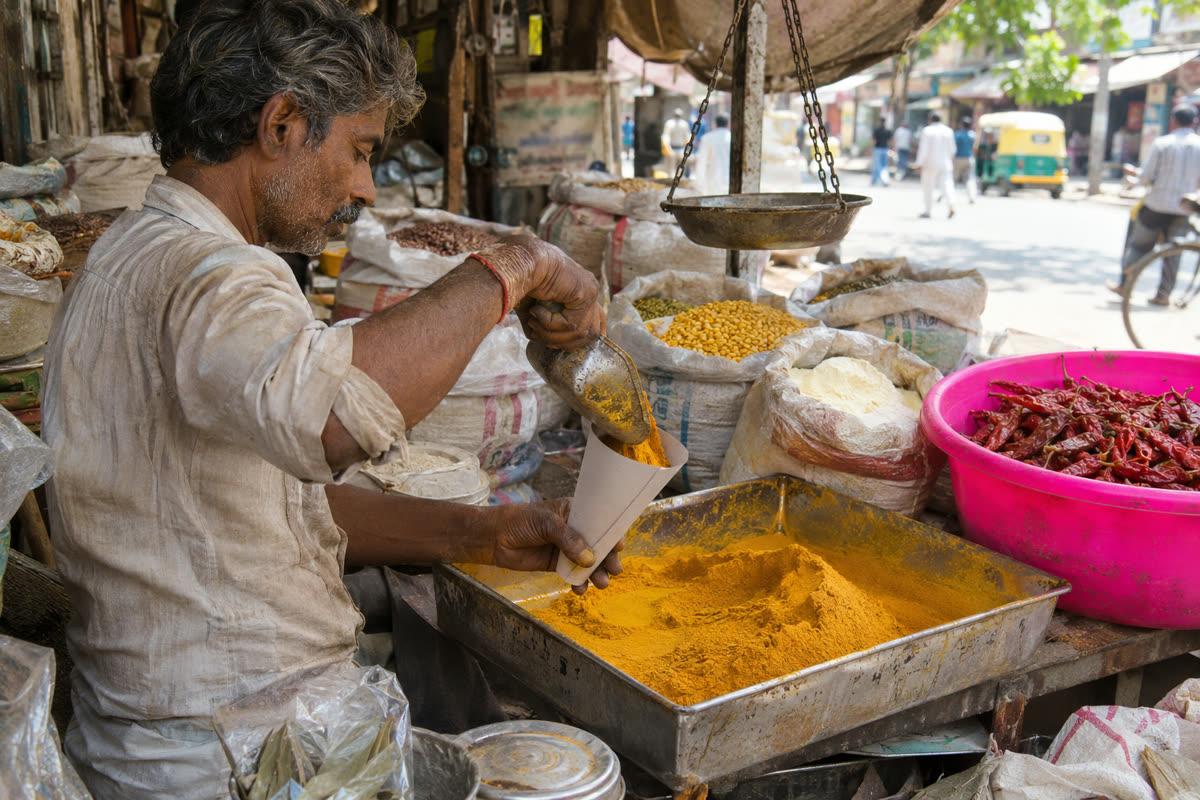 Gluten-free in India: hing, atta, rava and what a pack must sayWheat routes in Indian food that curry advice misses (hing, atta, rava, biryani seals, shared griddles) and what India’s own gluten free rules say.
 Gluten-Free in Israel: Labels, Kosher and the Israeli TableIsrael’s gluten label rules, the Hebrew words in the regulation, why kosher and kosher for Passover are not gluten-free claims, and where wheat enters.
 Gluten-free in Dubai and the Gulf: dishes by grain, imported packs and label checksWhich Gulf dishes start with wheat, how to read an imported pack in the UAE, and what Dubai Municipality says its laboratory tests.
 What “gluten-free” means on a pack in Asia, country by countryWhat a gluten-free claim requires in six Asian countries, what Japan, Hong Kong, Taiwan and China print instead, and how to read a pack in hand.
 Eating gluten-free in Thailand: sauces, noodles and street stallsWhere wheat shows up in Thai sauces, noodles and street food, how Thailand words its own gluten-free rule, and the Thai words to look for on a pack.
 Gluten-free in Singapore: hawker noodles, soya sauce and the new label ruleWhich Singapore hawker noodles are rice and which wheat, where soya and oyster sauce come in, and what the Food Agency's gluten-free label means.
Related guides
 Ordering at an Indian restaurant: where wheat enters the menuWhere wheat enters an Indian menu (naan, hing, thickeners, samosas, the fryer and the tandoor) and the questions to ask before you order.
 Seasoning packets, bouillon cubes and spice blends: where wheat entersWhy a packet, cube or blend can list wheat flour or barley when a single spice lists one item, and the order to read the label in.
 Where wheat, barley and rye hide in processed food: 15 places to checkFifteen processed foods where wheat, barley or rye turn up, the label step that catches each, and what US allergen law does and does not flag.
 Wheat, barley and rye on an ingredient list: the names to look forLook up wheat, barley and rye names on a US ingredient list, from durum to malt, and sort each as contains gluten, depends on the maker, or lookalike.
Sources
- [1, 2] Food Safety and Standards Authority of India (FSSAI), Food Product Standards, chapter 2.9: salt, spices, condiments (2.9.29 Asafoetida), checked Nov 17, 2026.
- [3, 5] Press Information Bureau, Government of India, FSSAI issues prohibition of sale order for compounded hing from two major spice brands over substandard quality (29 August 2026), checked Nov 17, 2026.
- [4] Government of India (India Code), Compounded Asafoetida Grading and Marking Rules, 1984, checked Nov 17, 2026.
- [6] Gluten Intolerance Group, Venturing into Indian Cuisine, checked Nov 17, 2026.
- [7] Beyond Celiac, Which Spices, Seasonings and Herbs are Gluten-Free?, checked Nov 17, 2026.
- [8, 9] Celiac India, Hidden gluten: gluten present as the source of one of the ingredients, checked Nov 17, 2026.
- [10, 14, 15, 16, 17, 18, 19, 20, 46] Pure Indian Foods, Best Hing Ever (asafoetida): Green, Blue and Gold labels, checked Nov 17, 2026.
Read on 2026-11-17: the page says the Blue Label powder and the Gold Label lumps are “batch tested gluten-free”; it gives no parts-per-million figure, test method or laboratory for the testing.
- [11, 12, 13, 44] Rani Brand, Rani Asafetida (Hing) Ground 3.75oz, Gluten Friendly, checked Nov 17, 2026.
Read on 2026-11-17: the page calls the jar “Gluten Friendly” in its title and bullet list and “GLUTEN FREE” in its description; it gives no gluten test result, certification or definition of “gluten friendly”.
- [21] Kalustyan's, Asafoetida (Hing) Powder w/ Wheat Flour, checked Nov 17, 2026.
- [22, 23, 24] Ayurvedic Institute store, Ayurvedic Institute Hing Asafoetida Compound (1 oz), checked Nov 17, 2026.
Read on 2026-11-17: the page’s web address ends “hing-asafoetida-compound-wheat-free”, while the page’s own ingredient line lists wheat and its note reads “Contains wheat.”
- [25, 26, 27, 28, 29, 30, 31] US Food and Drug Administration, Questions and Answers on the Gluten-Free Food Labeling Final Rule, checked Nov 17, 2026.
- [32, 33, 34] US Food and Drug Administration, Food Allergen Labeling and Consumer Protection Act of 2004 (FALCPA), checked Nov 17, 2026.
- [35, 36, 37] Celiac Disease Foundation, Sources of Gluten, checked Nov 17, 2026.
- [38, 39, 47] Food Safety and Standards Authority of India (FSSAI), Labelling and Display Regulations compendium, version VIII (9 September 2025), regulation 5(14), checked Nov 17, 2026.
- [40, 41] Food Safety and Standards Authority of India (FSSAI), Food Product Standards, chapter 2.14: Gluten Free Food, checked Nov 17, 2026.
- [42] Ministry of Health and Family Welfare, Government of India (Lok Sabha answer, 9 August 2024), Labelling of gluten-free products (Unstarred Question 3000), checked Nov 17, 2026.
- [43, 45] News item hosted on the FSSAI website, FSSAI note on gluten-free food (19 June 2019), checked Nov 17, 2026.