Gluten-Free in Israel: Labels, Kosher and the Israeli Table
Short answer
Three things to settle before you eat in Israel:
- Which rule sits behind “gluten-free”: the Hebrew text of the 1996 regulation on gov.il names 20 parts per million12, 26, and USDA reports that Israel adopted the EU regulation, which sets 20 mg of gluten per kg for the claim1, 15; USDA says labeling changes phase in until January 1, 2028, so we cannot tell which rule a given pack follows3.
- The Hebrew words in the regulation: מכיל גלוטן (“Contains Gluten”) for gluten in the ingredient list and ללא גלוטן for the gluten-free marking10, 11, 14. We did not check these words on a current pack.
- Kosher and kosher for Passover are not gluten-free claims: one certifier says some certifiers may certify wheat flour as kosher for Passover17, and a pita its maker calls Kosher Pareve lists wheat flour and malted barley flour19, 20.
- Gluten-free limit
- 20 mg of gluten per kg of food as sold for “gluten-free” in the EU regulation USDA reports Israel adopted1, 15; the Hebrew text of the 1996 regulation names 20 parts per million12
- Set by
- EU Regulation 828/2014 as adopted in Israel, phased in until January 1, 2028; earlier, the Public Health Regulations (Food) (Gluten Marking), 19961, 3, 9
- Oats
- Under the EU text, oats in a gluten-free food must be specially produced, prepared or processed against contamination and contain at most 20 mg/kg16
Part of Travel: Asia and the Middle East, 12 guides

Key points
- USDA reports that Israel adopted EU Regulation 828/2014 on gluten claims, without its “very low gluten” category1, 2.
- The Hebrew text of the 1996 gluten marking regulation on gov.il, whose amendment notes end in 2011, names 20 parts per million in section 2 and in the first condition of section 312, 26.
- The labeling rules Israel adopted from the EU phase in until January 1, 2028, and businesses may apply them earlier, so we cannot tell you which rule a given pack follows3.
- USDA describes kosher certification as meeting Israeli rabbinical demands on ingredients and processes, and says most supermarkets and hotels refuse to carry non-kosher products; neither passage mentions wheat or gluten, so a kosher mark does not answer the gluten question6, 7.
- The regulation’s definition of gluten names wheat, rye, barley and oats and their products13; read the ingredient list for those grains and for the words מכיל גלוטן10.
Which gluten label rule applies in Israel?
The Tel Aviv office of the US Department of Agriculture’s Foreign Agricultural Service reported in January 2026 that Israel adopted EU Regulation 828/2014, the regulation on claims about the absence or reduced presence of gluten in food1. Two parts do not carry over: a food labeled “gluten-free” does not become a “specialized food” for that reason alone, and the provisions on reduced gluten and “very low gluten” labeling will not apply2.
The EU text allows the statement “gluten-free” only when the food as sold contains no more than 20 mg/kg of gluten15. Oats in a food presented as gluten-free must have been specially produced, prepared or processed to avoid contamination by wheat, rye, barley or their crossbred varieties, and contain at most 20 mg/kg16. The Hebrew text of the 1996 regulation on gov.il also names 20 parts per million12, 26.
The timing is the catch. USDA says a transition period for the adopted EU labeling rules runs until January 1, 2028, and a business that chooses to apply them earlier must comply with them3. The English-language Food Label and Nutritional Labeling portal that USDA points to describes the rules in effect before the EU rules were adopted4. Before the change, USDA described the Public Health Regulations (Food) (Gluten Marking) as the rule on labeling gluten-free products, available in Hebrew only9.
The adopted EU labeling rules also make allergens a mandatory declaration; USDA’s list reads “Allergens listed in Appendix 2” and the report excerpt we read does not spell out which allergens that covers8. So we do not say how cereals with gluten are declared on an Israeli pack.
We could not open the Knesset Research Center’s paper on celiac disease in Israel directly (the server refused our request); a text reader returned it, but it covers diagnosis and costs and we did not rely on it. No page we could open says which of the two rules a pack on a shelf today follows. Treat this page as a reading of what we could verify, dated 2026-11-17.
The Hebrew words the 1996 regulation prints
The English summary of the 1996 regulation on FAO’s legal database says section 2 bars producing, importing or marketing a food that contains gluten unless the ingredient list shows it and carries the words “Contains Gluten”, and that section 3 covers the marking of foods that do not contain gluten14. The Hebrew text of the regulation on gov.il is a single page10. The English summary comes from FAO; the glosses in the table are our reading of the Hebrew.
| Hebrew | Where it appears | What the source says |
|---|---|---|
| מכיל גלוטן | Section 2: the words that go with the plant the gluten comes from, for food above 20 parts per million | Rendered “Contains Gluten” in the FAO summary10, 14; the figure is in the Hebrew12 |
| ללא גלוטן | Section 3: the words a food may carry if it meets three conditions | The marking of foods that do not contain gluten11, 14 |
| גלוטן | Section 1: the definition | Wheat, rye, barley and oats and their products are named in the definition; our reading of the Hebrew13 |
The Hebrew prints the figure twice: section 2 applies to gluten in an amount above 20 parts per million12, and the first of the three conditions in section 3 for the words ללא גלוטן also names 20 parts per million; the other two concern manufacture under good manufacturing conditions as defined in a 1993 regulation and steps taken against contamination26. The EU rule USDA reports Israel adopted uses 20 mg/kg1, 15. We could not confirm which of the two a given pack follows during the transition3.
Kosher, kosher for Passover and gluten-free are three different claims
Kosher certification is not a legal requirement for importing food into Israel, except for beef, poultry and other meat products5. USDA says non-kosher products have a smaller market share because most supermarkets and hotels refuse to carry them6. USDA describes the kosher standard as rabbinical demands that ingredients and processes meet kosher standards; the passage names no gluten limit7.
Kosher and wheat can sit on the same pack. Toufayan’s Classic White Pita is among the pitas its page calls Kosher Pareve19, and its ingredient list starts with enriched flour made from wheat flour and malted barley flour and ends with “CONTAINS: WHEAT, SESAME”20. That is a US maker’s pita, an example of the pairing rather than a rule about Israeli bread; our pita verdict has the rest.
Kosher for Passover
Seal-K, a kosher certifier, says many Passover-certified products are gluten-free because they contain no wheat or other grains, but that some certifiers may certify wheat flour as kosher for Passover under certain conditions17. It advises people who are gluten intolerant or have celiac disease not to use the Passover certification alone as an indicator of “gluten free” status18. That is one certifier’s statement (its page lists a Chicago address)17, not a rule for every certifier and not a statement from an Israeli authority.
The Israeli table: where wheat can enter
We link our verdict page for each food instead of restating it. Each verdict shows what the makers’ own pages said and the date we read them.
| On the table | What to check | Our verdict page |
|---|---|---|
| Hummus and chickpeas | The tub or restaurant recipe, and what you scoop it with | hummus, chickpeas |
| Tahini | Makers describe it as ground sesame seeds: Ziyad22 and Har Bracha23. Check the jar for anything added. | tahini |
| Pita and other breads | The ingredient list: the pita we read lists wheat flour and wheat gluten20 | pita, bread |
| Pearl-style couscous | The pearl couscous we read from one US maker is made with semolina flour21. We found no page we could open that defines Israeli couscous, so ask what the grain is made from. | couscous |
| Bulgur and other grain salads | Our bulgur record says it contains gluten; for other grain salads, ask what the grain is | bulgur, lentils |
| Falafel and spit-roasted meat | The mix or coating, and the seasoning blend | falafel, gyro, spices |
| Beer | The grain it is brewed from | beer |
Schnitzel, sabich, kubbeh and freekeh are not covered here because we found no source we could open for them. Ask what the coating, bread or shell is made from.
Where to turn for local help
The Celiac Disease Foundation’s list of celiac associations around the world lists, for Israel, the address www.celiac.org.il24. When we requested that address on 2026-11-17 it returned status 410 and an error page with no site content25, so we cannot point you to a working association site from here.
What we did not find, and so do not claim: any prevalence figure for Israel, any list of restaurants or cities, or any account of how a given kitchen handles shared fryers. Before a trip, read the pack, photograph the ingredient list, and compare it against the words above and our labels guide, which covers US labels. Our gluten scanner has a “Read with AI” option meant for labels in other languages; compare what it returns with the label.
Verdicts in this guide
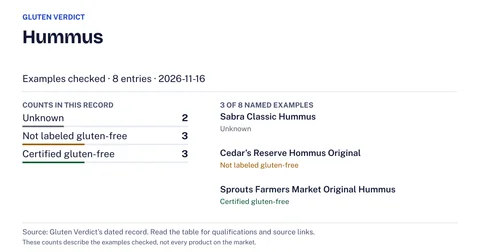 HummusDepends on the productchecked Nov 16, 2026
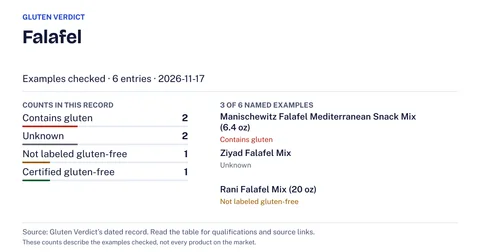 FalafelDepends on the product2 of 6 products we checked contain gluten: Manischewitz Falafel Mediterranean Snack Mix (6.4 oz) and Al’Fez Lebanese Falafel Kit (5.3 oz)checked Nov 17, 2026
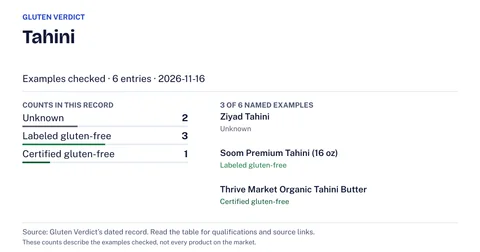 TahiniDepends on the productchecked Nov 16, 2026
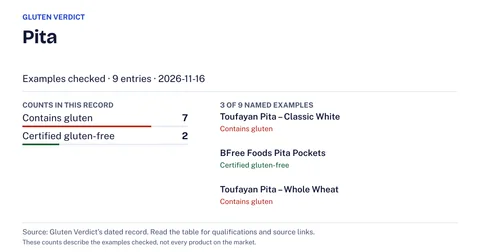 PitaContains glutenchecked Nov 16, 2026
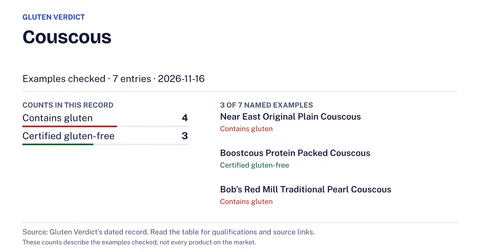 CouscousContains glutenchecked Nov 16, 2026
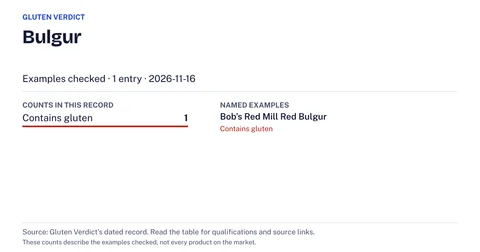 BulgurContains glutenchecked Nov 16, 2026
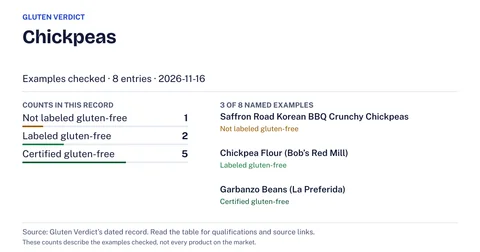 ChickpeasNaturally gluten-freechecked Nov 16, 2026
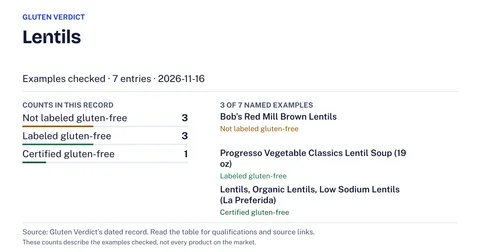 LentilsDepends on the productchecked Nov 16, 2026
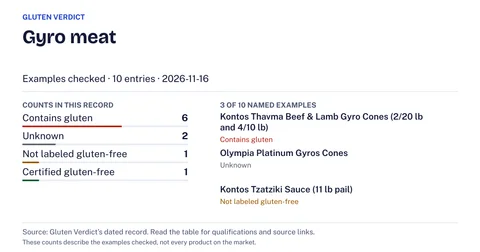 Gyro meatDepends on the product6 of 10 products we checked contain glutenchecked Nov 16, 2026
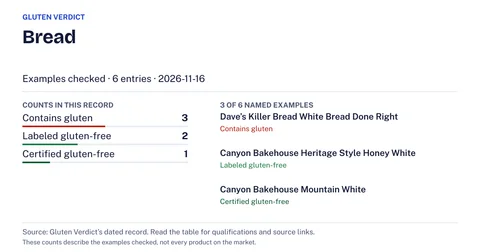 BreadContains glutenchecked Nov 16, 2026
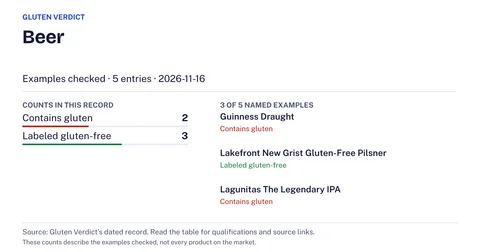 BeerDepends on the product2 of 5 products we checked contain gluten: Guinness Draught and Lagunitas The Legendary IPAchecked Nov 16, 2026
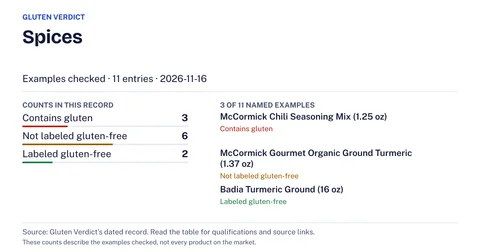 SpicesDepends on the product3 of 11 products we checked contain gluten: McCormick Chili Seasoning Mix (1.25 oz), Lawry’s Chili Spices & Seasonings Mix (1.48 oz), and McCormick Cheesy Taco Seasoning Mix (1.12 oz)checked Nov 16, 2026
Questions people ask
Does kosher mean gluten-free?
No. USDA describes the kosher requirement as rabbinical demands on ingredients and processes7, and a pita its maker calls Kosher Pareve lists wheat flour19, 20. Seal-K says some certifiers may certify wheat flour as kosher for Passover17.
Is Israel’s gluten-free limit 20 ppm?
The Hebrew text of the 1996 regulation on gov.il names 20 parts per million12, 26, and the EU regulation USDA reports Israel adopted allows “gluten-free” at no more than 20 mg/kg1, 15. We could not confirm which rule a given pack follows during the transition to January 1, 20283.
What does ללא גלוטן say?
It is the phrase in section 3 of the 1996 regulation for the marking of foods that do not contain gluten11, 14.
Can I buy a “very low gluten” food in Israel?
USDA reports that the provisions on “very low gluten” labeling do not apply in Israel2.
More in Travel: Asia and the Middle East
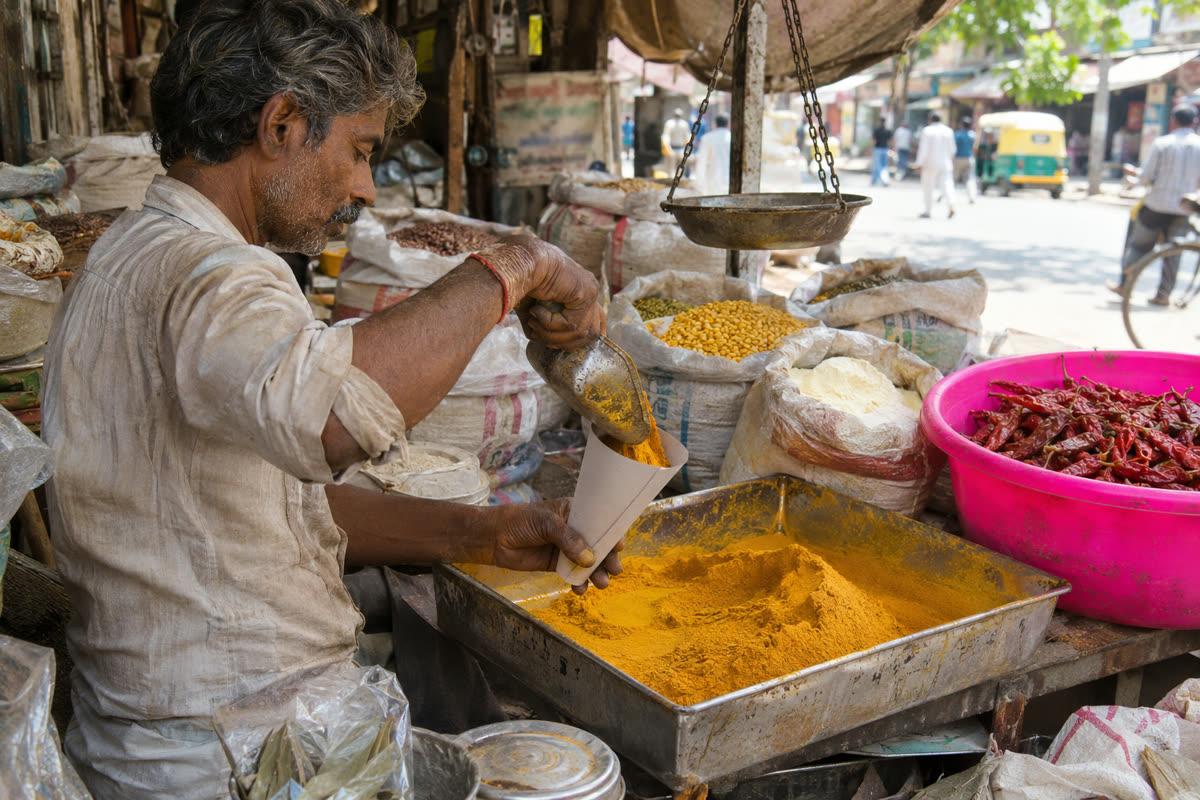 Gluten-free in India: hing, atta, rava and what a pack must sayWheat routes in Indian food that curry advice misses (hing, atta, rava, biryani seals, shared griddles) and what India’s own gluten free rules say.
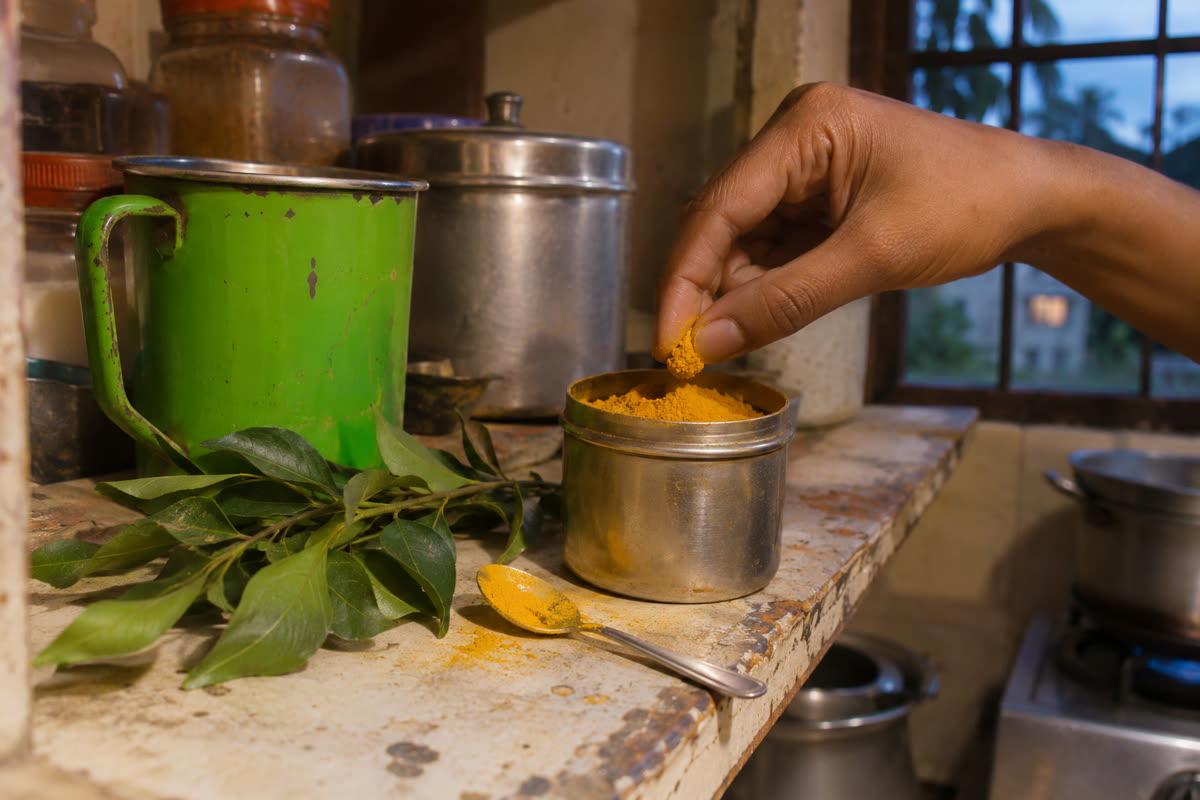 Is hing (asafoetida) gluten-free? How to read the jarHing powder can be a blend. How to read its binder, and what “gluten friendly”, “wheat free” and “batch tested” do and do not promise.
 Gluten-free in Dubai and the Gulf: dishes by grain, imported packs and label checksWhich Gulf dishes start with wheat, how to read an imported pack in the UAE, and what Dubai Municipality says its laboratory tests.
 Gluten-free in Japan: soy sauce, miso, barley tea and the allergen boxWhat to check in Japan: wheat in soy sauce, barley in miso and barley tea, and what the Japanese allergen box covers and leaves out.
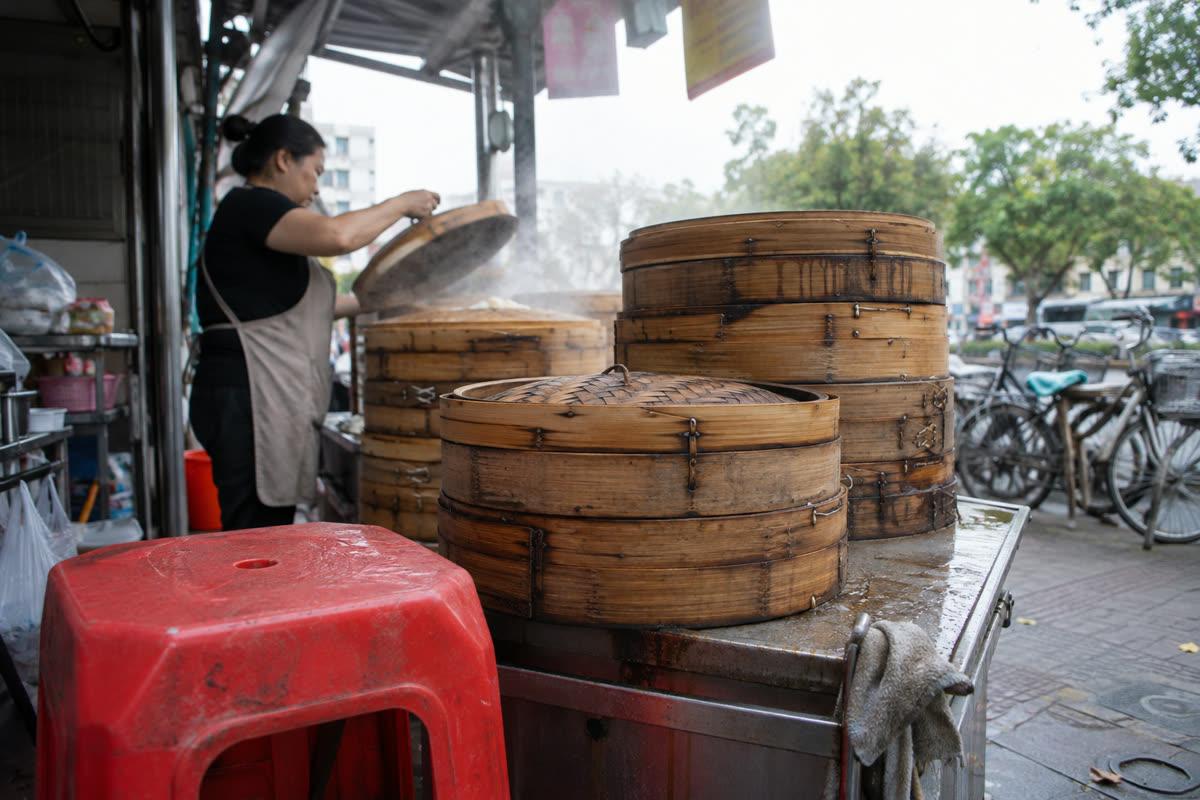 Gluten-free in China: wheat staples, sauces, hot pot and the label rulesWhere wheat sits in Chinese staples, sauces and hot-pot bases, what China’s label standard requires, and the Chinese words it prints for wheat and gluten.
 Gluten-free in South Korea: where wheat and barley turn up at a Korean tableWhere wheat and barley turn up in Korean food: marinades, ganjang, doenjang, gochujang, noodles, barley tea, and what a Korean label says.
Related guides
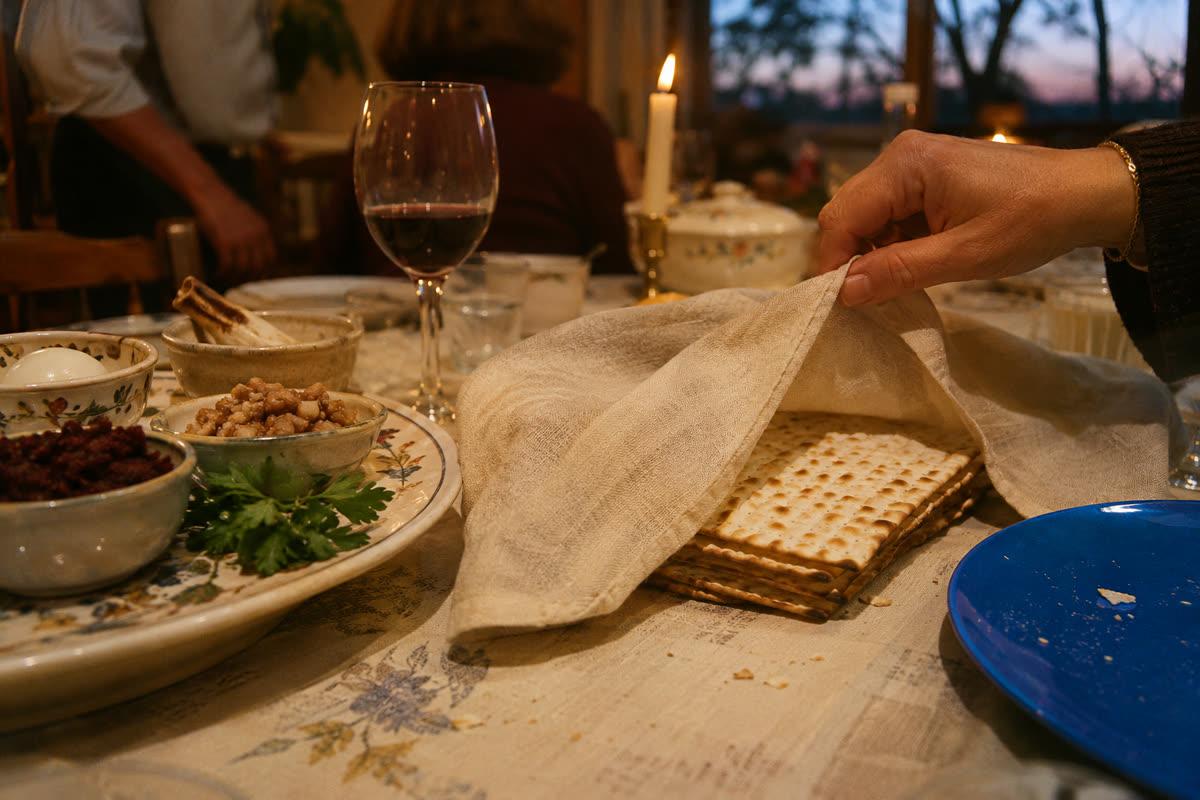 Passover and gluten: matzo, matzo meal and what a kosher mark leaves outWheat matzo contains gluten and a kosher-for-Passover mark is not a gluten-free claim. How to check matzo, matzo meal, cake meal and seder dishes.
 Gluten-free dining cards in other languages: where the wording comes fromWhich gluten-free card wording comes from EU law or a celiac society, which cards are members-only, and how to hand one to a server.
 What “gluten-free” means on a pack in Asia, country by countryWhat a gluten-free claim requires in six Asian countries, what Japan, Hong Kong, Taiwan and China print instead, and how to read a pack in hand.
 Kosher and halal marks on food: what they say about glutenA kosher or halal mark and a gluten-free claim answer different questions. What each certifier says its mark covers, and where the gluten answer is.
Sources
- [1, 2, 3, 4, 5, 6, 7, 8] US Department of Agriculture, Foreign Agricultural Service (Tel Aviv), Israel: FAIRS Country Report Annual (report IS2025-0023, January 21, 2026), checked Nov 17, 2026.
- [9] US Department of Agriculture, Foreign Agricultural Service (Tel Aviv), Israel: Food and Agricultural Import Regulations and Standards Country Report (IS2022-0006, August 29, 2022), checked Nov 17, 2026.
- [10, 11, 12, 13, 26] Government of Israel (gov.il legislation database), Public Health Regulations (Food) (Gluten Marking), 1996 (Hebrew text, amendment notes to 2011), checked Nov 17, 2026.
Read on 2026-11-17: the Hebrew text's amendment notes list 1997 and 2011, and section 3 lists three numbered conditions after the words "ללא גלוטן": (1) a gluten level stated against 20 חלקים למיליון (parts per million); (2) manufacture under good manufacturing conditions as defined in a 1993 regulation, to the satisfaction of the Director; (3) steps taken to ensure the gluten level in the raw material and the food does not exceed 20 חלקים למיליון.
- [14] FAO / UNEP Law and Environment Assistance Platform (FAOLEX), Public Health Regulations (Food) (Gluten Marking), 1996: abstract, checked Nov 17, 2026.
- [15, 16] European Union (EUR-Lex), Commission Implementing Regulation (EU) No 828/2014, checked Nov 17, 2026.
- [17, 18] Seal-K Kosher Certification, Kosher for Passover, checked Nov 17, 2026.
- [19, 20] Toufayan Bakeries, Pita – Classic White, checked Nov 17, 2026.
- [21] Bob’s Red Mill, Traditional Pearl Couscous, checked Nov 17, 2026.
- [22] Ziyad Brothers Importing, Ziyad Tahini, checked Nov 17, 2026.
- [23] Har Bracha, Tahini (squeeze bottle), checked Nov 17, 2026.
- [24] Celiac Disease Foundation, Associations Around the World, checked Nov 17, 2026.
Read on 2026-11-17: the page headed “Associations Around the World” lists, for Israel, the address www.celiac.org.il and no association name or other text.
- [25] celiac.org.il (address listed by the Celiac Disease Foundation), Home page request, checked Nov 17, 2026.
Requested on 2026-11-17: the address returned HTTP status 410 and a short error page with no site content.