What “gluten-free” means on a pack in Asia, country by country
Short answer
What “gluten-free” promises on a pack in Asia depends on the country where it is sold, and the regulators’ own texts we read fall into three groups1, 2, 3, 4, 5, 6:
- Singapore, South Korea, India, Thailand, Indonesia and Malaysia each define a gluten-free claim in their own rules, and each text states a 20 mg/kg limit (Thailand: for foods made from gluten grains processed to remove gluten; Malaysia prints it as 0.002 g per 100 g)1, 2, 3, 4, 5, 6.
- Japan has no general claim in the documents we read; its voluntary “Non-Gluten” label term for rice flour is set at 1 ppm or less7, 8, and its allergen rule names wheat but not barley or rye9.
- Hong Kong, Taiwan and China print an allergen line that includes cereals containing gluten, and the pages we read define no gluten-free claim10, 11, 12, 13, 14, 15.
Part of Travel: Asia and the Middle East, 12 guides
Key points
- Six regulators we read define a gluten-free claim, each stating a 20 mg/kg limit in its own words (Thailand: for foods made from gluten grains processed to remove gluten; Malaysia: 0.002 g per 100 g)1, 2, 3, 4, 5, 6.
- Singapore, Thailand and Indonesia let a gluten cereal count once it is processed to the limit; South Korea’s English text requires that no wheat, barley or rye is used1, 2, 4, 5.
- A Singapore pack can say gluten-free and still name wheat: SFA says such a pack must still declare the cereal in the ingredients16.
- Japan’s allergen duty names wheat and says barley and rye are outside the wheat item9; its 1 ppm “Non-Gluten” label term covers rice flour7.
- The one product test we found, of 119 packs labelled gluten-free in China, put 13.4% above 20 mg/kg17.
What a pack can say: a claim, or only an allergen line
Two different things can be printed on a pack: a gluten-free claim, and an allergen declaration that names cereals containing gluten. This guide reads them separately, because the countries below treat them separately.
The international reference is Codex Alimentarius. Its standard for people intolerant to gluten says the gluten content of a gluten-free food shall not exceed 20 mg/kg18. It sets a second band for foods specially processed to reduce gluten, above 20 and up to 100 mg/kg19, and says those foods must not be called gluten-free20.
Singapore’s food agency says its new labelling amendments were written to incorporate provisions of that Codex standard21, 22. Whether any other country’s rule follows Codex is something only its own text can show, so the tables below quote each one.
Countries with a written gluten-free claim
Six regulators we read set out what a gluten-free claim means in their own text. The table gives the wording and limit as that text states it, what it says about gluten grains in the food, and what else the pack carries.
| Country and rule | Claim wording and limit | Gluten grains in the food | Also on the pack |
|---|---|---|---|
| Singapore: Regulation 250B, in operation from 30 January 2026 per SFA’s slides23 | “Gluten-free”: 20 mg/kg or less of gluten by weight of the food as sold. “Reduced gluten”: more than 20 and up to 100 mg/kg1, 24 | A cereal may be in the food if processed down to the limit; the cereals named are barley, oat, rye and wheat1, 25 | The cereal must still be named in the ingredients16. SFA’s example: on potato chips with wheat-based seasoning, “naturally gluten-free” must sit immediately before or after “potato chips”26 |
| South Korea: Foods Labeling Standards, English edition, last revised 12 February 201427 | “Gluten Free” may be used when the gluten is less than 20 mg/kg2 | No wheat, barley or rye used2 | The allergen list names wheat among its items28. A warning of possible allergen mixture is required where one process makes products with and without allergens29 |
| India: FSSAI claims compendium, labelling compendium and regulation 2.14 | “Gluten content in the product shall not exceed 20 mg/kg” in the claims compendium3; regulation 2.14(4) says the gluten levels shall be below 20 mg/kg30 | Regulation 2.14 describes gluten free food as made of ingredients containing rice, millets, ragi, pulses or legumes31 | “Gluten Free” printed in immediate proximity to the product name32. A gluten-free product made in a plant that also makes gluten products must say so33. The “Contains” allergen line names cereals containing gluten34, with listed exceptions such as wheat-based glucose syrups63; cross-contamination may be declared separately as “May Contains”35 |
| Thailand: Ministry of Public Health Notification No. 384 (2017)4 | Only “ไม่มีกลูเตน” or “gluten free” may be used; 20 mg/kg is the stated limit for foods made from gluten grains processed to remove gluten4 | Foods from naturally gluten-free grains or tubers, or from wheat, rye, barley or oat processed to remove gluten4 | Those processed products must also carry a statement that they were specially processed to remove gluten, in Thai or as “being specially processed to remove gluten”4. The allergen statement names cereals containing gluten, with listed exceptions such as wheat-based glucose syrups36, 37 |
| Indonesia: BPOM Regulation No. 1 of 2022, Article 16 and Annex VI38 | “Bebas Gluten” at 20 mg/kg or less; “Rendah Gluten” at 21-100 mg/kg; “tanpa” and “tidak mengandung” are allowed in place of “bebas”5 | Claim only on food made from gluten cereals processed to reduce gluten, or from named gluten-free raw materials such as rice, maize and cassava5 | Allergen statement names cereals containing gluten39; wording such as “mungkin mengandung” (may contain) is among those listed40 |
| Malaysia: Food Regulations 1985, Fifth A Schedule (updated to P.U.(A) 48/2026)6 | Gluten “Free”: 0.002 g per 100 g; “Reduced”: 0.01 g per 100 g, solids or liquids6 | “Reduced gluten” only on food from wheat, rye, barley, oats or crossbred varieties specially processed to reduce gluten41 | Ingredients known to cause hypersensitivity must be declared on the label42; the list opens with “cereal containing gluten including wheat, rye, barley and oat”43 |
Malaysia writes its limit in grams per 100 g6. In the unit the other rows use, 0.002 g per 100 g is 20 mg per kg (our conversion).
Where the six differ
The number is close, the wording is not. Singapore says 20 mg/kg or less1; South Korea says less than 20 mg/kg2. India’s claims compendium says the gluten “shall not exceed 20 mg/kg”3 while its regulation 2.14 says below 20 mg/kg30. The US rule says any unavoidable gluten must be less than 20 ppm44. Read the limit in the country’s own text rather than assuming a match.
Whether a gluten grain can be in the food splits them. Singapore, Thailand and Indonesia let a gluten cereal count once it is processed down to the limit1, 4, 5. Thailand then requires “being specially processed to remove gluten” beside the claim on those products4. South Korea’s English text instead requires that no wheat, barley or rye is used2, and India’s regulation describes gluten free food by its ingredients, rice, millets, ragi, pulses or legumes31.
A Singapore pack can say gluten-free and still name wheat. SFA says a pack labelled gluten-free that contains the specified cereals or their products must still declare them in the ingredients16, and notes that gluten may still be present because the threshold is 20 mg/kg or less45.
Singapore’s rule is new. SFA’s slides say the amendments, published in the e-Gazette on 31 January 2025, come into operation on 30 January 202623.
South Korea’s English text is old. The English edition we read ends with a revision of 12 February 201427, and its own note says the Korean original prevails over the English translation46.
Thailand attaches the figure to one group of foods. The Thai FDA’s page lists the gluten-free notification and a clarification of it47. In the notification itself, the 20 mg/kg figure is attached to foods made from gluten grains processed to remove gluten; the items for naturally gluten-free grains and tubers state no figure4.
Indonesia asks for proof. Its regulation says a claim on the label must be proved by analysis from an accredited or government laboratory48.
Japan: the Non-Gluten label term and a wheat-only allergen rule
Japan’s agriculture ministry set a Japanese “Non-Gluten” for rice flour, defined as 1 ppm or less of gluten, against the 20 ppm “gluten-free” of the West7, 49. In 2017 the ministry issued a labelling guideline for rice flour products, which it describes as a way to promote manufacturers’ voluntary efforts50. A product using it shows the word “Non-Gluten” together with a note that it is 1 ppm or less8.
We found no Japanese claim rule for foods in general in the documents we read. The Consumer Affairs Agency’s April 2026 allergen handbook tells makers, in its notes on imported foods, that Western gluten-free labelling and Japan’s allergen labelling follow different standards51, and it gives no gluten-free definition or limit52.
The allergen duty covers nine items, including wheat53. The handbook says barley and rye are outside the wheat item9, so the mandatory wheat item does not cover them; for barley-based foods the ingredient list is where to look. Our verdicts on barley and miso show what the sources and makers’ own pages we read said. Our Japan travel guide covers the country’s other label issues.
Hong Kong, Taiwan and China: an allergen line, and no claim definition on the pages we read
| Place | What the allergen rule lists | Traces and shared lines | Claim definition |
|---|---|---|---|
| Hong Kong | Prepackaged food must declare the presence of any of eight substances, the first being cereals containing gluten10. CFS says this has been required since 200454 | CFS says an allergen warning statement may also appear near the ingredients55 | None on the pages we read13 |
| Taiwan | Eleven allergens must be labelled, including gluten-containing cereals11 | A precautionary statement about shared plant, equipment or line is suggested56 | None on the page we read14 |
| China | GB 7718-2025 names cereals containing gluten (wheat, rye, barley, oats, spelt or hybrids) among eight allergen categories12; the copy we read gives 16 March 2027 as the implementation date57 | Declaring a hint where allergens may be carried in during production is encouraged57 | The authors of a 2025 study, including CFSA researchers, write that there is currently no national standard for gluten-free foods15, and that CFSA began developing one in 202358 |
“None on the pages we read” is a dated observation, not a finding that no rule exists anywhere. See the section on what we could not confirm. Our country guides cover more of each place: Hong Kong and China.
A claim still needs a maker’s page: 119 packs tested in China
The one product test we found is a 2025 study by authors including researchers at China’s CFSA. They bought 119 prepackaged products labelled gluten-free from Chinese internet suppliers in March 202459. Among them, 13.4% contained gluten exceeding 20 mg/kg and 5.0% contained over 100 mg/kg17. None of the 33 imported products was above 20 mg/kg; 16 of the 86 domestically made ones (18.6%) were60.
This is one study of one market and one way of buying packs, so it does not describe other countries. It shows that where there is no national standard15, the claim alone did not settle the question for those packs. Look for the maker’s own page on testing or certification: see what to ask a manufacturer and how certification programs differ.
Using the tables on a pack in hand
- Note the exact wording on the pack and the country where you bought it, then find that country in the tables above.
- If the country defines a claim, check the wording. In Thailand only “ไม่มีกลูเตน” or “gluten free” counts4; in Indonesia the word is “bebas”, with “tanpa” and “tidak mengandung” allowed5; in India “Gluten Free” goes in immediate proximity to the product name32.
- Read the ingredient list for wheat, barley, rye and oats anyway. A Singapore pack can name the cereal and still carry the claim16, and a Thai product made from a gluten grain must carry a statement that it was processed to remove gluten4.
- If the pack has only an allergen line, remember what it names. Japan’s mandatory line names wheat, and barley and rye are outside the wheat item53, 9; South Korea’s list names wheat28; Singapore, India, Thailand, Indonesia, Malaysia, Hong Kong, Taiwan and China name cereals containing gluten61, 34, 36, 39, 43, 10, 11, 12. India and Thailand list exceptions, such as wheat-based glucose syrups63, 36.
- Our verdicts on ingredients that turn up on these packs show what the sources and makers’ own pages we read said: soy sauce, miso, rice flour, barley, MSG and hydrolyzed vegetable protein. Sauces and noodles have their own guide.
- If a claim matters and you cannot tell whether the maker tested, ask the maker; the manufacturer questions guide lists what to ask.
Country pages with more on eating there: Singapore, South Korea, India, Thailand, Japan, Hong Kong and China.
What we could not confirm, and when we read it
Everything here was read on 17 November 2026. The limits:
- Singapore: we read SFA’s slides, which say the amendments come into operation on 30 January 202623; we did not read the gazetted text.
- South Korea: the English text ends with a revision of 12 February 201427 and the Korean original prevails46; we could not read the current Korean text.
- India: the live FSSAI web address would not open from our connection, so we read FSSAI’s own PDFs through Internet Archive copies (the addresses in the sources show their capture dates). The limit is worded two ways3, 30.
- Thailand: we read the notification in Thai4. The English translation of Notification No. 450 that we read is headed “(Unofficial)”62.
- Indonesia: the annex pages of the gazette copy are scanned images, so we read Annex VI by OCR5.
- Hong Kong, Taiwan and China: “no claim definition found” means only that the pages we read have none.
- Not read at all: the Gulf states, Israel, the Philippines, Vietnam, Pakistan, Sri Lanka and other Asian countries; penalties and enforcement in every country.
Verdicts in this guide
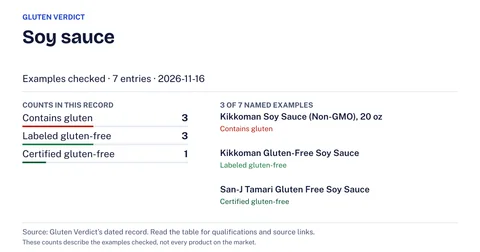 Soy sauceDepends on the product3 of 7 products we checked contain gluten: Kikkoman Soy Sauce (Non-GMO), 20 oz; San-J Organic Shoyu Soy Sauce; and Lee Kum Kee Premium Soy Sauce (No Preservatives Added)checked Nov 16, 2026
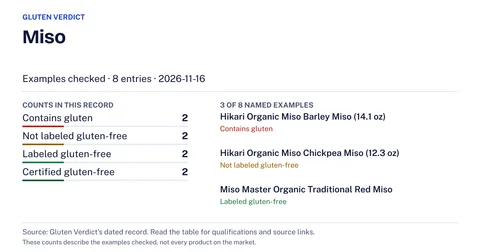 MisoDepends on the product2 of 8 products we checked contain gluten: Hikari Organic Miso Barley Miso (14.1 oz) and Hikari Miso Soup Akadashi (12 servings, 7.0 oz)checked Nov 16, 2026
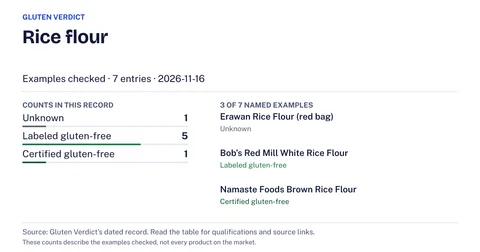 Rice flourNaturally gluten-freeBuy it labeled gluten-freechecked Nov 16, 2026
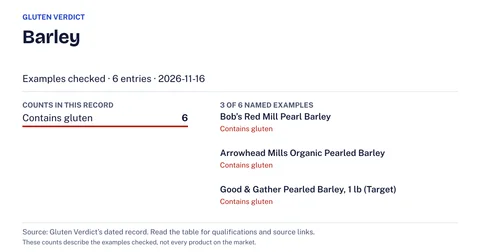 BarleyContains glutenchecked Nov 16, 2026
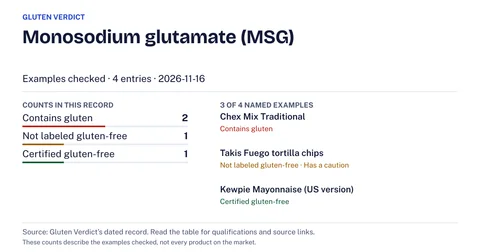 Monosodium glutamate (MSG)Naturally gluten-free2 of 4 products we checked contain gluten: Chex Mix Traditional and S&B Golden Curry Mix (Mild)checked Nov 16, 2026
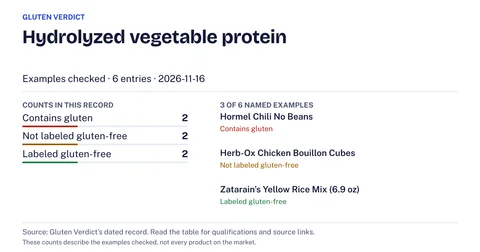 Hydrolyzed vegetable proteinDepends on the product2 of 6 products we checked contain gluten: Hormel Chili No Beans and Pioneer Brown Gravy Mix (1.61 oz)checked Nov 16, 2026
Questions people ask
Is a gluten-free label in Asia the same as in the US?
Not necessarily. The US rule says any unavoidable gluten must be less than 20 ppm44. Singapore says 20 mg/kg or less1, South Korea says less than 20 mg/kg2, and the countries differ on which ingredients may be in the food, as the table above shows.
Does Japan have a gluten-free label?
Not a general one in the documents we read52. Its voluntary “Non-Gluten” label term for rice flour is 1 ppm or less7, 8.
Does a gluten-free claim in Asia mean the pack was tested?
Indonesia’s regulation says a claim must be proved by analysis from an accredited or government laboratory48; we did not look for an equivalent clause in the other countries’ texts. In the one study we found, of packs sold in China, 13.4% of 119 labelled gluten-free packs contained gluten above 20 mg/kg17.
What does “Processed in a plant where gluten containing products are manufactured” mean on an Indian pack?
FSSAI’s labelling compendium says a gluten-free product made in a plant that also makes gluten-containing products must carry that statement33.
More in Travel: Asia and the Middle East
 Gluten-free in Japan: soy sauce, miso, barley tea and the allergen boxWhat to check in Japan: wheat in soy sauce, barley in miso and barley tea, and what the Japanese allergen box covers and leaves out.
 Gluten-free in South Korea: where wheat and barley turn up at a Korean tableWhere wheat and barley turn up in Korean food: marinades, ganjang, doenjang, gochujang, noodles, barley tea, and what a Korean label says.
 Gluten-free in Hong Kong: dim sum wrappers, noodles, sauces and the packet labelSort Hong Kong dim sum, noodle-shop and sauce choices by wrapper, noodle and ingredient, and read what a Hong Kong packet must name.
 Gluten-free in China: wheat staples, sauces, hot pot and the label rulesWhere wheat sits in Chinese staples, sauces and hot-pot bases, what China’s label standard requires, and the Chinese words it prints for wheat and gluten.
 Gluten-free in Vietnam, the Philippines, Malaysia, Indonesia and Taiwan: sauces, noodles and label rulesWhere wheat enters a Southeast and East Asian meal, what four regulators print about gluten cereals, and the one country whose rule we could not read.
 Eating gluten-free in Thailand: sauces, noodles and street stallsWhere wheat shows up in Thai sauces, noodles and street food, how Thailand words its own gluten-free rule, and the Thai words to look for on a pack.
Related guides
 Gluten-free labeling rules by country: ceilings, claim wording and where no rule was foundLook up the gluten-free limit and claim wording for the US, Canada, EU, UK, Australia, New Zealand and more, each figure tied to the page we read.
 What the Codex gluten standard says, and which countries follow itWhat Codex Standard 118-1979 sets for gluten-free food, why it is not law, and how the US, EU, UK, Canada, Australia, NZ and Argentina compare.
 Gluten-free logos outside the US: who issues each one and what it requiresTell a certifier’s gluten-free logo from a maker’s own: who issues Crossed Grain, Coeliac Australia’s and Celiac Canada’s marks, and the limit each sets.
 May-contain labels abroad: what each country’s regulator says about themWhether a “may contain” or shared-facility line is required, voluntary or guided by a scheme in the US, UK, EU, Canada, Australia, New Zealand and Codex.
Sources
- [1, 16, 21, 22, 23, 24, 25, 26, 45, 61] Singapore Food Agency, Amendments to Labelling Requirements for Prepacked Food (SFA presentation on the Food (Amendment) Regulations 2025), checked Nov 17, 2026.
Read on 2026-11-17: the table row “Cereal (in the context of the new Regulation 250B)” lists barley; oat; rye; wheat (durum wheat, Khorasan wheat, spelt or any other Triticum species); a hybridised strain of any of these; and a product of any of these.
- [2, 27, 46] Ministry of Food and Drug Safety (South Korea), Foods Labeling Standards, English edition, checked Nov 17, 2026.
- [3] Food Safety and Standards Authority of India (FSSAI), Advertising and Claims Regulations compendium, version IV (14 December 2022); Internet Archive copy, checked Nov 17, 2026.
- [4] Thai Food and Drug Administration (Ministry of Public Health), Ministry of Public Health Notification (No. 384) B.E. 2560, labelling of gluten-free food (Royal Gazette, 4 April B.E. 2560), checked Nov 17, 2026.
Read on 2026-11-17 (in Thai): clause 2(1) lists the foods that may bear the claim: grains or tubers that are naturally gluten-free, their flours, and foods made from them, with no numeric limit stated in those three items; and, in item (ง), foods containing wheat (Triticum species), rye, barley, oat or their hybrids that have been processed to remove gluten, where total gluten in the final product is “ไม่เกิน ๒๐ มิลลิกรัมต่ออาหาร ๑ กิโลกรัม” (not more than 20 mg per 1 kg of food). Clause 2(2) allows only the words “ไม่มีกลูเตน” or “gluten free”, and for item (ง) products also “ผ่านกระบวนการกําจัดกลูเตน” or “being specially processed to remove gluten”. The definition of gluten in clause 1 names wheat, rye, barley, oat or their hybrids.
- [5, 38, 48] Badan Pengawas Obat dan Makanan (BPOM, Indonesia), BPOM Regulation No. 1 of 2022 on supervision of claims on labels and advertising of processed food (Berita Negara 2022 No. 2), checked Nov 17, 2026.
Read on 2026-11-17 (by OCR, because the annex pages of the gazette copy are scanned images): Lampiran VI, “Klaim gluten”, lists “Rendah Gluten” at 21-100 mg/kg and “Bebas Gluten” at ≤20 mg/kg; point 3 allows words of similar meaning such as “tanpa” and “tidak mengandung” in place of “bebas”; point 1 allows a gluten claim only on processed food made from wheat (Triticum species), rye, barley or oat or their crossbred varieties that has been processed to reduce gluten, and/or from gluten-free raw materials replacing them, named as rice, maize, sago, sorghum, cassava, sweet potato, potato, taro and gadung.
- [6, 41] Ministry of Health Malaysia, Food Safety and Quality Programme, Schedules in the Food Regulations 1985, updated to P.U.(A) 48/2026: Fifth A Schedule, Table I, checked Nov 17, 2026.
Read on 2026-11-17: Fifth A Schedule, Table I (“Conditions for nutrient contents for use of nutrition claims”), row Gluten: “Reduced” 0.01 g per 100 g (solids or liquids) and “Free” 0.002 g per 100 g (solids or liquids).
- [7, 8, 49, 50] Japan Ministry of Agriculture, Forestry and Fisheries (MAFF), Third-party certification of Non-Gluten rice flour and process-control JAS (米粉のノングルテンの第三者認証と製造工程管理JAS), checked Nov 17, 2026.
- [9, 51, 52, 53] Japan Consumer Affairs Agency, Food allergy labelling handbook for processed foods, April 2026 (加工食品の食物アレルギー表示ハンドブック), checked Nov 17, 2026.
Read on 2026-11-17: the handbook mentions グルテンフリー once, in the note quoted for the difference between Western gluten-free labelling and Japan’s allergen labelling; it gives no gluten-free definition or limit.
- [10] Centre for Food Safety (Hong Kong), Labelling of Prepackaged Food in Hong Kong (CFS slides), checked Nov 17, 2026.
- [11, 14, 56] Taiwan Food and Drug Administration, Regulations Governing Food Allergen Labeling on the Recommended Labeling Allergens, checked Nov 17, 2026.
Read on 2026-11-17: the regulation page has two articles, on the allergens that must or may be labelled and on cross-contamination controls; it states no definition or limit for a gluten-free claim.
- [12] China National Center for Food Safety Risk Assessment (CFSA), GB 7718-2025 questions and answers: labelling of allergens (关于致敏物质标示), checked Nov 17, 2026.
- [13, 54, 55] Centre for Food Safety (Hong Kong), Food Safety Focus, issue 236 (March 2026): Are gluten-free food products better choices for the general population?, checked Nov 17, 2026.
Read on 2026-11-17: the article’s labelling advice is to check the ingredient list and any allergen warning statement; it states no legal definition or limit for a gluten-free claim.
- [15, 17, 58, 59, 60] Foods (MDPI), authors including China National Center for Food Safety Risk Assessment; PubMed Central, Gluten Contamination of Labelled Gluten-Free Food Products Marketed in China (2025), checked Nov 17, 2026.
- [18, 19, 20] Codex Alimentarius (FAO and WHO), Standard for foods for special dietary use for persons intolerant to gluten (CXS 118-1979), checked Nov 17, 2026.
- [28, 29] Ministry of Food and Drug Safety (South Korea), Food labeling system: allergen list and labeling method, checked Nov 17, 2026.
- [30, 31] Food Safety and Standards Authority of India (FSSAI), Regulation 2.14, Gluten free food (Food Products Standards and Food Additives); Internet Archive copy, checked Nov 17, 2026.
- [32, 33, 34, 35, 63] Food Safety and Standards Authority of India (FSSAI), Labelling and Display compendium, version VIII (9 September 2025); Internet Archive copy, checked Nov 17, 2026.
- [36, 37, 62] Thai Food and Drug Administration (Ministry of Public Health), Notification No. 450 B.E. 2567 (2024), labeling of prepackaged foods (unofficial English translation), checked Nov 17, 2026.
- [39, 40] Badan Pengawas Obat dan Makanan (BPOM, Indonesia), Processed-food label rules page: allergen statement and wording, checked Nov 17, 2026.
- [42, 43] Ministry of Health Malaysia, Food Safety and Quality Programme, Food Regulations 1985, updated to P.U.(A) 48/2026: Regulation 11 (particulars in labelling), checked Nov 17, 2026.
- [44] US Food and Drug Administration, Questions and Answers on the Gluten-Free Food Labeling Final Rule, checked Nov 17, 2026.
- [47] Thai Food and Drug Administration (Ministry of Public Health), Law and regulation: food labelling notifications (Thai-language page), checked Nov 17, 2026.
Read on 2026-11-17 (in Thai): section 4 of the page, headed “การแสดงฉลากอาหารไม่มีกลูเตน” (labelling of gluten-free food), lists Ministry of Public Health Notification (No. 384) B.E. 2560 and a Thai FDA clarification of it, each with a Thai-language PDF.
- [57] National Health Commission and State Administration for Market Regulation (China), GB 7718-2025, General Rules for the Labelling of Prepackaged Foods (copy hosted by China Customs), checked Nov 17, 2026.
Read on 2026-11-17 (in Chinese): the cover gives 2025-03-16 as the publication date and 2027-03-16 as the date of implementation; clause 4.12.1 lists cereals containing gluten (wheat, rye, barley, oats, spelt or their hybrids) first among eight allergen ingredients; clause 4.12.2 says that where allergens may be carried in during production, such as shared workshops or lines, declaring a hint is encouraged (鼓励).