Kosher and halal marks on food: what they say about gluten
Short answer
Not by itself. The OU and IFANCA pages we read describe what their marks cover as ingredient sources, equipment, meat, dairy and slaughter rules, and neither names gluten1, 2, 3. On foods FDA regulates, a “gluten-free” claim is what carries FDA’s limit of less than 20 parts per million4.
Part of Label reading and gluten-free claims, 17 guides
Key points
- Star-K says kosher status depends on the source of the ingredients and the status of the production equipment5; that is a statement about kashrut, not about gluten.
- Kosher or halal food can contain wheat: a halal gyro cone page lists wheat breadcrumbs and a Contains Wheat line6, 7, and OU says wheat can be listed as matzo or matzo meal8; Seal-K says some kosher certifiers may certify wheat flour as kosher for Passover under certain conditions19.
- Parve describes food that is neither meat nor dairy9; it is not a statement about wheat, barley or rye.
- Labeling of meat and poultry is generally USDA’s, and FDA’s gluten-free rule does not apply to foods whose labeling USDA regulates10.
- Read each statement on the pack on its own: the mark, the gluten-free claim, the ingredient list, then the maker’s page.
Three separate statements on one pack
A food label can carry a certifier’s mark, a gluten-free claim and an ingredient list, and each answers a different question. The table sorts them.
| Statement | Who stands behind it | Where gluten comes in |
|---|---|---|
| Kosher mark (OU, Star-K and other agencies) | A kosher certifying agency, which says what its symbol means11, 5 | Not part of what the OU’s page on its symbols describes1 |
| Parve, dairy or meat designation | The same agency11, 9 | It sorts foods by milk and meat, not by wheat, barley or rye9 |
| Halal mark (for example IFANCA’s Crescent-M) | A halal certifier12 | IFANCA’s list of excluded sources names no grain3 |
| “Gluten-free” claim | The maker, under FDA’s rule on the foods FDA regulates13 | The claim means the food meets FDA’s definition, including less than 20 ppm of any unavoidable gluten4 |
| Ingredient list and Contains line | The maker, printed on the label | The place to read for wheat, barley, rye and malt: see how to read a US food label for gluten |
What a kosher mark covers
Star-K, a kosher certifier, says the line between kosher and non-kosher depends on two variables: the source of the ingredients and the status of the production equipment5. The OU, another certifier, describes its plain OU symbol in similar terms: among other things, the product contains neither dairy nor meat nor any derivative of either, and was not made on equipment used for making meat products11, 14.
The OU’s page that explains all of its symbols covers dairy, meat, fish, equipment and Passover status. The word “gluten” does not appear on it1.
A kosher mark can sit on everyday foods. Star-K lists baked goods, beverages, cereals, confections and snack foods among the items that qualify for kosher certification15.
A mark also covers only what the certifier certified. The OU says that not every product under a brand name is OU certified, and that it is very common for it to certify only some products bearing a brand16. So the symbol has to be on the pack in your hand, not just on the brand’s other products.
In an article on Passover and health, OU Kosher’s Rabbi Avi Juravel notes that kashrus agencies and Rabbonim are not health specialists17. The certifier’s mark answers a religious-law question; the gluten question goes to the label and the maker.
Parve, dairy and meat: a milk-and-meat designation
Parve (also spelled pareve) is the kosher designation for food that contains neither meat nor dairy ingredients; Star-K translates the Hebrew word as “neutral”9. The OU defines its plain symbol by what it leaves out: dairy, meat, and derivatives of either11.
The dairy and meat designations sort foods the same way, by milk and meat, and the OU page that explains them does not mention gluten1. A “parve” label tells you the food has no meat or dairy ingredients9. It says nothing about wheat, barley or rye, so a parve cracker or soup still needs its ingredient list read.
Kosher for Passover is a separate question again
Kosher for Passover has its own rules, and the match with gluten-free fails in both directions. OU Kosher’s own recap is that gluten-free does not equal chametz-free18. In the other direction, Seal-K Kosher says some kosher certifiers may certify wheat flour as kosher for Passover under certain conditions, and advises that people with celiac disease not use Passover certification alone as an indicator of gluten-free status19.
OU Kosher’s article on Passover and celiac disease notes that wheat can be listed as matzo, matzo meal, cake meal, farfel, egg matzo or matzo balls8. Our Passover guide works through matzo and the other Passover foods.
What a halal mark covers
IFANCA, the Islamic Food and Nutrition Council of America, says its trademark Crescent-M logo means one thing: “This is halal.”12
IFANCA’s page on what halal means says all foods are considered halal except the sources it lists2. The list names pork and its by-products, animals not properly slaughtered by the Islamic method, alcoholic drinks and intoxicants, carnivorous animals and birds of prey, blood and its by-products, and foods contaminated with any of these. It names no grain3.
For meat, IFANCA says zabiha refers to slaughter of an animal or bird by a Muslim according to Islamic requirements20. In the US, the USDA’s meat and poultry inspection agency (FSIS) says products from federally inspected plants whose labels refer to “Halal” or “Zabiah Halal” must be handled according to Islamic law and under Islamic authority21.
Kosher and halal meat: USDA decides the label, not FDA
FDA’s gluten-free rule does not apply to foods whose labeling USDA regulates, and USDA generally regulates meats, poultry and certain egg products10. Kosher beef franks and halal beef and lamb gyro cones are meat products, so FDA’s gluten-free definition may not be the rule that governs their labels10.
USDA says “Kosher” may be used only on labels of meat and poultry products prepared under rabbinical supervision22. FSIS also says labels bearing “Halal” and “Kosher” claims do not need FSIS approval unless the claims are identified on the label as certified23. A gluten-free claim is handled differently: FSIS lists negative claims such as “gluten free” among its special statements and claims24, and its Appendix 1 list of claims it must approve before labels enter commerce includes “Gluten free (certified or non-certified)”25, 34.
Our guide to who regulates gluten-free claims covers FDA, USDA and TTB side by side.
Kosher and halal products in our records
Hebrew National’s page for its Kosher Beef Franks says: “No artificial flavors or colors, no fillers, no by-products, and no gluten—no kidding.”26 That is the maker’s own statement about the product. Our hot dogs verdict shows which hot dog brands’ pages carry a gluten-free tag and which only list no gluten grain.
Kontos’s page for its Halal Gyro Cone lists breadcrumbs made with wheat flour among the ingredients6, an allergen line reading “Contains Wheat and Soy”7, and “Halal Certificate: Yes”27. A halal certificate and wheat sit on the same product page. Our gyro meat verdict covers this maker’s gyro products.
Other foods you may meet at a kosher or halal table have their own verdicts: pita, couscous, falafel, deli meat and sausage.
A dated case: a kosher food maker’s recall over a gluten claim
On 15 October 2026 Coeliac UK published a food alert: Gilbert’s Kosher Foods Limited recalled Gilbert’s Chopped Liver because the product contains wheat (gluten) and had been incorrectly labelled as gluten free28. The alert is England specific29.
The alert concerns the gluten-free statement on the label and the wheat in the product28. It does not say what kosher mark, if any, the product carried, and we make no claim about that.
This is one dated UK example, not a count of how often it happens, and UK labeling rules differ from US ones.
Kosher or halal beside a gluten-free claim
A halal or kosher identity and a gluten-free statement can sit on one product, and each is checked on its own. In Australia, Coeliac Australia lists Puopolo Smallgoods Halal SKINLESS Frankfurts Frozen among its endorsed products30. Coeliac Australia says products using its logo have been reviewed and approved as part of its Endorsement program and are suitable for a gluten free diet31. In that listing “Halal” is part of the product’s name; the page has no sentence about halal certification30, so the gluten-free endorsement is Coeliac Australia’s own review, not something the word “Halal” supplies.
Certifiers publish directories you can use to confirm their own marks. The OU says its database lists OU-certified products and can be searched for gluten-free32; the page does not say what standard that search rests on, so treat the filter as a lead and confirm with the maker. IFANCA says its certification includes a listing of halal-certified products on its website33.
What to check, in order
- Look for a gluten-free claim on the pack. On foods FDA regulates it carries FDA’s definition, including less than 20 ppm of any unavoidable gluten4; on meat and poultry the claim goes through USDA’s label review24, 25, 34.
- Read the full ingredient list and the Contains line for wheat, barley, rye and malt, whatever mark is on the pack. See how to read a US food label for gluten and what the Contains line leaves out.
- Check the brand’s own page, or ask the maker: what to ask a manufacturer about gluten.
- If the pack shows a gluten-free certification seal, look it up in the certifier’s directory: how to check a seal.
- Treat the kosher or halal mark as the answer to its own question, and confirm the symbol is on the pack you hold16.
Other claims on a pack, such as vegan or non-GMO, also answer their own questions: see other label claims versus gluten-free.
Verdicts in this guide
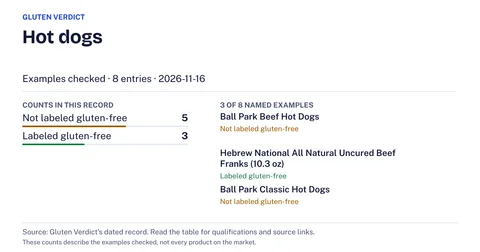 Hot dogsDepends on the productchecked Nov 16, 2026
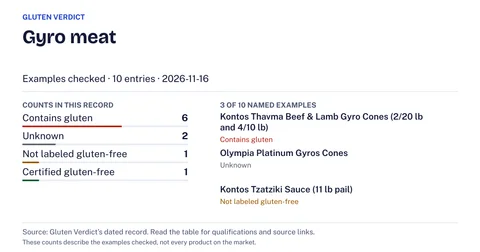 Gyro meatDepends on the product6 of 10 products we checked contain glutenchecked Nov 16, 2026
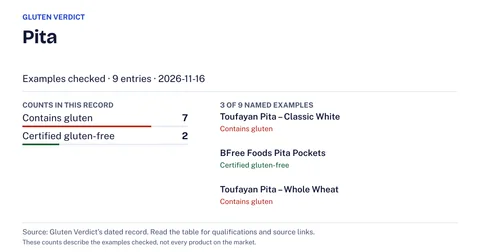 PitaContains glutenchecked Nov 16, 2026
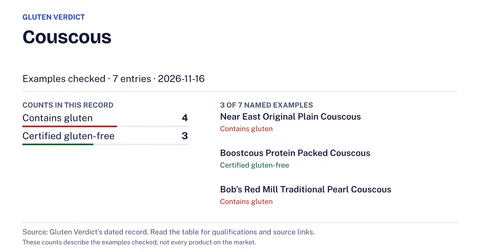 CouscousContains glutenchecked Nov 16, 2026
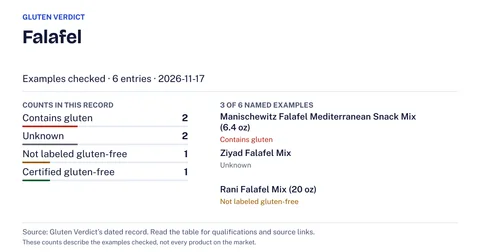 FalafelDepends on the product2 of 6 products we checked contain gluten: Manischewitz Falafel Mediterranean Snack Mix (6.4 oz) and Al’Fez Lebanese Falafel Kit (5.3 oz)checked Nov 17, 2026
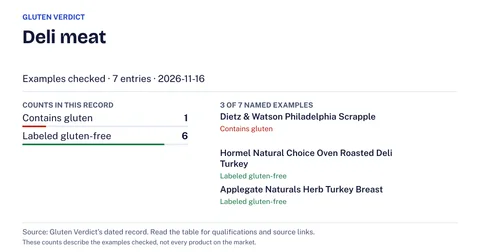 Deli meatDepends on the product1 of 7 products we checked contains gluten: Dietz & Watson Philadelphia Scrapplechecked Nov 16, 2026
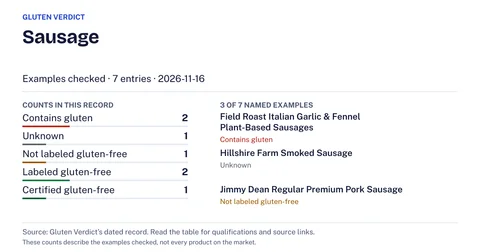 SausageDepends on the product2 of 7 products we checked contain gluten: Field Roast Italian Garlic & Fennel Plant-Based Sausages and Tofurky Plant-Based Italian Sausagechecked Nov 16, 2026
Questions people ask
Is kosher gluten-free?
Not because it is kosher. The OU page that explains its symbols covers dairy, meat, fish, equipment and Passover status and does not mention gluten1. Look for a gluten-free claim and read the ingredient list4.
Is halal gluten-free?
Not because it is halal. IFANCA says all foods are considered halal except the sources it lists2, and the list names no grain3. One halal gyro cone page lists wheat breadcrumbs6.
Does parve mean gluten-free?
No. Parve means a kosher food that contains neither meat nor dairy ingredients9; it is not a statement about wheat, barley or rye.
More in Label reading and gluten-free claims
 Who regulates a gluten-free claim: FDA, USDA or TTBWhich agency sets the rules for a gluten-free claim on packaged food, meat, eggs, beer, wine and spirits, and what to check when a label is unclear.
 “Low gluten”, “gluten removed” and “gluten friendly” on a labelWhat “low gluten”, “gluten removed” and “gluten friendly” mean on a US label, which phrases FDA or TTB define, and what to ask the maker.
 Wheat-free, gluten-free and “no gluten ingredients”: what each label statement covers“Wheat-free”, “gluten-free” and “made with no gluten-containing ingredients” are three different statements. What each covers, and what to check.
 How to check whether a packaged food is gluten-freeA four-step check for one packaged food: the claim, the ingredient and allergen lines, the maker’s dated page and the certifier’s directory.
 How to read a US food label for glutenWhere gluten shows up on a US food label: the gluten-free claim, the Contains line, the ingredient list and may-contain lines, and what each means.
 What “may contain wheat” and “made in a facility with wheat” mean on a US labelHow to read “may contain wheat”, shared-facility and shared-equipment lines on US labels, with and without a gluten-free claim, and what to check next.
Related guides
 Passover and gluten: matzo, matzo meal and what a kosher mark leaves outWheat matzo contains gluten and a kosher-for-Passover mark is not a gluten-free claim. How to check matzo, matzo meal, cake meal and seder dishes.
 Gluten-Free in Israel: Labels, Kosher and the Israeli TableIsrael’s gluten label rules, the Hebrew words in the regulation, why kosher and kosher for Passover are not gluten-free claims, and where wheat enters.
 Vegan, organic, non-GMO, natural and keto labels do not mean gluten-freeVegan, organic, non-GMO, natural, plant-based and keto labels describe other things. What each claims, and which gluten claim or source to check instead.
 The Contains line names wheat, not barley or rye: what US allergen labels coverWhat the US allergen Contains line covers, why it names wheat but not barley or rye, and which ingredient-list names stand in for them.
Sources
- [1, 11, 14] Orthodox Union (OU Kosher), OU Kosher Symbols Explained, checked Nov 17, 2026.
Read on 2026-11-17: the page lists what the OU, OU-D, OU-Meat, OU-Glatt, OU-Fish and OU-P symbols indicate (dairy, meat, fish, equipment and Passover status); the word “gluten” does not appear on it.
- [2, 3, 20] Islamic Food and Nutrition Council of America (IFANCA), What is halal?, checked Nov 17, 2026.
Read on 2026-11-17: the list that follows “All foods are considered halal except the following sources” names swine/pork and its by-products; animals not properly slaughtered according to the Islamic method or dead before slaughtering; alcoholic drinks and intoxicants; carnivorous animals and birds of prey; blood and blood by-products; and foods contaminated with any materials from those categories. It names no grain. The word “gluten” does not appear on the page.
- [4, 10, 13] US Food and Drug Administration, Questions and Answers on the Gluten-Free Food Labeling Final Rule, checked Nov 17, 2026.
- [5, 9, 15] Star-K Kosher Certification, Kosher in Depth, checked Nov 17, 2026.
- [6, 7, 27] Kontos Foods, Halal Gyro Cone 2/20 Lbs., checked Nov 17, 2026.
- [8, 17] Orthodox Union (OU Kosher), Gluten Intolerance, Celiac, Allergies, and Pesach, checked Nov 17, 2026.
- [12] Islamic Food and Nutrition Council of America (IFANCA), Halal for All (home page), checked Nov 17, 2026.
- [16] Orthodox Union (OU Kosher), Eight Points To Remember When Looking For The Kosher Symbol, checked Nov 17, 2026.
- [18] Orthodox Union (OU Kosher), Gluten Free (Kosher for Passover), checked Nov 17, 2026.
- [19] Seal-K Kosher, Kosher For Passover, checked Nov 17, 2026.
- [21, 22] USDA Food Safety and Inspection Service, Meat and Poultry Labeling Terms (revised April 2011), checked Nov 17, 2026.
- [23] USDA Food Safety and Inspection Service, Constituent Update - June 5, 2020, checked Nov 17, 2026.
- [24, 25, 34] USDA Food Safety and Inspection Service, FSIS Compliance Guideline for Label Approval (July 2020), checked Nov 17, 2026.
- [26] Hebrew National (Conagra Brands), Kosher Beef Franks, checked Nov 17, 2026.
- [28, 29] Coeliac UK, Food alert: Gilbert's Kosher Foods Limited recalls Gilbert's Chopped Liver, checked Nov 17, 2026.
- [30] Coeliac Australia, Puopolo Smallgoods Halal SKINLESS Frankfurts Frozen (endorsed product), checked Nov 17, 2026.
Read on 2026-11-17: the page lists “Puopolo Smallgoods Halal SKINLESS Frankfurts Frozen” as an endorsed product (brand Puopolo Smallgoods, 1 kg, category Protein). It has no sentence about halal certification.
- [31] Coeliac Australia, Endorsed product list, checked Nov 17, 2026.
- [32] Orthodox Union (OU Kosher), Kosher Certification for the Consumer, checked Nov 17, 2026.
- [33] Islamic Food and Nutrition Council of America (IFANCA), What is the benefit of IFANCA halal certification?, checked Nov 17, 2026.