Play-Doh, paste and art supplies: what the makers say about wheat
Short answer
Look each material up on its maker’s own page, because makers differ: Hasbro’s pages for the three Play-Doh products we read say “Contains Wheat”1, 3, 4, and Crayola says its Dough, Glitter Dots and Easy Peel Crayon Pencils are made with wheat flour6. NIDDK ties the concern to gluten reaching the mouth, by eating the material, using it around the mouth or carrying it there on hands28.
Part of Kids, school, college and family, 21 guides
Key points
- Hasbro’s pages for the three Play-Doh products we read each say the product contains wheat1, 3, 4. Wheat is a gluten-containing grain26.
- Crayola says most of its products have no wheat, gluten or other gluten-containing grain added on purpose, with named exceptions, and that many are made in shared facilities6, 7.
- In one preliminary school study, Play-Doh and dry pasta left little gluten on hands and tables, while paper mâché, cooked pasta and a flour-dough baking project left a lot15, 16, 17, 18, 19, 20.
- In that study, washing was effective at removing gluten from hands, and soap and water was the most consistent method22, 23.
- Where a maker is silent or its page will not open, write “no statement found” with the date and ask the maker or the school to confirm. Do not read silence as a yes.
What the makers say, as we read it on 2026-11-17
A maker’s own page is where a maker speaks for its product, so the table below says what each page said on the day we read it. It covers the pages we could open, not every product a maker sells.
| Maker | Product | What the maker’s page says |
|---|---|---|
| Hasbro | Play-Doh 12 Pack Assorted Celebration Compound | “Notice to Parents: Contains Wheat”1. The page describes the compound as made primarily with flour, salt and water5. |
| Hasbro | Play-Doh Kitchen Creations Cheesy Pizza Playset | The four classic modeling compound cans in the set all contain wheat3. |
| Hasbro | Play-Doh Essential Colors 10 Pack of Refill Sticks | “Notice to Parents: Contains Wheat”4. |
| Crayola | Crayola Dough, Glitter Dots, Easy Peel Crayon Pencils | Made with wheat (flour) as an ingredient and therefore not considered gluten free6. |
| Crayola | Most other products, including Silly Putty | No wheat, gluten or other gluten-containing grains intentionally added6. Many products are made in the same facility and may be made on the same machinery, so Crayola says there is a chance of cross contamination7. It also says the machinery is cleaned between production runs30. Licensed products, such as Crayola-brand bath, personal care or food items, are made by licensing partners and are outside this statement8. |
| Elmer’s | Elmer’s products | No statement read: elmers.com refused to open for us on 2026-11-1727. |
Hasbro says “wheat”, not “gluten”. Wheat is one of the grains FDA’s gluten-free rule treats as gluten-containing26, so a Hasbro page that says a product contains wheat is a page that says it contains a gluten source. We read three Hasbro product pages. If the dough in the classroom is another Play-Doh set, read that set’s page or its label.
Crayola’s statement is about wheat and other gluten grains added on purpose. For the products other than the three named, Crayola does not describe them as gluten free, and it says their exact ingredients are proprietary9. For an ingredient that is not on its list and is due to a medical concern, it asks readers to contact Crayola Customer Support29. The list of ingredients it says are not found in its products names casein, eggs, fish and shellfish, latex, milk, nuts, peanuts, red dye #40, sesame and whey, and does not name wheat or gluten10.
Elmer’s: we have no statement to report. Its site returned an access-denied response to our request, and we did not work around it27. Search results from other sites are not a maker’s statement. Check the bottle or tube, or ask Elmer’s.
Eating, touching and hands that go to mouths
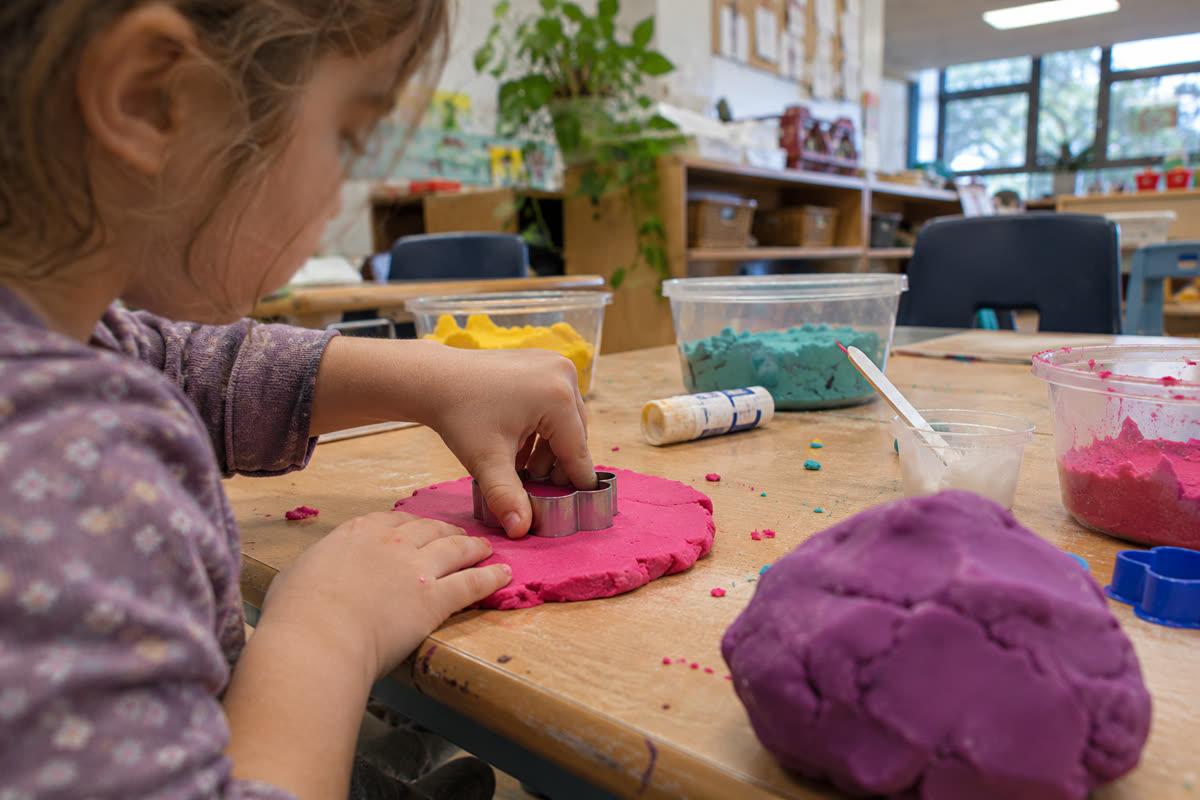
NIDDK lists children’s modeling dough, such as Play-Doh, among products that may contain gluten11. It says a person may take in small amounts of gluten by consuming these products, using them around the mouth or transferring them from hands to mouth by accident28.
Hasbro’s celebration pack page adds that the compound is not intended to be eaten2. That line is a product warning, not a gluten statement, but it matches the route NIDDK describes.
The Gluten Intolerance Group (GIG) makes the same point for young children. Its preschool and childcare page says toddlers are unaware, trusting and cannot communicate when something may contain gluten, so it says to always check with the parents of gluten-free children instead of taking a risk14.
So each material raises two questions: does the product contain wheat, and can any of it reach the child’s mouth, for example on fingers or from a shared table? The study below measured the second question.
What one school study measured, activity by activity
A study from Children’s National Hospital, published in the Journal of Pediatric Gastroenterology and Nutrition, ran five classroom experiments, with Play-Doh, a baking project, paper mâché, dry pasta and cooked pasta25. The hospital called it a preliminary study15. Thirty participants aged 2 to 18 were enrolled25. Gluten was measured on slices of gluten-free bread rubbed on participants’ hands and on table surfaces25.
| Activity | What the study reported |
|---|---|
| Play-Doh, five minutes of play | No hand sample above 20 ppm. Two bread slices rubbed on tables tested above 20 ppm, and both had visible pea-sized pieces of Play-Doh stuck to them16. |
| Dry pasta in a sensory table | All hand and surface samples under 20 ppm, and 9 of 10 under 5 ppm17. |
| Cooked, dyed pasta in a sensory table | More than 20 ppm after five minutes, with most samples above 84 ppm19. |
| Paper mâché balloon art | Transfer stayed high after hands and surfaces dried, mostly above 84 ppm20. |
| Home economics baking, rolling out flour-containing cookie dough | Hands and workspaces transferred amounts well above 84 ppm, the assay’s upper limit of quantification18. |
The study’s washing results matter as much as the activity results. After the paper mâché and baking projects, gluten residue was not detected when hands and surfaces were cleaned by basic hygiene such as hand-washing and routine surface cleaning21. After the Play-Doh and baking projects the team compared three methods, washing with water, washing with soap and water, and wiping with an antibacterial hand wipe, and all three showed they could remove gluten22. In the paper, soap and water was consistently the most effective, though other methods matched it in some scenarios23.
The authors concluded that exposure at school is high for some materials and low for others, and that for the high-risk ones schools should provide gluten-free supplies and have a strong plan to prevent cross-contact with food24.
One preliminary study is not a verdict on any product. It measured transfer onto bread, with the Play-Doh the researchers used, over five minutes of play16. It does not replace the maker’s statement for the product in your classroom.
What to ask the teacher, one sentence each
- Which dough, paste, paint and clay will the class use this term, and can I see each label or the maker’s page?
- For any material that contains wheat, can my child use a different one whose maker says it has no wheat added, and can that statement stay on file with the date?
- Can every child wash hands with soap and water after dough, paste or paint and before any snack23?
- Can the tables be cleaned before food goes on them21?
- Can paper mâché, flour-dough baking and cooked-pasta crafts be planned with my child’s version ready in advance, since they were the high-transfer activities in the study18, 19, 20?
- Can dry macaroni crafts stay away from the table where my child eats, since GIG lists macaroni among craft supplies that contain wheat unless the package says otherwise13?
- For a material with no maker statement, who will ask the maker, and what will my child use until the answer comes back?
If a school plan is still being set up, our guide on talking to your child’s teacher has a script and a one-page sheet.
When a maker has no statement
NIDDK’s advice when a label does not say what is in a product is to ask the company for an ingredients list, and it says you cannot assume the product is gluten-free12. A missing statement is not a yes.
Write what you found in a form anyone can check later: the product, the page you read, the date, and the words on the page. For example: “Elmer’s School Glue, elmers.com, read on a date: page would not open, no statement found.” That is an observation. It is different from a maker saying the product contains no wheat.
When a maker’s page does answer, copy the sentence and keep the date. Note what it covers: Crayola’s “intentionally added” wording6 is about ingredients, and its shared-machinery sentence7 is a separate statement.
Pasta, macaroni, paper mâché and bird seed
GIG’s preschool and childcare page, in a list headed “Craft Supplies That Contain Wheat (Unless otherwise stated on package)” names playdough, finger paint, paper mache, craft paste, macaroni and bird seed13. The list’s “unless otherwise stated” wording is why the package or the maker’s page matters for each one.
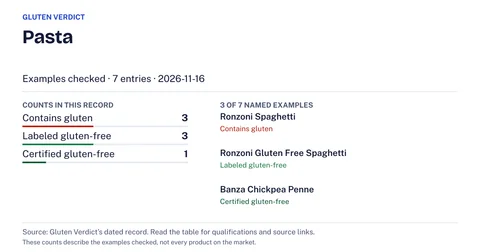
In the Children’s National study, dry pasta in a sensory table stayed under 20 ppm in every sample, while cooked, dyed pasta did not17, 19. Our pasta verdict covers regular pasta as a food. For craft pasta the question in the classroom is the same as for any dough: does it contain wheat, and can it reach the mouth.
Verdicts in this guide
Questions people ask
Is Play-Doh gluten-free?
Hasbro’s pages for the three Play-Doh products we read say the product contains wheat1, 3, 4, and wheat is a gluten-containing grain26. Check the page or label for the exact set in the room.
Does Elmer’s glue contain gluten?
We could not read an Elmer’s statement: its site refused to open for us on 2026-11-1727. Check the label or ask Elmer’s, and write down what you were told.
Which Crayola products contain wheat?
Crayola names Dough, Glitter Dots and Easy Peel Crayon Pencils as made with wheat flour6. It says most of its other products have no wheat or other gluten-containing grain added on purpose6, but many products share facilities and machinery7.
Is touching dough a problem if nobody eats it?
NIDDK describes gluten from these products being taken in by consuming them, using them around the mouth or hand-to-mouth transfer28. In one preliminary study, Play-Doh left no hand sample above 20 ppm after five minutes of play16, and washing was effective at removing gluten22.
More in Kids, school, college and family
 A care sheet for the babysitter or grandparent of a child with celiac diseaseA one-page care sheet for a babysitter or grandparent: the checked foods, the kitchen cross-contact points, what to do after an exposure, and whom to call.
 A 504 plan and school meal rules for celiac disease: what to ask for and where to complainMeal substitution or a 504 plan for a child with celiac disease: what each rule says, what the medical statement must hold, and where to complain.
 Your child has celiac disease: a first-week plan for the kitchen, labels, school and talking to your childThe first week after a child’s celiac diagnosis, in order: the diet plan, first labels, kitchen, two school routes, talking to your child and follow-up.
 Going gluten-free as a family: choose the household rule, then fix the kitchenAll gluten-free, shared with rules or split: what NIDDK, the charities and one small study say, plus rules for siblings and visiting relatives.
 A gluten-free child who refuses food: what to track and when to ask the doctorHow to tell ordinary picky eating from a pattern to raise with your child’s doctor or dietitian, what ARFID is, and a one-week log to bring.
 Gluten-free in a college dorm: the fridge, microwave, toaster and roommate rulesHow to set up a shared dorm room or kitchen for gluten-free living: fridge, microwave, toaster, sponges, a roommate script and how to ask for housing help.
Related guides
 A gluten-free care plan for daycare and preschoolWrite a one-page gluten-free care plan for daycare or preschool, ask the right questions on a tour, and see which government rule covers each program.
 Talking to your child’s teacher about celiac disease: a script, a one-page sheet and the classroom questionsA two-minute script, a one-page sheet, a template email and the classroom questions about snacks, crafts and trips, drawn from US celiac charity guidance.
 Where wheat, barley and rye hide in processed food: 15 places to checkFifteen processed foods where wheat, barley or rye turn up, the label step that catches each, and what US allergen law does and does not flag.
 Gluten in medications: what the label, DailyMed and a pharmacist can showFDA’s gluten-free food rule does not cover drugs. Use the ingredient list, DailyMed, the maker and a pharmacist, and know what each can show.
Sources
- [1, 2, 5] Hasbro, Play-Doh 12 Pack Assorted Celebration Compound (Consumer Care product page), checked Nov 17, 2026.
- [3] Hasbro, Play-Doh Kitchen Creations Cheesy Pizza Playset (Consumer Care product page), checked Nov 17, 2026.
- [4] Hasbro, Play-Doh Essential Colors 10 Pack of Refill Sticks (Consumer Care product page), checked Nov 17, 2026.
- [6, 7, 8, 30] Crayola, Do Crayola Products Contain Gluten or Wheat? (FAQ), checked Nov 17, 2026.
- [9, 10, 29] Crayola, Due to allergies and allergy concerns, can you tell me the ingredients in your products? (FAQ), checked Nov 17, 2026.
Read on 2026-11-17: the list of ingredients not found in products currently manufactured by Crayola names casein; eggs and egg shell; fish and shellfish; latex; milk; nut and nut oil (including tree nuts); peanuts; red dye #40; sesame and sesame oil; and whey. It does not name wheat or gluten.
- [11, 12, 28] National Institute of Diabetes and Digestive and Kidney Diseases (NIDDK), Treatment for Celiac Disease, checked Nov 17, 2026.
Read on 2026-11-17: under “Avoiding medicines and other products that may contain gluten”, the list after “Products that may contain gluten include” names children’s modeling dough, such as Play-Doh; cosmetics; lipstick, lip gloss, and lip balm; skin and hair products; toothpaste and mouthwash; and communion wafers.
- [13, 14] Gluten Intolerance Group, Pre-School, Childcare, and Gluten Risks, checked Nov 17, 2026.
Read on 2026-11-17: the list headed “Craft Supplies That Contain Wheat (Unless otherwise stated on package)” names playdough, finger paint, paper mache, craft paste, macaroni, bird seed and sunscreen.
- [15, 16, 17, 18, 19, 20, 21, 22] Children’s National Hospital, Just don't eat it: Play-Doh, dry pasta show little gluten transfer when used for play, checked Nov 17, 2026.
- [23, 24, 25] PubMed (Journal of Pediatric Gastroenterology and Nutrition), A Quantitative Assessment of Gluten Cross-contact in the School Environment for Children With Celiac Disease (abstract), checked Nov 17, 2026.
- [26] US Food and Drug Administration, Questions and Answers on the Gluten-Free Food Labeling Final Rule, checked Nov 17, 2026.
- [27] Elmer’s Products, Elmer’s website (FAQ page), checked Nov 17, 2026.
Read on 2026-11-17: requests to elmers.com and elmers.com/faq returned an access-denied response (HTTP 403) and no page text, so we have no Elmer’s statement on gluten or wheat.