Rice and arsenic on a gluten-free diet: what FDA says
Short answer
FDA says rice tends to absorb arsenic more readily than other crops and that consumers can certainly eat rice as part of a well-balanced diet1. For someone eating gluten-free, three points come from FDA, the Celiac Disease Foundation and Consumer Reports:
- Spot the rice-based staples. For its 2012 testing, Consumer Reports bought rice pasta, rice flour and rice drinks, which it describes as products often used by people on gluten-free or other special diets2.
- FDA reports that cooking rice like pasta, in extra water that is then drained, can reduce 40 to 60 percent of the inorganic arsenic, depending on the rice, and also reduces by 50 to 70 percent the folate, iron, niacin and thiamine added to polished and parboiled rice3, 4.
- Other grains. The Celiac Disease Foundation suggests eating less rice and choosing other gluten-free grains, seeds and starchy foods, and lists amaranth, buckwheat, corn, flax, gluten-free oats, millet, quinoa and teff5.
Part of Nutrition and combining diets, 24 guides
Key points
- FDA says rice and rice-based foods have higher levels of inorganic arsenic than the other foods it tested and are a major food source of it6.
- On FDA’s Arsenic in Food page, the one action level for a rice food is for infant rice cereal, set in guidance that is not legally binding7, 8, 9.
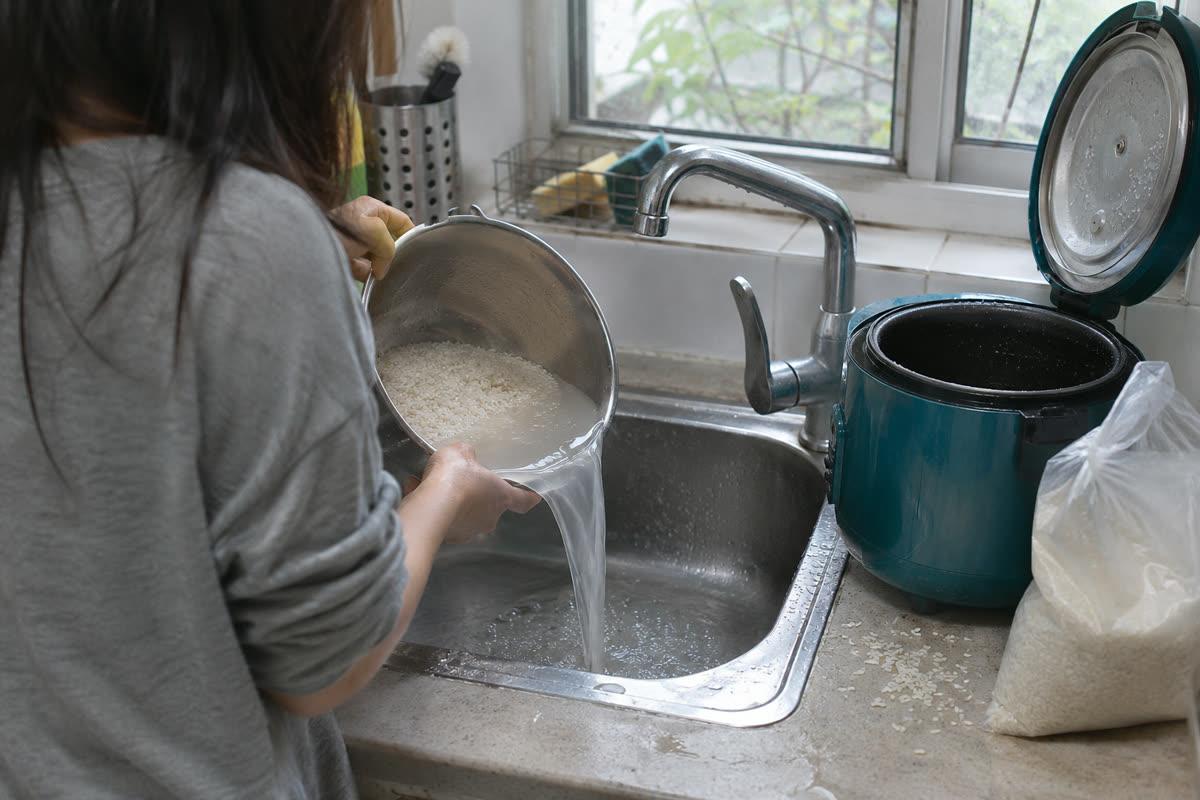
- FDA reports that rinsing rice before cooking has a minimal effect on its arsenic content, while cooking it in excess water reduces inorganic arsenic10, 3.
- In one study of 35 children with celiac disease who completed sample collection, median urinary arsenic rose after 6 months on a gluten-free diet; a follow-up in the 21 who gave a sample reported it back at baseline at 12 months11, 12.
- A 2023 review says whether the higher exposure seen with gluten-free diets is biologically relevant “remains unanswered”13.
What FDA says about arsenic in rice
ATSDR’s ToxFAQs on the CDC site describe arsenic as a naturally occurring element widely distributed in the earth’s crust14, and report that the Department of Health and Human Services and the EPA have determined that inorganic arsenic is a known human carcinogen15. FDA adds that inorganic arsenic is more dangerous than organic arsenic16.
Rice stands out among grains for a reason FDA gives: it tends to have higher arsenic concentrations than other cereal crops such as wheat and barley, because it can take up arsenic from soil and water and is typically grown under flooded conditions17. FDA says rice and rice-based foods have higher levels of inorganic arsenic than the other foods it tested and, given how widely they are eaten, are a major food source of it6. Its Total Diet Study found that total arsenic levels tend to be higher in rice and rice products than in other foods18.
Not every rice is alike. FDA’s 2011-2013 survey found inorganic arsenic levels that varied among and within categories of rice grain, from 23 to 249 parts per billion19.
Rice is not the only route. FDA says that, according to the World Health Organization and the CDC, the most common source of high levels of inorganic arsenic is contaminated drinking water20. It also says that testing results that detect arsenic do not necessarily mean a food should be avoided, and that eating a variety of nutrient-dense foods across the main food groups can limit exposure to a contaminant from a specific food21.
What FDA has set for rice, and what it has not
FDA has done a risk assessment of inorganic arsenic in rice and rice products. It includes a quantitative estimate of lung and bladder cancer risk from long-term exposure and a qualitative assessment of certain potential non-cancer risks in susceptible life stages22.
For one rice food it has set a number: an action level of 100 micrograms per kilogram, or 100 parts per billion, of inorganic arsenic in infant rice cereals, covering white-rice, brown-rice, organically grown and conventionally grown cereals7.
An action level is guidance, and FDA says guidance is not legally binding for FDA or industry9. Read on 2026-11-17, FDA’s Arsenic in Food page lists guidance documents for apple juice, infant rice cereals, bottled water and a general document on action levels, and none for other rice products such as rice pasta, rice cakes or rice flour8. That is the position of one FDA page on one date, in the United States; other countries set their own rules.
For infants, FDA’s tips page says the AAP advises parents to feed infants and toddlers a variety of grains as part of a well-balanced diet23. Our guide to gluten-free baby food covers the label side.
FDA’s tips for rice, and what each one costs
| Tip | What FDA reports | Trade-off |
|---|---|---|
| Cook rice like pasta: 6 to 10 parts water to 1 part rice, then drain | Can reduce 40 to 60 percent of the inorganic arsenic content, depending on the type of rice3 | Reduces folate, iron, niacin and thiamine added to polished and parboiled rice by 50 to 70 percent4 |
| Rinse rice before cooking | Minimal effect on the arsenic content of the cooked grain10 | Washes off iron, folate, thiamine and niacin from polished and parboiled rice10 |
| Eat a variety of foods and grains | Can limit exposure to a contaminant from a specific food21 | FDA says consumers can certainly eat rice as part of a well-balanced diet1 |
Other sources give their own figures. The Celiac Disease Foundation suggests choosing a rice with less arsenic, such as quick-cooking, instant or sushi rice, or Basmati rice from India, Pakistan or California24. Consumer Reports reported in 2014 that white basmati from California, India and Pakistan, and sushi rice from the US, averaged half the inorganic arsenic of most other types of rice in its testing25, and that brown rice averaged 80 percent more inorganic arsenic than white rice of the same type26. For the fiber side of that trade-off, see our guide to fiber on a gluten-free diet.
On rinsing, Consumer Reports said in 2014 that research shows rinsing together with extra water removes about 30 percent of the inorganic arsenic27. Coeliac UK says rinsing rice and boiling it in plenty of water will further reduce arsenic28. FDA reports a minimal effect from rinsing alone10. Read each figure as that source’s own.
What studies of people eating gluten-free found
The Celiac Disease Foundation says that because rice is usually the dominant grain for people on a gluten-free diet, it is likely that they have more arsenic exposure than people on a standard Western diet29, and that people with celiac disease may be more susceptible to health effects from arsenic due to nutritional deficiencies30. In 2017 the foundation said it was collaborating with Dartmouth College researchers on a study of arsenic exposure in people with celiac disease31. Each study below is reported as its abstract gives it, with the size or scope that abstract states.
| Study | What it measured | What it reported | Limit |
|---|---|---|---|
| Raehsler and colleagues, 2018 | Total arsenic in urine of US survey participants (NHANES) | Urine total arsenic of 15.15 mcg/L on a gluten-free diet against 8.38 mcg/L not on one32 | Urine results were available for 32 people on the diet33 |
| Du and colleagues, 2025 | Urinary arsenic in children with celiac disease, at diagnosis and after 6 months on the diet | Median 3.3 µg/L at diagnosis, 13.6 µg/L after 6 months11 | 35 children completed sample collection34; the authors call the clinical impact of chronic mildly higher exposure unknown35 |
| Du and colleagues, 2026 (follow-up) | The same children at 12 months | Median urinary arsenic returned to baseline (3.42 against 4.93 μg/L, p = 0.17)12 | 21 of the 35 gave a follow-up sample; the authors say future studies are needed to identify dietary contributors36 |
| Munera-Picazo and colleagues, 2014 | Arsenic in rice-based gluten-free products | Up to 120 μg/kg total arsenic and 85.8 μg/kg inorganic arsenic in the rice-based products analysed37 | It analysed products, not people37 |
| Bascuñán and colleagues, 2023 (review) | Published data on arsenic, mercury, cadmium and lead with gluten-free diets | Rice-based products are a relevant source of arsenic and other metals38 | Levels described were statistically significant compared with persons on complete diets, but “far from toxic levels”; biological relevance “remains unanswered”13 |
Coeliac UK takes a lower-alarm view on a page dated March 20, 2017: it says recent research suggests the risk of arsenic poisoning is still very low for people with coeliac disease eating more rice28. Treat it as one charity’s reading from 2017, not a current review.
Which gluten-free staples are rice-based
In 2012 Consumer Reports tested rice pasta, rice flour and rice drinks among products often used by people on gluten-free or other special diets2. In 2014, working from FDA data on 656 processed rice-containing products, it reported that rice cereal and rice pasta can have much more inorganic arsenic than its 2012 data showed39, that rice cakes supply close to a child’s weekly limit in one serving by its own limits40, and that rice drinks can be high in arsenic, and that children younger than 5 shouldn’t drink them instead of milk41. These are one organization’s testing, analysis and recommendations, dated 2012 and 2014, not an FDA finding.
Rice turns up in the gluten-free staples we have verdicts for. Read the ingredient list for it in rice, rice flour, rice noodles, rice cakes and rice milk. Our verdicts cover gluten, not arsenic.
Other naturally gluten-free grains and what Consumer Reports found
The Celiac Disease Foundation’s list to choose from when eating less rice: amaranth, buckwheat, corn, flax, gluten-free oats, millet, quinoa and teff5. Our guide to naturally gluten-free grains covers what each is, and gluten-free oats has its own labeling questions.
In its 2014 testing Consumer Reports found negligible levels of inorganic arsenic in amaranth, buckwheat, millet, and polenta or grits42. Quinoa averaged levels comparable to the other alternative grains it tested, but some samples had quite a bit more, though still much lower than any of the rices; Consumer Reports said those spikes show why to vary the grains you eat43. Our verdicts: quinoa, millet, buckwheat, polenta and grits.
What the evidence does not settle
FDA says the potential for long-term adverse health effects from arsenic in food depends on the level in the food, the age of the consumer, the length, amount and frequency of exposure, and other exposures at the same time44. The gluten-free studies above measured arsenic in urine; the authors of the 2025 children’s study say the clinical impact of chronic, mildly higher exposure is unknown35, and the 2023 review says the question remains unanswered13.
This page reports what agencies, charities and studies say and gives no advice about any one person’s exposure. Questions about your own situation are for your own clinician.
Verdicts in this guide
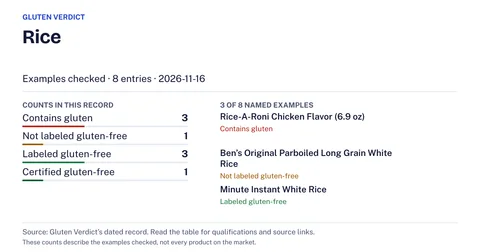 RiceNaturally gluten-free3 of 8 products we checked contain gluten: Rice-A-Roni Chicken Flavor (6.9 oz), Near East Original Rice Pilaf, and Ben’s Original Ready Rice Rice PilafBuy it labeled gluten-freechecked Nov 16, 2026
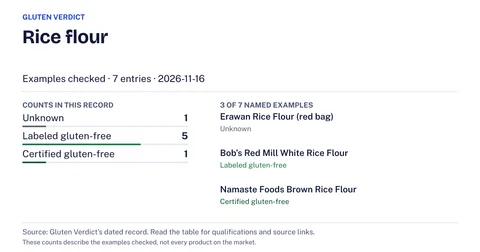 Rice flourNaturally gluten-freeBuy it labeled gluten-freechecked Nov 16, 2026
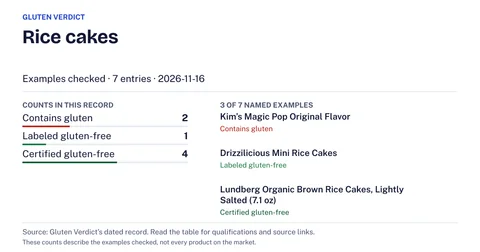 Rice cakesDepends on the product2 of 7 products we checked contain gluten: Kim’s Magic Pop Original Flavor and Kim’s Magic Pop Whole Wheat Flavorchecked Nov 16, 2026
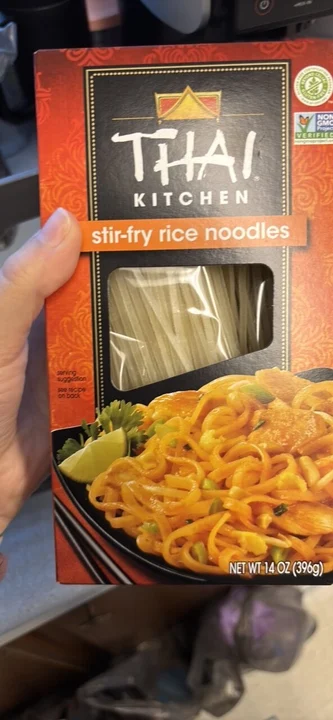 Rice noodlesNaturally gluten-free2 of 9 products we checked contain gluten: Annie Chun’s Pad Thai Noodle Bowl with Vegetables and Annie Chun’s Pho Soup Bowl with VegetablesBuy it labeled gluten-freechecked Nov 16, 2026
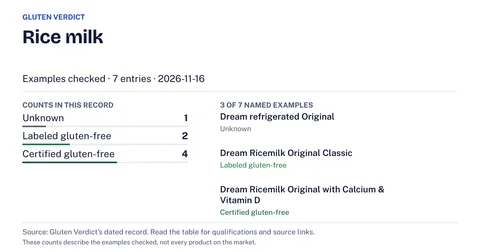 Rice milkDepends on the productchecked Nov 16, 2026
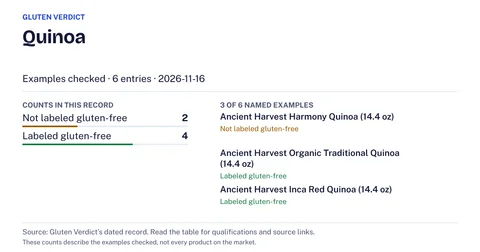 QuinoaNaturally gluten-freeBuy it labeled gluten-freechecked Nov 16, 2026
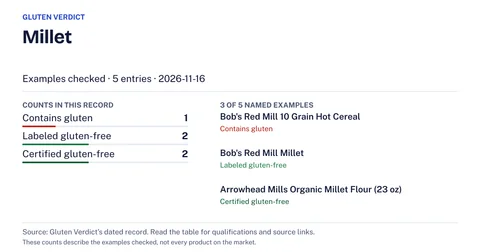 MilletNaturally gluten-free1 of 5 products we checked contains gluten: Bob's Red Mill 10 Grain Hot CerealBuy it labeled gluten-freechecked Nov 16, 2026
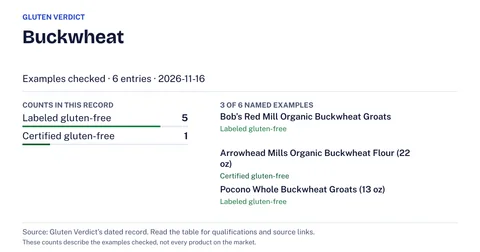 BuckwheatNaturally gluten-freeBuy it labeled gluten-freechecked Nov 16, 2026
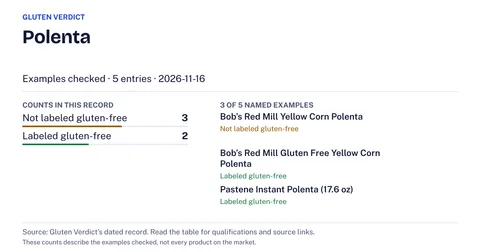 PolentaNaturally gluten-freeBuy it labeled gluten-freechecked Nov 16, 2026
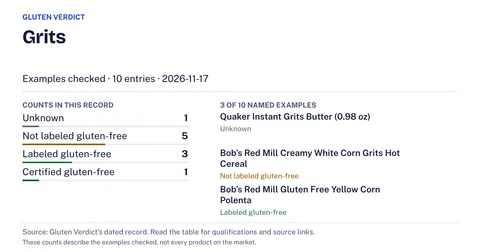 GritsNaturally gluten-freeBuy it labeled gluten-freechecked Nov 17, 2026
Questions people ask
Does FDA say to avoid rice?
No. FDA says rice tends to absorb arsenic more readily than other crops, and that consumers can certainly eat rice as part of a well-balanced diet1.
Is there a US limit for arsenic in rice pasta or rice flour?
On FDA’s Arsenic in Food page, the guidance list names an action level only for infant rice cereals among rice foods8, 7, and FDA says guidance is not legally binding9. This is the US position; other countries set their own rules.
More in Nutrition and combining diets
 Calcium and magnesium on a gluten-free, dairy-free dietWhere calcium and magnesium come from without dairy or gluten, and how to read a plant milk’s panel and ingredient list for added calcium.
 Fiber on a gluten-free diet: where it drops and what fills the gapCheck the fiber on gluten-free breads and pastas against the US Daily Value, and see which gluten-free whole foods charities list to add more.
 What to eat after a celiac diagnosis: what the sources document and what they do notBone broth, collagen, glutamine or plain staples? What NIDDK, ACG and celiac charities document after a diagnosis, and what no page we read names.
 Gluten-free with type 2 diabetes or high cholesterol: where the plans overlapWhere a gluten-free plan and a diabetes or cholesterol plan agree, where packaged gluten-free foods cut across them, and what to ask a dietitian.
 Iron, B12 and B6 on a gluten-free diet: where they come from and how to check a labelWhich foods supply iron, B12 and B6, what US enrichment standards name, and how to check whether a gluten-free flour, bread or cereal is fortified.
 Does a gluten-free diet change blood sugar? What each study measuredRead the BMJ heart-disease cohort, the type 2 diabetes cohort, a pasta glucose trial and celiac and type 1 diabetes sources by what each measured.
Related guides
 Gluten-free baby food: what the makers’ labels say about wheat, barley and oatsWhat baby cereal, puff, snack and pouch makers print about wheat, barley, oats and gluten, read from their own pages, with the date we read them.
 Is a gluten-free diet healthy if you do not have celiac disease?What a gluten-free label promises, what studies of gluten-free products and eaters report, and why testing comes before cutting gluten.
 Millet, sorghum, quinoa, buckwheat, teff, amaranth and wild rice: what the bag has to sayWhich grains and seeds are gluten-free plants, what makers and certifiers say about seven of them, and the cross-contact checks for bags, bins and blends.
 Gluten-free flours for baking: what rice, sorghum, tapioca, almond and coconut flour each doWhat makers say rice, sorghum, millet, tapioca, potato starch, almond and coconut flour do in a bake, and which bags say gluten-free on the label.
Sources
- [1, 3, 4, 10, 23] US Food and Drug Administration, What You Can Do to Limit Exposure to Arsenic, checked Nov 17, 2026.
- [2] Consumer Reports, Arsenic in your food (November 2012), checked Nov 17, 2026.
- [5, 24, 29, 30] Celiac Disease Foundation, Arsenic & the Gluten-Free Diet, checked Nov 17, 2026.
- [6, 7, 17, 18, 19] US Food and Drug Administration, Supporting Document for Action Level for Inorganic Arsenic in Rice Cereals for Infants, checked Nov 17, 2026.
- [8, 9, 16, 20, 21, 44] US Food and Drug Administration, Arsenic in Food, checked Nov 17, 2026.
Read on 2026-11-17: the table headed “Guidance for Industry and Support Documents by Date Issued” lists Action Level for Inorganic Arsenic in Apple Juice (June 2023); Action Level for Inorganic Arsenic in Rice Cereals for Infants (August 2020); Bottled Water and Arsenic, Small Entity Compliance Guide (April 2009); and Action Levels for Poisonous or Deleterious Substances in Human Food and Animal Feed (August 2000). It names no rice guidance other than the one for rice cereals for infants.
- [11, 34, 35] American Journal of Gastroenterology (PubMed abstract), Effect of Adopting a Gluten-Free Diet on Exposure to Arsenic and Other Heavy Metals in Children With Celiac Disease (Du et al., 2025), checked Nov 17, 2026.
- [12, 36] JPGN Reports (PubMed abstract), Return to baseline arsenic concentrations after 1 year on gluten-free diet in children with celiac disease (Du et al., 2026), checked Nov 17, 2026.
- [13, 38] Nutrients (PubMed abstract), Heavy Metal and Rice in Gluten-Free Diets: Are They a Risk? (Bascuñán et al., 2023), checked Nov 17, 2026.
- [14, 15] CDC, Agency for Toxic Substances and Disease Registry (ATSDR), ToxFAQs for Arsenic, checked Nov 17, 2026.
- [22] US Food and Drug Administration, Arsenic in Rice and Rice Products Risk Assessment, checked Nov 17, 2026.
- [25, 26, 27, 39, 40, 41, 42, 43] Consumer Reports, How much arsenic is in your rice? (November 2014), checked Nov 17, 2026.
- [28] Coeliac UK, Arsenic in rice and rice based products (page dated March 20, 2017), checked Nov 17, 2026.
- [31] Celiac Disease Foundation, Arsenic in the Gluten-Free Diet: Are You At Risk? (26 May 2017), checked Nov 17, 2026.
- [32, 33] Clinical Gastroenterology and Hepatology (PubMed abstract), Accumulation of Heavy Metals in People on a Gluten-Free Diet (Raehsler et al., 2018), checked Nov 17, 2026.
- [37] Food Additives & Contaminants Part A (PubMed abstract), Arsenic speciation in rice-based food for adults with celiac disease (Munera-Picazo et al., 2014), checked Nov 17, 2026.