Packing a gluten-free work lunch from shelf-stable foods
Short answer
Four checks cover a packed office lunch:
- Start with foods that are gluten-free by nature: NIDDK lists meat, fish, fruits, vegetables, rice and potatoes without additives or some seasonings1.
- Read every packaged item. A “gluten-free” claim on a food FDA regulates means less than 20 parts per million of gluten2; with no claim, the Celiac Disease Foundation says to read the label3.
- Keep perishable items cold: at least two cold sources in the bag, and no more than 2 hours at room temperature, or 1 hour above 90 degrees F4, 5.
- For the shared fridge, the Gluten Intolerance Group advises the top shelf, well packaged or sealed, and clearly labeled6. The Celiac Disease Foundation lists toasters used for regular bread and double-dipped spreads as places cross-contact occurs7, 8.
Part of Grocery shopping and meal planning, 15 guides
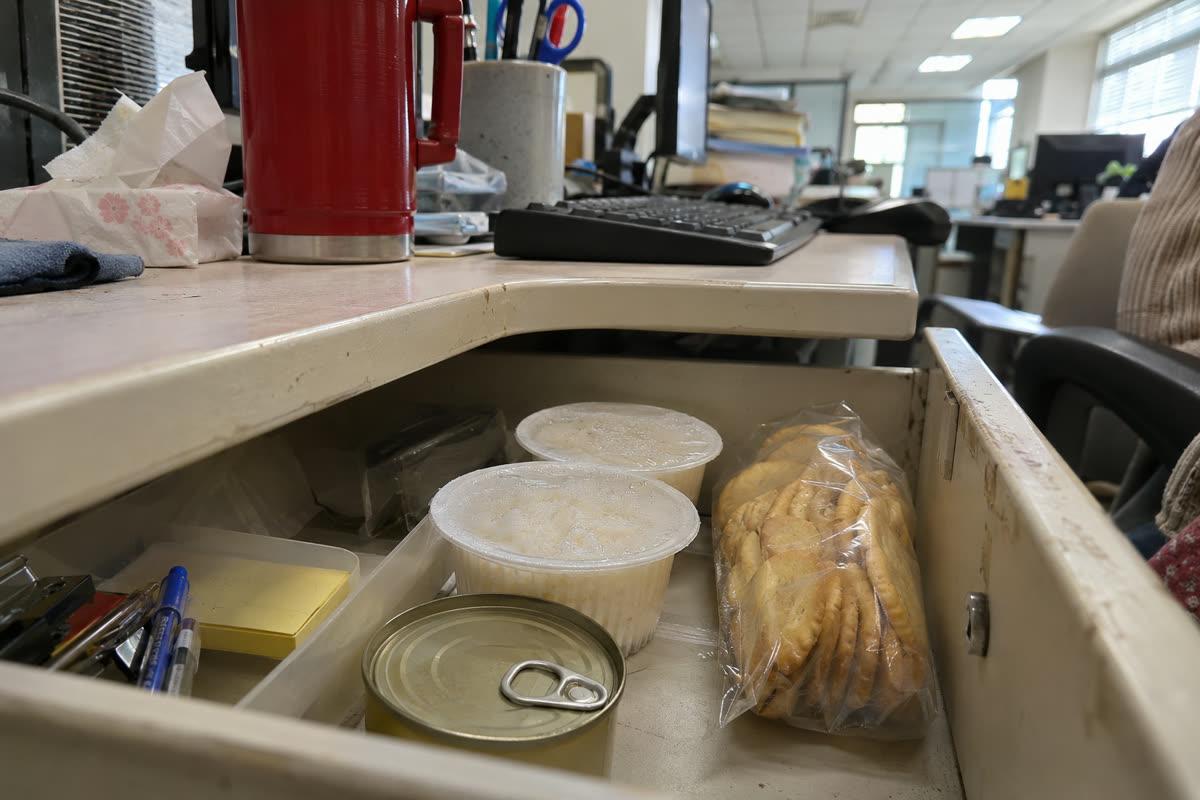
Key points
- Foods that are gluten-free by nature often carry no claim, because FDA’s “gluten-free” claim is voluntary9, 10.
- Needing no refrigeration is a different question from containing gluten: FSIS lists breads and crackers among items that need no refrigeration11, and the Celiac Disease Foundation lists breads and crackers among common foods that contain gluten12.
- The Celiac Disease Foundation says energy and granola bars, potato chips, processed lunch meats, soups and multi-grain tortilla chips must be verified by reading the label or asking the maker13, 14.
- One line per packaged item, written once (claim or no claim, ingredient list read, date), saves re-reading the same label every week.
What a packed lunch has to get through before noon
An office lunch has two things to get through: time and temperature for perishable food, and shared surfaces, appliances and spreads that other people’s crumbs can reach. FSIS, a US Department of Agriculture agency, covers the first; the celiac charities cover the second.
FSIS says perishable food should not be left out at room temperature for more than 2 hours, or 1 hour if the temperature is above 90 degrees F5. For a lunch carried away from home it says to include at least two cold sources, such as two frozen gel packs, or a frozen gel pack plus a frozen juice box or bottle of water4. It calls insulated, soft-sided lunch bags best for keeping food cold15.
If the office has a refrigerator, FSIS says to store perishable items there on arrival, and to leave the insulated bag’s lid open if the bag goes in16. It also advises packing just the amount of perishable food that can be eaten at lunchtime17.
| Item | Cold source? | Gluten check |
|---|---|---|
| Whole fruit and vegetables | FSIS lists them as needing no refrigeration11 | Plain fruit and vegetables are gluten-free by nature1, 10 |
| Canned fish and canned meat | No refrigeration needed11 | Plain fish is gluten-free by nature1; a seasoned or sauced can needs its label read. See our tuna salad verdict. |
| Peanut butter, jelly, mustard, pickles | No refrigeration needed11 | Read each jar. See peanut butter. Spreads such as peanut butter, jam and mustard may become contaminated when utensils used on gluten-containing food are double-dipped8. |
| Chips, crackers, bread | No refrigeration needed11 | Breads and crackers are listed among common foods that contain gluten12; some potato chip seasonings may contain malt vinegar or wheat starch18. See the table below, crackers and tortilla chips. |
| Yogurt | Perishable: no more than 2 hours at room temperature19 | Flavor and maker differ. See yogurt. |
| Prepackaged combos with luncheon meat, cheese or cut fruit | Must be kept refrigerated20 | Processed lunch meats are on the Celiac Disease Foundation’s verify list21. |
Cold-chain rules and gluten rules are separate checks. A lunch can pass one and fail the other: a cracker needs no ice pack, and may still be made with wheat11, 12.
A base of foods that are gluten-free by nature
NIDDK says many foods, such as meat, fish, fruits, vegetables, rice and potatoes, are naturally gluten-free when they come without additives or some seasonings1. The qualifier matters at lunchtime: NIDDK adds that many food ingredients and additives, such as colorings, flavorings, starches and thickeners, are made from grains that contain gluten22. A plain piece of fruit and a marinated, sauced or seasoned item are different questions.
FDA says fruits, vegetables, eggs and bottled spring water are naturally gluten-free, but because the “gluten-free” claim is not required, it may not appear on them10. A missing claim on an apple is not a warning.
Oats are the item to read twice. NIDDK’s advice to anyone eating oats is to make sure they are gluten-free23, and the Celiac Disease Foundation lists oats among easily contaminated foods, advising oats specifically labeled gluten-free24. For oat cups and bars, see our oatmeal verdict and the guide on gluten-free oats versus regular oats.
Our popcorn and rice cakes verdicts show how a plain snack and its flavored or branded versions can differ, which is why the next section applies to every packaged item.
Check each packaged item once, and write down what you read
FDA’s rule says a food labeled “gluten-free”, “no gluten”, “free of gluten” or “without gluten” must contain less than 20 parts per million of gluten2. The claim itself is voluntary9.
Meat, poultry and certain egg products are regulated by USDA and fall outside FDA’s rule25, and the Celiac Disease Foundation puts processed lunch meats on its list of foods to verify21. For a deli-meat or jerky pack, read the ingredient list.
When a food carries no claim, the Celiac Disease Foundation says to read its label3. NIDDK says not to eat a food if you are unsure whether it contains gluten, and to contact the maker or visit its website if possible26. The Celiac Disease Foundation’s advice when ingredients cannot be verified is the same: do not eat the item27.
A one-line record per item
- Open the package or the maker’s page and look for a gluten-free claim. Note it, or note that there is none.
- Read the ingredient list for wheat, barley, rye, malt and oats that are not labeled gluten-free. The guide on how to read a US food label walks through the words, and may-contain lines covers the shared-facility statement.
- Write one line in your phone: product and pack size, claim or no claim, the date you read it.
- Read again when the package changes, and go by the package in your hand.
For what the rule does and does not cover, see FDA’s gluten-free labeling rule.
Bars, crackers, chips and meats: where lunch items go wrong
The Celiac Disease Foundation keeps a list of foods that it says must be verified by reading the label or checking with the maker13. Several are lunch staples, and crackers and pretzels sit on its separate list of common foods that contain gluten12.
| Item | What the Celiac Disease Foundation says |
|---|---|
| Granola and energy bars (granola bars, Clif Bar, KIND bar) | Some bars may contain wheat as an ingredient, and most use oats that are not gluten-free28 |
| Potato chips | Some seasonings may contain malt vinegar or wheat starch18 |
| Tortilla chips (tortilla chips) | Multi-grain or “artisan” chips, or tortillas not entirely corn-based, may contain a wheat-based ingredient29 |
| Processed lunch meats (for jerky, see our beef jerky verdict) | Processed lunch meats are on the verify list21 |
| Salad dressings and marinades | May contain malt vinegar, soy sauce or flour30 |
| Soup | Cream-based soups use flour as a thickener, and many soups contain barley31 |
| Crackers and pretzels (crackers) | Listed among common foods that contain gluten12 |
Other lunch-box staples differ by brand and flavor in our verdicts: hummus, peanut butter, yogurt and tuna salad. Each verdict page shows what the pages we read said, and the date we read them.
The shared fridge and the break room
The Gluten Intolerance Group (GIG) advises storing gluten-free items on the top shelf of the office fridge, well packaged or sealed, and clearly labeled6. Another GIG article, on cross-contact, gives a similar reason for shelf order: crackers and cookies could generate crumbs, so if both kinds of food share a fridge or cupboard, it says to put the gluten-free packages above the gluten-containing ones and keep them securely packaged32.
- Container: the Celiac Disease Foundation lists shared containers, including improperly washed ones, among places cross-contact can occur33. A lid-sealed container from home, washed at home, is one way to sidestep the question. Coeliac UK, a UK charity, says standard washing-up liquid or a dishwasher will remove gluten34.
- Bag: USDA suggests wiping the inside of the lunch bag with hot soapy water and letting it air dry35.
- Plates and cutlery: GIG suggests washing them thoroughly with soap and water, asking whether the company can supply extras, or bringing a few of your own for your exclusive use and storing them separately36.
- Table: GIG suggests wiping down any surface where you prepare or lay out your meal, so residual crumbs from gluten-containing foods do not get into your food37.
Vending machines and snack boxes
GIG notes that vending-machine snacks are typically individually wrapped, which helps prevent cross-contact in the machine, but that the challenge is reading the label before you pay38. Its options include asking the vending company for ingredient information, and asking for labeled or certified gluten-free snacks to be stocked39. A lunch packed from home does not depend on any of this.
Microwave, toaster and shared spreads
GIG’s appliance article is written for home kitchens, and we apply it to a shared office kitchen on the same reasoning: small spaces, shared surfaces, other people’s food.
- Microwave: GIG says gluten-free members of a household can share a microwave with people who eat gluten, but not to heat up items together, because microwave ovens are generally smaller than a conventional oven and items could spill onto each other40. It also says to wipe down a shared microwave after each use, since remains of earlier food could splatter onto your food41. If you reheat leftovers, FSIS says to reheat them to at least 165 degrees F42.
- Toaster: the Celiac Disease Foundation lists toasters used for both gluten-free and regular bread as a place cross-contact occurs7. GIG says crumbs can end up on gluten-free bread, and suggests toaster bags or a toaster used only for gluten-free bread43; Coeliac UK gives the same two options44. A lunch built from the shelf can simply skip the office toaster.
- Spreads and condiments: the Celiac Disease Foundation says butter, peanut butter, jam, mustard and mayonnaise may become contaminated when utensils used on gluten-containing food are double-dipped8. GIG calls double-dipping one of the most common ways gluten crumbs get into gluten-free food45. Coeliac UK suggests separate condiments, or at least clean cutlery for shared butters, jams and spreads46. A small jar or single-serve packs of your own keep your spread out of the shared jar.
When someone else provides the food
For a catered meeting, GIG suggests asking early for a gluten-free option, such as a prepared and packaged salad without dressing47. When a group order is delivered, it suggests checking that foods are individually wrapped and asking the restaurant to package gluten-free items separately48.
When there was no notice, GIG says well-packaged gluten-free options kept in the office fridge, cupboard or desk can help49. Our guide on a gluten-free emergency food supply covers what to keep on hand.
For asking an employer for storage, a fridge shelf or a say in catering, see workplace accommodations and lunches and travel at work.
A five-point check before you close the lunch box
- Every packaged item has a line in your record: claim or no claim, ingredient list read, date.
- Perishable items have two cold sources4.
- The lunch is in a sealed, labeled container for the top shelf6.
- Spreads and sauces are your own, not the shared jar8.
- Nothing goes through the shared toaster7, and anything reheated is heated on its own40.
Verdicts in this guide
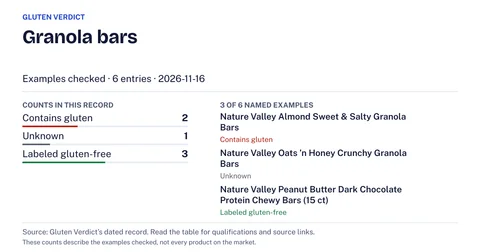 Granola barsDepends on the product2 of 6 products we checked contain gluten: Nature Valley Almond Sweet & Salty Granola Bars and Nature Valley Cinnamon Brown Sugar Soft-baked Oatmeal Squareschecked Nov 16, 2026
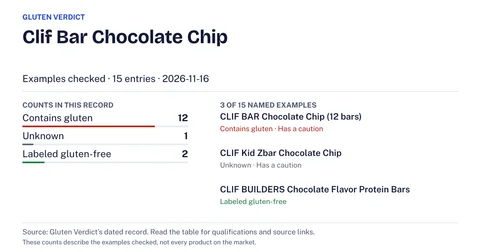 Clif Bar Chocolate ChipContains glutenClif Bar & Company · checked Nov 16, 2026
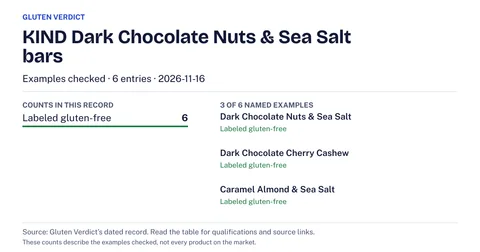 KIND Dark Chocolate Nuts & Sea Salt barsLabeled gluten-freeKIND (Mars) · checked Nov 16, 2026
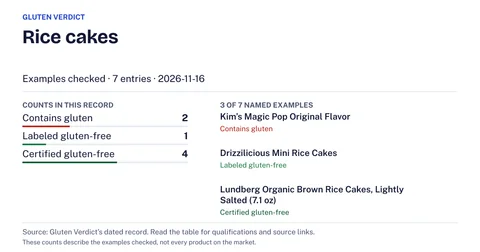 Rice cakesDepends on the product2 of 7 products we checked contain gluten: Kim’s Magic Pop Original Flavor and Kim’s Magic Pop Whole Wheat Flavorchecked Nov 16, 2026
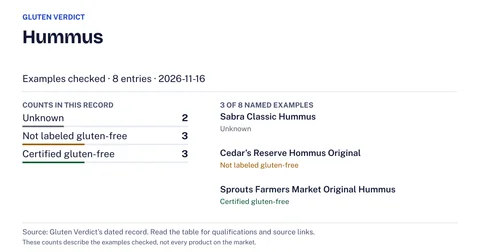 HummusDepends on the productchecked Nov 16, 2026
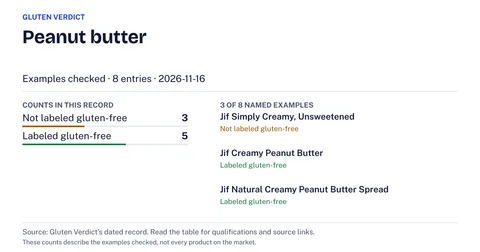 Peanut butterDepends on the productchecked Nov 16, 2026
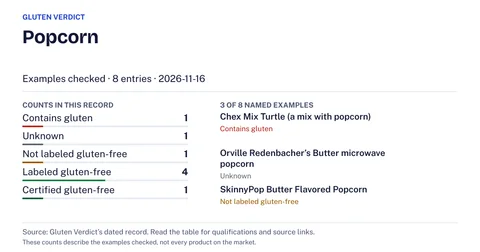 PopcornNaturally gluten-free1 of 8 products we checked contains gluten: Chex Mix Turtle (a mix with popcorn)checked Nov 16, 2026
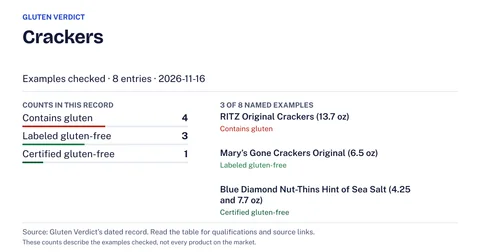 CrackersDepends on the product4 of 8 products we checked contain glutenchecked Nov 16, 2026
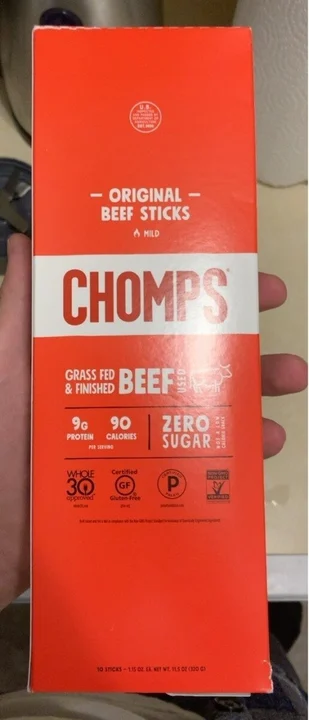 Beef jerkyDepends on the product3 of 8 products we checked contain gluten: Jack Link’s Original Beef Jerky, Jack Link’s Teriyaki Beef Jerky, and Old Trapper Teriyaki Beef Jerky (bulk)checked Nov 16, 2026
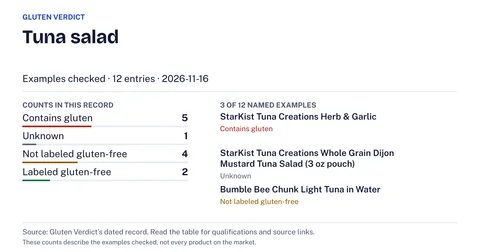 Tuna saladDepends on the product5 of 12 products we checked contain glutenchecked Nov 16, 2026
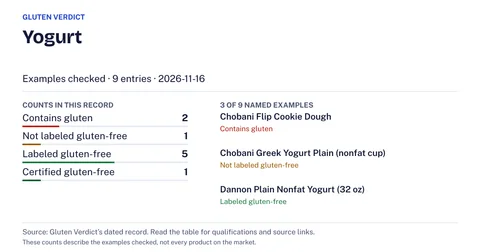 YogurtDepends on the product2 of 9 products we checked contain gluten: Chobani Flip Cookie Dough and Chobani Flip Cookies & Creamchecked Nov 16, 2026
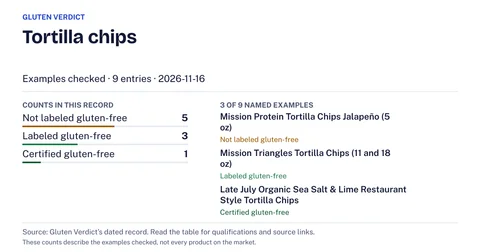 Tortilla chipsDepends on the productchecked Nov 16, 2026
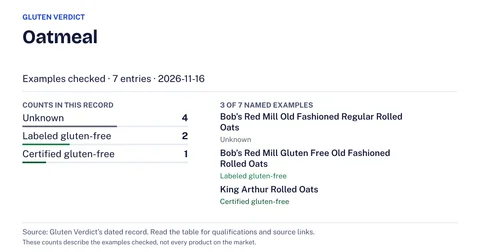 OatmealDepends on the productchecked Nov 16, 2026
Questions people ask
Does a lunch of shelf-stable food need an ice pack?
FSIS lists items that do not require refrigeration, including whole fruits and vegetables, canned meat and fish, chips, breads, crackers, peanut butter, jelly, mustard and pickles11. Perishable items such as yogurt should not sit at room temperature for more than 2 hours19.
Is a food with no gluten-free claim ruled out?
No. The claim is voluntary9, and naturally gluten-free foods may not carry it10. For a made food with no claim, the Celiac Disease Foundation says to read the label3.
Can I use the office microwave?
GIG’s appliance article, written for home kitchens, says gluten-free household members can share a microwave with people who eat gluten but should not heat up items together, and to wipe down a shared microwave after each use40, 41.
Can I buy snacks from the office vending machine?
GIG says vending snacks are typically individually wrapped, and that the challenge is reading the label to verify a snack before you pay for it38.
More in Grocery shopping and meal planning
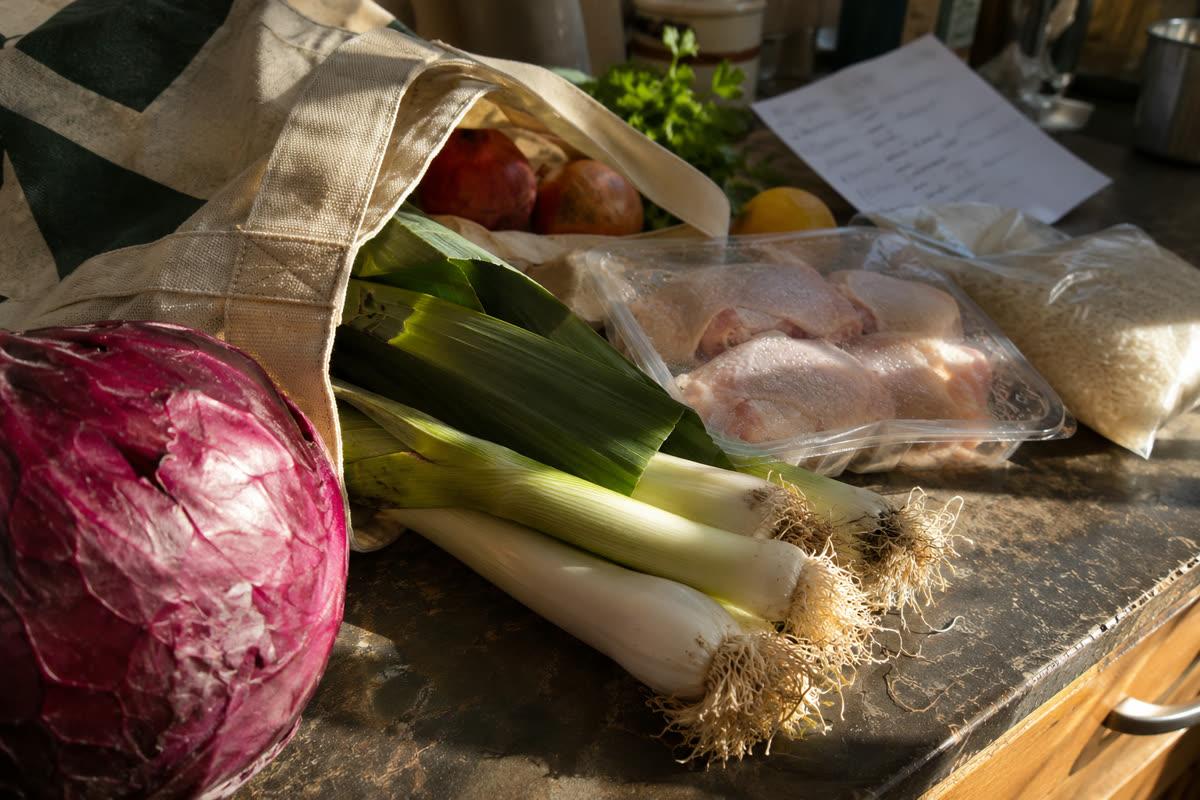 A gluten-free meal plan as a shopping template, by meal slotA weekly gluten-free shopping template: staples for each meal slot, the check each packaged item needs, and a ledger of when you last read each label.
 Gluten-free grocery shopping: what to check at the shelf, the bulk bins and the checkoutOne reading order for any US supermarket pack, plus what to do about bulk bins, frozen cases, wheat starch and storage once the bags are home.
 Gluten-free at the farmers market and in a CSA box: what to ask each producerWhich farmers market stalls and CSA add-ons need no label, which need questions, and the order to ask them, with what state cottage food rules cover.
 Gluten-free grocery pickup and delivery: setting substitutions and checking swapsHow to set no-substitution choices on Instacart, Target and Whole Foods orders, check each swapped item at the door, and report a swap that fails.
 How to check a grocery listing for gluten before you orderRead an online grocery listing for gluten in a fixed order, tell a store tag from a maker claim and a certifier mark, and re-check on reorders.
 Store-brand gluten-free: what the tag, claim or seal rests onSort a store-brand item into certified, maker-stated or ingredient-only, see what each lets you conclude, and know what to ask the store.
Related guides
 Gluten-free meal prep in a shared kitchen: order, containers, labels and refrigerator timesHow to run a gluten-free prep session in a kitchen shared with wheat eaters: what to clean, what to handle first, how to label, and how long food keeps.
 Gluten-free at work: catered lunches, client dinners, the office kitchen and business tripsWhat to ask a caterer, say to a server, label in the office fridge and carry on a business trip, from GIG, NIDDK, FDA and a chain's own allergen page.
 Asking an employer for celiac-related accommodations: what the ADA, EEOC and JAN sayHow to ask an employer for a celiac-related accommodation: what the ADA, EEOC and JAN say, what a request contains, and the EEOC charge deadline.
 Gluten-free snack bars: reading oats and barley malt on the wrapperRead a snack-bar wrapper in four steps (gluten-free claim, malt, oats, Contains line), with a Clif and a KIND bar worked through.
Sources
- [1, 22, 23, 26] National Institute of Diabetes and Digestive and Kidney Diseases, Eating, Diet, & Nutrition for Celiac Disease, checked Nov 17, 2026.
- [2, 9, 10, 25] US Food and Drug Administration, Gluten and Food Labeling, checked Nov 17, 2026.
- [3, 7, 8, 12, 13, 14, 18, 21, 24, 27, 28, 29, 30, 31, 33] Celiac Disease Foundation, Sources of Gluten, checked Nov 17, 2026.
Read on 2026-11-17: the list headed “Common Foods That Contain Gluten” names, among others, breads and pastries (croissants, pita, naan, bagels, flatbreads, cornbread, potato bread, muffins, donuts, rolls) and crackers (pretzels, goldfish, graham crackers).
Read on 2026-11-17: the list headed “Foods That May Contain Gluten” names, among others, energy bars/granola bars, French fries, potato chips, processed lunch meats, candy and candy bars, soup, multi-grain or “artisan” tortilla chips, and salad dressings and marinades.
- [4, 5, 11, 15, 16, 17, 20, 42] US Department of Agriculture, FSIS, Bag lunches: cold sources and time limits, checked Nov 17, 2026.
- [6, 36, 37, 38, 39, 47, 48, 49] Gluten Intolerance Group, The Gluten-Free Office and Workplace, checked Nov 17, 2026.
- [19, 35] US Department of Agriculture, Using an insulated lunch bag, checked Nov 17, 2026.
- [32, 45] Gluten Intolerance Group, 25 Ways Cross-Contact Could Happen (And How to Avoid It), checked Nov 17, 2026.
- [34, 44, 46] Coeliac UK, Avoid Gluten Free Cross Contamination at Home, checked Nov 17, 2026.
- [40, 41, 43] Gluten Intolerance Group, Appliances: Risks of Cross-Contact, checked Nov 17, 2026.