What a European restaurant must tell you about gluten, country by country
Short answer
EU law makes a restaurant give allergen information, including “cereals containing gluten”, for food served without a pack1, 3, 21, 22, but each country may set how it is given2, and the six below differ on whether it is written, spoken or both. What the six countries chose:
- France: written, either the information itself or a written notice of where it is held, directly accessible to you4, 5.
- Germany: written first; spoken only with a written or electronic record you can ask to see and a visible notice6, 7, 8.
- Austria: written or spoken; spoken answers come from trained staff, with a visible notice9, 10, 11.
- Italy: on the menu, a register or a sign, or a notice pointing you to staff and written documentation12, 13.
- Spain: written by default; spoken allowed with a written record and a visible notice14, 15, 16.
- United Kingdom (FSA guidance for England, Northern Ireland and Wales): any means, spoken included, with a notice directing you to where to ask17, 18, 33.
Part of Travel: Europe, 19 guides

Key points
- Every EU restaurant owes allergen information for unpacked food, and the list includes cereals containing gluten1, 3, 21, 22.
- Member States may set the means and form, so the same duty looks different from country to country2.
- France requires a written form; Germany, Spain and Italy allow spoken answers only behind a written record or documentation4, 7, 15, 13.
- Austria and the UK (England, Northern Ireland and Wales) allow spoken answers with a notice; Austria expects trained staff10, 11, 18, 33.
- “Gluten-free” on a menu is a separate statement with a 20 mg/kg limit19, 41.
What EU law requires of every restaurant
The EU’s food information regulation defines a mass caterer as any establishment, such as a restaurant, canteen, school, hospital or catering enterprise, in which food is prepared to be ready for consumption by the final consumer20. For food offered without prepackaging, giving the allergen particulars is mandatory1.
Those particulars cover any ingredient or processing aid listed in Annex II, or derived from an Annex II substance, that was used in making the food and is still in the finished product, even in altered form21. Annex II begins with cereals containing gluten: wheat, rye, barley, oats, spelt, kamut or their hybridised strains, and products thereof, with listed exceptions3. The European Commission describes the result as mandatory allergen information for non-prepacked foods, including in restaurants and cafes22.
The regulation lets each member state set the “how”: it may adopt national measures on the means through which the information is made available and on its form of expression and presentation2. That is why one country’s restaurants can meet the same duty with a printed list and another’s with a spoken answer.
The legal term is “cereals containing gluten”, not “gluten”, and it names oats, spelt and kamut next to wheat, rye and barley3. Our guide to which gluten grains a pack’s allergen line must name, by country compares it with US wording.
Written, spoken or both: six countries compared
The table gives each country’s rule in one line. Each row comes from that country’s own legal text, health-ministry page or food regulator’s guidance, read on 2026-11-17; the paragraphs below give the wording behind it.
| Country | Written information | May staff answer aloud instead? | What must then be in place |
|---|---|---|---|
| France | Required, in written form: the information itself, or a written notice of where it is held4 | Not the route the decree describes: the written information must be directly and freely accessible4, 5 | A written source the consumer can reach without asking5 |
| Germany | The main rule: on a sign, a menu or price list, a notice in the shop, or another written or electronic offer6 | Yes, by the owner or by staff who know the ingredients, on request and without delay before the purchase23 | A written or electronic record of ingredients, reachable by the authority and, on request, by consumers7; a visible notice that answers are spoken8 |
| Austria | Allowed; no form is prescribed for it9 | Yes9, by trained staff10, 11 | A clearly visible, legible notice that the information is available orally on request10 |
| Italy | On the menu, a register, a sign or an equivalent system, digital included12 | Only as an alternative: a notice pointing you to staff13 | Written documentation that is easy to find for the authority and the consumer13 |
| Spain | The default: on labels or signs on or near the food14 | Yes, if staff can answer easily before the purchase is complete15 | A written or electronic record at the premises that staff, inspectors and consumers who ask can reach15; a visible notice16 |
| United Kingdom (England, Northern Ireland, Wales) | No fixed form17 | Yes17 | A readily discernible notice, menu, ticket or label directing you to where the information is, for example by asking staff18 |
France: a written form
France’s decree no. 2015-447 of 17 April 2015 says that where meals are served for eating on the premises, the consumer is told in writing, legibly and visibly, either the allergen information itself or how it is kept at their disposal4. In the second case the consumer must be able to reach the information directly and freely, in written form5. The same rule now sits in the Code de la consommation as article R412-14, in force since 1 July 201642, 43. Collective catering has a separate exception, in article R412-15: the information is not required at the meal where a system lets consumers say beforehand which ingredients they refuse24.
We read the decree as first published in the Journal officiel of 19 April 2015, and the current articles R412-14 and R412-15 on Légifrance, which we could open only through a text-fetch service because its own site sits behind a bot check. We did not read the other articles of that subsection in their current form.
Germany: written first, spoken with a record
Germany’s LMIDV, section 4, requires the information to be clearly visible and legible for the food in question and lists the written means: a sign at or near the food, a menu or price list, a notice in the shop, or another written or electronic offer6. A spoken answer is the exception. The owner, or staff sufficiently informed about the ingredients, may answer aloud, and must give the information on request, without delay, before the purchase is concluded and the food handed over23. That route needs a written or electronic record of the ingredients used, which the authority, and on request the consumer, can reach easily7, and a visible notice saying that the information is given aloud and the record is available on request8.
Austria: written or spoken, and a letter code
Austria’s health ministry says allergen information on unwrapped food may be given in writing or aloud, and that no form is prescribed for the written version, a menu for example9. Spoken information may come from trained staff, provided guests are told in a clearly visible, legible place that it is available orally on request10. Only people trained for it may give it11.
The Austrian Codex has a recommendation for written allergen information that includes letter codes, and it assigns A to cereals containing gluten25. Where letter codes are used, it says its letter assignment is followed so the codes are not misunderstood, and that a legend headed “Allergeninformation gemäß Codex-Empfehlung” is displayed or made available where it can be seen and read26. That is a recommendation; the ministry itself prescribes no form for the written version9.
Italy: a sign or menu entry, or a notice pointing to written records
Italy’s legislative decree 231/2017, article 19, paragraph 8, covers unwrapped food served by the “collettività” of the EU regulation, a term whose definition includes restaurants12, 20. The allergen information must be given for each food before it is served, on the menu, a register, a sign or an equivalent system, digital included, kept in plain view12. Where a digital system is used, the information must also be in written documentation that the authority and the consumer can easily find44. The alternative is a notice on the menu, register or sign that sends you to staff, with the information held in written documentation that the authority and the consumer can easily find13. A server’s answer alone is therefore not the Italian rule: the spoken route sits behind a notice and written documentation13.
Spain: written by default, spoken with a written record
Spain’s Real Decreto 126/2015 applies to food sold unwrapped to final consumers and to “colectividades”27, a term it takes from the EU regulation’s definitions28. Among the required particulars are the allergen mentions of the EU regulation, with a clear reference to the Annex II substance29, 21. The default is written: on labels attached to the food or signs on or near it14.
Article 6(5) allows spoken information if staff can give it easily on request before the purchase is complete, and the information is recorded in writing or electronically at the premises and is easy to reach for staff, inspectors and consumers who ask15. A visible, legible notice must then say where the information is available or that customers may ask staff16. A restaurant serving meals specifically adapted to people with allergies or intolerances need not display that notice, but must still provide the information whenever consumers or inspectors ask30.
United Kingdom: any means, with signposting if spoken
The UK is outside the EU: the Food Standards Agency (FSA) says directly applicable EU legislation no longer applies in Great Britain, and retained EU legislation became assimilated law on 1 January 202431. It describes the framework as assimilated Regulation 1169/2011 for England and Wales and the EU regulation for Northern Ireland32. The FSA guidance we read applies to England, Northern Ireland and Wales33; we did not read Scotland’s.
The duty uses the same 14-allergen list: businesses must declare any of the 14 allergens used as an ingredient or processing aid34, and cereals containing gluten are named as wheat (such as spelt and Khorasan wheat), rye, barley, oats and their hybridised strains and products thereof, with exceptions35. The FSA’s technical guidance says businesses may give the information for non-prepacked food by any means, including orally by a member of staff17. If it is spoken, the business must signpost where to get it, for example by asking staff, and a statement on a notice, menu, ticket or label must be readily discernible18.
The FSA’s best-practice guidance goes further. It describes a change in best practice, to meet the expectation of both written allergen information and a conversation, while stating that the minimum legislative requirement, information by any means with a sign when it is given verbally, has not changed36. Businesses are not required by law to follow best practice37; written information readily available without asking, on the menu, in a booklet or on a wall matrix, is part of that best practice38. Food prepacked for direct sale is different: the business must label it with the food’s name and a full ingredient list with allergens emphasised39.
What the rules do not settle
The EU duty is worded around ingredients and processing aids used in making the food21. Whether a kitchen keeps gluten away from your meal is a question to put to the person you ask. The FSA’s best-practice guidance, which businesses are not required by law to follow37, says cross contact with allergens that are not intentional ingredients should be considered40.
“Gluten-free” on a menu is a separate statement. The EU gluten-statement regulation applies to information to consumers on the absence or reduced presence of gluten in food41, and allows “gluten-free” only where the food as sold to the final consumer contains no more than 20 mg/kg of gluten19. For what the phrase on a menu does and does not tell you, see what “gluten-free” on a restaurant menu means and gluten-free and very low gluten on EU labels.
What to ask when the answer is spoken
This is our advice on using the rules above, not a legal rule.
- Look for the notice first. Germany, Austria, Italy, Spain and the UK each describe a notice for spoken answers8, 10, 13, 16, 18.
- Ask for the Annex II wording: “cereals containing gluten”, which in the law includes oats, spelt and kamut next to wheat, rye and barley3.
- Ask whether the written or electronic record can be seen. Germany and Spain require one that consumers who ask can reach7, 15; Italy ties the spoken route to written documentation13; France wants the written information directly accessible5.
- Ask who is answering. Austria expects trained staff11; Germany, the owner or staff informed about the ingredients23.
- For common restaurant components, read our verdicts first: gravy, soup, breadcrumbs, mayonnaise, soy sauce and french fries.
If staff cannot answer or cannot show the record
The rules describe what a business must provide or hold. The sources we read do not say what a customer can do next, so we do not either. They do say where an answer should come from: a written form in France4, a record in Germany and Spain7, 15, written documentation in Italy13, trained staff in Austria11.
Verdicts in this guide
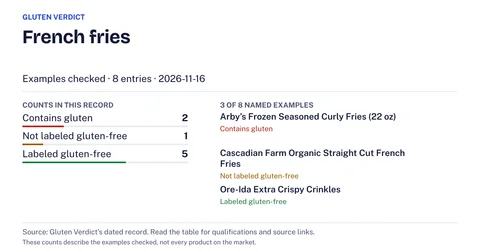 French friesDepends on the product2 of 8 products we checked contain gluten: Arby’s Frozen Seasoned Curly Fries (22 oz) and Checkers Frozen Crispy Seasoned Fries (28 oz)checked Nov 16, 2026
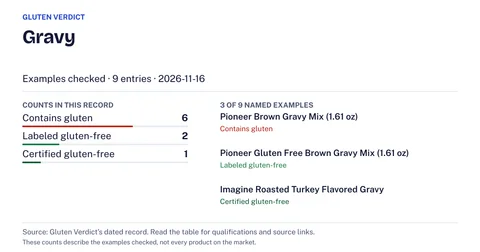 GravyDepends on the product6 of 9 products we checked contain glutenchecked Nov 16, 2026
 SoupDepends on the product3 of 8 products we checked contain gluten: Campbell’s Condensed Tomato Soup (10.75 oz), Campbell’s Condensed Cream of Mushroom Soup (10.5 oz), and Progresso Traditional Chicken Noodlechecked Nov 16, 2026
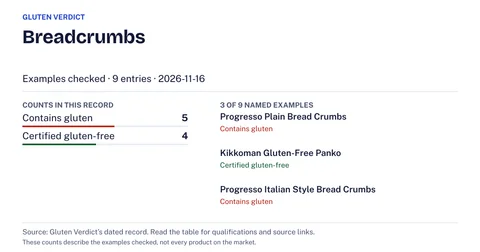 BreadcrumbsContains glutenchecked Nov 16, 2026
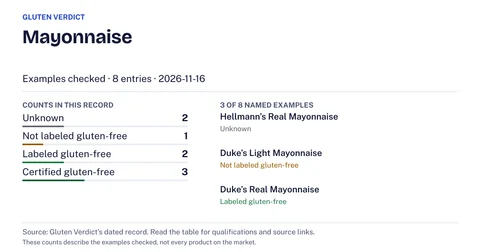 MayonnaiseNaturally gluten-freechecked Nov 16, 2026
 Soy sauceDepends on the product3 of 7 products we checked contain gluten: Kikkoman Soy Sauce (Non-GMO), 20 oz; San-J Organic Shoyu Soy Sauce; and Lee Kum Kee Premium Soy Sauce (No Preservatives Added)checked Nov 16, 2026
Questions people ask
Must a restaurant in the EU tell me whether a dish contains gluten?
It must provide allergen information for food served without a pack, and Annex II lists cereals containing gluten1, 3, 21. Member States may set the means and form of providing it2.
Does the EU rule cover restaurants in the UK?
Not in Great Britain: the FSA says directly applicable EU legislation no longer applies there31. For Northern Ireland it names the EU regulation32.
Is a letter on an Austrian menu a legal requirement?
The ministry says no form is prescribed for written allergen information9. The letter codes, with A for cereals containing gluten, come from a Codex recommendation25.
Can a server in Spain just tell me?
Yes, if staff can answer easily before you buy and the information is also recorded in writing or electronically at the premises15.
More in Travel: Europe
 Gluten-free in Portugal: the couvert, pastelarias and what to askWhat «isento de glúten» means in Portugal, what you owe for the couvert, what restaurants must say about allergens, and what the celiac society advises.
 Gluten-free in Central Europe: the rules in five countries and where wheat hides in the dishesWhich gluten-free rule covers a pack in Austria, Czechia, Hungary, Poland and Switzerland, and where wheat enters schnitzel, dumplings and sauces.
 Gluten-free in Denmark, Sweden, Norway, Finland and IcelandOne rule table for Denmark, Sweden, Norway, Finland and Iceland, with the regulator and society pages, the claim words, oats, rye and licorice.
 Gluten-free in the Netherlands and Belgium: labels, fryers, waffles and beerWhat glutenvrij and sans gluten mean on a pack, what Dutch and Belgian counters must tell you, and the fryer, waffle and beer questions to ask.
 Gluten-free in Scotland: the rule, haggis, oatcakes, pies and whiskyWhat changes in Scotland: who sets the gluten-free rule, how oats count, and how to judge haggis, oatcakes, pies, broth and whisky.
 Gluten-free in France: reading a pack, a menu and a “sans gluten” signWhat «sans gluten» means on a French pack, how restaurants must give allergen information, and what a bakery’s “sans gluten” sign does not promise.
Related guides
 How to read a restaurant allergen chart for glutenWhat a mark, a blank cell, an X and a footnote mean on real US chain allergen charts, and which gluten questions the chart cannot answer.
 What “gluten-free” on a restaurant menu meansFDA’s gluten-free rule is written for packaged food. See what a menu label can mean, and how to tell a recipe from a procedure or an audited program.
 Gluten-free in Germany: what “glutenfrei” and German allergen rules tell youHow to read “glutenfrei” and German allergen rules, spot wheat in pretzels and Spätzle, and ask a restaurant for its allergen information.
 Gluten-free in the UK: allergen rules, the Crossed Grain mark and pub and chip-shop foodHow a British pack and menu differ from a US one: the 20 mg/kg rule, 14 allergens, Crossed Grain versus venue accreditation, and chip-shop condiments.
Sources
- [1, 2, 3, 20, 21] European Union (EUR-Lex), Regulation (EU) No 1169/2011 on the provision of food information to consumers, checked Nov 17, 2026.
- [4, 5] Journal officiel de la République française (copy held by FAO FAOLEX), Décret n° 2015-447 du 17 avril 2015 relatif à l’information des consommateurs sur les allergènes et les denrées alimentaires non préemballées, checked Nov 17, 2026.
- [6, 7, 8, 23] Bundesministerium der Justiz (gesetze-im-internet.de), Verordnung zur Durchführung unionsrechtlicher Vorschriften betreffend die Information der Verbraucher über Lebensmittel (LMIDV), § 4, checked Nov 17, 2026.
- [9, 10, 11] Austrian health ministry (verbrauchergesundheit.gv.at), FAQ zur Allergeninformationsverordnung für unverpackte Lebensmittel, checked Nov 17, 2026.
- [12, 13, 44] Normattiva (Presidenza del Consiglio dei Ministri), Decreto legislativo 15 dicembre 2017, n. 231, articolo 19: Vendita di prodotti non preimballati, checked Nov 17, 2026.
- [14, 15, 16, 27, 28, 29, 30] Agencia Estatal Boletín Oficial del Estado (BOE), Real Decreto 126/2015: norma general de información alimentaria de los alimentos sin envasar, checked Nov 17, 2026.
Read on 2026-11-17: article 3(2) takes its definitions of «colectividades» and other terms from article 2(2) of Regulation (EU) No 1169/2011.
- [17, 18, 34, 39] Food Standards Agency (GOV.UK), Food allergen labelling and information requirements: technical guidance, checked Nov 17, 2026.
- [19, 41] European Union (EUR-Lex), Commission Implementing Regulation (EU) No 828/2014 on information on the absence or reduced presence of gluten in food, checked Nov 17, 2026.
- [22] European Commission, Food Safety, Food information to consumers: legislation, checked Nov 17, 2026.
- [24] Légifrance (Direction de l’information légale et administrative), Code de la consommation, article R412-15, checked Nov 17, 2026.
- [25, 26] Austrian health ministry (verbrauchergesundheit.gv.at), Österreichisches Lebensmittelbuch, Codexkapitel A 5: Kennzeichnung, Aufmachung, checked Nov 17, 2026.
Read on 2026-11-17: the table headed “Allergeninformation gemäß Codex-Empfehlung” (pages 10 and 11) pairs the letter A with “glutenhaltiges Getreide” (cereals containing gluten), and uses the letters B, C, D, E, F, G, H, L, M, N, O, P and R for the other thirteen allergens.
- [31, 32, 33, 35, 36, 37, 38, 40] Food Standards Agency (GOV.UK), Allergen information for non-prepacked foods: best practice guidance, checked Nov 17, 2026.
- [42, 43] Légifrance (Direction de l’information légale et administrative), Code de la consommation, article R412-14, checked Nov 17, 2026.