Gluten-free in Turkey: reading labels and menus
Short answer
Turkey is not in the EU, but its own labelling regulation sets the same number: “glutensiz” may be used for food with at most 20 mg of gluten per kg as sold1, 2. The EU’s gluten rule is binding in EU Member States3 and Türkiye is a candidate country, not a member4. Check in this order:
- On a pack, look for the word “glutensiz”, and read the full ingredient list: the regulation says allergen names in the list are set apart from the rest5.
- On a menu, ask for the allergen information: the regulation says mass-catering places must give it for food that is not prepacked, on menus, boards or brochures6, 7.
- Dish by dish, ask about bulgur, şehriye, irmik, makarna, kuskus and flour, which a Turkish celiac association lists among products with wheat8, and about flour or breadcrumb coatings and the mixes used in pilaf and köfte9, 10.
- For dishes where no source here describes how a kitchen makes them, such as börek, pide, İskender, baklava and künefe, ask what each is made from.
- Gluten-free limit
- At most 20 mg of gluten per kg of food as sold for “glutensiz”, and at most 100 mg/kg for “çok düşük gluten”1, 20
- Set by
- Turkish Food Codex Food Labelling and Consumer Information Regulation, Article 45 and Annex 1611
- Oats
- Oats in a “glutensiz” food must be specially produced, prepared or processed against contamination and contain at most 20 mg/kg18
- Celiac society
- Çölyakla Yaşam Derneği (Life with Celiac Association)
Part of Travel: Europe, 19 guides
Key points
- The EU gluten rule binds EU Member States3 and Türkiye is a candidate country4; on a Turkish pack, the statements about no gluten or less gluten are those in Annex 16 of the Turkish labelling regulation11, 1, and Article 45 also allows “çölyak hastaları için uygundur” beside them46.
- Turkey’s older gluten notice (2012/4) was repealed in July 2020, so a page that presents it as current describes a text no longer in force12.
- The Turkish celiac association lists bulgur, irmik, makarna, şehriye, kuskus and flour among products with wheat, and the mixes used in pilaf, köfte and breading8, 10.
- Its list of foods without gluten includes poultry, beef, veal and lamb only when not floured or seasoned13.
- No source we could open describes how börek, pide, İskender, baklava or künefe are made, so this page says nothing about how a kitchen makes them.
Which gluten-free rule applies in Turkey?
The sources for Turkey are in Turkish. Where this page describes one in English, the description is our reading of the quoted passage; each quote is verbatim.
The EU’s gluten regulation is binding in its entirety in all EU Member States3. Türkiye is a candidate country for EU membership4. The Turkish regulation’s own scope covers all food meant for the final consumer, including food from mass-catering places35, so we read a Turkish pack and a Turkish menu as answering to it.
The Turkish text that sets the gluten statements is the Food Labelling and Consumer Information Regulation. Article 45 says that to tell consumers a food has no gluten or less gluten, only the statements in its Annex 16 may be used11. The regulation was published on 26 January 2017 and amended on 6 April 202414.
On the numbers, Annex 16 matches the EU’s: “glutensiz” and two other statements are allowed for a food with at most 20 mg/kg of gluten as sold to the consumer1; the EU’s “gluten-free” has the same ceiling2. The US rule is written in parts per million: FDA says any unavoidable gluten in a food labeled “gluten-free” is less than 20 ppm15.
| US (FDA) | EU | Turkey | |
|---|---|---|---|
| Limit | Unavoidable gluten less than 20 ppm15 | No more than 20 mg/kg2 | At most 20 mg/kg1 |
| Oats | Oats labeled gluten-free must contain less than 20 ppm gluten16 | Oats must be specially produced to avoid contamination, and their gluten cannot exceed 20 mg/kg17 | Same condition: specially produced, prepared or processed, and at most 20 mg/kg18 |
| Reduced-gluten tier | Not covered here | “Very low gluten”: up to 100 mg/kg19 | “Çok düşük gluten”: up to 100 mg/kg20 |
Turkey’s gluten rule has changed form. Notice 2012/4, the notice on foods suitable for people with gluten intolerance, was repealed by a notice of 29 July 202012. A page or pack that presents it as current refers to a text no longer in force; the statements now sit in Article 45 and Annex 1611.
Where wheat enters a Turkish menu
The Çölyakla Yaşam Derneği (Life with Celiac Association), a Turkish celiac society, publishes lists of foods with and without gluten8, 21, in Turkish. The table below sets what it and our other sources say beside a question to put to the kitchen. English meanings of the Turkish words are ours.
| Word or dish | What the sources say | Ask |
|---|---|---|
| Bulgur | The Gluten Intolerance Group lists bulgur among the forms of wheat22. The Turkish association lists it among products with added wheat that must not be eaten8. See our bulgur verdict. | Is there bulgur in this dish, in a salad or in a filling? |
| Şehriye, makarna, irmik, kuskus | The association lists all four, with bulgur and flour, among products with wheat8. Couscous is made from semolina, which comes from durum wheat23. See our pasta and couscous verdicts. | Is the rice cooked with şehriye, or is a small pasta mixed in? |
| Flour and breadcrumb coatings | The association lists meat products such as chicken and fish fried after being dipped in breadcrumbs or flour9. See our breadcrumbs and flour verdicts. | Is it floured or breaded before it is cooked? |
| Köfte, pilav and soup mixes | The association lists ready-made soups and the mixes used in pilaf, köfte and breading10. What goes into a meatball varies by recipe: see our meatballs verdict. | What is the mince mixed or bound with? Is the soup ready-made? |
| Bread, lavaş, simit | NIDDK lists breads among foods made with gluten grains24. See our bread and pita verdicts. The association’s product list has a bread section naming gluten-free simit, lavaş and bazlama from named makers25; the list covers only the products it names, not a bakery’s ordinary loaf. | Is there a bread made without wheat, and where is it kept? |
| Börek, pide, lahmacun, İskender, baklava, künefe | No page we opened describes how a kitchen makes these, so we say nothing about that. The association’s packaged-product list does name a gluten-free su böreği and a Tavas baklavası from one maker29; those are packaged products, not a restaurant’s dish. | What are the dough, the base and the layers made from? |
Kebab, grill and fried food
The association’s list of foods without gluten includes poultry, beef, veal and lamb, with the condition that they are not floured and not seasoned13. A spiced or seasoned skewer therefore falls outside that entry13. What a given marinade holds is a question for the cook.
For fish, the same list names fresh or frozen fish that is not floured or seasoned26. For shellfish it adds the condition that it is not floured and not fried in oil that earlier fried floury foods27.
The Gluten Intolerance Group advises avoiding deep-fried foods cooked in oil that is also used for breaded products28. No source we opened describes shared grill surfaces in Turkish kitchens; our guides on where gluten hides in restaurant kitchens and cross-contact cover the general ways it happens.
The association’s packaged-product list has a döner heading with two products from named makers29. That says nothing about a döner shop’s skewer, marinade or flatbread.
Pilaf, legumes and snacks
The association’s list of foods without gluten names rice, potatoes and chickpea flour30, and dried beans, lentils and chickpeas31. Our rice and lentils verdicts show where those two vary (rice in seasoned mixes and pilafs, lentils by package), and the question about şehriye in the table above applies to every pilaf.
For snacks, the association says that unprocessed nuts and seeds in the shell, such as peanuts, almonds, sunflower seeds and pumpkin seeds, are on its list, but that packaged, processed and salted nuts contain gluten32. Sesame paste varies by jar: see our tahini verdict.
Drinks and sweets
Among foods with gluten, the association lists drinks made with malt, naming beer, vodka and gin33. Our beer verdict and alcohol guide explain the difference between grain-based drinks and others.
The association’s packaged-product list has sections for lokum, boza and salep, with named products from named makers29. It compiles the list from information makers send it, with the work done by a limited number of volunteer members21, and it tells readers to read each product’s description and allergen information even for products on the list, because makers sometimes change production without telling it34.
The list also has a HELVA heading with products from named makers29. No source we opened describes how a restaurant makes baklava, künefe or helva, so ask what is in the layers, the syrup and the dough.
What the regulation asks of a restaurant
The regulation covers food offered by mass-catering places (toplu tüketim yerleri), which we read as covering restaurants35. For food that is not prepacked, it says the information given to the consumer includes the food’s name and the allergen information (the Annex 1 items)6, 36. The information has to be easy to see and clearly legible, on menus, boards or brochures, and symbols or graphic forms may replace words7.
Annex 1 lists the gluten cereals as wheat, rye, barley and oats, with their hybrids and products37. The same regulation defines gluten as a protein fraction from wheat, rye, barley, oats or their crossbred varieties and derivatives38. Oats count here as a gluten cereal, and may be in a “glutensiz” food only when specially produced and at most 20 mg/kg18.
Because the regulation’s scope covers food from mass-catering places35 and Article 45 says the Annex 16 statements are the ones used to say a food has no gluten or less gluten11, our reading is that a “glutensiz” on a menu falls under the same limit. The text cannot show whether a given kitchen meets it, so the questions below still apply.
Reading a Turkish pack
Mandatory food information is given in Turkish; other languages may be added39. In the ingredient list, an Annex 1 allergen is set apart from the rest by type, such as size, style or background colour5; where a food has no ingredient list, the allergen’s name is followed by the word “içerir”40.
Annex 1 has a column of excluded products beside the gluten-cereals row, which names wheat-based glucose syrups, wheat-based maltodextrins and barley-based glucose syrups among others41. Our reading is that ingredients named in that column are not set apart as allergens, so the whole ingredient list still needs reading.
Article 45 also allows “gluten intoleransı olan bireyler için uygundur” or “çölyak hastaları için uygundur” beside the Annex 16 statements46. For how the US rule words the same claim, see how to read a US food label and labeling laws by country.
What to say, and who to ask
We do not print a Turkish ordering card: none of the pages we opened supplies a checked Turkish request, and one we composed ourselves would be unchecked. A native Turkish speaker can check a request before you use it.
| Turkish | Where it appears | English (our gloss) |
|---|---|---|
| glutensiz, gluten içermez, gluten yoktur | The three statements Annex 16 allows for at most 20 mg/kg1 | gluten-free wording |
| çok düşük gluten | Annex 16’s statement for specially processed foods at most 100 mg/kg20 | very low gluten |
| çölyak hastaları için uygundur | Article 45(2) allows it beside the Annex 16 statements46 | suitable for people with celiac disease |
| buğday, çavdar, arpa, yulaf | The gluten cereals in Annex 137 | wheat, rye, barley, oats |
| içerir | The word after an allergen’s name on a pack with no ingredient list40 | contains |
| bulgur, irmik, makarna, şehriye, kuskus, un | Named by the association among products with wheat8 | bulgur, semolina, pasta, small pasta, couscous, flour |
| galeta unu, köfte, pilav, çorba | Named in the association’s lists of coatings and mixes9, 10 | breadcrumbs, meatballs, rice dish, soup |
The Çölyakla Yaşam Derneği has worked with producers, health bodies and ministries since March 200242 and is a member of AOECS, the Association of European Celiac Societies43. Its site is colyak.org.tr. It lists an advisory line, 0850 885 12 7744, and its page on the gluten-free diet says people can call it for information about a product45.
Questions to ask before you order
- Is there bulgur, şehriye, irmik, makarna or flour in this dish, including in the pilaf or the filling?
- What is the köfte mixed or bound with?
- Is the meat, chicken or fish floured, breaded or marinated before it is cooked?
- Is the frying oil also used for floured or breaded food?28
- Can I see the allergen information for this dish?7
- Is there a bread made without wheat, and where is it kept?
- On a packaged item: does it say “glutensiz”, and is the allergen list in Turkish?1, 39
Verdicts in this guide
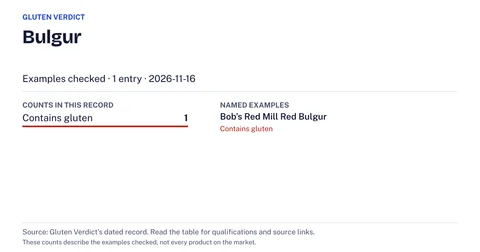 BulgurContains glutenchecked Nov 16, 2026
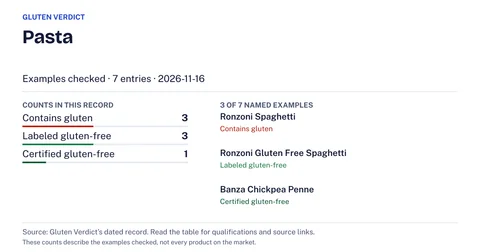 PastaContains glutenchecked Nov 16, 2026
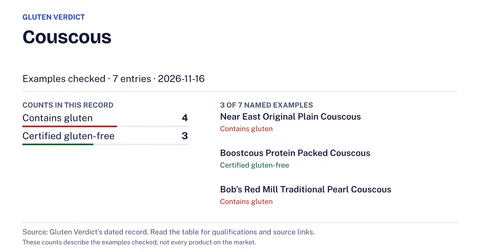 CouscousContains glutenchecked Nov 16, 2026
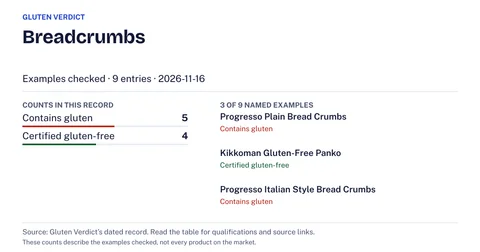 BreadcrumbsContains glutenchecked Nov 16, 2026
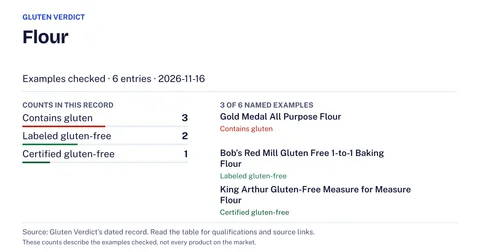 FlourContains glutenchecked Nov 16, 2026
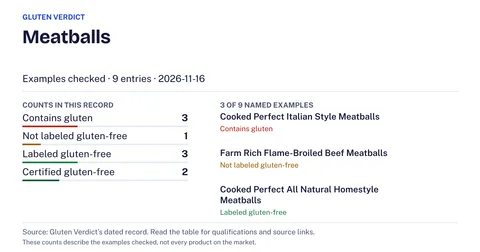 MeatballsDepends on the product3 of 9 products we checked contain gluten: Cooked Perfect Italian Style Meatballs, Cooked Perfect Restaurant Style Meatballs, and Farm Rich Homestyle Meatballschecked Nov 16, 2026
 BreadContains glutenchecked Nov 16, 2026
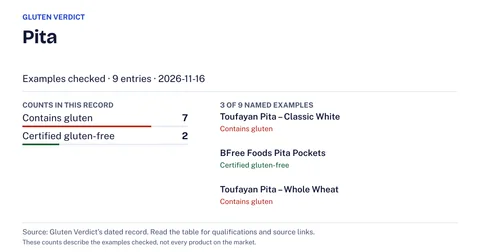 PitaContains glutenchecked Nov 16, 2026
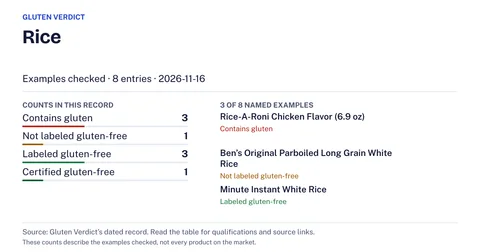 RiceNaturally gluten-free3 of 8 products we checked contain gluten: Rice-A-Roni Chicken Flavor (6.9 oz), Near East Original Rice Pilaf, and Ben’s Original Ready Rice Rice PilafBuy it labeled gluten-freechecked Nov 16, 2026
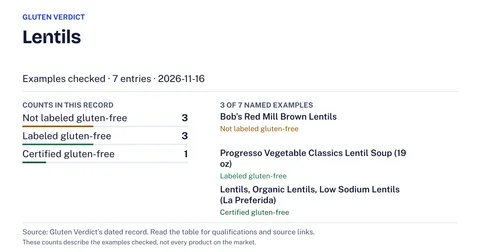 LentilsDepends on the productchecked Nov 16, 2026
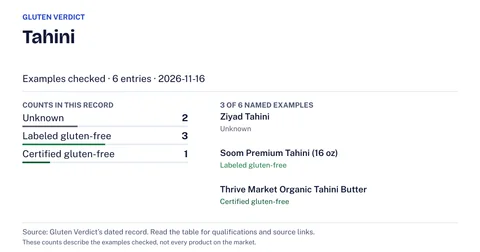 TahiniDepends on the productchecked Nov 16, 2026
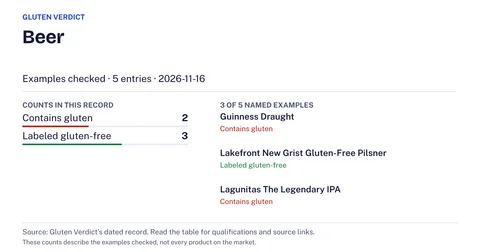 BeerDepends on the product2 of 5 products we checked contain gluten: Guinness Draught and Lagunitas The Legendary IPAchecked Nov 16, 2026
Questions people ask
Is a Turkish “glutensiz” the same as the EU’s “gluten-free”?
The limit is the same number: at most 20 mg/kg1, 2. The Turkish text is Article 45 and Annex 16 of its own regulation, a separate text from the EU’s11.
More in Travel: Europe
 Gluten-free in Central Europe: the rules in five countries and where wheat hides in the dishesWhich gluten-free rule covers a pack in Austria, Czechia, Hungary, Poland and Switzerland, and where wheat enters schnitzel, dumplings and sauces.
 Gluten-free in Denmark, Sweden, Norway, Finland and IcelandOne rule table for Denmark, Sweden, Norway, Finland and Iceland, with the regulator and society pages, the claim words, oats, rye and licorice.
 Gluten-free in Portugal: the couvert, pastelarias and what to askWhat «isento de glúten» means in Portugal, what you owe for the couvert, what restaurants must say about allergens, and what the celiac society advises.
 Gluten-free in Greece: what the label and the taverna promise, and what to askWhat “gluten-free” means in Greece, where wheat hides in Greek dishes such as gyro, orzo and pies, and what to ask at a taverna.
 Gluten-free ranges at European supermarkets, as the chains describe themWhat Mercadona, Carrefour, Tesco, Sainsbury’s, Albert Heijn and Migros say about their gluten-free lists, filters and marks, read from their own pages.
 Gluten-free in Croatia and the Balkans: which rule applies where, and where wheat enters the dishesWhich gluten-free rule applies in Croatia, Serbia, Bosnia and Montenegro, how to read the claim, and where wheat enters burek, ćevapi and palačinke.
Related guides
 Gluten-free and very low gluten on EU labels, and how allergens are highlightedWhat EU “gluten-free” and “very low gluten” claims permit, how cereals containing gluten are highlighted in ingredient lists, and the rules for loose food.
 Eating out with celiac disease: what to check, ask and watch forPlan a restaurant meal with celiac disease: what to check before you go, the questions to ask in order, how to read the answers, and what studies measured.
 Gluten words on European food labels, language by languageFind the ingredient list, the gluten-cereal name and the gluten-free claim on a European pack in 11 languages, using words from the EU’s own texts.
 Gluten-free labeling rules by country: ceilings, claim wording and where no rule was foundLook up the gluten-free limit and claim wording for the US, Canada, EU, UK, Australia, New Zealand and more, each figure tied to the page we read.
Sources
- [1, 18, 20, 37, 41] Republic of Türkiye Legislation Information System (Mevzuat Bilgi Sistemi), Turkish Food Codex Food Labelling and Consumer Information Regulation, Annex 16 (permitted gluten statements), checked Nov 17, 2026.
Read on 2026-11-17: in the Annex 1 table, the column headed “Hariç Tutulan Ürünler” beside the row for gluten-containing cereals lists wheat-based glucose syrups including dextrose, wheat-based maltodextrins, barley-based glucose syrups, and cereals used for distillates for alcoholic drinks.
- [2, 3, 17, 19] European Union (EUR-Lex), Commission Implementing Regulation (EU) No 828/2014, Annex, checked Nov 17, 2026.
- [4] European Commission, Türkiye (EU enlargement country page), checked Nov 17, 2026.
- [5, 6, 7, 11, 14, 35, 36, 38, 39, 40, 46] Republic of Türkiye Legislation Information System (Mevzuat Bilgi Sistemi), Turkish Food Codex Food Labelling and Consumer Information Regulation (Article 24), checked Nov 17, 2026.
Read on 2026-11-17: the footer of the consolidated text gives the Resmî Gazete publication as 26/1/2017, no. 29960 Mükerrer, and one amending regulation, 6/4/2024, no. 32512.
- [8, 9, 10, 13, 26, 27, 30, 31, 32, 33] Çölyakla Yaşam Derneği (Life with Celiac Association), Çölyakla Yaşam (foods containing gluten), checked Nov 17, 2026.
- [12] Turkish Official Gazette (Resmî Gazete), Notice 2020/18 repealing Notice 2012/4 on foods for people with gluten intolerance, checked Nov 17, 2026.
- [15, 16] US Food and Drug Administration, Questions and Answers on the Gluten-Free Food Labeling Final Rule, checked Nov 17, 2026.
- [21, 25, 29, 34] Çölyakla Yaşam Derneği (Life with Celiac Association), Glutensiz Ürünler (gluten-free products list), checked Nov 17, 2026.
Read on 2026-11-17: the list headed EKMEKLER names gluten-free breads from named makers, among them a simit (Burbella, Rolla), a lavaş and a bazlama (Burbella), and a bazlama (Rolla).
Read on 2026-11-17: the list has headings including DÖNER, EKMEKLER, LOKUM, MAKARNALAR, BOZA, SALEP, HELVA, PASTIRMA and KOKOREÇ, each followed by products from named makers. The DÖNER heading names two products: ERPiLiÇ TAVUK Döner and Tire Süt Döner. The ATIŞTIRMALIK heading names, among others, Burbella Glutensiz Su Böreği and Burbella Glutensiz Tavas Baklavası.
- [22, 28] Gluten Intolerance Group, Getting Started on a Gluten-Free Diet, checked Nov 17, 2026.
- [23] National Celiac Association, Couscous, checked Nov 17, 2026.
- [24] National Institute of Diabetes and Digestive and Kidney Diseases (NIDDK), Eating, Diet, & Nutrition for Celiac Disease, checked Nov 17, 2026.
- [42] Çölyakla Yaşam Derneği (Life with Celiac Association), Hakkımızda (about us), checked Nov 17, 2026.
- [43, 44] Çölyakla Yaşam Derneği (Life with Celiac Association), Home page (membership), checked Nov 17, 2026.
- [45] Çölyakla Yaşam Derneği (Life with Celiac Association), Glutensiz Diyet (gluten-free diet), checked Nov 17, 2026.