Gluten-free in Croatia and the Balkans: which rule applies where, and where wheat enters the dishes
Short answer
The same “gluten-free” claim sits under different laws as you cross the region: Croatia, an EU member, uses the EU rule of no more than 20 mg/kg1, 10, while Serbia, Bosnia and Herzegovina and Montenegro each print 20 mg/kg in their own texts11, 12, 16. For the dishes, the useful question is where wheat enters: the dough of a burek, the bread crumbs or seasoning mix in ćevapi, the flour in palačinke29, 34, 37, 41.
Part of Travel: Europe, 19 guides

Key points
- Croatia has been an EU member since 1 July 2013, and the EU gluten-free rule is directly applicable in every member state10, 2.
- Serbia, Bosnia and Herzegovina (state level) and Montenegro each print 20 mg/kg for their own gluten-free claim, and the Republika Srpska gazette carries a separate gluten rulebook11, 12, 16, 15.
- EU allergen information names cereals containing gluten among 14 allergens in a dish20; how the kitchen keeps gluten apart is a separate question to ask.
- The dish matters more than the border: the importer pages we read show a burek with a wheat flour dough, one ćevapi with wheat bread crumbs and another with no wheat ingredient29, 34, 35.
- For North Macedonia we read a 2012 rulebook that says it lapses on EU accession and did not confirm what replaced it18, 19.
Which rule sits behind a gluten-free claim in each country?
Croatia is a member of the EU, and the EU rule on gluten-free statements is directly applicable in every member state10, 2. The other countries we read have their own texts. The table gives the text we read for each, how it prints the claim, and the limit it prints; in every row the figure is 20 mg/kg1, 11, 12, 15, 16, 18.
| Country | Text we read | Claim as the text prints it | Limit as the text prints it |
|---|---|---|---|
| Croatia | EU Regulation 828/2014, directly applicable in all member states2; Croatia has been an EU member since 1 July 201310 | «bez glutena»7 | No more than 20 mg/kg1 |
| Serbia | Pravilnik o hrani sa izmenjenim nutritivnim sastavom, Službeni glasnik RS 61/24, as copied on the Ministry of Health’s site11 | «без глутена», in Cyrillic on that copy11 | 20 mg/kg; the text reads «мањи од 20 mg/kg»11 |
| Bosnia and Herzegovina (state level) | Pravilnik o sastavu i označavanju hrane pogodne za osobe netolerantne na gluten, Službeni glasnik BiH 105/1212 | «ne sadrži gluten»12 | 20 mg/kg; the text reads «ne prelazi 20 mg/kg»12 |
| Republika Srpska (entity of Bosnia and Herzegovina) | Pravilnik o hrani pogodnoj za lica netolerantna na gluten, in the Republika Srpska gazette, Službeni glasnik Republike Srpske 9/201815 | «без глутена», in Cyrillic15 | 20 mg/kg; the text reads «мањи од 20 mg/kg»15 |
| Montenegro | Government decree of 29 December 2016 on placing food for particular nutritional uses on the market; its footnote lists several EU acts whose provisions it carries over, among them Regulation 828/201417 | «bez glutena»16 | 20 mg/kg; the text reads «manji od 20mg/kg»16 |
| North Macedonia | 2012 rulebook of the Food and Veterinary Agency and the Ministry of Health; its Article 6 says it ceases to apply when the country joins the EU19 | «без глутен»18 | 20 mg/kg; the text reads «не надминува 20 mg/kg»18 |
Bosnia and Herzegovina has more than one layer: the state rulebook’s preamble names cooperation with the competent bodies of the entities and of Brčko District14, and the Republika Srpska gazette carries its own gluten rulebook15. For North Macedonia we did not find whether a later text replaced the 2012 one, so treat that row as what the 2012 text says. We read rule texts, not how each country enforces them, and we did not find a rule to read for Albania, so this guide says nothing about it.
Reading a pack: the claim, “very low gluten” and the allergen words
In the EU the gluten-free claim and the allergen duty are two separate rules. The claim “gluten-free” may be made only where the food as sold has no more than 20 mg/kg of gluten1. “Very low gluten” is a different statement: it is allowed only for food made with wheat, rye, barley or oats that were specially processed to reduce gluten, up to 100 mg/kg3. The Croatian text of the regulation carries both statements and both figures: «vrlo mali sadržaj glutena» for 100 mg/kg and «bez glutena» for 20 mg/kg7.
Oats in a food presented as gluten-free must have been specially produced, prepared or processed to avoid contamination by wheat, rye, barley or their crossbred varieties, and the gluten content of those oats cannot exceed 20 mg/kg4.
The allergen rule works on the ingredient list. Cereals containing gluten are among 14 allergens that must be clearly indicated when used as ingredients in food sold in the EU20, and the Commission says allergens must be emphasised within the list of ingredients, for example by a different font, style or background colour21. A “may contain” line is optional: the Commission says businesses may use precautionary allergen labelling where cross-contamination is a risk, based on a risk assessment23.
Bosnia and Herzegovina’s state rulebook uses a different pair of phrases. Food made with specially processed grains is labelled «sadrži vrlo malo glutena» and may carry «ne sadrži gluten» if the gluten level does not exceed 20 mg/kg12. The rulebook also lets food for normal use carry «ne sadrži gluten» on the same 20 mg/kg condition13.
What a restaurant in Croatia has to tell you
For food sold without a pack, such as in restaurants, cafés or deli counters, EU rules say allergen information must be provided. It can be given verbally, but there must be clear indications of how to get it, and it must be available in writing on request22.
Croatia’s Ministry of Agriculture published a guide on non-prepacked food (third edition, December 2020). It says the duty applies to all catering premises and to retail24. It allows oral information when a visible notice says where the information is kept or invites customers to ask staff25.
That is allergen information: it names the cereals containing gluten among the 14 allergens in a dish20. How the kitchen kept gluten apart is a separate question. The Celiac Disease Foundation says cross-contact occurs when foods or ingredients come into contact with gluten, generally through shared utensils or a shared cooking or storage environment48, so ask about the grill, the pan and the oil as well as the recipe. The Commission page and the Croatian guide are about the EU; for a restaurant in Serbia or Bosnia we did not read a rule on non-prepacked food, and we say nothing about one.
Burek and other phyllo pastries
The burek we read about are wheat pastries. One importer describes its meat burek as “Phyllo (filo, fillo) pastry filled with beef meat”30; its ingredient list starts with a dough of enriched wheat flour and also names bread crumbs29, and the page says “Contains wheat and soy”31. The same importer’s cheese burek, a product of Bosnia and Herzegovina, lists wheat flour and an allergen line that begins “Contains: gluten”32.
These are packaged products from one importer’s shop: the meat burek is a product of USA31 and the cheese burek a product of Bosnia and Herzegovina32. They show what a burek recipe can hold, not what a particular bakery does. Ask the bakery what the dough is made of and what the filling is bound with. For another flour-based pastry see our verdict on pie crust.
Ćevapi, pljeskavica and grilled meat
One importer sells ćevapi as “a traditional skinless beef sausage specialty of the Balkans and Bosnia-Herzegovina”33. Wheat can enter through the recipe. The same importer’s Brother and Sister ćevapi list bread crumbs, with wheat named in the brackets34. Its Podravka beef ćevapi, made in USA35, list beef, water, spices, corn starch and soy protein isolate, with no wheat ingredient35, and the page shows no gluten-free claim and does not mention gluten36.
A Croatian-made seasoning mix for ćevapčići, sold by the same importer, lists wheat bread crumbs and wheat flour37. So the answer can change with the mix a grill uses. The Celiac Disease Foundation lists pre-seasoned meats and processed lunch meats among foods that may contain gluten and must be checked with the label or kitchen staff50, and NIDDK names hot dogs and sausages among foods where gluten may be found52. Our verdict on sausage shows the same spread between products.
At a grill, ask whether the meat mixture holds bread, flour or a seasoning mix, and what the meat is cooked on. Pljeskavica raises the same two questions.
Polenta and gnocchi
According to Bob’s Red Mill, polenta is made from coarse-ground corn boiled in water to create a porridge45. The questions are what the cornmeal touched and what it is cooked with. Bob’s Red Mill notes that set polenta can be cut into squares and baked, grilled or fried46, and the Celiac Disease Foundation lists fried foods cooked in oil shared with breaded products as a place where cross-contact occurs47. Our polenta verdict covers the product side.
Gnocchi are the other way round: the Celiac Disease Foundation lists gnocchi among pastas that contain gluten49. Our gnocchi verdict shows which of the gluten-free gnocchi we checked carry a claim.
Bread, ajvar and kajmak
Kajmak, a cream spread, is dairy: one importer’s jar lists sweet cream, sour cream, margarine and salt38, and the page says it is “enjoyed with a bun as breakfast or fast food”39. That moves the question to the bread: the Celiac Disease Foundation lists rolls, pita and flatbreads among breads and pastries that contain gluten49. See our verdicts on bread and pita.
The ajvar jar we read, a Podravka product of Croatia, lists paprika, eggplant, vinegar, sunflower oil, tomato concentrate, salt, sugar, hot peppers and spices40. No gluten grain is named, but the list says only “vinegar”. The Celiac Disease Foundation lists malt vinegar among the forms of malt in its list of gluten sources51; our malt vinegar verdict covers it. At a table or a stall, ask what the ajvar is made with.
Palačinke and baklava
Palačinke are crepes: the Podravka mix, a product of Croatia41, says it makes crepes (palačinke)42, and its first ingredient is wheat flour41. The Celiac Disease Foundation lists pancakes and crepes among breakfast foods that contain gluten49. See crepes and pancakes.
Baklava is layered pastry: the baklava we read is described as nuts “layered between flaky Kontos Fillo Dough sheets, baked then soaked in sweet honey syrup”44, and it says “Contains wheat and tree nuts”43. It is a product of USA43, so it shows what filo desserts can contain rather than what a Balkan pastry shop does.
Words for the table, and questions to ask
The only translations below are pairs the EU regulation itself prints in English and in Croatian. We add no others.
| Croatian, as the regulation prints it | English, from the same regulation |
|---|---|
| «bez glutena» | gluten-free: no more than 20 mg/kg7, 1 |
| «vrlo mali sadržaj glutena» | very low gluten: up to 100 mg/kg, a different statement7, 3 |
| «prikladna za osobe s celijakijom» | “suitable for coeliacs”, a statement that may accompany the claim8, 5 |
| pšenica · raž · ječam | wheat · rye · barley, the grains the regulation names as containing gluten9, 6 |
| celijakija | coeliac disease9, 6 |
The Serbian and Republika Srpska texts we read print the claim in Cyrillic, «без глутена»11, 15, and the Bosnian state rulebook uses «ne sadrži gluten»12. The Croatian Society for Coeliac Disease’s site is bilingual and calls its workshop on gluten-free meals «Bezglutenski obroci»28.
- What is the dough or batter made of, and what is the filling bound with?
- Is the meat or sauce seasoned from a mix, and does the mix hold flour or bread crumbs?
- Is the grill, pan or oil shared with breaded or floured food?
- Is there a written allergen list I can read? In Croatia, an EU member, the information must be available in writing on request22, 10.
Celiac societies in the region
AOECS, the European association of coeliac societies, lists member societies for Croatia, Serbia and Montenegro, and an associate member for Bosnia and Herzegovina; North Macedonia and Albania do not appear on its page26. The entries for Croatia and Serbia carry a “Licensed products” link26. The Croatian society’s own site says it is an AOECS member27.
Verdicts in this guide
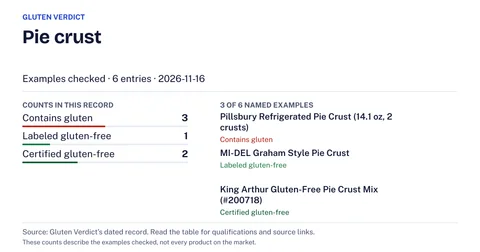 Pie crustContains glutenchecked Nov 16, 2026
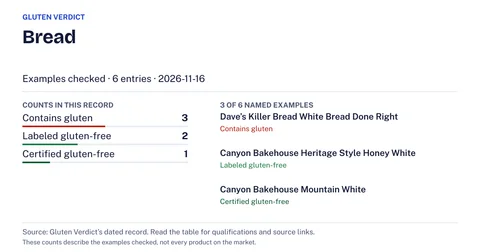 BreadContains glutenchecked Nov 16, 2026
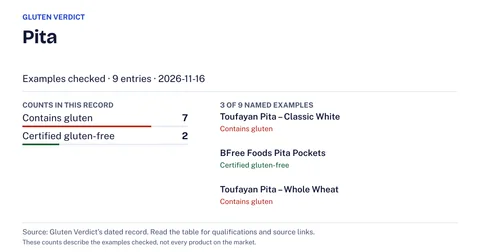 PitaContains glutenchecked Nov 16, 2026
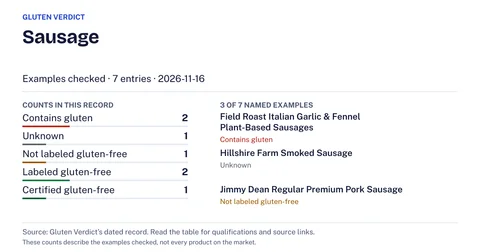 SausageDepends on the product2 of 7 products we checked contain gluten: Field Roast Italian Garlic & Fennel Plant-Based Sausages and Tofurky Plant-Based Italian Sausagechecked Nov 16, 2026
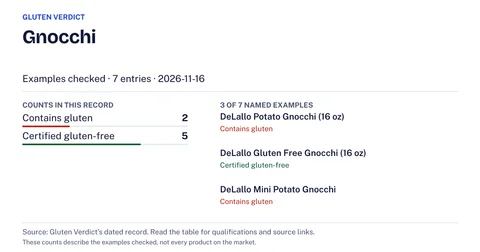 GnocchiDepends on the product2 of 7 products we checked contain gluten: DeLallo Potato Gnocchi (16 oz) and DeLallo Mini Potato Gnocchichecked Nov 16, 2026
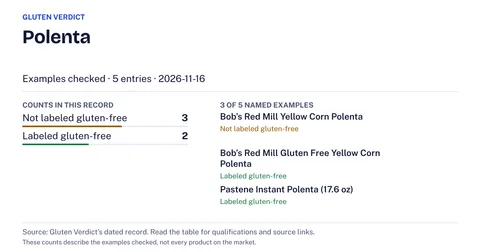 PolentaNaturally gluten-freeBuy it labeled gluten-freechecked Nov 16, 2026
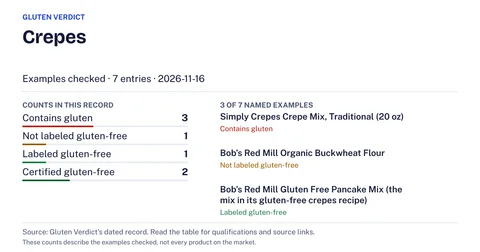 CrepesContains glutenchecked Nov 16, 2026
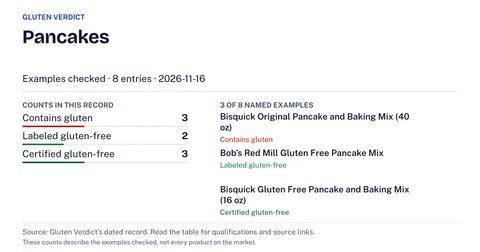 PancakesContains glutenchecked Nov 16, 2026
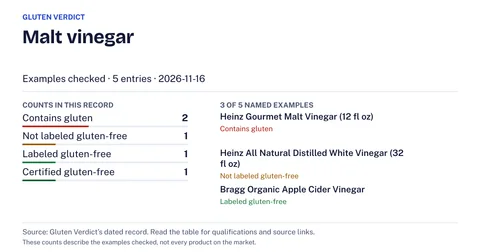 Malt vinegarContains glutenchecked Nov 16, 2026
Questions people ask
Is “bez glutena” the same in Serbia as in Croatia?
Both texts use a 20 mg/kg limit, but the EU text says the content does not exceed it7 and the Serbian text says less than it11. They are also different texts: Croatia applies EU Regulation 828/20142, 10, while Serbia’s own rulebook prints the claim in Cyrillic on the Ministry of Health’s copy11.
Is burek gluten-free?
Not in the products we read. The meat burek lists a wheat flour dough and bread crumbs and says it contains wheat29, 31, and the cheese burek lists wheat flour32. A bakery’s own recipe is a question for the bakery.
Are ćevapi gluten-free?
It depends on the recipe. One importer’s ćevapi list bread crumbs with wheat named34, another’s list no wheat ingredient35, and a Croatian-made seasoning mix lists wheat bread crumbs and wheat flour37.
Does a restaurant in Croatia have to tell me about gluten?
EU rules require allergen information for non-prepacked food22, and cereals containing gluten are among the 14 allergens20. Croatia’s ministry guide says the duty applies to all catering premises24 and allows oral information with a notice25.
More in Travel: Europe
 Gluten-free in Estonia, Latvia and Lithuania: label words, rye bread and dumplingsHow Estonia, Latvia and Lithuania word gluten-free claims, where rye, barley and wheat sit in local dishes, and which official pages to check.
 Gluten-free in Central Europe: the rules in five countries and where wheat hides in the dishesWhich gluten-free rule covers a pack in Austria, Czechia, Hungary, Poland and Switzerland, and where wheat enters schnitzel, dumplings and sauces.
 Gluten-free in Italy: what the AIC program covers and what to askWhat “senza glutine” means in Italy, what AIC’s restaurant program asks of a kitchen, and the questions to ask in a restaurant, pharmacy or shop.
 Gluten-free in Turkey: reading labels and menusTurkey’s gluten-free label rule, where wheat enters a Turkish menu (bulgur, şehriye, flour, mixes), and who to ask. Sources are Turkish and linked.
 Gluten-free in Greece: what the label and the taverna promise, and what to askWhat “gluten-free” means in Greece, where wheat hides in Greek dishes such as gyro, orzo and pies, and what to ask at a taverna.
 Gluten-free in the UK: allergen rules, the Crossed Grain mark and pub and chip-shop foodHow a British pack and menu differ from a US one: the 20 mg/kg rule, 14 allergens, Crossed Grain versus venue accreditation, and chip-shop condiments.
Related guides
 Gluten-free and very low gluten on EU labels, and how allergens are highlightedWhat EU “gluten-free” and “very low gluten” claims permit, how cereals containing gluten are highlighted in ingredient lists, and the rules for loose food.
 Fine on bread in Europe? What it does and does not showWhat a trip where bread felt fine does and does not show about celiac disease, and how EU and US gluten-free label rules compare.
 Gluten words on European food labels, language by languageFind the ingredient list, the gluten-cereal name and the gluten-free claim on a European pack in 11 languages, using words from the EU’s own texts.
 Gluten-free labeling rules by country: ceilings, claim wording and where no rule was foundLook up the gluten-free limit and claim wording for the US, Canada, EU, UK, Australia, New Zealand and more, each figure tied to the page we read.
Sources
- [1, 2, 3, 4, 5, 6] European Commission (EUR-Lex), Regulation (EU) No 828/2014 on information on the absence or reduced presence of gluten in food (English text), checked Nov 17, 2026.
- [7, 8, 9] European Commission (EUR-Lex), Regulation (EU) No 828/2014 on information on the absence or reduced presence of gluten in food (Croatian text), checked Nov 17, 2026.
- [10] European Union (european-union.europa.eu), EU countries: Croatia, checked Nov 17, 2026.
- [11] Ministry of Health of Serbia website (zdravlje.gov.rs), copy of Službeni glasnik RS 61/24 reproduced by Cekos In, Pravilnik o hrani sa izmenjenim nutritivnim sastavom, checked Nov 17, 2026.
- [12, 13, 14] Food Safety Agency of Bosnia and Herzegovina (Službeni glasnik BiH 105/12), Pravilnik o sastavu i označavanju hrane pogodne za osobe netolerantne na gluten, checked Nov 17, 2026.
- [15] Government of Republika Srpska (Službeni glasnik Republike Srpske 9/2018, pp. 198-199), Pravilnik o hrani pogodnoj za lica netolerantna na gluten, checked Nov 17, 2026.
- [16, 17] Government of Montenegro (Službeni list CG, text via FAO FAOLEX), Uredba o načinu i uslovima stavljanja na tržište hrane za posebne prehrambene potrebe (29 December 2016), checked Nov 17, 2026.
- [18, 19] Food and Veterinary Agency and Ministry of Health of North Macedonia (text via FAO FAOLEX), Правилник за составот и означувањето на прехранбените производи за лица нетолерантни на глутен (2012), checked Nov 17, 2026.
- [20, 21, 22, 23] European Commission, Food Safety, Allergies, checked Nov 17, 2026.
- [24, 25] Ministry of Agriculture of Croatia, Vodič za informiranje potrošača o nepretpakiranoj hrani, 3. izdanje (December 2020), checked Nov 17, 2026.
- [26] Association of European Coeliac Societies (AOECS), Members of the Association of European Coeliac Societies, checked Nov 17, 2026.
Read on 2026-11-17: the page lists Croatia (Croatian Society for Coeliac Disease), Montenegro (NVO Celijakija), Serbia (Serbian Coeliac Society) and Slovenia (Slovensko društvo za celiakijo - SDC) as members, and, under “AOECS associate & affiliate members”, Bosnia and Herzegovina (Union of Associations of Persons Affected by Coeliac Disease in Bosnia and Herzegovina). The entries for Croatia, Serbia and Slovenia carry a “Licensed products” link; those for Montenegro and Bosnia and Herzegovina do not. North Macedonia and Albania do not appear on the page.
- [27, 28] Hrvatsko društvo za celijakiju (Croatian Society for Coeliac Disease), Home page, checked Nov 17, 2026.
- [29, 30, 31] Parthenon Foods (US importer), Burek with Meat (EM) 720g, checked Nov 17, 2026.
- [32] Parthenon Foods (US importer), Classic Burek with Cheese, 600g, checked Nov 17, 2026.
- [33, 34] Parthenon Foods (US importer), Cevapi Sausage (Brother And Sister) 1.6 Lbs (640 g), checked Nov 17, 2026.
- [35, 36] Parthenon Foods (US importer), Cevapi Beef Link Sausages (Podravka) 1.6 Lbs, checked Nov 17, 2026.
Read on 2026-11-17: no gluten-free claim and no mention of gluten anywhere on the page.
- [37] Parthenon Foods (US importer), Fant Seasoning Mix for Minced Meat Sticks, Cevapcice, 1.4oz (product of Croatia), checked Nov 17, 2026.
- [38, 39] Parthenon Foods (US importer), Kajmak Spread - Sweet Cream Spread (Domasen) 15 oz (420g), checked Nov 17, 2026.
- [40] Parthenon Foods (US importer), Ajvar Mild (Podravka) 690g (product of Croatia), checked Nov 17, 2026.
- [41, 42] Parthenon Foods (US importer), Palacinke Mix, Crepe Mix (Podravka) 200g (product of Croatia), checked Nov 17, 2026.
- [43, 44] Parthenon Foods (US importer), Classic Baklava (Kontos) 11 oz, checked Nov 17, 2026.
- [45, 46] Bob's Red Mill, Gluten Free Yellow Corn Polenta, checked Nov 17, 2026.
- [47, 48, 49, 50, 51] Celiac Disease Foundation, Sources of Gluten, checked Nov 17, 2026.
Read on 2026-11-17: the list headed “Common Foods That Contain Gluten” names, among others, gnocchi (under Pastas), pita and flatbreads and rolls (under Breads and Pastries), pie crusts and cakes (under Baked Goods), pancakes and crepes (under Breakfast Foods) and panko breadcrumbs (under Breading & Coating Mixes).
Read on 2026-11-17: under the heading “Foods That May Contain Gluten”, whose lead line says these foods must be verified by reading the label or checking with the manufacturer/kitchen staff, the list names, among others, processed lunch meats and pre-seasoned meats.
- [52] National Institute of Diabetes and Digestive and Kidney Diseases (NIDDK), Eating, Diet, & Nutrition for Celiac Disease, checked Nov 17, 2026.