Gluten-free in China: wheat staples, sauces, hot pot and the label rules
Short answer
People in northern China are more likely to eat wheat staples1, Lee Kum Kee’s premium soy sauce and Haidilao-brand spicy hot-pot bases list wheat on US pages2, 3, and China’s label standard does not cover restaurant food4. Check, in this order:
- Region: people in northern China are more likely to eat noodles, flat cakes and steamed buns made from wheat, and in the south rice1. Treat that as a first guess and ask the cook.
- Sauces: Lee Kum Kee’s US pages list wheat flour in its premium soy sauce and premium oyster sauce, and wheat flour in its hoisin2, 5, 6. Haidilao-brand spicy hot-pot bases on a US shop list wheat too3, 7.
- Restaurants: the national label standard does not cover restaurant or made-to-order food4, so the kitchen is your source.
- Packs: wheat, rye, barley and oats come under the standard’s first allergen group8. From 16 March 2027 the 2025 edition makes that group’s label mandatory when it is used directly as an ingredient9, 10.
- Claims: a 2025 paper by researchers at China’s national food risk assessment center (CFSA) says China had no national gluten-free standard11.
- Words: the Chinese words the standard itself prints for wheat, barley, rye and gluten are in the table near the end.
- Gluten-free limit
- China had no national standard for gluten-free foods when CFSA researchers wrote in 2025; CFSA began developing one in 202311, 42
- Set by
- GB 7718-2025, the prepackaged-food labeling standard, in force from 16 March 2027: eight allergen groups, the first being cereals containing gluten8, 10
- Oats
- GB 7718-2025 lists oats among the cereals containing gluten for allergen labeling8
Part of Travel: Asia and the Middle East, 12 guides
Key points
- Under the 2011 edition of GB 7718, labeling the eight allergen groups was a recommended item12. The 2025 edition, in force from 16 March 2027, makes it mandatory when a group is used directly as an ingredient9, 10.
- The 2025 text exempts grain-processed starch, dextrin and glucose syrup from the allergen line13, 14, and lets an ingredient list print just a class name such as starch or soy sauce15.
- May-contain lines are encouraged, not required16.
- In one 2025 test of 119 products labeled gluten-free and bought online in China, 13.4% had gluten above 20 mg/kg17.
North wheat, south rice: what the split means on a menu
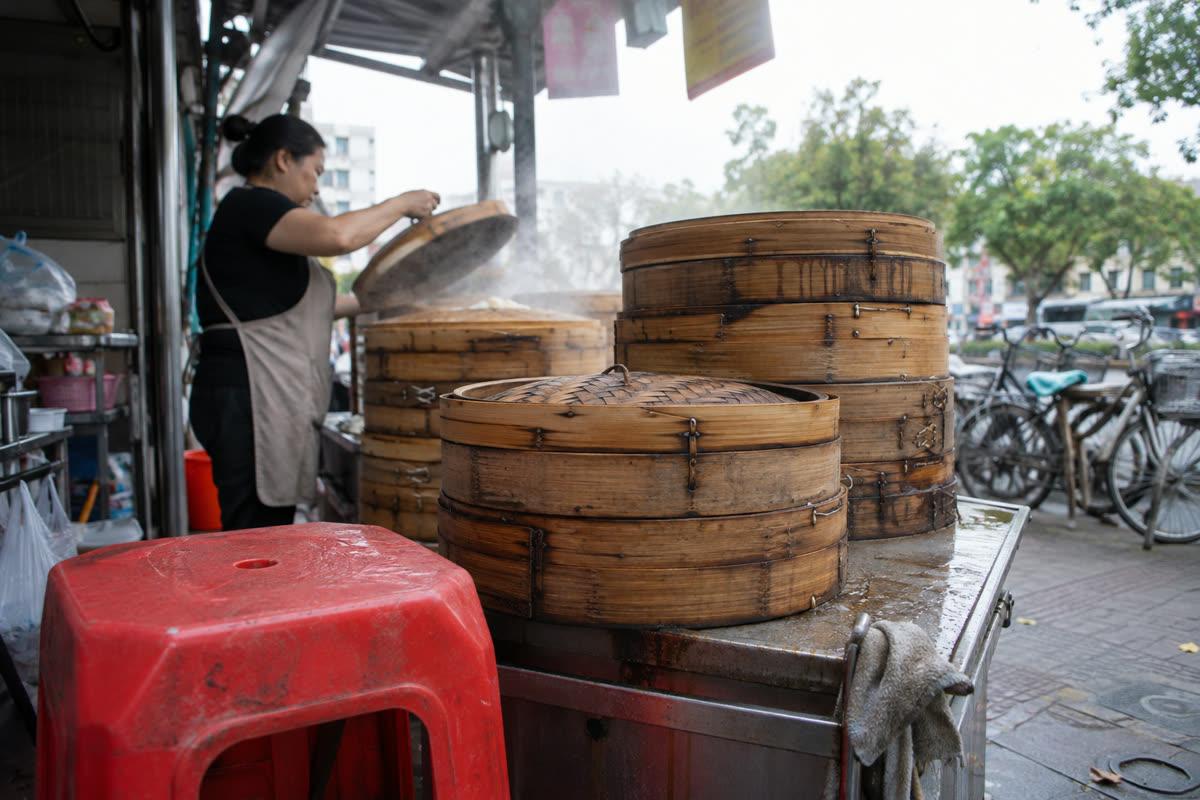
A research paper on diet and weight describes the Yangtze River as splitting the wheat-growing north from the rice-growing south18. Its authors write that people in northern China are more likely to eat staples made from wheat, such as noodles, flat cakes and steamed buns, while in the south people prefer rice as a staple1.
A systematic review of studies of the traditional Chinese diet reports the same pattern: wheat and wheat products, wheat with a filling, and corn and coarse grains were the most frequently consumed food groups in the north, and the southern diet commonly involved rice, fish and seafood, leafy vegetables and pork19.
These are tendencies in diet research, not a rule for any one menu. Use the split as a first guess about what a kitchen cooks, then ask. For the questions to put to a restaurant, see ordering at a Chinese restaurant.
Sauces: which ones list wheat on the maker’s page
The Gluten Intolerance Group (GIG) says many traditional Asian dishes are made with wheat-based ingredients, such as soy sauce, noodles and dumplings20, and that soy sauce traditionally contains wheat21. Lee Kum Kee’s own US product pages show how it plays out bottle by bottle:
| Sauce | What the page lists |
|---|---|
| Premium Soy Sauce | Water, salt, soybeans, sugar, wheat flour and two flavor enhancers; allergens soybeans, wheat2 |
| Premium Oyster Sauce | Includes wheat flour; the allergen line reads Wheat5 |
| Panda Brand green label oyster sauce | No wheat in the ingredient list and the allergen line reads N/A22; the page lists it as Gluten Free23 |
| Hoisin Sauce (jar) | Fermented soybean paste made with wheat flour; allergens soybeans, wheat, sesame6 |
Two oyster sauces from one maker, one with wheat flour and one without: the bottle’s label is the evidence, not the sauce’s name. Our verdicts: soy sauce, oyster sauce and hoisin sauce.
These are Lee Kum Kee’s US pages. We did not find ingredient pages for the versions sold in China, so a bottle bought there needs its own label read.
A cooking-wine label can leave wheat out. The Canadian Food Inspection Agency recalled a Shaoxing cooking wine in Ontario on 14 May 2026 because it contained wheat that the label did not declare24. One recall says nothing about other brands; it is a reason to ask whether a dish was cooked with wine.
Noodles, dumplings and rice: where wheat is the point
GIG says dumplings such as gyoza and potstickers are often made with wheat-based wrappers25. Coeliac New Zealand’s advice for eating out at Chinese New Year tells diners to look for gluten-containing ingredients such as soy sauce (other than tamari), wheat-based noodles or mock meats, and says dishes described as fried or crispy are more likely to contain gluten26.
A dumpling has two layers to ask about. Wei-Chuan USA’s Shan Dong Pork & Leek Dumpling shows both: the wrapper is enriched wheat flour27, and the filling includes a soy sauce made with wheat28.
On the rice side, Coeliac New Zealand says rice and products derived from rice are gluten free, and suggests checking whether rice noodles are available instead of wheat noodles29. It adds that plain tofu is naturally gluten free, but to check for a marinade or flavouring30. It also asks diners to be wary of cross-contamination from utensils, cooking surfaces, fryers and woks31.
Our verdicts for dishes you may know from home: dumplings, wonton soup, rice noodles, fried rice and tofu.
Hot pot: the base, the dipping sauces and the pot
A hot-pot meal has three things to ask about: the base, the dipping sauces and the pot itself. For bases we have ingredient pages from Yihai US Food’s US shop for Haidilao-brand products, each labeled as made in China:
| Base | Wheat items in the ingredient list | Allergen line |
|---|---|---|
| Spicy Sichuan Mala, 500 g | Broad bean paste made with wheat flour; fermented soybean made with wheat flour; sorghum wine listing wheat32 | Soybean, Wheat3 |
| Hot & Spicy Mala Chili Oil, 220 g | Wheat gluten and wheat flour33 | Soybean, Wheat7 |
| Spicy Green Chili, 200 g | Wheat flour, wheat gluten and wheat34 | Soybean, Wheat, Sulfites35 |
| Clear Broth, 110 g | No wheat ingredient named36 | Soybean, Milk36 |
These are US-shop listings for packaged bases. They are not the contents of any restaurant’s pot, and we found no ingredient list for a restaurant’s broth. At the table, ask what the base is made from, what each dipping sauce is made from (the products above list wheat flour in broad bean paste and in fermented soybean, and wheat in soy sauce), and whether you can have a pot of your own.
Reading a Chinese pack: what GB 7718 requires
The standard and its dates
GB 7718 is China’s general standard for prepackaged-food labels37. The 2025 edition was issued on 16 March 2025 and takes effect on 16 March 202710; it replaces the 2011 edition37. We did not find a source on how packs made before that date are treated.
Both editions use eight allergen groups, and the first is cereals containing gluten12, 8. The 2025 text gives wheat, rye, barley, oats and spelt, or their hybrids, as examples8, 38. Under the 2011 edition, labeling the groups was a recommended item12. Under the 2025 edition it is mandatory when a group is used directly as an ingredient9.
How it appears on a pack
The 2025 text allows two forms: a recognizable name in the ingredient list, set in bold or underlined type, or a line next to the list that may start with a guide word such as Food Allergen, Allergenic Substances or Allergen Information39, 40.
What the allergen line leaves out
- May-contain lines are optional. The 2025 text encourages makers to warn when an allergen may be carried in, for example through a shared workshop or line16.
- Some grain ingredients are exempt. The text lists starch, dextrin, glucose syrup and refined vegetable oil from grain as deep-processed ingredients whose allergenic protein has been removed, and exempts them from the allergen line13, 14. How US rules treat wheat starch is a separate question: see our wheat starch entry.
- An ingredient list can use class names. Table A.1 lets makers print soy sauce for any soy sauce added and starch for starches other than chemically modified ones15, 41. The word alone does not say which grain a starch came from.
- Restaurant food, unpackaged food, made-to-order food and food sold after being split from a package are outside the standard; the interpretation says they may follow it in whole or in part4.
“Gluten-free” on a pack sold in China
When researchers at CFSA, China’s national food risk assessment center, wrote up a 2025 test, they stated that there was no national standard for gluten-free foods in China11. CFSA had begun developing one in 202342.
Their test bought 119 prepackaged products labeled gluten-free from Chinese internet suppliers in 2024. Of the 119, 13.4% contained gluten above 20 mg/kg, and 5.0% contained over 100 mg/kg17. None of the 33 imported products was above 20 mg/kg, against 16 of the 86 made in China (18.6%)43. The authors measured against 20 mg/kg, the level they say Codex, EFSA (the European Union’s food authority) and FDA have adopted44.
The authors name a limit: every product came from internet suppliers, which may not represent the full domestic market45.
Read this as one study of online-bought packs, not a verdict on any brand. What it supports is simple: a gluten-free mark on a pack sold in China had no national rule behind it when the paper was written11, so read the ingredient list and allergen line too.
Chinese words the standard prints
These words come straight from the standard’s own text, with English from a translation whose official status is not stated38. They are for pointing at an ingredient list or a pack. GIG suggests carrying a printed translation card when the main language is not yours46.
| Chinese | English | Where the standard prints it |
|---|---|---|
| 含有麸质的谷物及其制品 | cereals and products containing gluten | First of the eight allergen groups8, 38 |
| 小麦 | wheat | First example in that group8, 38 |
| 黑麦 | rye | Example in that group8, 38 |
| 大麦 | barley | Example in that group8, 38 |
| 燕麦 | oats | Example in that group8, 38 |
| 斯佩耳特小麦 | spelt wheat | Example in that group8, 38 |
| 小麦粉 | wheat flour | In the standard’s sample ingredient list47, 48 |
| 酱油 | soy sauce | Class name for soy sauces added to a food15, 41 |
| 淀粉、糊精、葡萄糖浆 | starch, dextrin, glucose syrup | Grain ingredients exempt from the allergen line14, 49 |
| 含有…… | contains … | Sample allergen line: 含有鸡蛋、花生、坚果、乳成分50, 51 |
| 可能含有…… | may contain … | Sample precautionary wording52, 53 |
No source we found supplies a ready-made Chinese sentence about celiac disease, so we print none. For a sentence to hand a cook, ask a Chinese speaker you trust to write it.
What we could not confirm
- The National Health Commission’s own web pages for the GB 7718-2025 announcement and Q&A returned a block page (HTTP 412) to our fetches, and we did not work around it. The interpretation and standard text above come from a PDF copy of the same documents hosted by a municipal market regulator.
- Whether China has issued a national gluten-free standard since the 2025 paper. We found none; we did not find a source that says it has not.
- How packs made before 16 March 2027 are labeled under the transition from the 2011 edition.
- Ingredient pages for Lee Kum Kee and Haidilao products as sold in China. Our pages are US listings, and formulas can differ.
- The contents of any restaurant’s hot-pot broth or dipping sauces.
- City-level dining. We found no authority source for what a given city’s restaurants do, so this page names none.
Verdicts in this guide
 Soy sauceDepends on the product3 of 7 products we checked contain gluten: Kikkoman Soy Sauce (Non-GMO), 20 oz; San-J Organic Shoyu Soy Sauce; and Lee Kum Kee Premium Soy Sauce (No Preservatives Added)checked Nov 16, 2026
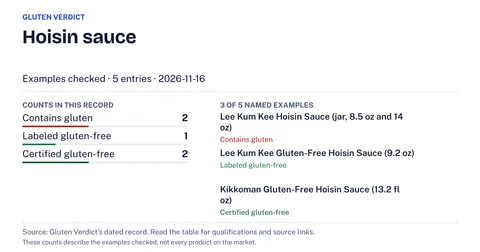 Hoisin sauceDepends on the product2 of 5 products we checked contain gluten: Lee Kum Kee Hoisin Sauce (jar, 8.5 oz and 14 oz) and Kikkoman Hoisin Sauce (9.3 oz)checked Nov 16, 2026
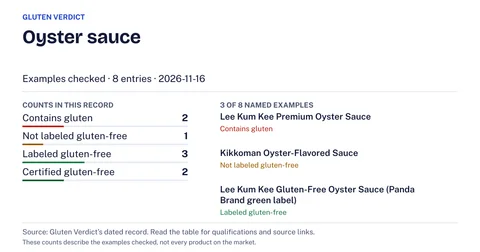 Oyster sauceDepends on the product2 of 8 products we checked contain gluten: Lee Kum Kee Premium Oyster Sauce and Lee Kum Kee Panda Brand Oyster Flavored Saucechecked Nov 16, 2026
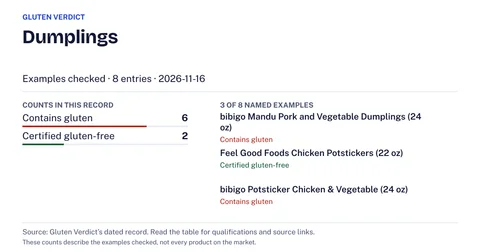 DumplingsContains glutenchecked Nov 16, 2026
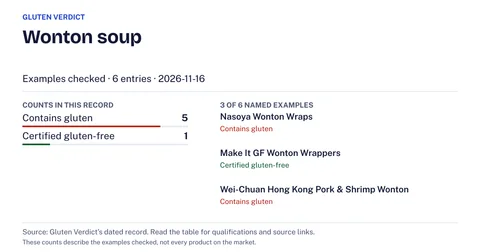 Wonton soupContains glutenchecked Nov 16, 2026
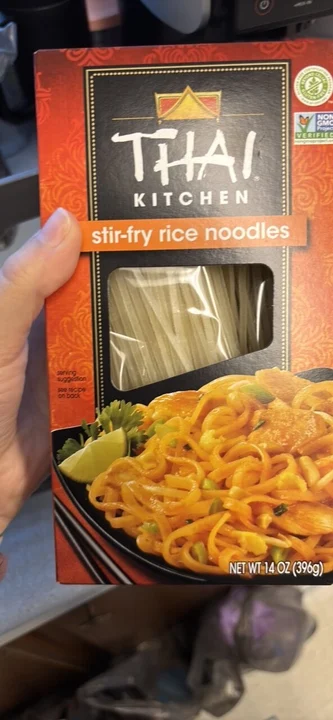 Rice noodlesNaturally gluten-free2 of 9 products we checked contain gluten: Annie Chun’s Pad Thai Noodle Bowl with Vegetables and Annie Chun’s Pho Soup Bowl with VegetablesBuy it labeled gluten-freechecked Nov 16, 2026
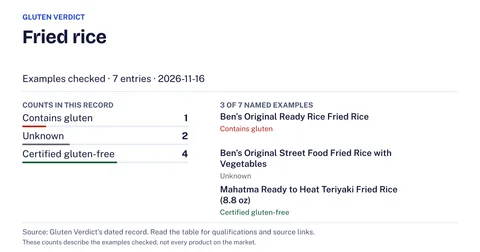 Fried riceDepends on the product1 of 7 products we checked contains gluten: Ben’s Original Ready Rice Fried Ricechecked Nov 16, 2026
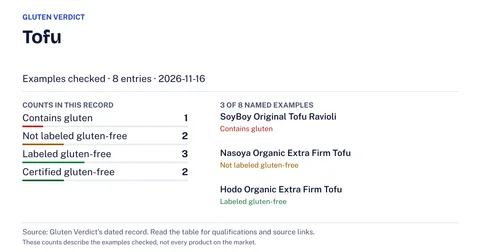 TofuDepends on the product1 of 8 products we checked contains gluten: SoyBoy Original Tofu Raviolichecked Nov 16, 2026
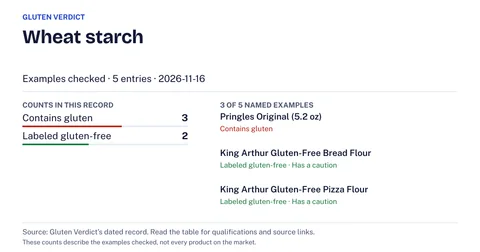 Wheat starchDepends on the product3 of 5 products we checked contain gluten: Pringles Original (5.2 oz), Jiffy Corn Muffin Mix, and Chex Mix Bold Garlic and Herbchecked Nov 16, 2026
Questions people ask
Is soy sauce in China gluten-free?
Not as a rule. GIG says soy sauce traditionally contains wheat21, and Lee Kum Kee’s US page for its premium soy sauce lists wheat flour2. Read the bottle.
Does a Chinese pack have to say it contains wheat?
Under the 2025 standard, from 16 March 2027, an allergen group used directly as an ingredient has to be flagged, and cereals containing gluten are the first group9, 8, 10. Grain-processed starch, dextrin and glucose syrup are exempt14.
Is there a Chinese standard for gluten-free food?
A 2025 paper by CFSA researchers says there was none, and that CFSA began developing one in 202311, 42.
Does GB 7718 cover restaurants?
No. Restaurant and made-to-order food are outside its scope, though they may follow it in whole or in part4.
More in Travel: Asia and the Middle East
 Eating gluten-free in Thailand: sauces, noodles and street stallsWhere wheat shows up in Thai sauces, noodles and street food, how Thailand words its own gluten-free rule, and the Thai words to look for on a pack.
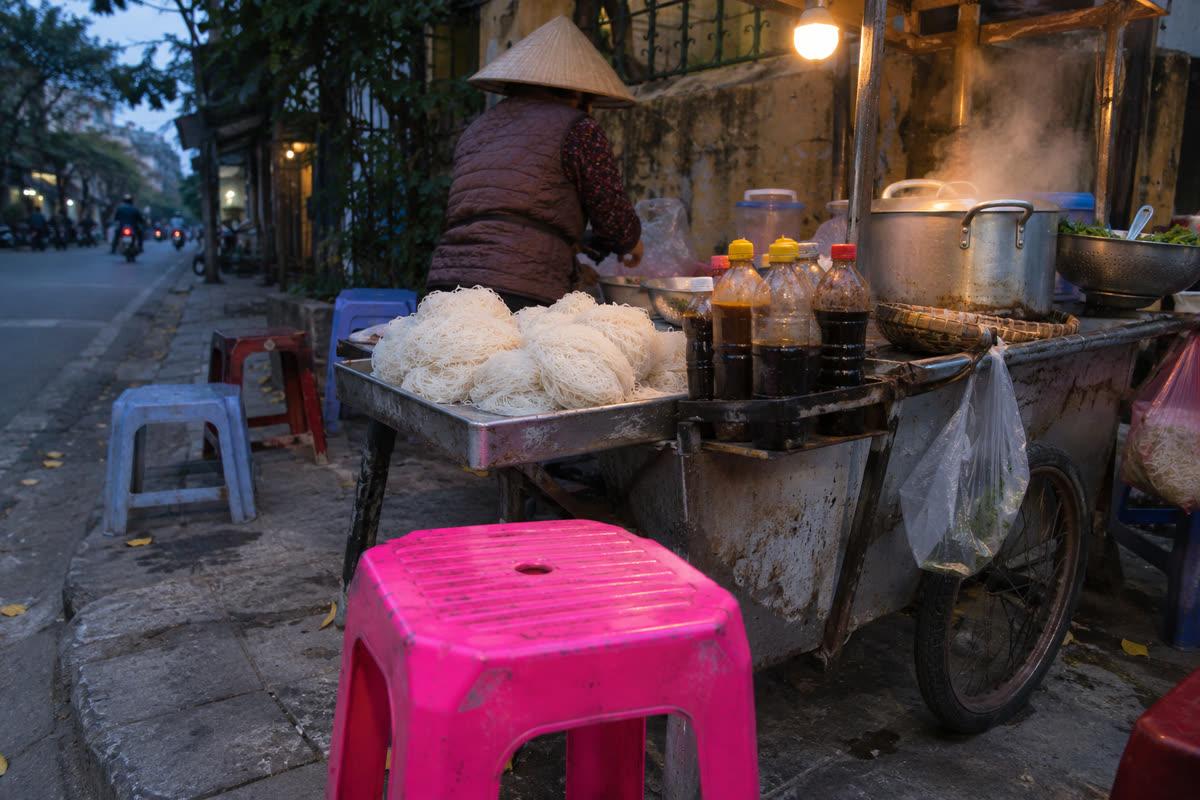 Gluten-free in Vietnam, the Philippines, Malaysia, Indonesia and Taiwan: sauces, noodles and label rulesWhere wheat enters a Southeast and East Asian meal, what four regulators print about gluten cereals, and the one country whose rule we could not read.
 Gluten-free in Singapore: hawker noodles, soya sauce and the new label ruleWhich Singapore hawker noodles are rice and which wheat, where soya and oyster sauce come in, and what the Food Agency's gluten-free label means.
 Gluten-free in Hong Kong: dim sum wrappers, noodles, sauces and the packet labelSort Hong Kong dim sum, noodle-shop and sauce choices by wrapper, noodle and ingredient, and read what a Hong Kong packet must name.
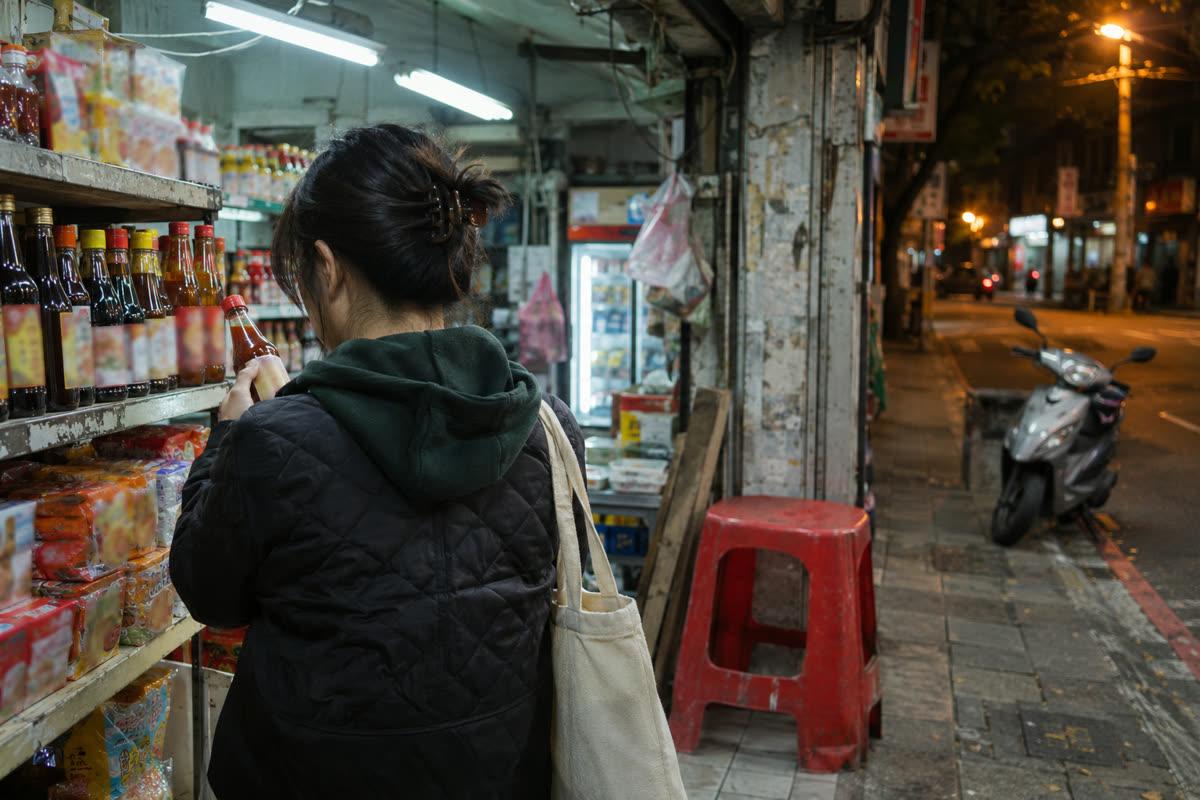 What “gluten-free” means on a pack in Asia, country by countryWhat a gluten-free claim requires in six Asian countries, what Japan, Hong Kong, Taiwan and China print instead, and how to read a pack in hand.
 Gluten-free in South Korea: where wheat and barley turn up at a Korean tableWhere wheat and barley turn up in Korean food: marinades, ganjang, doenjang, gochujang, noodles, barley tea, and what a Korean label says.
Related guides
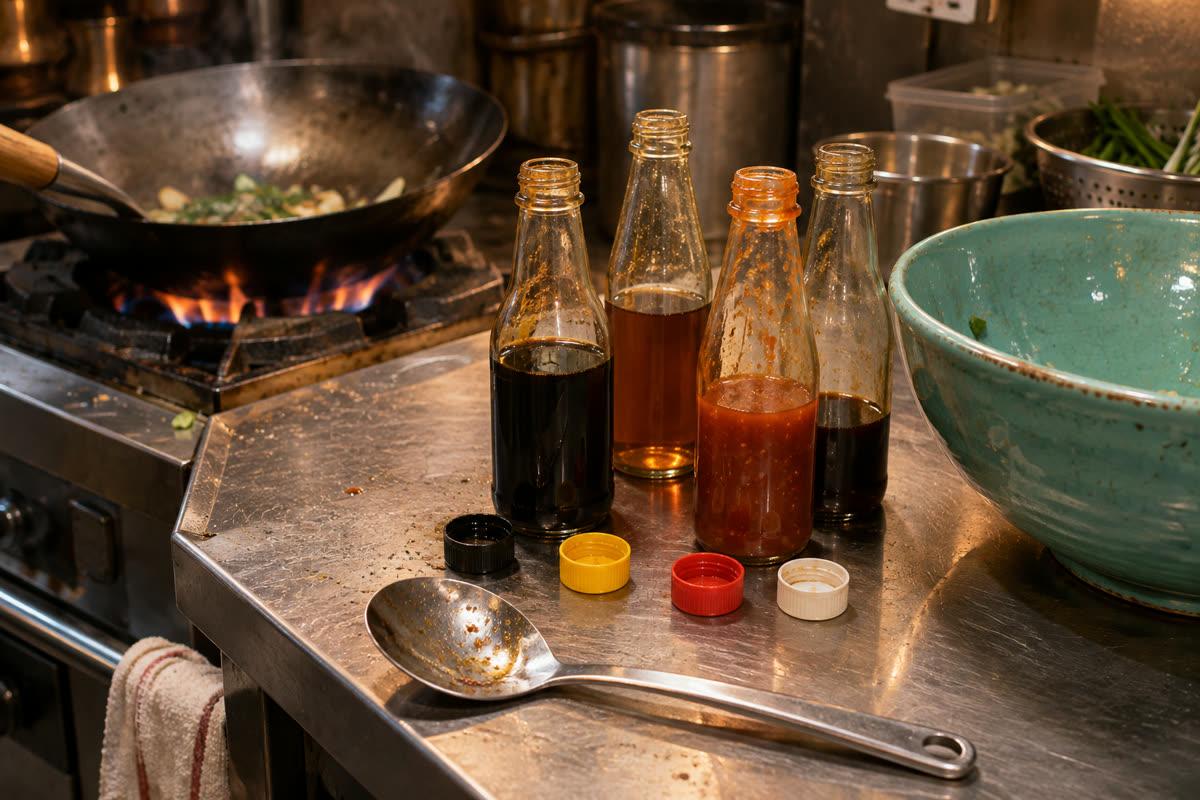 Soy, hoisin, oyster, teriyaki and fish sauce: which bottles carry wheatSoy, hoisin, oyster, teriyaki and fish sauce compared by the ingredient lists of Kikkoman, Lee Kum Kee, San-J and Red Boat, plus what to ask at a counter.
 Ordering gluten-free at a Chinese restaurant: sauces, coatings, wine, woks and MSGWhere wheat enters Chinese-restaurant cooking (sauces, coatings, cooking wine, woks), why MSG is not a gluten source, and what to ask before you order.
 Gluten-free dining cards in other languages: where the wording comes fromWhich gluten-free card wording comes from EU law or a celiac society, which cards are members-only, and how to hand one to a server.
 Ordering at a Thai restaurant when you avoid gluten: sauces, noodles and woksWhich Thai sauces, noodles, coatings and kitchen habits can bring in wheat, and the questions to ask before you order at a Thai restaurant.
Sources
- [1, 18] PubMed Central (Frontiers in Nutrition, 2022), Differential Association of Wheat and Rice Consumption With Overweight/Obesity in Chinese Adults: China Health and Nutrition Survey 1991-2015, checked Nov 17, 2026.
- [2] Lee Kum Kee USA, Premium Soy Sauce (No Preservatives Added), ingredients and allergens, checked Nov 17, 2026.
- [3, 32] Yihai US Food Inc (Haidilao-brand products), Spicy Sichuan Mala Hot Pot Soup Base, 17.6oz, allergens, checked Nov 17, 2026.
- [4, 8, 9, 10, 12, 13, 14, 15, 16, 39, 47, 50, 52] National Health Commission and State Administration for Market Regulation (text on the CFSA standards platform), GB 7718-2025 prepackaged food labeling standard: official interpretation and standard text (copy hosted by the Quanzhou municipal market regulator), checked Nov 17, 2026.
Read on 2026-11-17: the cover page of the standard text prints 2025-03-16 beside 发布 (issued) and 2027-03-16 beside 实施 (in force), over the names of the National Health Commission and the State Administration for Market Regulation.
Read on 2026-11-17: Table A.1 (表A.1, class names for some ingredients) pairs “各种淀粉,不包括化学改性淀粉” (starches of all kinds, excluding chemically modified starch) with the class name “淀粉”, and “食品产品中添加的各种酱油” (the various soy sauces added to a food) with the class name “酱油”.
- [5] Lee Kum Kee USA, Premium Oyster Sauce, ingredients and allergens, checked Nov 17, 2026.
- [6] Lee Kum Kee USA, Hoisin Sauce (Jar), ingredients and allergens, checked Nov 17, 2026.
- [7, 33] Yihai US Food Inc (Haidilao-brand products), Hot & Spicy Mala Chili Oil Soup Base, 220 g, allergens, checked Nov 17, 2026.
- [11, 17, 42, 43, 44, 45] PubMed Central (Foods, 2025; authors at China’s national food risk assessment center (CFSA)), Gluten Contamination of Labelled Gluten-Free Food Products Marketed in China, checked Nov 17, 2026.
Read on 2026-11-17: the Introduction says that CFSA (the authors’ own institution) launched the development of a national standard for gluten-free foods in 2023.
Read on 2026-11-17: the Introduction says the 20 mg/kg threshold for gluten-free foods has been adopted by major food regulatory agencies, naming the Codex Alimentarius Commission, the European Union’s food authority (EFSA) and the US Food and Drug Administration.
- [19] PubMed Central (Nutrition Reviews, 2024), Exploring the traditional Chinese diet and its association with health status: a systematic review, checked Nov 17, 2026.
- [20, 21, 25] Gluten Intolerance Group, Explore Asian Cuisine – Gluten-Free, checked Nov 17, 2026.
- [22, 23] Lee Kum Kee USA, Gluten-Free Oyster Sauce (Panda Brand green label), ingredients and allergens, checked Nov 17, 2026.
- [24] Canadian Food Inspection Agency, Certain Shaoxing Cooking Wines recalled due to undeclared wheat (recall of 14 May 2026), checked Nov 17, 2026.
- [26, 29, 30, 31] Coeliac New Zealand, Advice for eating out to celebrate Chinese New Year, checked Nov 17, 2026.
- [27, 28] Wei-Chuan USA, Shan Dong Pork & Leek Dumpling, wrapper ingredients, checked Nov 17, 2026.
- [34, 35] Yihai US Food Inc (Haidilao-brand products), Spicy Green Chili Hot Pot Soup Base, 200 g, ingredients, checked Nov 17, 2026.
- [36] Yihai US Food Inc (Haidilao-brand products), Clear Broth Hot Pot Soup Base, 110 g, checked Nov 17, 2026.
Read on 2026-11-17: the page lists powder ingredients (maltodextrin, monosodium glutamate, salt, milk powder, corn starch, sugar, yeast extract, disodium 5'-ribonucleotides, soy protein isolate, natural and artificial flavorings, spices) and dry material (Chinese red date, Chinese wolfberry): no wheat ingredient is named. The page also states Made in China. Its allergen line reads "Contains: Soybean, Milk".
- [37, 38, 40, 41, 48, 49, 51, 53] Czech State Veterinary Administration (hosting an English translation of GB 7718-2025; its status is not stated), GB 7718-2025 General Principles for the Labeling of Prepackaged Foods, English translation (PDF), checked Nov 17, 2026.
Read on 2026-11-17: the Preface of the translation states that the standard replaces the 2011 edition of the prepackaged-food labeling standard, GB 7718-2011.
Read on 2026-11-17: the table of class names for some ingredients in Appendix A pairs "Starches of different kinds, not including chemically modified starches" with "Starch", and "Soy sauce added during the production process" with "Soy sauce".
- [46] Gluten Intolerance Group, Traveling Gluten-Free with Confidence, checked Nov 17, 2026.