Gluten-free in Hong Kong: dim sum wrappers, noodles, sauces and the packet label
Short answer
Sort what you order by wrapper, noodle and sauce, and read the ingredient list of any packet. In Hong Kong, the government’s food centre, the CFS, says prepackaged food must name cereals containing gluten1, but declaring allergens is not a requirement for non-prepackaged food3. Four checks, in order:
- Wrapper: a crystal (translucent) shrimp dumpling wrapper is formulated from wheat starch and potato starch, and a traditional dumpling wrapper is prepared primarily from wheat flour4, 5. Ask what the wrapper is made from.
- Noodle: one UK seller of Hong Kong-style wonton noodles says its noodle is made with wheat flour and eggs6; rice noodles are the other choice, and the Gluten Intolerance Group (GIG), in an article on Thai food, says to confirm they really are rice noodles7.
- Sauce: Lee Kum Kee’s Hong Kong pages for its soy sauces and oyster sauce list wheat8, 9, 10, and its two XO sauce pages differ on wheat11, 12.
- Packet: look in the ingredient list for wheat, rye, barley, oats or spelt13; the CFS guideline also describes a “May contain traces of” warning-statement format14.
- Gluten-free limit
- No gluten-free limit found: the CFS pages we read give none, and the CFS guideline says there is at present no tolerance limit for allergenic substances in food18, 17
- Set by
- Food and Drugs (Composition and Labelling) Regulations, Cap 132W: cereals containing gluten must be named in the ingredient list of prepackaged food, as the CFS describes it1, 16
- Oats
- Oats are named, with wheat, rye, barley and spelt, in the CFS guideline’s definition of cereals containing gluten15
Part of Travel: Asia and the Middle East, 12 guides

Key points
- Hong Kong’s rule names cereals containing gluten as wheat, rye, barley, oats, spelt, their hybridized strains and their products, and requires the name in the ingredient list15, 16.
- Products not packed beforehand and just put in packaging at the point of sale are not considered prepackaged food2, and for non-prepackaged food the CFS only suggests that the trade consider declaring allergens on the menu3.
- The CFS guideline says there is at present no tolerance limit for allergenic substances in food, and none of the CFS’s March 2026 article, labelling slides or labelling guideline defines “gluten-free”17, 18.
- In 2019 the CFS warned about two prepackaged US-made cereals that might contain gluten and wheat not declared on their labels19.
Dim sum: read it by the wrapper
Dim sum wrappers are not all alike. The two kinds the sources we could open describe:
- A crystal wrapper, the translucent skin of the shrimp dumplings the study calls “an iconic Cantonese dim sum delicacy”20. A 2026 food-science paper says crystal wrappers are formulated from wheat starch and potato starch4.
- A traditional dumpling wrapper, which the same paper says is prepared primarily from wheat flour5. GIG says gyoza and potstickers are often made with wheat-based wrappers21.
That is one study of how wrappers are made, not a survey of Hong Kong kitchens, so a dumpling on a given steamer cart can still differ.
Wheat starch is still a wheat product
In the US, a food labeled gluten-free may contain an ingredient derived from wheat and processed to remove gluten, such as wheat starch, only if that ingredient does not bring the food to 20 parts per million (ppm) or more of gluten22. That is a US labeling rule; we found no Hong Kong rule on it (see the section on gluten-free claims below). Nothing we read says whether a given kitchen’s starch was processed that way, so the question to ask is what the wrapper is made of, not whether it is “gluten-free”. Our ingredient page on wheat starch shows what the sources say.
| Item | What the wrapper is, per the source | What to ask |
|---|---|---|
| Crystal shrimp dumpling (translucent skin) | Wheat starch and potato starch4 | Whether the wrapper holds wheat starch, and the kitchen’s answer on how it is made |
| Traditional dumpling wrapper (not the crystal kind) | Prepared primarily from wheat flour5; GIG says gyoza and potstickers are often made with wheat-based wrappers21 | What the wrapper is made from; see our verdict on dumplings |
| Wonton in soup | Not read for this guide; our verdict record shows the products we checked | See wonton soup |
| Cheung fun and congee | No source fetched, so we state nothing about their ingredients | Ask what the roll or the congee is made from, and what is poured over it |
Noodle shops: noodle first, then the bowl
In a noodle shop two questions sort most of the menu: what is the noodle, and what is in the bowl or on the plate.
- A wonton noodle is the first thing to check. The one product page we read, from a UK seller of Hong Kong-style fresh wonton noodles, says its noodle is made with wheat flour and eggs6. Our verdicts: egg noodles, chow mein and lo mein.
- A rice noodle is the other side of the menu. In its article on Thai food, GIG’s advice is that rice noodles are almost always gluten-free, but to check the package or ask the restaurant that they are rice noodles and completely gluten-free7. Our verdict: rice noodles. GIG’s tip for ordering noodle dishes in a Thai restaurant is to choose rice noodles and avoid egg noodles23.
The bowl matters as much as the noodle. The CFS says gluten may also be found in sauces and gravies such as soy sauce, and in soup24, so a rice-noodle soup is not settled by the noodle alone. A broth’s ingredients are the kitchen’s to tell you, and none of our sources lists what a given Hong Kong noodle shop puts in its stock.
Soy, oyster and XO sauce: what one maker’s Hong Kong pages show
GIG says traditional soy sauce contains wheat25, and the CFS names soy sauce among foods where gluten may be found24. To see what that looks like on a Hong Kong pack, we read Lee Kum Kee’s Hong Kong product pages on 2026-11-17. This is one maker’s pages. It tells you nothing about another brand or about the bottle on a restaurant’s table.
| Product page | What the page shows |
|---|---|
| Supreme Authentic First Draw Soy Sauce | Ingredients end “Sugar, Wheat”; the Allergens line reads “Contains Soybeans, Wheat.”8 |
| Savoury Seafood Soy Sauce | Wheat flour is in the ingredient list9 |
| Premium Oyster Sauce | Wheat flour is in the ingredient list and the Allergens line reads “Wheat”10 |
| XO Sauce | The Allergens line reads “Contains Soybeans, Crustacean Product and Naturally Present Sulphites.”; the ingredient list names no wheat ingredient11 |
| Seafood XO Sauce | A fermented broad bean paste with wheat flour is in the ingredient list12 |
Two things follow. On these pages the wheat in the soy and oyster sauces is a named ingredient, so a label reader can find it8, 9, 10. And two sauces with the same name on the front can differ inside: of the two XO sauces above, one lists no wheat ingredient and one lists wheat flour in its bean paste11, 12. The XO Sauce page makes no gluten-free claim11. Our verdicts for the sauce family: soy sauce, oyster sauce and hoisin sauce.
We found no source on which soy sauce a Hong Kong restaurant pours, so that is a question for the kitchen.
Restaurants, counters and cha chaan teng: no packet label to read
A Hong Kong packet has an ingredient list that must name cereals containing gluten (next section). Food that is not prepackaged is a different case. The CFS’s labelling slides say products that are not packed beforehand and are just put in packaging for customers at the point of sale are not considered prepackaged food, and general labelling is not required for them2. The CFS’s March 2026 article, aimed at the trade, says declaring allergens is not a requirement for non-prepackaged foods but suggests considering it on the menu3.
A bakery product packed in a plastic bag fastened up with a metal wire, a plastic wire or a date hook counts as prepackaged food under the CFS slides26; an item put into packaging for you at the point of sale is the other kind described above2.
We found no source that describes cha chaan teng menus, set-meal sauces or milk tea, so this guide lists no dishes for them. The same three questions apply to any restaurant: what the wrapper or noodle is, which sauces go in or on the dish, and how it is cooked and handled. GIG’s advice for an Asian restaurant is to call ahead and make sure the gluten-free standard is understood, particularly avoiding cross-contact27, and to ask about preparation methods and cross-contact28. GIG also suggests a printed translation card when you do not share the local language29. This guide does not supply the translation.
Reading a Hong Kong packet
The CFS’s labelling slides list eight substances that must be declared in the ingredient list, the first being cereals containing gluten30. The CFS’s labelling guideline defines that group as wheat, rye, barley, oats, spelt, their hybridized strains and their products15, and says the name of the substance shall be specified in the list of ingredients16. The CFS says this has been required since 2004 under the Food and Drugs (Composition and Labelling) Regulations, Cap 132W1. For how the US reads a label, see our guide to reading a food label.
| On the pack | What the CFS says |
|---|---|
| Ingredient list | You can check whether wheat, rye, barley, oats, spelt or gluten is written in it13 |
| Acceptable wording | The guideline lists as acceptable, among others, “Wheat”, “Rye” and “Flour (cereals containing gluten)”31 |
| Declared only elsewhere on the pack | Asked whether allergens can be declared somewhere else to avoid a long list, the CFS answers no: they shall be specified in the list of ingredients32 |
| “May contain traces of …” line | The guideline says the CFS tends to accept a warning statement at the end of, or in immediate proximity to, the ingredient list when the allergen is not an ingredient but is handled on a shared line or in the same factory36; the formats are “May contain traces of (NAME OF ALLERGEN)”, “Contains traces of (NAME OF ALLERGEN)” or “Produced in a factory where (NAME OF ALLERGEN)” is also handled14 |
| Gluten unintentionally introduced | In its rice example, the CFS says gluten that is unintentionally introduced shall be disclosed in the list of ingredients or in immediate proximity to it33 |
The guideline’s example of acceptable wording for soy is “Soy sauce (contains soybeans)”31; it shows no soy sauce example that names wheat, so read the whole list for the word wheat rather than the soy line.
The same guideline says there is at present no tolerance limit for allergenic substances in food17. The CFS advises people with gluten-related disorders check labels carefully for gluten-containing ingredients34.
A label can still be wrong: the 2019 alert
On 17 February 2019 the CFS said that two US-made prepackaged cereal products might contain gluten and wheat that were not declared on their labels19. It learned of it from notices issued by US and Canadian authorities about a recall35. The point for a traveler is narrow: an imported packet is only as good as its maker’s label, and the ingredient list is still where to start.
What Hong Kong’s CFS says about gluten-free products
Hong Kong’s CFS has a March 2026 article on gluten-free food products for the general population. It tells people with gluten-related disorders to check labels carefully34. We read the text of that article, the text of the labelling slides and the labelling guideline on 2026-11-17, and looked at the article’s one figure, and none of them defines “gluten-free” or gives a numerical gluten limit18.
We did not find a Hong Kong rule for the claim on these three pages, and we did not open the regulation text itself, so we do not say that none exists. What this means on a shelf: a “gluten-free” statement on a Hong Kong packet is the maker’s own wording until a source we have read says what it must meet, so the ingredient list stays the check. For the US definition (less than 20 ppm) and how other countries word theirs, see gluten-free labeling rules by country.
What we could not confirm
- The regulation text. Hong Kong’s e-Legislation site loads only a script shell without the text we could read, so every statement of the rule comes from the CFS’s own guidance pages. The guideline we read dates from the 2004 amendment and its page says “Updated June 2007”; we did not confirm whether later amendments changed the wording.
- A gluten-free definition or limit. None appears on the three CFS pages we read; we did not look for an unpublished or separate standard.
- Cheung fun, congee, siu mai and har gow wrappers by name, and cha chaan teng dishes and milk tea. The pages that would describe them (a tourism board page and a charity’s travel page) blocked our fetch, and we did not work around that. The only wrapper source is the 2026 study of crystal dumpling wrappers.
- Anything about a particular restaurant, stall or cart. This guide names none and rates no district.
- Whether the wheat starch in a given kitchen is processed to remove gluten.
Verdicts in this guide
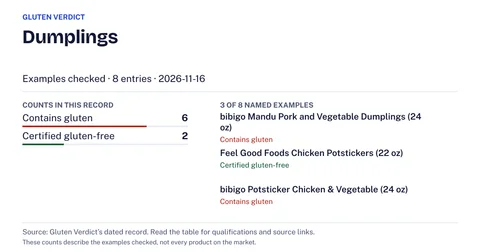 DumplingsContains glutenchecked Nov 16, 2026
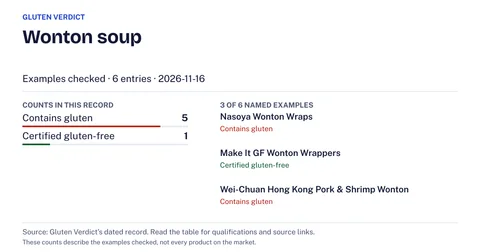 Wonton soupContains glutenchecked Nov 16, 2026
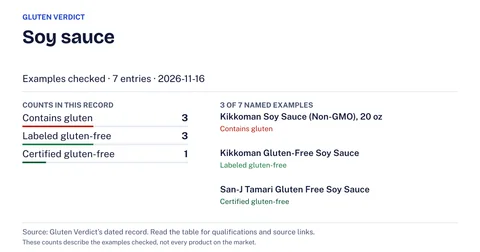 Soy sauceDepends on the product3 of 7 products we checked contain gluten: Kikkoman Soy Sauce (Non-GMO), 20 oz; San-J Organic Shoyu Soy Sauce; and Lee Kum Kee Premium Soy Sauce (No Preservatives Added)checked Nov 16, 2026
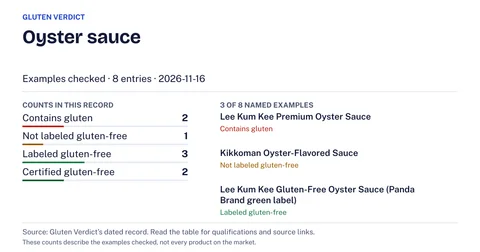 Oyster sauceDepends on the product2 of 8 products we checked contain gluten: Lee Kum Kee Premium Oyster Sauce and Lee Kum Kee Panda Brand Oyster Flavored Saucechecked Nov 16, 2026
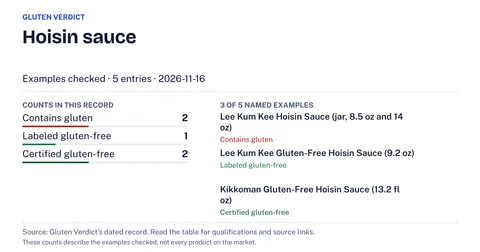 Hoisin sauceDepends on the product2 of 5 products we checked contain gluten: Lee Kum Kee Hoisin Sauce (jar, 8.5 oz and 14 oz) and Kikkoman Hoisin Sauce (9.3 oz)checked Nov 16, 2026
 Rice noodlesNaturally gluten-free2 of 9 products we checked contain gluten: Annie Chun’s Pad Thai Noodle Bowl with Vegetables and Annie Chun’s Pho Soup Bowl with VegetablesBuy it labeled gluten-freechecked Nov 16, 2026
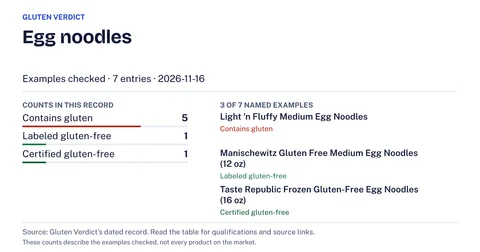 Egg noodlesContains glutenchecked Nov 16, 2026
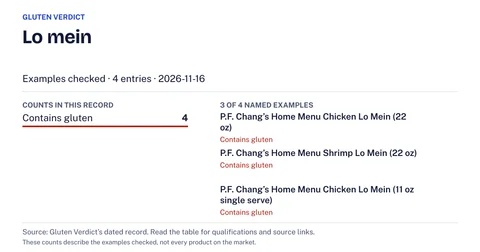 Lo meinContains glutenchecked Nov 16, 2026
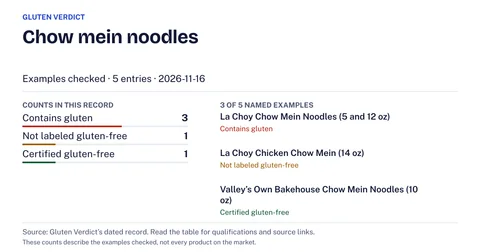 Chow mein noodlesContains glutenchecked Nov 16, 2026
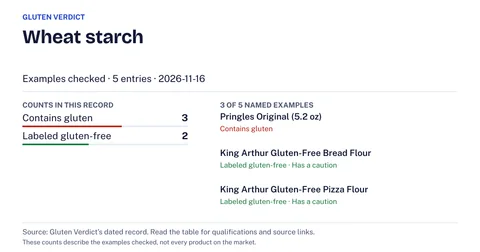 Wheat starchDepends on the product3 of 5 products we checked contain gluten: Pringles Original (5.2 oz), Jiffy Corn Muffin Mix, and Chex Mix Bold Garlic and Herbchecked Nov 16, 2026
Questions people ask
Is the translucent shrimp dumpling wrapper rice-based?
A 2026 food-science paper says crystal wrappers are formulated from wheat starch and potato starch4. Nothing we read says whether a given kitchen’s starch is processed to remove gluten, so ask what the wrapper holds.
Does Hong Kong have a gluten-free label rule?
None of the three CFS pages we read defines “gluten-free” or gives a limit18. We did not open the regulation text, so we do not say none exists.
Is soy sauce in Hong Kong made with wheat?
GIG says traditional soy sauce contains wheat25, and the Lee Kum Kee Hong Kong soy sauce pages we read list wheat or wheat flour8, 9. A different brand or a restaurant’s bottle can differ, so read its list.
Do Hong Kong restaurants have to list allergens?
The CFS says it is not a requirement for non-prepackaged foods, and suggests the trade consider declaring allergens on the menu3.
More in Travel: Asia and the Middle East
 Gluten-free in Singapore: hawker noodles, soya sauce and the new label ruleWhich Singapore hawker noodles are rice and which wheat, where soya and oyster sauce come in, and what the Food Agency's gluten-free label means.
 Eating gluten-free in Thailand: sauces, noodles and street stallsWhere wheat shows up in Thai sauces, noodles and street food, how Thailand words its own gluten-free rule, and the Thai words to look for on a pack.
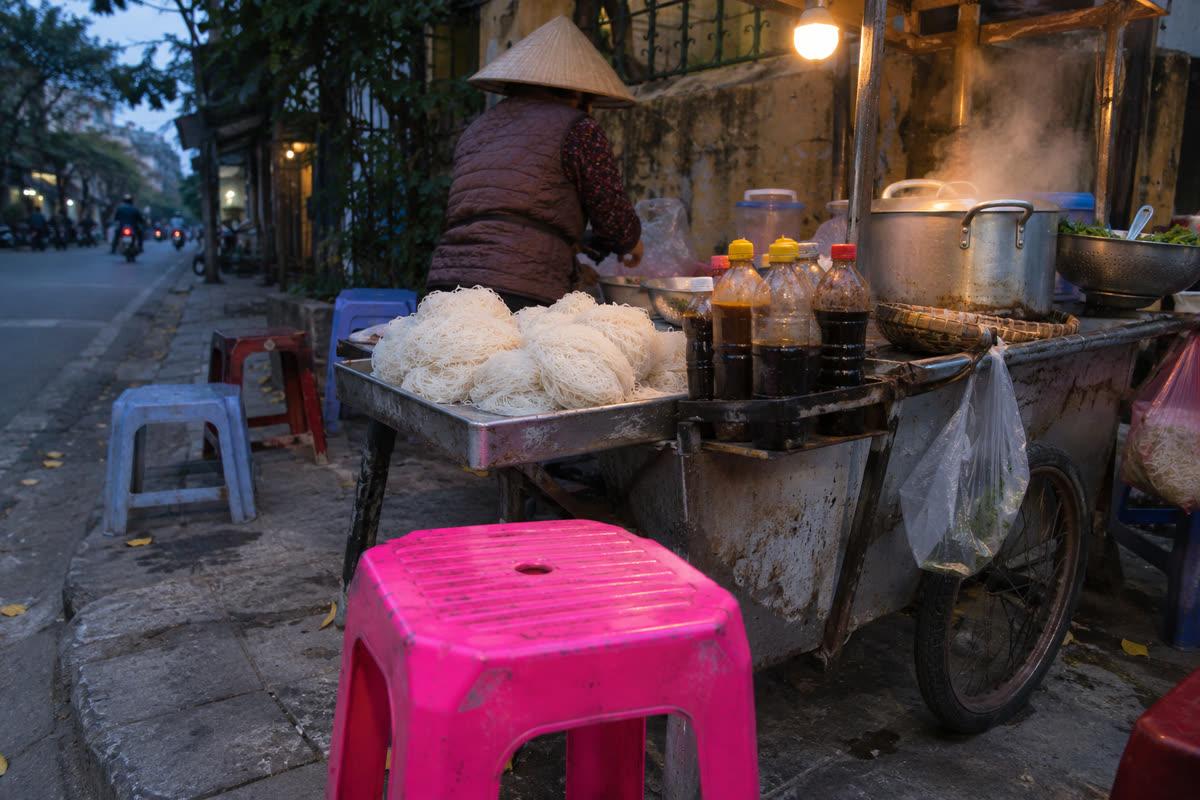 Gluten-free in Vietnam, the Philippines, Malaysia, Indonesia and Taiwan: sauces, noodles and label rulesWhere wheat enters a Southeast and East Asian meal, what four regulators print about gluten cereals, and the one country whose rule we could not read.
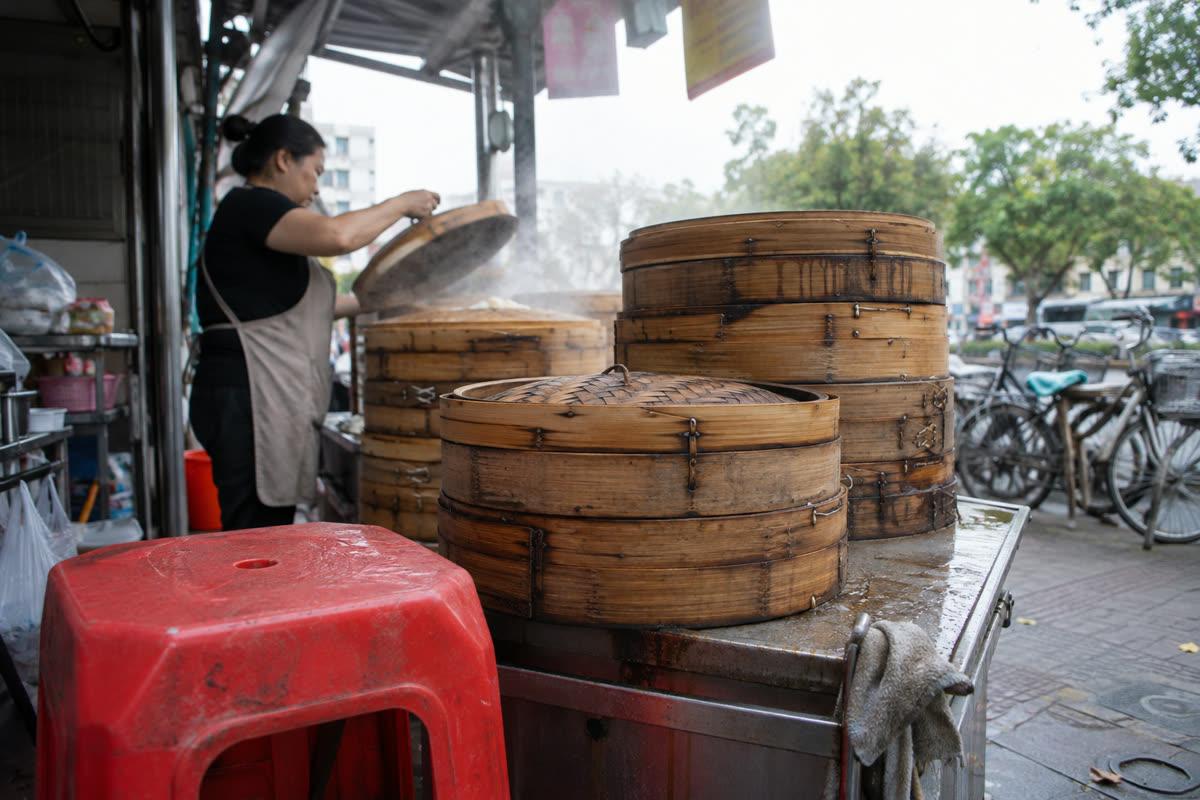 Gluten-free in China: wheat staples, sauces, hot pot and the label rulesWhere wheat sits in Chinese staples, sauces and hot-pot bases, what China’s label standard requires, and the Chinese words it prints for wheat and gluten.
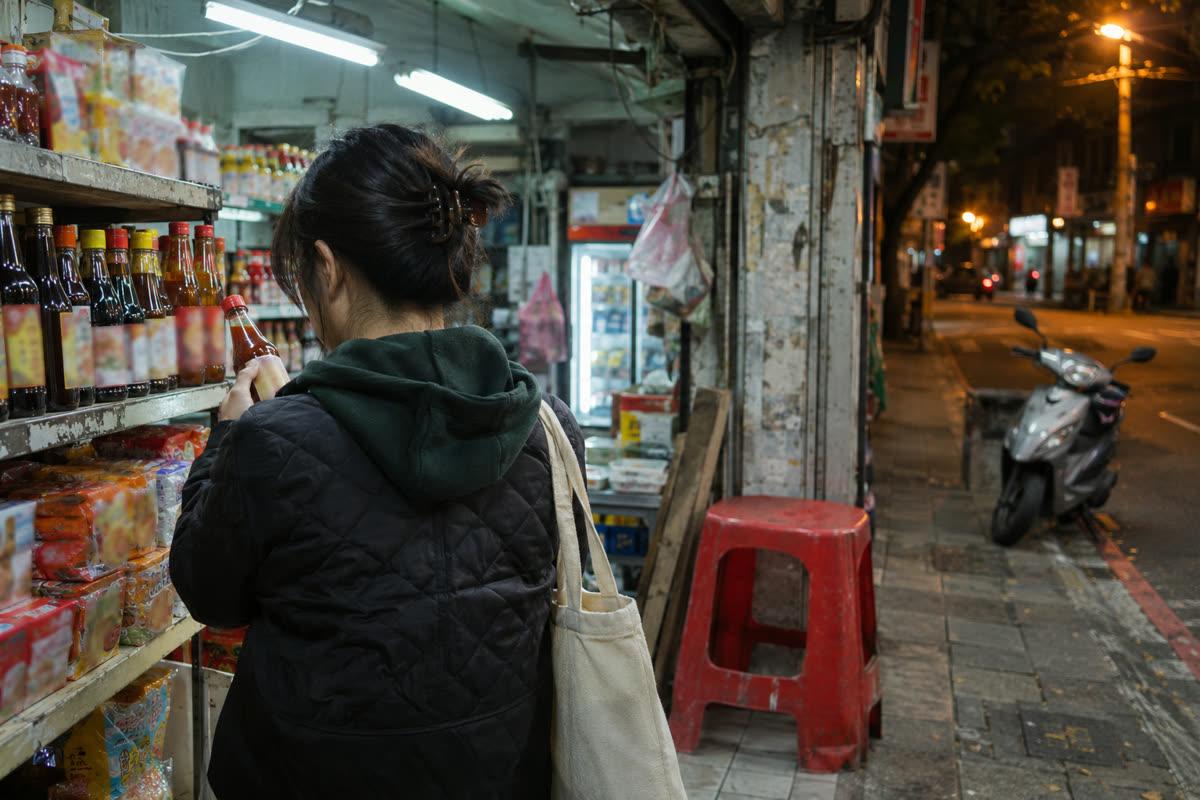 What “gluten-free” means on a pack in Asia, country by countryWhat a gluten-free claim requires in six Asian countries, what Japan, Hong Kong, Taiwan and China print instead, and how to read a pack in hand.
 Gluten-free in South Korea: where wheat and barley turn up at a Korean tableWhere wheat and barley turn up in Korean food: marinades, ganjang, doenjang, gochujang, noodles, barley tea, and what a Korean label says.
Related guides
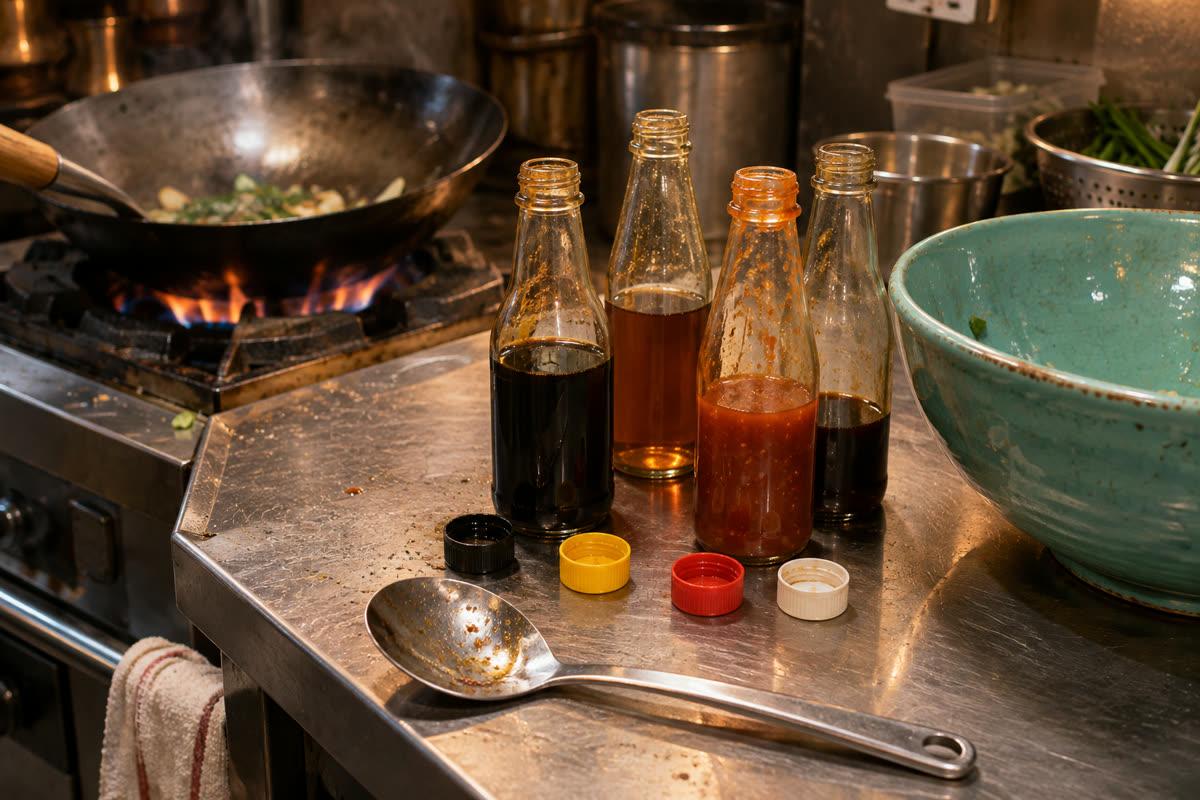 Soy, hoisin, oyster, teriyaki and fish sauce: which bottles carry wheatSoy, hoisin, oyster, teriyaki and fish sauce compared by the ingredient lists of Kikkoman, Lee Kum Kee, San-J and Red Boat, plus what to ask at a counter.
 Gluten-free dining cards in other languages: where the wording comes fromWhich gluten-free card wording comes from EU law or a celiac society, which cards are members-only, and how to hand one to a server.
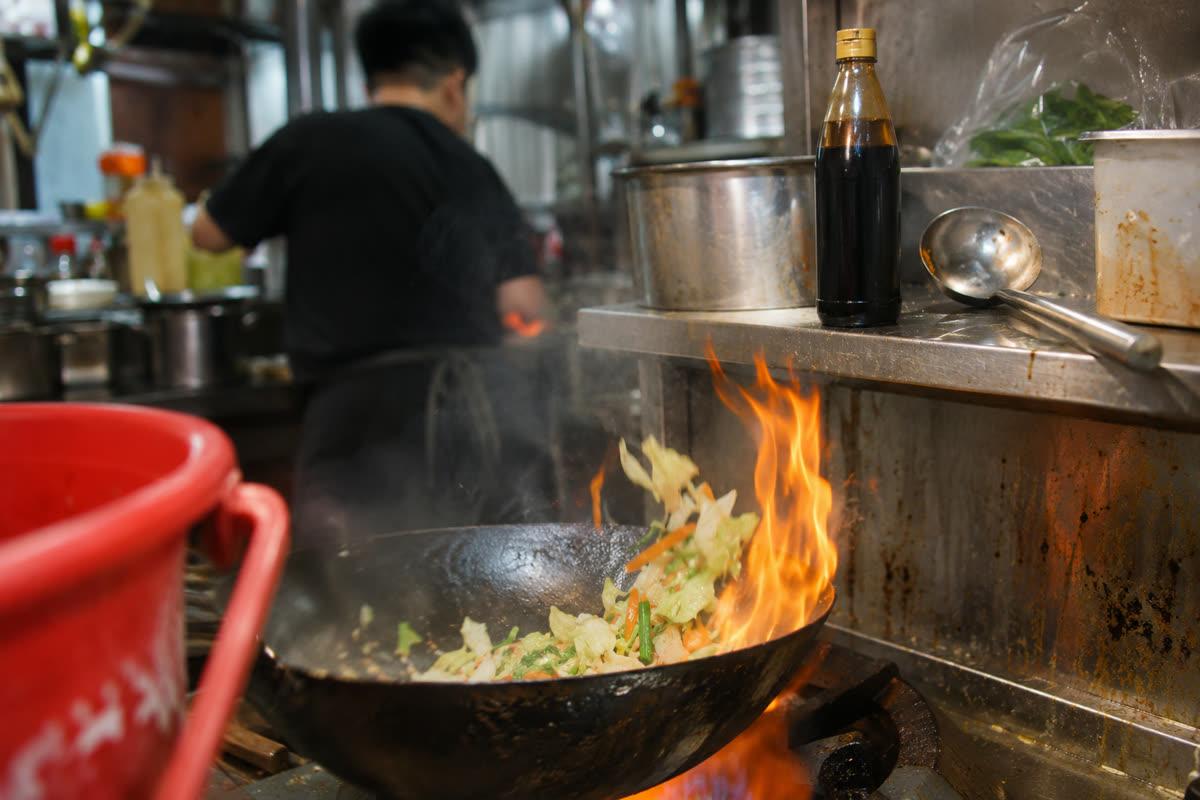 Ordering gluten-free at a Chinese restaurant: sauces, coatings, wine, woks and MSGWhere wheat enters Chinese-restaurant cooking (sauces, coatings, cooking wine, woks), why MSG is not a gluten source, and what to ask before you order.
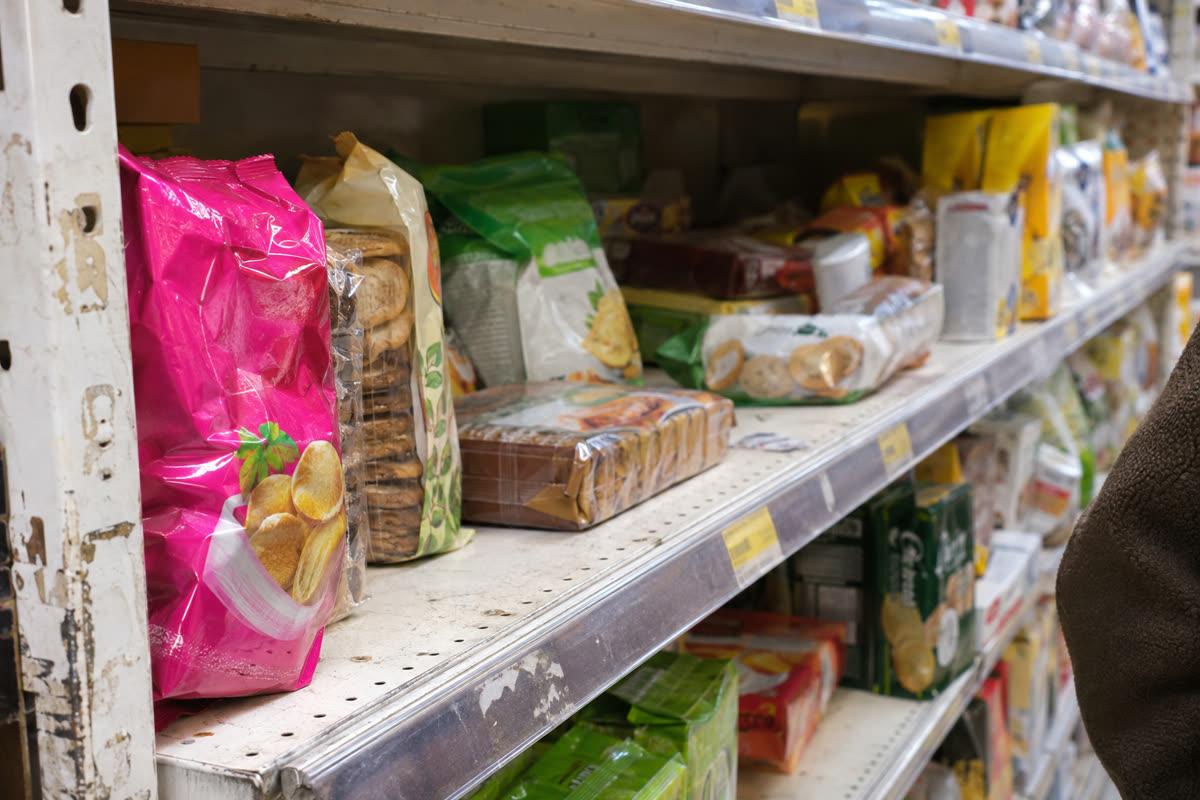 Gluten-free labeling rules by country: ceilings, claim wording and where no rule was foundLook up the gluten-free limit and claim wording for the US, Canada, EU, UK, Australia, New Zealand and more, each figure tied to the page we read.
Sources
- [1, 3, 13, 18, 24, 34] Centre for Food Safety (Hong Kong), Food Safety Focus, issue 236 (March 2026): Are gluten-free food products better choices for the general population?, checked Nov 17, 2026.
Read on 2026-11-17 (text and its one figure, a sample label with the “wheat flour” and “Contains” lines highlighted): the article describes gluten-free pasta, noodles, bread and candies on supermarket shelves and says how to check a label for gluten; it gives no legal definition of “gluten-free” and no numerical gluten limit. The CFS labelling slides and the CFS labelling guideline, both read the same day, state none either.
- [2, 26, 30] Centre for Food Safety (Hong Kong), Labelling of Prepackaged Food in Hong Kong (CFS slides), checked Nov 17, 2026.
- [4, 5, 20] Foods (MDPI), via PubMed Central, Functional Additives Enhance Freeze–Thaw Stability and Retard Retrogradation in Wheat–Potato Starch Gels and Crystal Dumpling Wrappers (2026), checked Nov 17, 2026.
- [6] HK Tasty, Fresh Wonton Noodles Thin (product page, UK seller of Hong Kong-style noodles), checked Nov 17, 2026.
- [7, 23] Gluten Intolerance Group, Exploring Thai Cuisine on a Gluten-Free Diet (August 15, 2021), checked Nov 17, 2026.
- [8] Lee Kum Kee (Hong Kong), Supreme Authentic First Draw Soy Sauce (Hong Kong product page), checked Nov 17, 2026.
- [9] Lee Kum Kee (Hong Kong), Savoury Seafood Soy Sauce (Hong Kong product page), checked Nov 17, 2026.
- [10] Lee Kum Kee (Hong Kong), Premium Oyster Sauce (Hong Kong product page), checked Nov 17, 2026.
- [11] Lee Kum Kee (Hong Kong), XO Sauce (Hong Kong product page), checked Nov 17, 2026.
- [12] Lee Kum Kee (Hong Kong), Seafood XO Sauce (Hong Kong product page), checked Nov 17, 2026.
- [14, 15, 16, 17, 31, 32, 36] Centre for Food Safety (Hong Kong), Labelling Guidelines on Food Allergens, Food Additives and Date Format, checked Nov 17, 2026.
- [19, 35] Centre for Food Safety (Hong Kong), Press release, 17 February 2019: Two kinds of prepackaged cereal products may contain allergens (gluten and wheat), checked Nov 17, 2026.
- [21, 25, 27] Gluten Intolerance Group, Explore Asian Cuisine – Gluten-Free (April 11, 2023), checked Nov 17, 2026.
- [22] US Food and Drug Administration, Questions and Answers on the Gluten-Free Food Labeling Final Rule, checked Nov 17, 2026.
- [28, 29] Gluten Intolerance Group, Traveling Gluten-Free with Confidence (April 15, 2026), checked Nov 17, 2026.
- [33] Centre for Food Safety (Hong Kong), Food Labelling (CFS frequently asked questions), checked Nov 17, 2026.