Gluten-free in Vietnam, the Philippines, Malaysia, Indonesia and Taiwan: sauces, noodles and label rules
Short answer
Taiwan, Indonesia, Malaysia and the Philippines each name gluten-containing cereals in their packaged-food allergen labeling rules1, 3, 8, 10; we could not read a Vietnamese regulator page. A label rule does not cover a stall or a table, so ask about four places wheat can come in:
- Soy-type sauce: the soy sauce pages we read from two makers list wheat14, 15, and the Celiac Disease Foundation lists soy sauce among foods that may contain gluten, and says tamari made without wheat is gluten-free18.
- Noodles: the foundation lists ramen, udon, chow mein and egg noodles as containing gluten, and rice noodles and mung bean noodles as gluten free16.
- Dumplings: the foundation lists dumplings among foods that contain gluten17.
- Batter and shared fryers: for French fries the foundation advises care with batter containing wheat flour and with cross-contact from fryers19.
Part of Travel: Asia and the Middle East, 12 guides
Key points
- Taiwan’s rule names gluten-containing cereals among 11 allergens that prepackaged food must declare1; Malaysia’s list names wheat, rye, barley and oat8.
- Indonesia’s BPOM asks for the allergen statement when a product contains an allergen or was made on the same production facilities as one that does3; Taiwan only suggests a shared-line statement2.
- Indonesia’s page makes an exception for allergen ingredients that have been further purified, and for cereal products it names glucose syrup, maltodextrin, fructose and sugar alcohols5.
- Red Boat says its fish sauces contain no wheat11 and Thai Kitchen’s fish sauce ingredient list names none13; two soy sauce pages list wheat14, 15.
- The Malaysian regulations text we searched has no gluten-free claim provision9, and we could not read a Vietnamese regulator page.
Where wheat enters the meal
The same few wheat sources sit behind many dishes in these countries. The sauce pages below are makers’ own pages that we read; we did not read the versions sold in each country, so the bottle or package in front of you has the final word.
| Route | What the pages we read say |
|---|---|
| Soy-type sauce (soy sauce, hoisin sauce) | Kikkoman’s Non-GMO soy sauce page lists water, soybeans, wheat and salt15. Lee Kum Kee’s Premium Soy Sauce page lists wheat flour and names soybeans and wheat as allergens14. The Celiac Disease Foundation lists soy sauce among foods that may contain gluten, and says tamari made without wheat is gluten-free18. |
| Fish sauce (fish sauce) | Red Boat says its fish sauces and umami salt contain no wheat or wheat by-products and are produced in a gluten-free facility11, while its lemongrass curry and simmer sauces are produced in a facility that uses wheat12. Thai Kitchen’s fish sauce page lists anchovy, sea salt, water and sugar13. |
| Wheat noodles beside rice noodles (rice noodles, egg noodles, ramen) | The foundation lists ramen, udon, chow mein and egg noodles as containing gluten, and says rice noodles and mung bean noodles are gluten free16. |
| Dumplings (dumplings) | The foundation lists dumplings among foods that contain gluten17. |
| Batter and fried food | On French fries the foundation says to be careful of batter containing wheat flour and of cross-contact from fryers19. It says tofu is gluten free but advises caution with soy sauce marinades and cross-contact when eating out, especially when the tofu is fried20. |
| Instant noodles | Nissin’s US FAQ says the company currently has no gluten-free options21. |
What each country’s label rule says about gluten cereals
These are labelling rules, so they decide what is printed on a package, not what a cook puts in a bowl. The table covers only the regulator pages we opened.
| Country | Rule we read | How it names gluten cereals | Shared-equipment wording |
|---|---|---|---|
| Taiwan | Taiwan FDA, Regulations Governing Food Allergen Labeling on the Recommended Labeling Allergens1 | “Gluten-containing cereals” is one of 11 allergens that prepackaged food must declare1 | Suggested, not required: a statement that the plant, equipment or production line is also used to process the allergen2 |
| Indonesia | BPOM, label page for processed food3 | Cereals containing gluten: wheat, rye, barley, oats, spelt or hybrid strains3 | The allergen statement is given if the product contains an allergen or was made on the same production facilities as processed food that does3; the page lists statement forms such as “made with equipment that also processes”, “may contain” and “can contain”, each followed by the allergen4 |
| Malaysia | Food Regulations 1985, Regulation 117 | “Cereal containing gluten including wheat, rye, barley and oat”8 | Not searched for |
| The Philippines | Department of Health Administrative Order No. 2014-0030, section 910 | Cereal containing gluten (wheat, rye, barley, oat, spelt or their hybridized strain, and products of these) is always declared10 | The section gives “may contain” and “manufactured in equipment that processes” as example expressions10 |
| Vietnam | Regulator page not read | — | — |
The Indonesian page is in Indonesian. Its words are quoted in the sources list; the English in this guide is our reading of them. The Philippine order is a scanned file that we read by optical character recognition, so check its wording against the scan before relying on it.
Taiwan: gluten-containing cereals on the mandatory list
Taiwan’s rule says prepackaged foods must carry allergen labeling when they contain any of 11 listed allergens as an ingredient or food additive, and gluten-containing cereals are on that list1. For cross-contamination risk, such as the same plant, equipment or production line being used for food with allergenic ingredients, the page suggests a precautionary statement2.
For drinks, see our verdicts on bubble tea and oolong tea.
Indonesia: the allergen statement also covers shared production
BPOM’s page says the allergen statement is given if a processed food contains an allergen or was made on the same production facilities as a processed food that does3. Its list of allergens begins with cereals containing gluten: wheat, rye, barley, oats, spelt or hybrid strains3.
The page also makes an exception for allergen ingredients that have been further purified. For cereal products it names glucose syrup (including dextrose), maltodextrin, fructose and sugar alcohols5.
As a format example, BPOM prints a kecap manis label whose composition lists coconut sugar, water, black soybean (19.5%), salt, and spices, followed by the statement “Mengandung alergen, lihat daftar bahan yang dicetak tebal”, which points to ingredients printed in bold6. That is the regulator’s illustration of the wording, not a product we checked.
Malaysia: Regulation 11 names oat with wheat, rye and barley
In the Ministry of Health’s consolidated copy of the Food Regulations 1985, updated until August 2026, a food that contains ingredients known to cause hypersensitivity must declare them on the label7. The list of those ingredients begins with “cereal containing gluten including wheat, rye, barley and oat”8.
In the regulations text we searched we found no provision for a gluten-free claim9. The separate Schedules file and any ministry guidance on claims were not read.
The Philippines: Administrative Order No. 2014-0030
The Department of Health order on prepackaged food labeling has a section on food allergen information. It puts the information directly below the list of ingredients and lists cereal containing gluten first among the ingredients that must always be declared10.
We did not find a maker’s own page for a Philippine toyo, so this guide makes no claim about one. Read its ingredient list for wheat and the allergen line.
Vietnam: the regulator text we could not read
On 2026-11-17 the Vietnam Food Administration and Ministry of Health sites did not respond to us. This guide therefore states no Vietnamese labeling rule. For the meal itself, the sauce and noodle material above applies, and our verdicts on pho and rice noodles show what we checked.
Using this on a trip
- On a package, find the allergen line, then read the full ingredient list anyway: Indonesia’s page exempts some purified cereal-derived ingredients from the allergen statement5.
- At a table or stall, ask what the sauce is made from and whether the noodle is rice or wheat; a label rule does not answer that.
- Ask about batter and the fryer before ordering fried food, as the foundation advises for French fries19.
- Keep a bottle’s own ingredient list over this page: our sauce pages are makers’ pages, not country versions, and one maker’s wording for its fish sauce differs from its wording for curry and simmer sauces11, 12.
For single countries, see Thailand, Singapore, Hong Kong and China; for numeric limits and claim wording by country, see labeling rules by country.
What we could not confirm
Every page was read on 2026-11-17. These gaps remain:
- Vietnam: no regulator page was read, so no Vietnamese rule is stated.
- The Philippines: the order is a scan read by optical character recognition.
- Indonesia: BPOM’s page is in Indonesian, and its separate gluten-claim download was not read22.
- Malaysia: the Schedules file and any claim guidance were not read.
- Taiwan: only the allergen rule page was read, not a page on gluten-free claims.
- Makers: only the maker pages cited above; no page for a toyo, kicap or kecap manis product was read.
- Dishes: no source we read says how a particular dish is made, so ask.
Verdicts in this guide
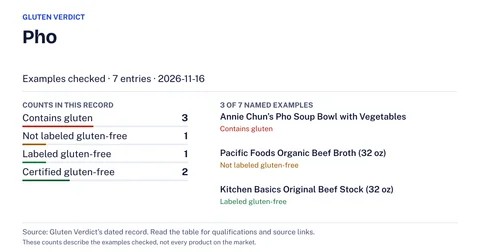 PhoDepends on the product3 of 7 products we checked contain gluten: Annie Chun’s Pho Soup Bowl with Vegetables, Lee Kum Kee Hoisin Sauce (jar), and Kikkoman Hoisin Sauce (9.3 oz)checked Nov 16, 2026
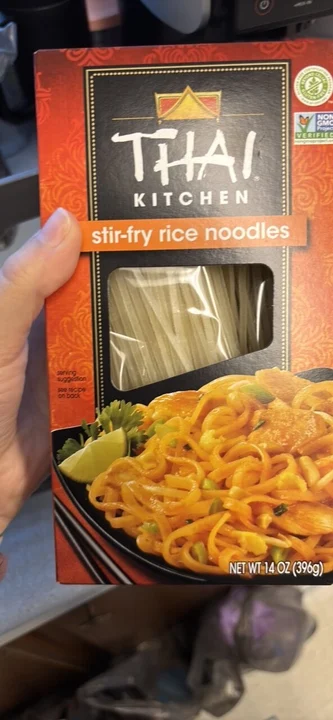 Rice noodlesNaturally gluten-free2 of 9 products we checked contain gluten: Annie Chun’s Pad Thai Noodle Bowl with Vegetables and Annie Chun’s Pho Soup Bowl with VegetablesBuy it labeled gluten-freechecked Nov 16, 2026
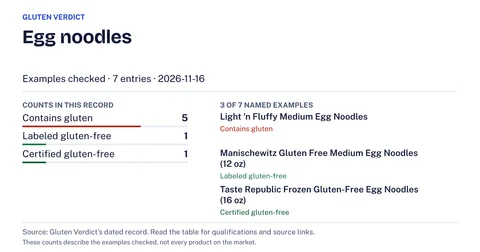 Egg noodlesContains glutenchecked Nov 16, 2026
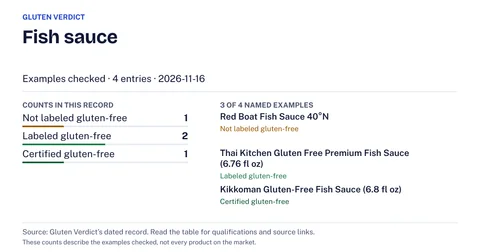 Fish sauceDepends on the productchecked Nov 16, 2026
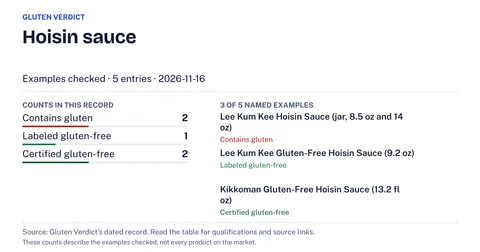 Hoisin sauceDepends on the product2 of 5 products we checked contain gluten: Lee Kum Kee Hoisin Sauce (jar, 8.5 oz and 14 oz) and Kikkoman Hoisin Sauce (9.3 oz)checked Nov 16, 2026
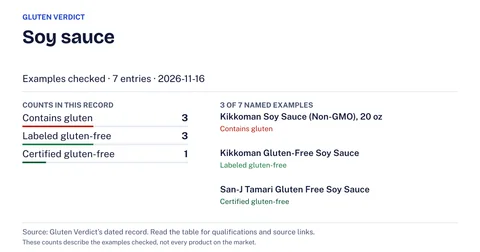 Soy sauceDepends on the product3 of 7 products we checked contain gluten: Kikkoman Soy Sauce (Non-GMO), 20 oz; San-J Organic Shoyu Soy Sauce; and Lee Kum Kee Premium Soy Sauce (No Preservatives Added)checked Nov 16, 2026
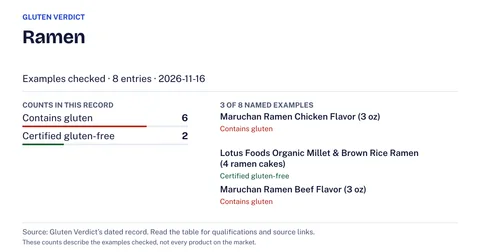 RamenContains glutenchecked Nov 16, 2026
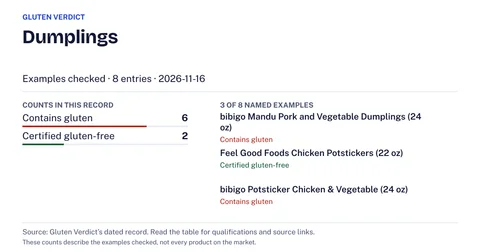 DumplingsContains glutenchecked Nov 16, 2026
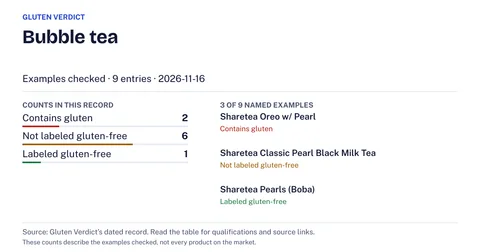 Bubble teaDepends on the product2 of 9 products we checked contain gluten: Sharetea Oreo w/ Pearl and Kung Fu Tea Oreo toppingchecked Nov 16, 2026
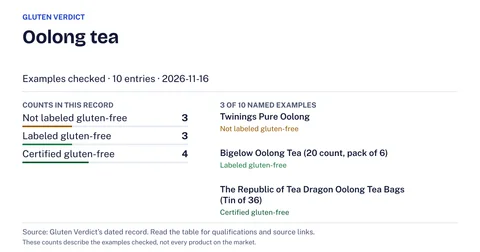 Oolong teaDepends on the productchecked Nov 16, 2026
Questions people ask
Does Malaysia’s rule count oat as a gluten cereal?
Malaysia’s list of ingredients known to cause hypersensitivity reads “cereal containing gluten including wheat, rye, barley and oat”8.
Is fish sauce gluten free?
Red Boat says its fish sauces contain no wheat or wheat by-products11, and Thai Kitchen’s page lists anchovy, sea salt, water and sugar13. Read the ingredient list of the bottle in front of you.
Is a rice-noodle soup always free of gluten?
The Celiac Disease Foundation says rice noodles are gluten free16, but it lists soy sauce among foods that may contain gluten18, so a seasoning or sauce in the bowl is a separate question.
Do these countries have a gluten-free claim rule?
We did not read a claim rule for any of the five. The Malaysian regulations text we searched has no such provision9, and BPOM’s label page links a separate download headed “Klaim gluten” that we did not read22. For countries where we did find one, see labeling rules by country.
More in Travel: Asia and the Middle East
 Eating gluten-free in Thailand: sauces, noodles and street stallsWhere wheat shows up in Thai sauces, noodles and street food, how Thailand words its own gluten-free rule, and the Thai words to look for on a pack.
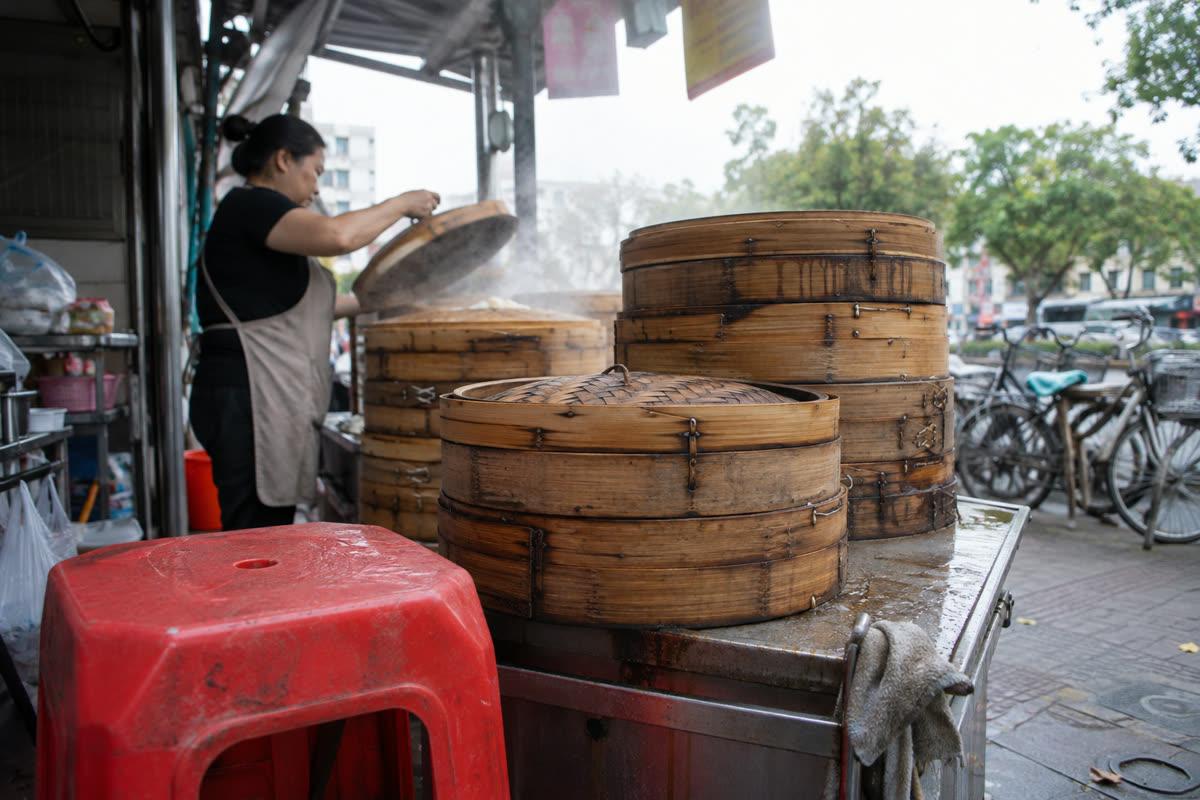 Gluten-free in China: wheat staples, sauces, hot pot and the label rulesWhere wheat sits in Chinese staples, sauces and hot-pot bases, what China’s label standard requires, and the Chinese words it prints for wheat and gluten.
 Gluten-free in Singapore: hawker noodles, soya sauce and the new label ruleWhich Singapore hawker noodles are rice and which wheat, where soya and oyster sauce come in, and what the Food Agency's gluten-free label means.
 Gluten-free in South Korea: where wheat and barley turn up at a Korean tableWhere wheat and barley turn up in Korean food: marinades, ganjang, doenjang, gochujang, noodles, barley tea, and what a Korean label says.
 Gluten-free in Hong Kong: dim sum wrappers, noodles, sauces and the packet labelSort Hong Kong dim sum, noodle-shop and sauce choices by wrapper, noodle and ingredient, and read what a Hong Kong packet must name.
 What “gluten-free” means on a pack in Asia, country by countryWhat a gluten-free claim requires in six Asian countries, what Japan, Hong Kong, Taiwan and China print instead, and how to read a pack in hand.
Related guides
 Soy, hoisin, oyster, teriyaki and fish sauce: which bottles carry wheatSoy, hoisin, oyster, teriyaki and fish sauce compared by the ingredient lists of Kikkoman, Lee Kum Kee, San-J and Red Boat, plus what to ask at a counter.
 Gluten-free labeling rules by country: ceilings, claim wording and where no rule was foundLook up the gluten-free limit and claim wording for the US, Canada, EU, UK, Australia, New Zealand and more, each figure tied to the page we read.
 Gluten-free dining cards in other languages: where the wording comes fromWhich gluten-free card wording comes from EU law or a celiac society, which cards are members-only, and how to hand one to a server.
 Festival foods and gluten: where wheat enters and what to ask the cookWhere wheat enters South Asian and East Asian festival meals, what the sources leave out for Ramadan and Eid, and what to ask a host or sweet shop.
Sources
- [1, 2] Taiwan Food and Drug Administration, Regulations Governing Food Allergen Labeling on the Recommended Labeling Allergens (Taiwan FDA), checked Nov 17, 2026.
- [3, 4, 5, 6, 22] Badan Pengawas Obat dan Makanan (BPOM, Indonesia), Processed-food label rules: allergen statement (Indonesian), checked Nov 17, 2026.
- [7, 8, 9] Ministry of Health Malaysia, Food Regulations 1985, consolidated copy updated until August 2026: Regulation 11, checked Nov 17, 2026.
Searched the text of the Food Regulations 1985 PDF (updated until August 2026) on 2026-11-17 for “gluten-free”, “gluten free”, “free from gluten” and “low gluten”: no match. The only mentions of gluten are the hypersensitivity list in Regulation 11(5) and Regulation 45 on gluten wheat flour. The separate Schedules file was not read.
- [10] Department of Health, Philippines (file hosted by the Philippine FDA), Administrative Order No. 2014-0030: Revised Rules and Regulations Governing the Labeling of Prepackaged Food Products, section 9, checked Nov 17, 2026.
Read on 2026-11-17: the file is a scanned PDF with no text layer, read by optical character recognition. Section 9, “Food Allergen Information”, says allergen information shall be indicated directly below the List of Ingredients, with examples of a “Contains food allergen” line and of “may contain” and “Manufactured in equipment that processes” expressions. It then lists ingredients known to cause hypersensitivity that shall always be declared, the first being “Cereal containing gluten, i.e. wheat, rye, barley, oat, spelt or their hybridized strain and products of these”, followed by crustaceans, eggs, fish, peanuts and soybeans, milk, tree nuts, and sulphite at 10 mg/kg or more.
- [11, 12] Red Boat Fish Sauce, Red Boat FAQs: gluten-free question, checked Nov 17, 2026.
- [13] McCormick (Thai Kitchen), Thai Kitchen Gluten Free Premium Fish Sauce, 6.76 fl oz, checked Nov 17, 2026.
- [14] Lee Kum Kee (USA), Premium Soy Sauce (No Preservatives Added), checked Nov 17, 2026.
- [15] Kikkoman USA, Soy Sauce (Non-GMO), checked Nov 17, 2026.
- [16, 17, 18, 19, 20] Celiac Disease Foundation, Sources of Gluten: noodles, checked Nov 17, 2026.
- [21] Nissin Foods (US), Nissin Foods FAQ: gluten-free products, checked Nov 17, 2026.