Gluten-free in South Korea: where wheat and barley turn up at a Korean table
Short answer
In Japanese and Korean food, the Celiac Disease Foundation lists rice, seafood and meat as naturally gluten-free and warns that most sauces will contain soy sauce (wheat)1. Whether a paste or a noodle carries wheat depends on the brand and the recipe2, 3, 7, 9, so check four things:
- The sauce on or beside the dish: soy-sauce marinades, soybean paste, chili paste and ssamjang, which on the Sempio and bibigo pages we read list wheat in their regular versions2, 4, 5, 6, 25.
- The noodles and the batter: wheat flour in a Nongshim ramyun and a Sempio pancake mix, while Sempio’s glass noodles name no wheat7, 8, 9.
- The pack: MFDS’s allergen list names wheat but not barley or rye, and its English texts give conditions for the “Gluten Free” phrase10, 11, 12.
- Barley tea, which the Gluten Intolerance Group says should be avoided because it contains gluten13.
- Gluten-free limit
- Below 20 mg of gluten per kg for a food to be labelled “Gluten Free”, in the June 2016 English text of MFDS’s labeling standards12; the 2014 English edition says less than 20 mg/kg11
Part of Travel: Asia and the Middle East, 12 guides

Key points
- Soy sauce is one route for wheat: GIG says the marinade for its Korean beef barbecue includes it14, and FDA says soy sauce is ordinarily made by fermenting soybeans and wheat, though some is not15.
- One maker’s shelf shows the split: Sempio’s regular doenjang lists wheat powder, its gluten-free doenjang lists no wheat, and its soup soy sauce lists water, soybean, salt and spirits2, 3, 16.
- A “vegan” label does not settle it: Sempio’s vegan gochujang lists wheat extract and a soy seasoning with wheat gluten17.
- MFDS’s allergen list names wheat; barley and rye are not on it10.
- MFDS’s two English texts of its “Gluten Free” rule name different grains (wheat, barley or rye in the 2014 edition; wheat, rye and oats in the June 2016 text), and both say the Korean version prevails11, 12, 18, 19.
What a Korean table gives you to work with
The Gluten Intolerance Group (GIG) names two hallmarks of Korean cuisine: numerous side dishes called banchan, and kimchi at virtually all meals20. Banchan are small dishes served with rice and with most meals, some fermented, pickled or salted21. That is many small dishes to check, and GIG’s advice is to confirm the gluten-free status of each banchan22.
The Celiac Disease Foundation (CDF) groups Japanese and Korean food: rice, seafood and meat are naturally gluten-free, but most sauces will contain soy sauce (wheat), and it suggests asking for tamari if available1. GIG’s closing advice on Korean food is to check that noodles, sauces and marinades are entirely gluten-free, because wheat- and barley-based ingredients can be used in almost any Korean dish23.
Grilled meat: the marinade, the dip and the grill
The meat is one question and what is done to it is another. GIG says the marinade for its Korean beef barbecue (bulgogi) includes soy sauce, so confirm its status or substitute tamari14. Maker pages show what that looks like: Sempio’s kalbi sauce, sold as a marinade for beef short ribs, lists naturally brewed soy sauce containing wheat24, 25, and bibigo’s original Korean BBQ sauce lists soy sauce made from water, soybeans, wheat and salt26. Ask whether the cut you are ordering is marinated, and in what. Our soy sauce verdict lists the bottles we read.
The paste in the lettuce wrap counts too. Sempio describes its regular ssamjang as a dipping paste for lettuce wraps and grilled meats27, and its list starts with water, wheat flour, corn syrup and soybeans and includes wheat6. For bossam, a pork dish served with a dipping sauce, GIG says to confirm the gluten-free status of the broth the pork is cooked in as well as the dipping sauce28.
The grill is a third question. GIG’s restaurant questions include: is the grill used to cook gluten-free foods separate or shared with gluten foods, and if shared, how is it cleaned and how often29? At a table grill, ask the same thing in your own words. Our eating out guide covers shared surfaces.
Ganjang, doenjang and gochujang: traditional, commercial and gluten-free
Soy sauce, soybean paste and chili paste are where the label matters most, because the sources we read describe both grain-free and wheat versions. FDA’s baseline for soy sauce in general is that it is ordinarily made by fermenting soybeans and wheat, though some soy sauces are not made using wheat15.
Ganjang (soy sauce)
A 2016 review in Frontiers in Microbiology describes ganjang as prepared from soybean blocks called meju30, which are dried and then fermented in a clay pot mixed with salt and water31. No grain appears in that description. A bottle may differ. On Sempio’s global store, Soy Sauce 501 lists water, defatted soybean, salt and wheat among its ingredients4, while its Soy Sauce for Soup (Chosun), described as traditional Korean guk-ganjang for clear soups and vegetable sides32, lists water, soybean, salt and spirits16. The list does not say what the spirits are made from, so that bottle still needs a question to the maker. The same store sells a soy sauce it labels gluten-free, listing water, soybeans, salt and alcohol33, 34.
Doenjang (soybean paste)
The same review says doenjang is produced by fermenting cooked, crushed soybean seeds or blocks of meju35, with no grain named in that description, and that commercially made doenjang differs in quality with, among other things, the basic ingredients used, such as soybeans or a combination of soybeans and grains36. It does not say which grains. Sempio’s regular doenjang lists wheat powder2; its gluten-free doenjang lists water, soybeans, salt, alcohol and koji-starter3 and carries a gluten-free label37.
Gochujang (chili paste)
The review describes gochujang as a fermented paste of red chili powder, glutinous rice powder, pureed soybeans and salt, with seasonings such as garlic and onion38. GIG describes a wider range: gochujang usually contains wheat or barley but may also be made using rice, and gluten-free gochujang is available but may not be served in most restaurants39. The labels we read show both ends:
| Product | What its ingredient list shows |
|---|---|
| Sempio regular doenjang | Lists wheat powder2 |
| Sempio gluten-free doenjang | Lists water, soybeans, salt, alcohol and koji-starter3; the maker labels it gluten-free37 |
| Sempio vegan gochujang | Lists wheat extract and a soy seasoning containing wheat gluten17 |
| Sempio gluten-free gochujang | Lists rice, red pepper powder and rice powder, with no wheat, barley or rye named40; the maker labels it gluten-free41 |
| bibigo gochujang (US) | Lists wheat flour, wheat and wheat koji5 |
GIG says Korean stews may be seasoned with gochujang, fermented miso and sesame oil42; our miso verdict shows what we read in miso. These lists come from Sempio’s global store and bibigo’s US site, so a tub in a Seoul supermarket needs its own label read.
Dish by dish: the usual wheat carrier
Each row names the wheat carrier that the sources we read point to in that dish, not every possible one.
| Dish | Usual carrier | What we read |
|---|---|---|
| Bibimbap (rice with vegetables, often meat, plus an egg) | The gochujang, and soy sauce in the meat | GIG says bibimbap usually contains gochujang44, which usually contains wheat or barley39. In bibigo’s US bibimbap bowl the hot pepper paste lists wheat flour and wheat45 and the beef lists soy sauce with wheat46. A plain bibigo rice bowl lists water, rice and glucono-delta-lactone47. |
| Japchae (stir-fried glass noodles) | The soy sauce seasoning, not the noodles | Sempio’s glass noodles, described as essential for japchae48, list tapioca starch and sweet potato starch and name no wheat9; its japchae sauce lists soy sauce with wheat and wheat extract49. |
| Scallion, seafood and kimchi pancakes | The batter | Sempio’s vegetable pancake mix is described as simplifying scallion, seafood and kimchi pancakes50 and lists wheat flour first8. |
| Tteokbokki (rice cakes in chili sauce, a street food) | The sauce | bibigo’s tteokbokki lists rice flour, salt and sunflower oil for the rice cakes51, but its sauce includes soy sauce containing wheat52; Sempio’s tteokbokki sauce lists gochujang with wheat53. GIG’s note: make sure soy sauce or other gluten-containing ingredients are not used54. |
| Gimbap (seaweed rice roll) | Seasoned fillings | bibigo’s bulgogi and vegetable gimbap lists seasoned burdock with brewed soy sauce containing wheat55. |
| Mandu (dumplings) | The wrapper | bibigo’s pork and vegetable mandu lists a dough of wheat flour, water, modified tapioca starch, wheat gluten, soybean oil and salt56. See our dumplings verdict. |
| Ramyun (noodles in soup) | The noodles and the seasoning | Nongshim’s Shin Ramyun Original lists enriched wheat flour7 and hydrolyzed wheat protein57 and says it contains wheat and soy58. CDF says to avoid udon or ramen noodles, which are made with wheat59. See our ramen verdict and hydrolyzed vegetable protein. |
| Noodle dishes in general | Wheat noodles | GIG says noodle dishes could be made using wheat, buckwheat or glass noodles made from vegetable starch, that wheat noodles are most used, and that you should always ask about the noodles60. |
| Stews (jjigae) | The paste in the broth | GIG says stews may be seasoned with gochujang, fermented miso and sesame oil42. |
| Kimchi | Flour in the paste, soy sauce, or fish sauce | GIG says some kimchi contains flour, traditionally rice flour61, and that soy sauce could be used though it is not traditional62. bibigo’s Korean-style napa cabbage kimchi lists napa cabbage, radish, red pepper powder, fish sauce and other ingredients, and no gluten grain63. See our kimchi verdict and fish sauce verdict. |
The bibigo and Sempio rows are products sold in the US; bibigo’s page says its information may vary in other countries43. They show what commercial versions of these dishes list, not what a particular Seoul kitchen uses.
Barley: tea, and the grain no allergen box names
GIG’s Korean-cuisine page lists barley tea as a popular Korean beverage that should be avoided because it contains gluten13. FDA names barley with wheat and rye as gluten-containing grains64; our barley verdict lists the barley products we checked.
Barley is easy to miss on a Korean pack because MFDS’s allergen list names wheat and does not name barley or rye10. A pack with barley in it would have no wheat entry to flag it, so the ingredient list is where barley shows. That is our reading of the list, not an MFDS statement.
Reading a Korean pack: the allergen box and the shared-line warning
MFDS, South Korea’s food and drug regulator, lists the foods that call for allergen labeling: eggs from poultry, milk, buckwheat, peanuts, soybeans, wheat, mackerel, crab, shrimp, pork, peach, tomato, sulfurous acid above a limit, walnuts, chicken, beef, squid, clams and pine nut65. Barley and rye are not on that list10.
The page describes the method as a separate allergen statement near the ingredient names, on a different background color, with the example “This product contains wheat and milk”66.
A second warning covers cross-contact. The June 2016 English text of MFDS’s labeling standards says that where there is an unavoidable chance of materials getting mixed because products with and without allergens go through the same manufacturing process, precautions shall be indicated; its example names buckwheat67. That warning is about the factory line, not a gluten test.
Since the list does not name barley or rye, a Korean allergen statement that does not name wheat says nothing about them10. For the US label, see how to read a US food label.
What “Gluten Free” means on a Korean pack
MFDS publishes English texts of its labeling standards, and the two we read give different grain lists for the phrase. The older English edition, which lists revisions through February 12, 201468, says that if a product does not use wheat, barley or rye and its gluten is less than 20 mg/kg, the phrase “Gluten Free” can be used11. The text dated June 13, 201669 says foods that do not use wheat, rye, oats and their hybrids as ingredients and whose total gluten is below 20 mg/kg, or that use those grains after removing gluten so the total is below 20 mg/kg, shall be labelled as “Gluten Free”12.
| English text | Grains named | Gluten limit | Oats |
|---|---|---|---|
| Edition revised through February 12, 201468 | Wheat, barley, rye11 | Less than 20 mg/kg11 | Not mentioned70 |
| Text dated June 13, 201669 | Wheat, rye, oats and their hybrids; the word “barley” does not appear in the text12, 71 | Below 20 mg/kg12 | Named among the grains12 |
Both texts say the Korean version prevails over the English18, 19. We cannot tell from the English which grain list the current Korean notice uses, so we do not state one. On a pack, treat the phrase as the maker’s claim under the Korean rule and read the ingredient list too.
A 2026 review in Critical Reviews in Food Science and Nutrition goes the other way. Its abstract says that in other countries, such as China, South Korea and Colombia, there are no regulations for gluten labeling yet, although there is legislation for the labeling of allergens, including wheat, rye, barley and oats72. The abstract does not say which of those allergens South Korea lists. The MFDS page we read lists wheat and not barley, rye or oats10. We report the disagreement rather than choose between the sources.
Questions to ask, in plain English
CDF suggests carrying celiac disease language cards and says they can help when discussing dietary restrictions with restaurant staff in foreign countries73. We found no Korean translation on a regulator, charity or maker page we could cite, so the questions below are in English; the translation is left to a card or app you trust.
- Is the meat marinated? In what, and does the marinade contain soy sauce?
- Is there soy sauce, soybean paste or chili paste in this dish or in the dip?
- Are the noodles, the dumpling wrapper or the batter made with wheat flour?
- Is there barley in the tea, the rice or the soup?
- Is the grill used for my food separate from the one used for marinated meat, and if shared, how is it cleaned?29
Name the ingredients to avoid (wheat, soy sauce, barley), not only the word celiac.
What we could not confirm
- Which grain list the current Korean “Gluten Free” notice uses: the two English texts differ and both defer to the Korean version18, 19. The newest English text we could open is dated June 13, 201669.
- Whether ganjang, doenjang and gochujang sold in Korea match the US-store pages above: bibigo’s page says its product information may vary in other countries43.
- Barley-mixed rice, and rice balls and gimbap sold at convenience stores: we found no regulator, charity or maker page in English to cite. The gimbap row above is a US maker’s product, not a Korean convenience store’s.
- What barley tea contains by brand: we found no maker or laboratory page, so the guide repeats GIG’s advice and does not describe the cup13.
Everything above was read on 2026-11-17. Recipes and labels change, and the package in your hand has the final word.
Verdicts in this guide
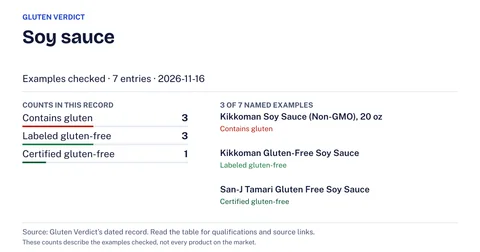 Soy sauceDepends on the product3 of 7 products we checked contain gluten: Kikkoman Soy Sauce (Non-GMO), 20 oz; San-J Organic Shoyu Soy Sauce; and Lee Kum Kee Premium Soy Sauce (No Preservatives Added)checked Nov 16, 2026
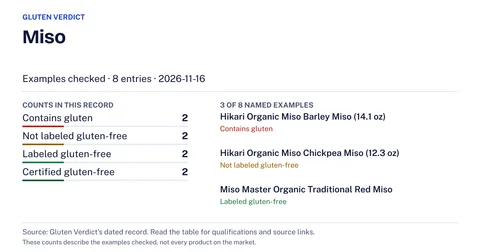 MisoDepends on the product2 of 8 products we checked contain gluten: Hikari Organic Miso Barley Miso (14.1 oz) and Hikari Miso Soup Akadashi (12 servings, 7.0 oz)checked Nov 16, 2026
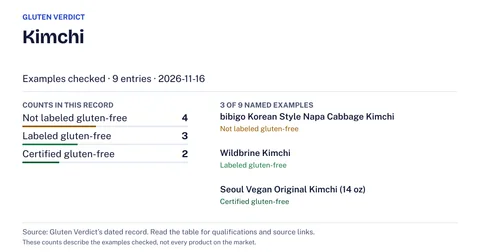 KimchiDepends on the productchecked Nov 16, 2026
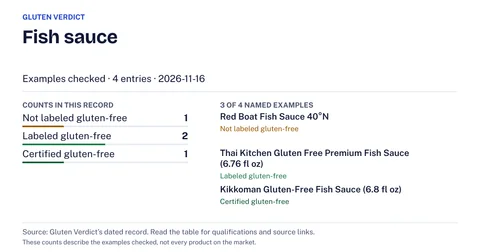 Fish sauceDepends on the productchecked Nov 16, 2026
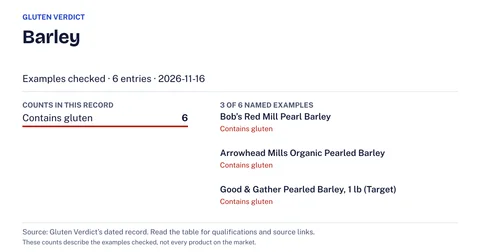 BarleyContains glutenchecked Nov 16, 2026
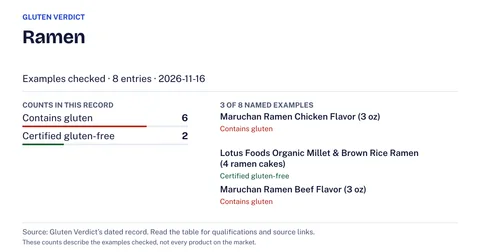 RamenContains glutenchecked Nov 16, 2026
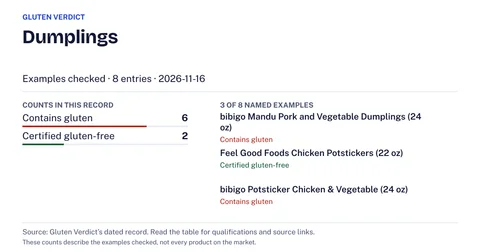 DumplingsContains glutenchecked Nov 16, 2026
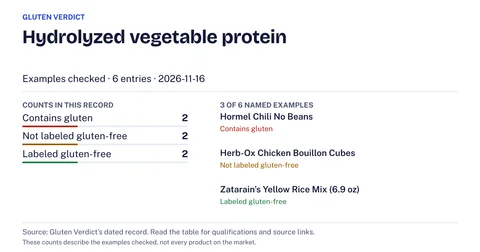 Hydrolyzed vegetable proteinDepends on the product2 of 6 products we checked contain gluten: Hormel Chili No Beans and Pioneer Brown Gravy Mix (1.61 oz)checked Nov 16, 2026
Questions people ask
Is Korean soy sauce gluten-free?
It depends on the bottle. FDA says soy sauce is ordinarily made by fermenting soybeans and wheat, and some is not15. On Sempio’s pages, Soy Sauce 501 lists wheat4 and its soup soy sauce lists water, soybean, salt and spirits16.
Is gochujang gluten-free?
Not by default. GIG says gochujang usually contains wheat or barley but may be made using rice39. The lists we read run from wheat flour in bibigo’s to rice in Sempio’s gluten-free one5, 40.
Does South Korea have a rule for the phrase “Gluten Free”?
MFDS’s English texts give conditions for it, including less than 20 mg/kg11, 12; a 2026 review abstract says South Korea is among countries with no regulations for gluten labeling yet72. The sources disagree, and the Korean version prevails over the English19.
Is barley tea gluten-free?
GIG advises avoiding it because it contains gluten13.
More in Travel: Asia and the Middle East
 Gluten-free in Japan: soy sauce, miso, barley tea and the allergen boxWhat to check in Japan: wheat in soy sauce, barley in miso and barley tea, and what the Japanese allergen box covers and leaves out.
 Gluten-free in Vietnam, the Philippines, Malaysia, Indonesia and Taiwan: sauces, noodles and label rulesWhere wheat enters a Southeast and East Asian meal, what four regulators print about gluten cereals, and the one country whose rule we could not read.
 What “gluten-free” means on a pack in Asia, country by countryWhat a gluten-free claim requires in six Asian countries, what Japan, Hong Kong, Taiwan and China print instead, and how to read a pack in hand.
 Gluten-free in China: wheat staples, sauces, hot pot and the label rulesWhere wheat sits in Chinese staples, sauces and hot-pot bases, what China’s label standard requires, and the Chinese words it prints for wheat and gluten.
 Eating gluten-free in Thailand: sauces, noodles and street stallsWhere wheat shows up in Thai sauces, noodles and street food, how Thailand words its own gluten-free rule, and the Thai words to look for on a pack.
 Gluten-free in Hong Kong: dim sum wrappers, noodles, sauces and the packet labelSort Hong Kong dim sum, noodle-shop and sauce choices by wrapper, noodle and ingredient, and read what a Hong Kong packet must name.
Related guides
 Miso, gochujang and other fermented pastes: where barley and wheat are usedHow to pick a miso or gochujang jar: read the koji grain, the full ingredient list and the maker’s gluten-free statement.
 Soy, hoisin, oyster, teriyaki and fish sauce: which bottles carry wheatSoy, hoisin, oyster, teriyaki and fish sauce compared by the ingredient lists of Kikkoman, Lee Kum Kee, San-J and Red Boat, plus what to ask at a counter.
 Gluten-free dining cards in other languages: where the wording comes fromWhich gluten-free card wording comes from EU law or a celiac society, which cards are members-only, and how to hand one to a server.
 Eating out with celiac disease: what to check, ask and watch forPlan a restaurant meal with celiac disease: what to check before you go, the questions to ask in order, how to read the answers, and what studies measured.
Sources
- [1, 59, 73] Celiac Disease Foundation, Tips for Traveling Gluten-Free, checked Nov 17, 2026.
- [2] Sempio (global store), Doenjang Regular, checked Nov 17, 2026.
- [3, 37] Sempio (global store), Doenjang Gluten Free, checked Nov 17, 2026.
- [4] Sempio (global store), Soy Sauce 501, checked Nov 17, 2026.
- [5, 43] bibigo (CJ Foods, US), Gochujang Korean Hot Pepper Paste, checked Nov 17, 2026.
- [6, 27] Sempio (global store), Ssamjang Regular, checked Nov 17, 2026.
Read on 2026-11-17: the page describes the product as a Korean ssamjang dipping paste for lettuce wraps, grilled meats, veggies, grain bowls and sandwiches, sold in a 14 kg food-service barrel.
- [7, 57, 58] Nongshim USA, Shin Ramyun Original, checked Nov 17, 2026.
- [8, 50] Sempio (global store), Vegetable Pancake Mix, checked Nov 17, 2026.
- [9, 48] Sempio (global store), Glass Noodles, checked Nov 17, 2026.
- [10, 65, 66] Ministry of Food and Drug Safety (South Korea), Food labeling system (allergen list and labeling method), checked Nov 17, 2026.
Read on 2026-11-17: the list after “Foods for Allergen Labeling:” names eggs (poultry only), milk, buckwheat, peanuts, soybeans, wheat, mackerel, crab, shrimp, pork, peach, tomato, sulfurous acid, walnuts, chicken, beef, squid, clams and pine nut. Barley, rye and oats are not on it.
- [11, 18, 68, 70] Ministry of Food and Drug Safety (South Korea), Foods Labeling Standards, English edition, checked Nov 17, 2026.
Read the PDF on 2026-11-17: the word “oats” does not appear anywhere in its text, including the “Gluten Free” provision.
- [12, 19, 67, 69, 71] Ministry of Food and Drug Safety (South Korea), Foods Labelling Standards, English text of June 13, 2016 (hosted on FAO FAOLEX), checked Nov 17, 2026.
Read the PDF on 2026-11-17: the word “barley” does not appear anywhere in its text, including the allergen list and the “Gluten Free” provision.
- [13, 14, 20, 21, 22, 23, 28, 39, 42, 44, 54, 60, 61, 62] Gluten Intolerance Group, Gluten-Free Korean Cuisine, checked Nov 17, 2026.
- [15, 64] US Food and Drug Administration, Questions and Answers on the Gluten-Free Food Labeling Final Rule, checked Nov 17, 2026.
- [16, 32] Sempio (global store), Soy Sauce for Soup, Chosun, checked Nov 17, 2026.
Read on 2026-11-17: the page describes the product as traditional Korean guk-ganjang made for clear soups and vegetable sides.
- [17] Sempio (global store), Gochujang Vegan, checked Nov 17, 2026.
- [24, 25] Sempio (global store), Kalbi Sauce, checked Nov 17, 2026.
- [26] bibigo (CJ Foods, US), BBQ Sauce Original (16.9 oz), checked Nov 17, 2026.
- [29] Gluten Intolerance Group, What are some of the most important questions to ask in a restaurant?, checked Nov 17, 2026.
- [30, 31, 35, 36, 38] Frontiers in Microbiology (PubMed Central, 2016), Kimchi and Other Widely Consumed Traditional Fermented Foods of Korea: A Review, checked Nov 17, 2026.
- [33, 34] Sempio (global store), Soy Sauce Gluten-Free, checked Nov 17, 2026.
- [40, 41] Sempio (global store), Gochujang Gluten Free, checked Nov 17, 2026.
- [45, 46] bibigo (CJ Foods, US), Beef & Vegetable Bibimbap Rice Bowl, checked Nov 17, 2026.
- [47] bibigo (CJ Foods, US), Korean Style Cooked Sticky White Rice Bowl (6 Pack), checked Nov 17, 2026.
- [49] Sempio (global store), Japchae Sauce, checked Nov 17, 2026.
- [51, 52] bibigo (CJ Foods, US), Tteokbokki Sweet & Spicy Rice Cakes, checked Nov 17, 2026.
- [53] Sempio (global store), Tteokbokki Sauce Sweet & Spicy, checked Nov 17, 2026.
- [55] bibigo (CJ Foods, US), Korean Bulgogi & Vegetable Gimbap Seaweed Rice Roll, checked Nov 17, 2026.
- [56] bibigo (CJ Foods, US), Mandu Pork and Vegetable Dumplings (24 oz), checked Nov 17, 2026.
- [63] bibigo (CJ Foods, US), Korean-Style Napa Cabbage Kimchi - 16oz, checked Nov 17, 2026.
- [72] PubMed (Critical Reviews in Food Science and Nutrition, 2026), Review of international gluten-free labeling regulations (abstract), checked Nov 17, 2026.