Gluten words on European food labels, language by language
Short answer
On a pack under EU rules, the gluten cereals (wheat, rye, barley, oats and their hybrids) are named in the ingredient list and set apart by font, style or background colour2, 3. A “gluten-free” statement means no more than 20 mg/kg of gluten in the food as sold to the final consumer38, the same figure in each of the 11 language versions we read39, 40, 41, 42, 43, 44, 45, 46, 47, 48.
- Find the ingredient list by its heading word, such as “ingredients”, “ingrédients”, “Zutaten” or “ingredienti”7, 8, 12, 14.
- Look for the one word that stands out in bold, capitals or another typeface, and compare it with the cereal table2.
- If there is no ingredient list, look for the “contains” word and the cereal after it5.
- Read the claim wording from the claim table, for example “sans gluten”, “sin gluten”, “glutenfrei” or “senza glutine”39, 40, 41, 42; “gluten-free” is the statement tied to the 20 mg/kg limit38.
Part of Travel: Europe, 19 guides
Key points
- Under the EU rule the gluten cereals are wheat (such as spelt and khorasan wheat), rye, barley, oats and their hybridised strains, and products thereof, with four listed exceptions3, 4.
- The name is emphasised in the ingredient list by font, style or background colour2.
- The “gluten-free” statement has the same 20 mg/kg limit in every language version we read38.
- “May contain” lines are precautionary labelling that businesses may use52.
What an EU pack has to show
In the EU, cereals containing gluten are one of 14 allergens that must be clearly indicated when they are used as ingredients in food sold there1. On a food with an ingredient list, the name has to be emphasised through a typeset that clearly distinguishes it from the rest of the list, for example by means of the font, style or background colour2. That is the rule to hunt for on a pack: one word in the ingredient list that looks different from the words around it.
The name comes from Annex II of Regulation (EU) No 1169/2011. Its gluten entry reads “Cereals containing gluten, namely: wheat (such as spelt and khorasan wheat), rye, barley, oats or their hybridised strains, and products thereof”, followed by exceptions3. The consolidated text of 1 April 2025 carries the same entry64. The exceptions are wheat-based glucose syrups including dextrose, wheat-based maltodextrins, glucose syrups based on barley, and cereals used for making alcoholic distillates4.
Two more rules shape what you see. Where there is no ingredient list, the indication includes the word “contains” followed by the name5. And the indication is not required where the name of the food clearly refers to the substance or product concerned6, so on a pack whose food name is itself the grain, the grain may appear without a separate indication.
The exceptions are a rule about allergen labelling, not a gluten-free verdict. For what they mean for the foods we have checked, see our records for maltodextrin and glucose syrup.
Finding the ingredient list and the “contains” word
The EU rule says the list of ingredients is headed or preceded by a heading that consists of or includes the word “ingredients”7, so the heading can carry extra words. Each row below takes the word from that language version of the regulation, and the “contains” word from the sentence about packs with no ingredient list.
| Language | Word in the list heading | “Contains” word (no ingredient list) |
|---|---|---|
| English7 | ingredients | contains5 |
| French8 | ingrédients | contient9 |
| Spanish10 | ingredientes | contiene11 |
| German12 | Zutaten | Enthält13 |
| Italian14 | ingredienti | contiene15 |
| Dutch16 | ingrediënten | bevat17 |
| Portuguese18 | ingredientes | contém19 |
| Swedish20 | ingredienser | innehåller21 |
| Danish22 | ingredienser | indeholder23 |
| Polish24 | składniki | zawiera25 |
| Greek26 | συστατικά | περιέχει27 |
The gluten-cereal names, language by language
Annex II names the cereals once in each language version of the regulation. The table gives those names as that version prints them. The table lists the names the EU text itself uses, so it is a place to start, not a complete dictionary.
| Language | Wheat | Rye | Barley | Oats | Spelt | Khorasan wheat |
|---|---|---|---|---|---|---|
| English3 | wheat | rye | barley | oats | spelt | khorasan wheat |
| French28 | blé | seigle | orge | avoine | épeautre | blé de Khorasan |
| Spanish29 | trigo | centeno | cebada | avena | espelta | trigo khorasan |
| German30 | Weizen | Roggen | Gerste | Hafer | Dinkel | Khorasan-Weizen |
| Italian31 | grano | segale | orzo | avena | farro | grano khorasan |
| Dutch32 | tarwe | rogge | gerst | haver | spelt | khorasantarwe |
| Portuguese33 | trigo | centeio | cevada | aveia | espelta | trigo Khorasan |
| Swedish34 | vete | råg | korn | havre | spelt | khorasanvete |
| Danish35 | hvede | rug | byg | havre | spelt | khorasanhvede |
| Polish36 | pszenica | żyto | jęczmień | owies | orkisz | pszenica khorasan |
| Greek37 | σίτος | σίκαλη | κριθάρι | βρώμη | όλυρα | σίτος khorasan |
In the Italian version the word printed where the English version has spelt is farro: “grano (tra cui farro e grano khorasan)”31. Our verdicts cover spelt, farro and barley, and oatmeal for oats.
The entry ends with “and products thereof” in English3; the other versions carry the matching phrase in their own words28, 29, 30, 31, 32, 33, 34, 35, 36, 37.
The gluten-free claim in each language
The EU allows information on the absence or reduced presence of gluten to be given only through the statements, and under the conditions, set out in the Annex to Implementing Regulation (EU) No 828/201449. Each language version carries its own wording of the “gluten-free” statement:
| Language | Statement |
|---|---|
| English38 | gluten-free |
| French39 | sans gluten |
| Spanish40 | sin gluten |
| German41 | glutenfrei |
| Italian42 | senza glutine |
| Dutch43 | glutenvrij |
| Portuguese44 | isento de glúten |
| Swedish45 | glutenfri |
| Danish46 | glutenfri |
| Polish47 | bezglutenowy |
| Greek48 | χωρίς γλουτένη |
In English the condition is that the food as sold to the final consumer contains no more than 20 mg/kg of gluten38. The other language versions in the table state the same figure in their own words39, 40, 41, 42, 43, 44, 45, 46, 47, 48.
“Very low gluten” and oats
A second statement, “very low gluten”, applies only to a food made from, or containing, ingredients from wheat, rye, barley, oats or their crossbred varieties that were specially processed to reduce the gluten, and it allows no more than 100 mg/kg50. Oats in a food presented as gluten-free or very low gluten must have been specially produced, prepared or processed to avoid contamination by wheat, rye, barley or their crossbred varieties, and the gluten content of those oats cannot exceed 20 mg/kg51.
May-contain lines
The European Commission says that where there is a risk of unintentional presence of allergens through cross-contamination, businesses may use precautionary allergen labelling, such as “may contain” statements, and that such statements must be based on a thorough risk assessment52. The Commission page does not describe such a line as a requirement. It also says Member States monitor compliance with allergen labelling requirements53.
In the EU texts we read we found no set words for such a line in each language, so we give none. One government example is in German. The Swiss federal food office’s label page ends its example ingredient list with the line “Kann Spuren von Haselnüssen und Erdnüssen enthalten”54. If a line like this names a cereal from the table above, read it as the maker flagging a risk of that cereal being present unintentionally52. Our guide on may-contain labels by country covers how the rules differ.
Where the EU rule stops
Regulation 828/2014 is binding in its entirety and directly applicable in all Member States55. A pack from outside the EU is not covered by that sentence, so the words above are a guide to packs sold under EU rules, not to every European shelf.
Switzerland
Switzerland has its own rules, set out on the federal food office’s label page. It says “glutenfrei” may be used only when the product contains at most 20 mg of gluten per kg when sold56. The page lists, among the allergens that must be declared, “glutenhaltige Getreide, namentlich Weizen (Dinkel und Khorasan-Weizen), Roggen, Gerste, Hafer oder deren Hybridstämme”57. They must be clearly highlighted in the ingredient list, for example in bold, capitals or underlined58, and with no ingredient list the note uses the word “Enthält”59.
One more Swiss rule: allergens that are present unintentionally, for example through contamination, must be declared if they can reach certain limits, and below those limits the declaration is voluntary60. The page does not give the limits in that passage.
The crossed-grain symbol across Europe
The Association of European Coeliac Societies (AOECS) says the Crossed Grain Trademark can only be used under licence on food and drink products that meet the AOECS standard61. Its territory page defines the AOECS Territory as the European area where the trademark is administered under the European Licensing System62, and the list of countries on that page includes Bosnia and Herzegovina, Switzerland, Türkiye and the United Kingdom63. The symbol is a licensed mark61; see our guide to gluten-free certification programs, our Turkey guide and our UK labeling guide.
Verdicts in this guide
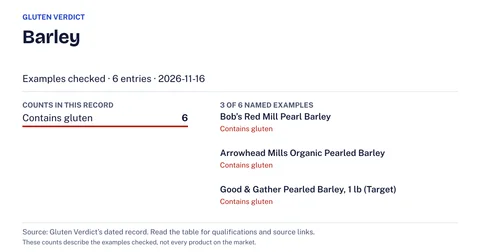 BarleyContains glutenchecked Nov 16, 2026
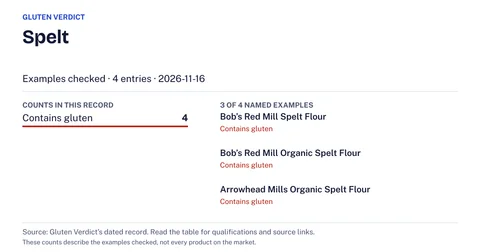 SpeltContains glutenchecked Nov 16, 2026
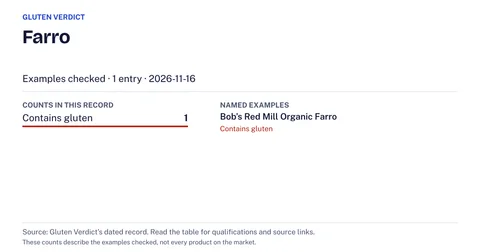 FarroContains glutenchecked Nov 16, 2026
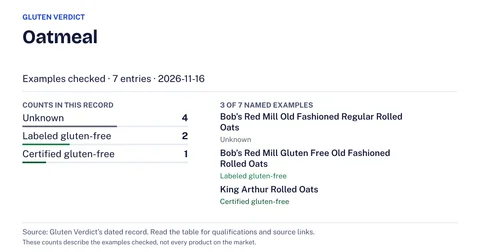 OatmealDepends on the productchecked Nov 16, 2026
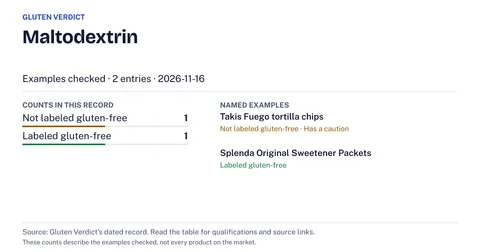 MaltodextrinNaturally gluten-freechecked Nov 16, 2026
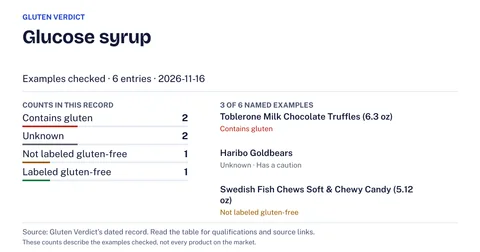 Glucose syrupNaturally gluten-free2 of 6 products we checked contain gluten: Toblerone Milk Chocolate Truffles (6.3 oz) and Darrell Lea Original Black Licorice (7 oz)checked Nov 16, 2026
More in Travel: Europe
 Gluten-free in Scotland: the rule, haggis, oatcakes, pies and whiskyWhat changes in Scotland: who sets the gluten-free rule, how oats count, and how to judge haggis, oatcakes, pies, broth and whisky.
 Gluten-free on a trip through several European countries: borders, trains, hostels and supermarketsA packing and shopping plan for a multi-country Europe trip: what each border lets you carry, what the EU label rule covers, and a check for each stop.
 Gluten-free in Denmark, Sweden, Norway, Finland and IcelandOne rule table for Denmark, Sweden, Norway, Finland and Iceland, with the regulator and society pages, the claim words, oats, rye and licorice.
 Gluten-free in Estonia, Latvia and Lithuania: label words, rye bread and dumplingsHow Estonia, Latvia and Lithuania word gluten-free claims, where rye, barley and wheat sit in local dishes, and which official pages to check.
 Gluten-free in the UK: allergen rules, the Crossed Grain mark and pub and chip-shop foodHow a British pack and menu differ from a US one: the 20 mg/kg rule, 14 allergens, Crossed Grain versus venue accreditation, and chip-shop condiments.
 Gluten-free in Ireland: labels, pub rules, Guinness and the Crossed Grain symbolWhat Irish labels, pub allergen rules and the Crossed Grain symbol say about gluten, and what Guinness lists, so a US traveler knows what to check.
Related guides
 Gluten-free and very low gluten on EU labels, and how allergens are highlightedWhat EU “gluten-free” and “very low gluten” claims permit, how cereals containing gluten are highlighted in ingredient lists, and the rules for loose food.
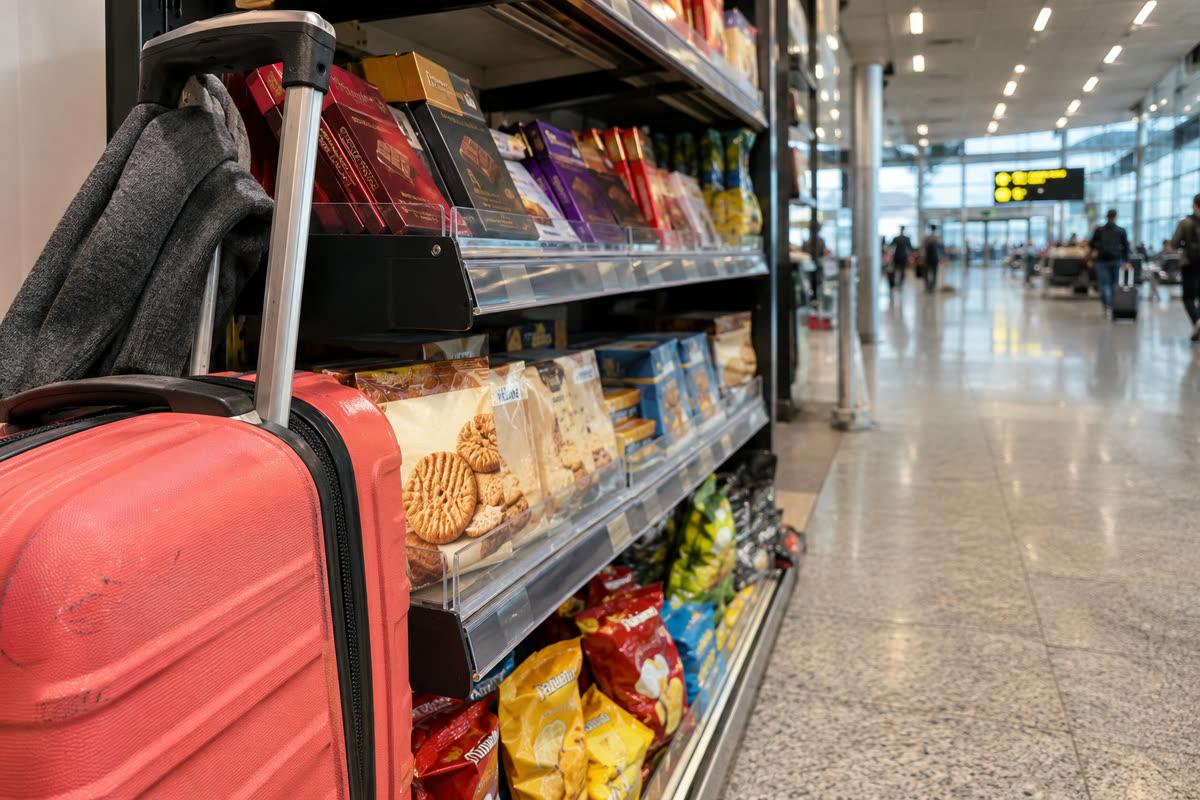 May-contain labels abroad: what each country’s regulator says about themWhether a “may contain” or shared-facility line is required, voluntary or guided by a scheme in the US, UK, EU, Canada, Australia, New Zealand and Codex.
 How to read a US food label for glutenWhere gluten shows up on a US food label: the gluten-free claim, the Contains line, the ingredient list and may-contain lines, and what each means.
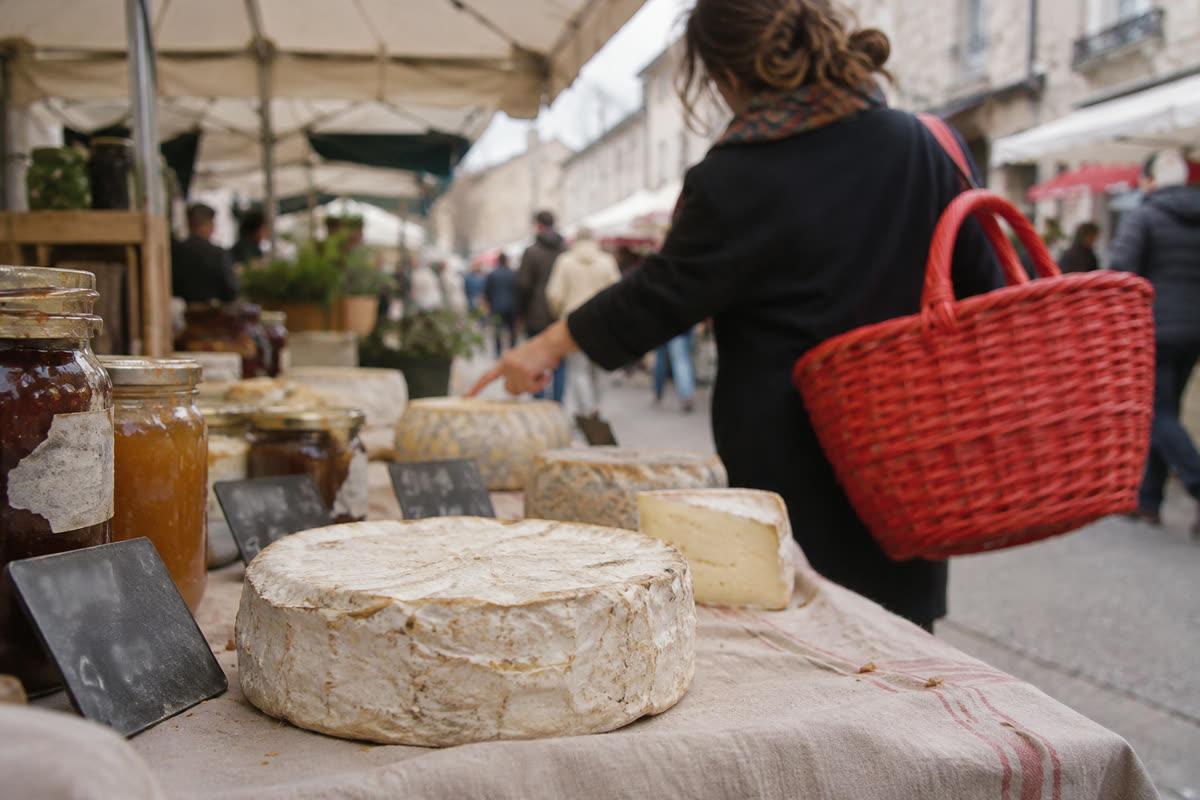 Gluten-free in France: reading a pack, a menu and a “sans gluten” signWhat «sans gluten» means on a French pack, how restaurants must give allergen information, and what a bakery’s “sans gluten” sign does not promise.
Sources
- [1, 52, 53] European Commission, Allergies (campaign page), checked Nov 17, 2026.
Read on 2026-11-17: under “Which allergens must be declared?” the page lists 14 allergens that must be clearly indicated if they are used as ingredients in food products sold in the EU, the first being “Cereals containing gluten” with the note “wheat, rye, barley, oats, etc.”.
- [2, 3, 4, 5, 6, 7] Publications Office of the European Union, Regulation (EU) No 1169/2011 (consolidated 2018-01-01), English version, Article 21(1), checked Nov 17, 2026.
Read on 2026-11-17: Annex II point 1 lists four exceptions after “except:”: (a) wheat based glucose syrups including dextrose; (b) wheat based maltodextrins; (c) glucose syrups based on barley; (d) cereals used for making alcoholic distillates including ethyl alcohol of agricultural origin.
- [8, 9, 28] Publications Office of the European Union, Regulation (EU) No 1169/2011 (consolidated 2018-01-01), French version, Article 18, checked Nov 17, 2026.
- [10, 11, 29] Publications Office of the European Union, Regulation (EU) No 1169/2011 (consolidated 2018-01-01), Spanish version, Article 18, checked Nov 17, 2026.
- [12, 13, 30] Publications Office of the European Union, Regulation (EU) No 1169/2011 (consolidated 2018-01-01), German version, Article 18, checked Nov 17, 2026.
- [14, 15, 31] Publications Office of the European Union, Regulation (EU) No 1169/2011 (consolidated 2018-01-01), Italian version, Article 18, checked Nov 17, 2026.
- [16, 17, 32] Publications Office of the European Union, Regulation (EU) No 1169/2011 (consolidated 2018-01-01), Dutch version, Article 18, checked Nov 17, 2026.
- [18, 19, 33] Publications Office of the European Union, Regulation (EU) No 1169/2011 (consolidated 2018-01-01), Portuguese version, Article 18, checked Nov 17, 2026.
- [20, 21, 34] Publications Office of the European Union, Regulation (EU) No 1169/2011 (consolidated 2018-01-01), Swedish version, Article 18, checked Nov 17, 2026.
- [22, 23, 35] Publications Office of the European Union, Regulation (EU) No 1169/2011 (consolidated 2018-01-01), Danish version, Article 18, checked Nov 17, 2026.
- [24, 25, 36] Publications Office of the European Union, Regulation (EU) No 1169/2011 (consolidated 2018-01-01), Polish version, Article 18, checked Nov 17, 2026.
- [26, 27, 37] Publications Office of the European Union, Regulation (EU) No 1169/2011 (consolidated 2018-01-01), Greek version, Article 18, checked Nov 17, 2026.
- [38, 49, 50, 51, 55] Publications Office of the European Union, Implementing Regulation (EU) No 828/2014 on gluten statements, English version, Annex, checked Nov 17, 2026.
- [39] Publications Office of the European Union, Implementing Regulation (EU) No 828/2014 on gluten statements, French version, Annex, checked Nov 17, 2026.
- [40] Publications Office of the European Union, Implementing Regulation (EU) No 828/2014 on gluten statements, Spanish version, Annex, checked Nov 17, 2026.
- [41] Publications Office of the European Union, Implementing Regulation (EU) No 828/2014 on gluten statements, German version, Annex, checked Nov 17, 2026.
- [42] Publications Office of the European Union, Implementing Regulation (EU) No 828/2014 on gluten statements, Italian version, Annex, checked Nov 17, 2026.
- [43] Publications Office of the European Union, Implementing Regulation (EU) No 828/2014 on gluten statements, Dutch version, Annex, checked Nov 17, 2026.
- [44] Publications Office of the European Union, Implementing Regulation (EU) No 828/2014 on gluten statements, Portuguese version, Annex, checked Nov 17, 2026.
- [45] Publications Office of the European Union, Implementing Regulation (EU) No 828/2014 on gluten statements, Swedish version, Annex, checked Nov 17, 2026.
- [46] Publications Office of the European Union, Implementing Regulation (EU) No 828/2014 on gluten statements, Danish version, Annex, checked Nov 17, 2026.
- [47] Publications Office of the European Union, Implementing Regulation (EU) No 828/2014 on gluten statements, Polish version, Annex, checked Nov 17, 2026.
- [48] Publications Office of the European Union, Implementing Regulation (EU) No 828/2014 on gluten statements, Greek version, Annex, checked Nov 17, 2026.
- [54, 56, 57, 58, 59, 60] BLV (Swiss federal food office), Informationen auf der Lebensmitteletikette, checked Nov 17, 2026.
Read on 2026-11-17: under the heading “Informationen für Allergikerinnen und Allergiker” the page shows an example ingredient list ending with the line “Kann Spuren von Haselnüssen und Erdnüssen enthalten”.
Read on 2026-11-17: the list headed “Gemäss Lebensmittelrecht sind folgende Zutaten und daraus gewonnene Erzeugnisse als Allergene kennzeichnungspflichtig” begins with “glutenhaltige Getreide, namentlich Weizen (Dinkel und Khorasan-Weizen), Roggen, Gerste, Hafer oder deren Hybridstämme”.
- [61] AOECS (Association of European Coeliac Societies), Gluten Free Certification, checked Nov 17, 2026.
- [62, 63] AOECS (Association of European Coeliac Societies), AOECS Territory definition, checked Nov 17, 2026.
Read on 2026-11-17: the list headed “Countries in AOECS Territory” includes Bosnia and Herzegovina, Switzerland, Türkiye and United Kingdom, among others.
- [64] Publications Office of the European Union (EUR-Lex), Regulation (EU) No 1169/2011 (consolidated 2025-04-01), English version, Annex II, checked Nov 17, 2026.